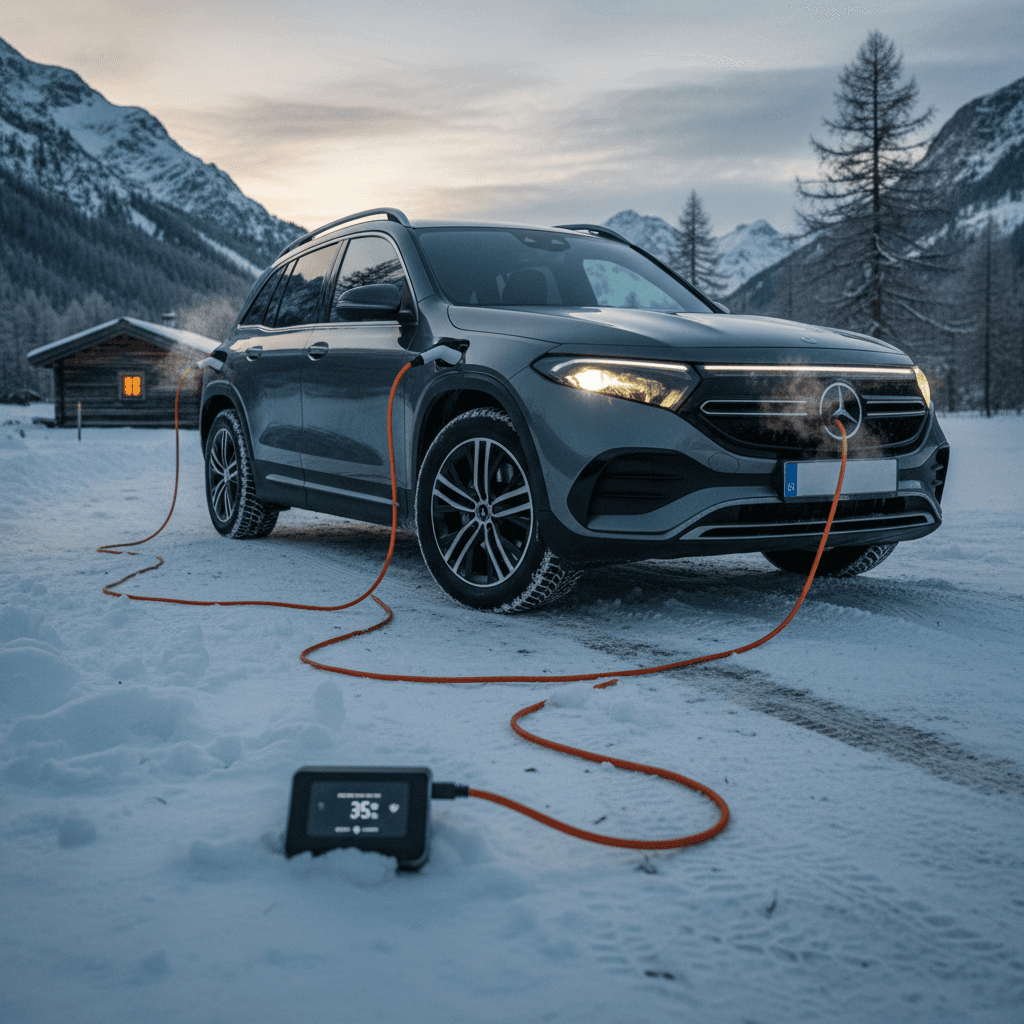
If you live where winter is a proper season, the question isn’t *if* your Mercedes EQB will lose range in the cold – it’s how much winter range loss, in percentage terms, you should plan around. The answer sits somewhere between “mildly annoying” and “this car just became a short‑haul shuttle,” depending on temperature, speed and how you use the heater.
The short answer
Mercedes EQB winter range loss at a glance
Typical Mercedes EQB winter range loss
Those percentages line up both with broad EV cold‑weather testing – where winter losses of 20–30% are considered normal and up to ~40% is possible in extreme cases – and with Recharged’s own EQB testing and owner anecdotes. Your exact number will depend on your EQB trim, speeds, temperature, trip length and how aggressively you heat the cabin.
Beware of pretty EPA numbers
How much winter range loss to expect in a Mercedes EQB
Let’s put numbers to it. Current U.S. EQB models (2023–2025) share roughly a 70.5 kWh usable battery and span from about 240–250 miles EPA in the EQB 250+ down to roughly 205–220 miles in the more powerful dual‑motor trims. In Recharged’s highway testing, those turn into about 170–210 real‑world mild‑weather highway miles, depending on trim and how big a buffer you keep.
Mercedes EQB winter range loss: modeled vs mild weather
Approximate planning numbers for U.S. spec EQB models, assuming a start around 90–100% and arriving with 5–10% battery remaining.
| Model | EPA rating (mi) | Mild‑weather usable highway (mi) | Typical winter loss (%) | Winter usable highway (mi) |
|---|---|---|---|---|
| EQB 250+ FWD | ~245–251 | ~200–210 | ≈25% | ~150–165 |
| EQB 300 4MATIC | ~221–230 | ~185–195 | ≈25–30% | ~130–150 |
| EQB 350 4MATIC | ~205–221 | ~175–190 | ≈25–35% | ~120–145 |
These are planning figures, not promises. Your actual results will vary with speed, elevation, wind, tires, passengers and how warm you keep the cabin.
So if you take your EQB 250+ that comfortably does around 200–210 highway miles in fall weather, a 25% winter haircut turns it into a 150‑mile road‑trip car. Not unusable, but your charging stops move closer together and detours become a real decision.
A simple rule of thumb
EQB 250+ vs 300 vs 350: winter range differences
The EQB’s winter behavior isn’t identical across trims. You’re hauling around the same battery, but the dual‑motor all‑wheel‑drive versions pay an efficiency penalty that winter only exaggerates.
How each Mercedes EQB trim behaves in winter
Same battery, different personalities once the temperature drops.
EQB 250+ FWD
Best winter range of the lineup. Single motor, front‑wheel drive, and less mass to drag through the cold air.
- EPA up to mid‑240s / low‑250s miles depending on year.
- Realistic mild‑weather highway: ~200–210 miles.
- Plan on ~150–165 miles in typical winter, 130–150 miles in harsh cold.
EQB 300 4MATIC
Middle child: more punch and grip, but still relatively efficient if you’re gentle.
- Sits between 250+ and 350 on power and range.
- Mild‑weather highway: often ~185–195 miles.
- Winter reality: ~130–150 highway miles is a smart planning window.
EQB 350 4MATIC
The spicy one, and the one that takes the biggest hit in winter.
- EPA rating in the low‑to‑mid‑200s.
- Mild‑weather highway: often ~175–190 miles.
- Severe winter: many owners treat it like a ~120–140‑mile highway SUV to keep a comfortable buffer.
AWD traction vs winter range
Real-world Mercedes EQB owner experiences in winter
Step out of the lab and into the wild and the story sounds familiar. EQB owners in Canada, the upper Midwest and Scandinavia regularly report that a car which shows ~230–250 km (140–155 miles) on the guess‑o‑meter in deep winter will show ~380–400 km (235–250 miles) in summer – roughly a 30–40% swing. In the U.S., EQB 250+ owners who comfortably see 200‑ish miles in mild weather often talk about 160 miles feeling like a full‑tank winter day on the freeway.
- EQB 250+ drivers in cooler coastal climates often report only 15–20% loss on longer trips where the battery and cabin stay warm.
- EQB 300 and 350 4MATIC owners in snowbelt regions more commonly mention 25–35% range loss, especially at 70–75 mph with the heat set to comfort‑first rather than miser‑mode.
- On brutal sub‑freezing days with short errands, some owners see cold‑start consumption so high that effective range feels cut nearly in half until they get onto a longer highway leg.
Why anecdotes matter
Why the Mercedes EQB loses range in cold weather
The EQB isn’t uniquely cursed in winter; it’s simply a compact SUV doing all the things EVs hate at once: pushing a tall box through dense cold air, running heavy cabin heat, and shuttling kids on short trips where nothing ever gets fully warm.
Main culprits behind EQB winter range loss
Battery chemistry slows down
Lithium‑ion cells in your EQB are less efficient when cold. Internal resistance rises, so it takes more energy to deliver the same power. Mercedes does some pre‑conditioning, but a frozen pack is still a reluctant pack.
Cabin heat is a battery hog
Unlike a gasoline car that steals waste heat from the engine, your EQB must <strong>create cabin heat from electricity</strong>. The HVAC system can easily pull several kilowatts, especially when you first blast the heat and defrosters.
Short trips are the worst case
Repeated 5–10 minute drives are murder on winter efficiency. The car keeps reheating a cold cabin and cold battery, then you park and let it all freeze again. Your displayed consumption will look shocking even though you didn’t go far.
Higher rolling resistance
Winter or all‑weather EV tires, cold rubber and slushy roads all add drag. That extra friction shows up as more kWh per mile and fewer miles out of the same pack.
Aerodynamic penalty of an SUV
The EQB is a tall square‑shouldered crossover, not a teardrop sedan. At 70+ mph in dense winter air, aero drag rises and so does consumption – especially in crosswinds.
Heat pump vs resistive heater
How to minimize Mercedes EQB winter range loss
You can’t negotiate with physics, but you can stop making things harder than they need to be. A few smart habits can claw back 5–15 percentage points of winter range in an EQB – the difference between a relaxed day and white‑knuckling it to the next fast charger.
Practical ways to protect EQB range in winter
Small routine changes, big effect over a whole season.
Preheat while plugged in
Use the Mercedes Me app or in‑car scheduler to pre‑condition the cabin and battery while you’re still charging. That way the wall power does the heavy lifting instead of your battery.
- Set a departure time on workdays.
- Even 10–15 minutes of preheat makes a big difference.
- Especially critical before highway drives.
Use seat & wheel heaters first
Seat and steering‑wheel heaters sip power compared to blasting hot air.
- Start with seat/wheel heat and a moderate cabin set‑point.
- Drop the fan speed once the cabin is warm.
- Defrost windows aggressively, then back the HVAC off.
Drive smoother & a bit slower
At winter highway speeds, every extra 5 mph costs range.
- 70 mph instead of 80 mph can save you double‑digit percentage points.
- Use ECO mode and gentle acceleration around town.
- Let regen do its thing instead of late, hard braking.
Plan smart charging stops
Use EV‑friendly route planners and the EQB’s built‑in nav to arrive at fast chargers with a warm battery and 10–20% state of charge.
- A warm pack charges faster and more efficiently.
- Stopping a bit earlier in winter is better than stretching it.
What you can realistically gain back
Trip planning with an EQB in winter conditions
The real test of any EV in winter isn’t the commute; it’s the road trip – when the kids, the skis and the dog are onboard and the ChargePoint map looks a lot lonelier once you leave the city.
1. Use winter numbers, not summer dreams
When you plug your route into an app or the EQB’s native nav, mentally replace your usual mild‑weather planning range with your winter‑adjusted range. If your EQB 300 usually gives you 190 miles comfortably, treat it as 135–145 miles in deep winter and pick chargers accordingly.
Always leave yourself a 10–15% battery buffer for detours, headwinds and full chargers.
2. Bias toward reliable fast‑charge corridors
On winter road trips, prioritize routes with multiple DC fast chargers rather than chasing the single theoretical “perfect” stop. A slightly longer route with redundancy is worth the extra minutes.
If you’re shopping for a used EQB for regular winter road trips, consider how its range pairs with the fast‑charging networks you actually have nearby – not just the spec sheet.
Don’t ignore charging speeds in the cold
Shopping used? Winter questions to ask about an EQB
If you’re looking at a used Mercedes EQB – especially in a northern state or Canada – winter performance isn’t an abstract concern. It’s Tuesday. The good news: you can ask very specific questions and look for real data rather than sales‑floor folklore.
Used Mercedes EQB winter‑readiness checklist
Ask for recent winter efficiency numbers
On a test drive or from the current owner, look at recent consumption figures (mi/kWh) from cold months. Numbers that look wildly high around town may just mean lots of short, cold starts.
Review battery health data
A healthy pack gives you more margin for winter losses. With a <strong>Recharged Score battery health report</strong>, you can see how much usable capacity the EQB still has and how that translates into real‑world winter planning range.
Confirm available winter tires and wheels
Dedicated winter tires can shorten stopping distances dramatically but may cost a bit of range. Ask what’s fitted now and whether a winter wheel‑and‑tire set is included or available.
Check charging behavior in cold weather
If possible, fast‑charge the EQB after a decent highway run on a chilly day. You’re checking that it reaches expected power levels and doesn’t throttle badly because of an unhappy pack or software issue.
Look at previous owner’s usage pattern
A car that spent winters in a garage and did mostly longer commutes will have a gentler winter history than one parked outside, doing only school runs. Neither is a dealbreaker, but it’s context that matters.
Use Recharged’s experts
If you buy through <strong>Recharged</strong>, an EV specialist can walk you through the EQB’s winter pros and cons, explain its <strong>Recharged Score</strong>, and help you sanity‑check whether the range works for your specific climate and commute.
FAQ: Mercedes EQB winter range & cold weather driving
Common questions about Mercedes EQB winter range loss
Key takeaways on Mercedes EQB winter range loss
The Mercedes EQB is not a winter fraud, but it is a realist: you will lose a meaningful chunk of range in the cold, especially in the punchier 4MATIC trims. For most drivers that means treating a 200‑mile fall‑weather car as a 140–160‑mile winter car and planning charging stops like an adult, not a brochure writer.
If you go in with eyes open, use pre‑conditioning, lean on seat heaters and give the pack some highway time before fast‑charging, the EQB will do the school run, the ski weekend and the winter road trip without drama. And if you’re shopping used, a Recharged EQB with a clean battery health report and expert guidance can take much of the guesswork out of winter: you’ll know roughly how many miles you’re buying today, and how many you can expect to keep when January shows up with an attitude.