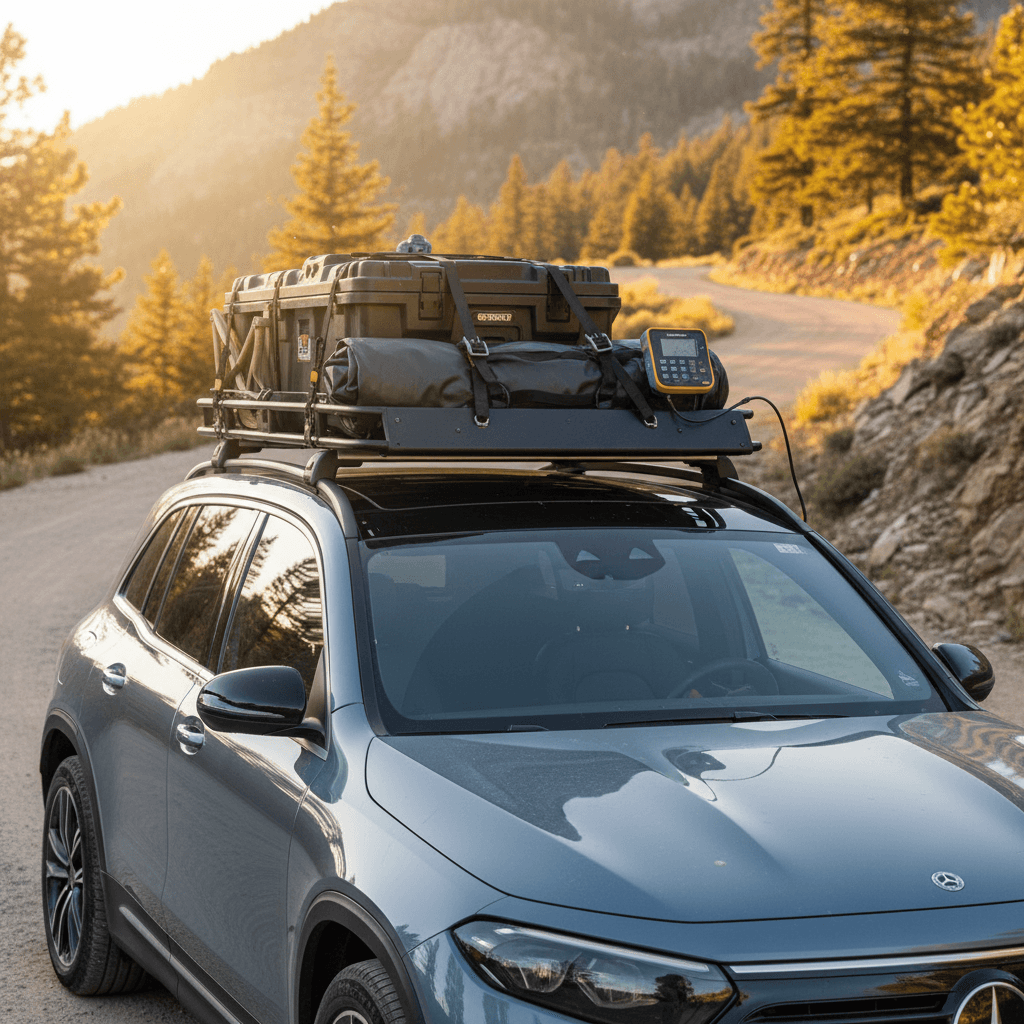
If you’re planning bikes, a cargo box, or even a rooftop tent for your Mercedes EQB, the first thing you need to understand is the roof rack weight limit. Overloading the roof can damage the rails, stress the body structure, and create handling issues, especially in a tall, heavy electric SUV like the EQB.
Dynamic roof load in one sentence
Mercedes EQB roof rack weight limit: the short answer
Mercedes doesn’t shout the EQB’s roof rack weight limit in marketing materials, but the number exists in the technical specs and owner’s manual as the maximum roof load. For North American-spec EQB 300 and EQB 350 models, independent spec databases list a roof load of 165 lbs (75 kg), which matches what major rack brands like Thule use as their maximum when they design EQB-specific systems.
Typical Mercedes EQB roof load figures
The key point: you’re limited by the lowest-rated component in the chain, and that’s almost always the vehicle’s roof load rating, not the crossbars. Even if an aftermarket rack advertises “100 kg” or “220 lbs,” you still need to stay under the EQB’s roof limit given in the manual.
Always confirm in your own manual
Roof load vs rack rating: which number matters?
1. Vehicle roof load (the hard limit)
This is the maximum dynamic roof load Mercedes allows while driving. It includes:
- Factory or aftermarket crossbars
- Mounts and accessories (bike trays, box mounts, etc.)
- The cargo itself (bikes, skis, luggage, tent, etc.)
For most EQB models, that limit is around 75 kg / 165 lbs. Even if your rack system claims a higher capacity, you must stay under the vehicle’s number.
2. Rack manufacturer rating (often higher)
Aftermarket systems like Thule WingBar or Evo Raised Rail kits frequently advertise:
- 75–100 kg maximum load on their crossbars
- Plenty of strength margin beyond the EQB’s roof limit
That’s reassuring from a hardware standpoint, but it does not increase the safe load your EQB’s body structure and rails can carry. Think of the rack rating as “capable of” and the Mercedes roof load as the rule.
Put simply: choose a quality rack that at least matches (and usually exceeds) the Mercedes rating, then treat the EQB roof load number as your real ceiling when you do the math.
Do different EQB trims and years change the roof limit?
The Mercedes EQB is built on the same MFA2 platform as the GLB, and across EQB 250, 300, and 350 trims, the overall roof architecture is very similar. That’s why you’ll often see third-party rack guides list the same 75 kg / 165 lbs dynamic roof load for multiple EQB variants.
- Most U.S.-spec EQB 300 and EQB 350 models with factory roof rails are quoted with about 165 lbs (75 kg) maximum roof load.
- European sources and roof-bar retailers typically confirm a 75–100 kg manufacturer roof load spread depending on exact trim and year, with 75 kg being the conservative default.
- Options like a panoramic roof or third-row seating can slightly change payload and sometimes roof load, which is why Mercedes calls out vehicle-specific values in the manual.
Where to find the official number
If your manual lists a higher number than 75 kg, for example, 100 kg, you can use that higher figure, as long as both your rack system and accessories are also rated to at least that level. When in doubt, stay conservative; your EQB’s battery pack and high center of gravity already give it plenty of mass to manage in an emergency maneuver.
What fits within the EQB roof rack weight limit?
Once you accept that your real-world dynamic limit is roughly 75 kg / 165 lbs, it becomes a math exercise. The surprise for many EQB owners is how quickly a few everyday accessories eat up that capacity.
Common Mercedes EQB roof setups and approximate weights
Approximate combined weights for typical EQB roof rack configurations. Always verify actual weights for your specific gear.
| Setup | Crossbars & feet | Accessories | Cargo | Total roof load | Within 75 kg / 165 lbs? |
|---|---|---|---|---|---|
| 2 bikes (standard, non‑electric) | 5 kg / 11 lbs | 2 bike trays: 6 kg / 13 lbs | 2 bikes: 30 kg / 66 lbs | 41 kg / 90 lbs | Yes, plenty of margin |
| 2 e‑bikes | 5 kg / 11 lbs | 2 heavy-duty trays: 8 kg / 18 lbs | 2 e‑bikes: 36 kg / 80 lbs | 49 kg / 109 lbs | Yes, but heavier braking/handling |
| Large cargo box + family luggage | 6 kg / 13 lbs | Box shell: 18 kg / 40 lbs | Luggage: 35 kg / 77 lbs | 59 kg / 130 lbs | Yes, but getting closer |
| 3 bikes (mixed road/MTB) | 5 kg / 11 lbs | 3 trays: 9 kg / 20 lbs | 3 bikes: 45 kg / 99 lbs | 59 kg / 130 lbs | Yes, if bikes are light |
| Medium rooftop tent (no occupants, driving) | 6 kg / 13 lbs | Mounting hardware: 4 kg / 9 lbs | Tent shell: 55 kg / 121 lbs | 65 kg / 143 lbs | Possibly, but only with a lighter tent and strict packing discipline |
These examples assume a 75 kg / 165 lbs roof load limit and are for illustration only.
Weigh before you guess
Can you run a rooftop tent on a Mercedes EQB?
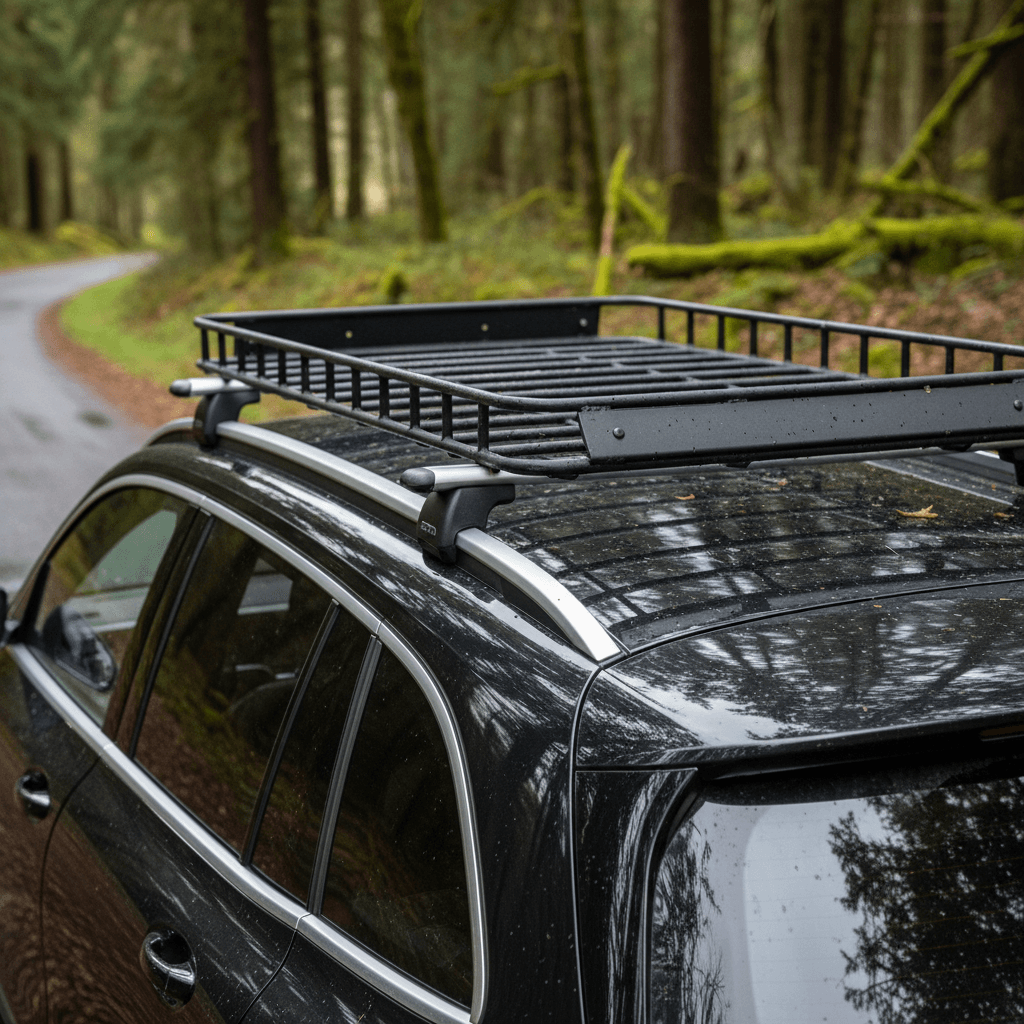
Rooftop tents are where roof rack weight limit questions get serious. Many hard-shell tents weigh 120–160 lbs before you add crossbars or mounting hardware. That can put you at or above the EQB’s dynamic rating before anyone climbs inside.
- Most rooftop tent brands quote relatively low dynamic load requirements (often 75–100 kg), but that assumes the vehicle roof is rated to at least that level.
- The EQB roof structure is designed for typical bike/cargo-box use, not frequent off-road abuse with a heavy tent, so it’s wise to stay well under any published limit.
- Static load (parked, with people in the tent) is higher than dynamic, but Mercedes rarely publishes a static figure for passenger EVs, so you’re in more of a gray area than with body-on-frame SUVs.
Rooftop tent on EQB? Proceed with extreme caution
For most EQB owners, a rear-mounted hitch cargo rack or bike rack is a better bet if you need to carry heavy gear. It keeps mass low and closer to the axle line instead of stacked up where the EQB is already tall and relatively heavy.
Step-by-step: calculating your EQB roof load
EQB roof load calculator checklist
1. Find your official roof load
Open your EQB owner’s manual and look up the <strong>maximum roof load</strong> (often around 75 kg / 165 lbs). If you can’t find it, your Mercedes dealer can print the spec from your VIN.
2. Look up rack system weight
Check the spec sheet for your crossbars and feet. Many EQB-specific bar kits weigh <strong>10–15 lbs (4–7 kg)</strong>. Write this number down.
3. Add mounts and accessories
Bike trays, ski mounts, cargo box hardware, and fairings all count. Collect their listed weights or put them on a scale if the numbers aren’t clear.
4. Weigh or estimate cargo
Weigh bikes individually, check the empty weight of your cargo box, and estimate luggage or gear weight realistically. Round up instead of down to maintain a safety margin.
5. Add everything together
Rack + accessories + cargo = <strong>total roof load</strong>. This total must be at or below the EQB’s official roof load rating. If you’re within 5–10% of the limit, trim cargo or move heavy items inside the cabin or onto a hitch rack.
6. Re-check after changes
Any time you swap to a different box, switch from analog bikes to e‑bikes, or add winter gear, recalculate. Treat the EQB roof load like you would tire pressure or torque specs: not a one-time job.
Aim for a safety buffer
How roof weight affects safety, noise, and range
Even when you stay under the EQB roof rack weight limit, you’ll feel, and hear, the difference when the roof is loaded. Weight up high changes how this compact EV SUV behaves, especially at highway speeds or in crosswinds.
What extra roof weight does to your EQB
Understanding the trade-offs when you pack the roof rail to rail
Handling & stability
Extra mass on the roof raises the center of gravity. Expect more body roll in corners, slightly slower steering response, and a more dramatic reaction if you have to swerve around an obstacle.
Noise & comfort
Even an empty rack adds wind noise. Add a box or bikes and your formerly quiet EQB may start to whistle or roar above 50–60 mph, especially on rough pavement or in gusty conditions.
Range & efficiency
Roof gear increases drag. On an EQB, a big cargo box can shave 10–20% off highway range depending on speed, temperature, and load. Plan charging stops accordingly on longer trips.
Highway driving tips with a loaded EQB roof
Buying a used EQB? What to check if it’s had a roof rack
If you’re shopping the used market, a growing slice of EQB sales, roof rack history is worth a quick look. A carefully used rack is no problem. Chronic overloading or poor installs can leave subtle signs you’ll want to catch before you sign.
Used Mercedes EQB roof and rack inspection list
1. Inspect roof rails and mounting points
Look closely at the factory roof rails for <strong>bends, distortions, paint cracks, or missing trim caps</strong>. Gently wiggle the rails, there should be no looseness or popping sounds.
2. Check for paint damage and rust
Under old rack foot locations, look for rubbed-through clearcoat, bare metal, or early rust. These spots can grow quickly in salted climates if not repaired.
3. Ask about rooftop tents or heavy loads
If the seller mentions a rooftop tent, long road trips with four e‑bikes, or an expedition roof platform, ask how they calculated roof load and whether they ever exceeded Mercedes’ rating.
4. Listen for creaks over bumps
During a test drive, listen for <strong>creaks from the roof area</strong> over driveways and speed bumps. Noises aren’t proof of damage, but persistent creaking around the rails is worth inspecting further.
5. Get a professional look if unsure
If something doesn’t feel right, consider a pre-purchase inspection at a shop with EV and body-structure experience. At <strong>Recharged</strong>, every vehicle on our marketplace gets a structural and cosmetic check alongside its <strong>Recharged Score</strong> battery health report.
If you buy a used EQB through Recharged, you’ll see transparent vehicle history, photos, and inspection notes, so you’re not guessing whether a prior owner treated the roof like a cargo van.
Mercedes EQB roof rack weight limit: FAQ
Frequently asked questions about the Mercedes EQB roof rack weight limit
Key takeaways for EQB roof rack safety
- Assume a conservative 75 kg / 165 lbs dynamic roof load limit for most Mercedes EQB models unless your manual states otherwise.
- That limit includes everything above the sheet metal: crossbars, mounts, boxes, bikes, skis, tents, and cargo.
- Even if your rack system is rated higher, you’re bound by the EQB’s roof load rating, not the rack’s marketing number.
- Heavy, bulky gear, especially rooftop tents and e‑bikes, can push you to the limit quickly. Weigh your setup instead of guessing.
- Extra weight on the roof affects handling, noise, and range, so drive more defensively and consider removing racks when not in use.
- If you’re considering a used EQB, inspect the roof rails and mounting areas carefully. With a platform like Recharged, you get transparency on vehicle condition plus a Recharged Score battery health report to round out the picture.
Treat the Mercedes EQB roof rack weight limit the same way you treat torque specs or tire pressures: as a firm engineering boundary, not a suggestion. Stay within it, leave yourself some margin, and your EQB will haul bikes, skis, and road-trip gear for years without complaint, and without unexpected creaks, cracks, or range surprises on the highway.