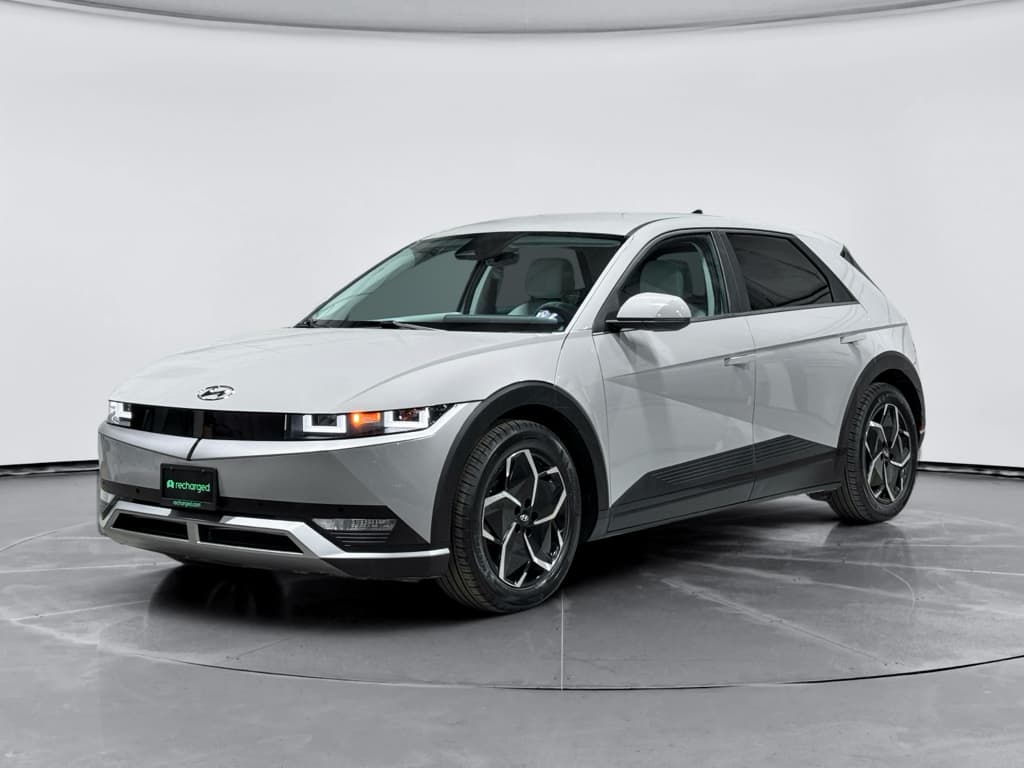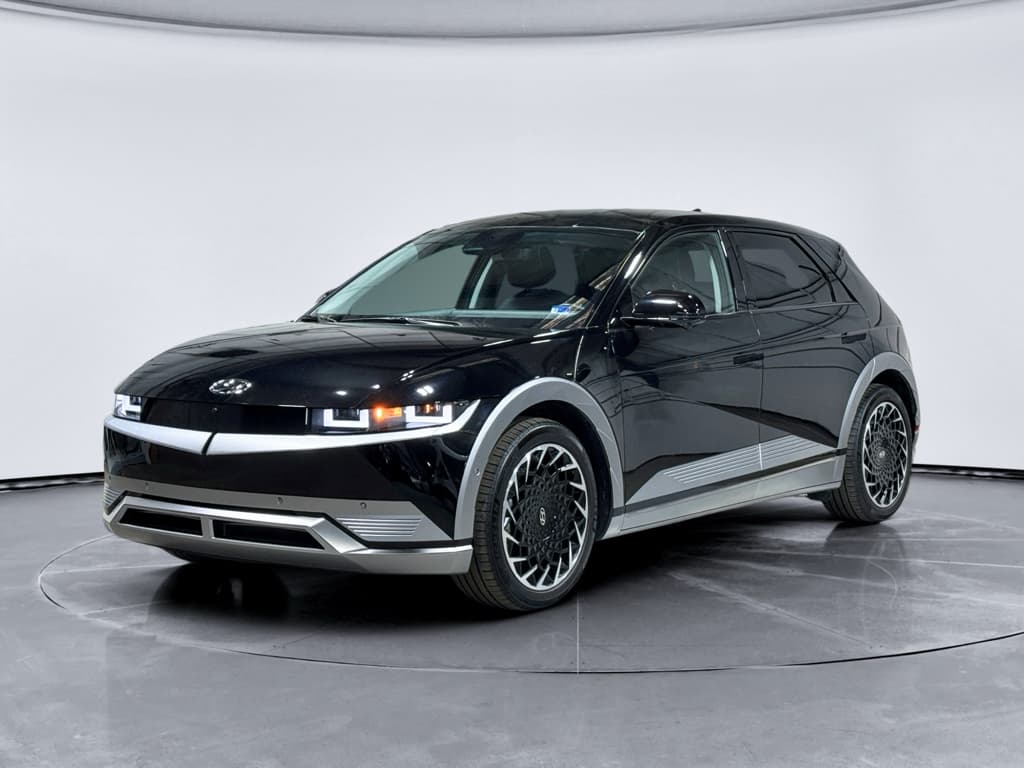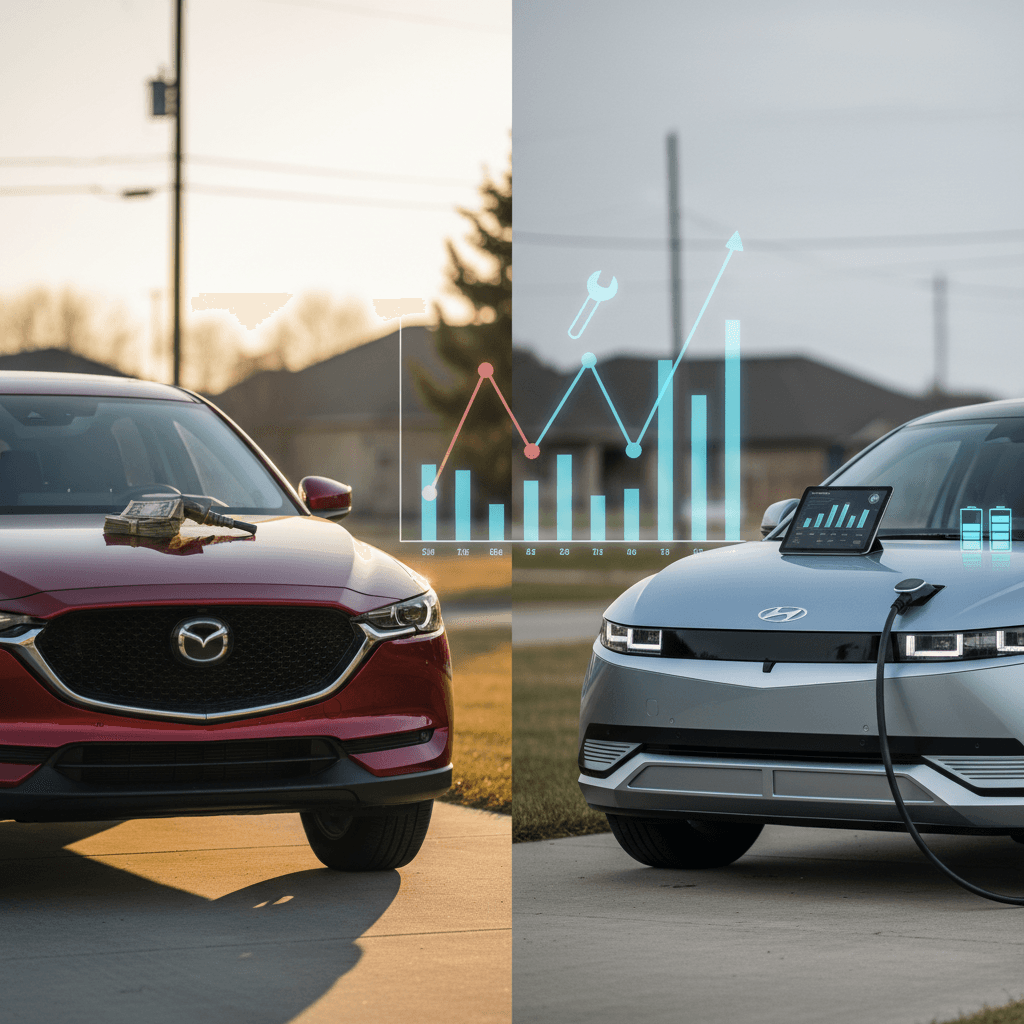
If you’re cross-shopping a **Mazda CX-5** against a **Hyundai Ioniq 5**, you’re really asking one big question: how does a comfortable gasoline crossover stack up against a modern electric SUV on **total cost of ownership** over the long haul? This guide walks through fuel vs electricity, maintenance, insurance, depreciation, and incentives so you can see, in real numbers, what Mazda CX-5 vs Hyundai Ioniq 5 total cost of ownership looks like over 5–10 years.
Snapshot: who’s cheaper to own?
Why compare Mazda CX-5 vs Hyundai Ioniq 5 total cost of ownership?
On paper, a **Mazda CX-5** looks straightforward: solid compact SUV, gas engine, familiar dealer experience. The **Hyundai Ioniq 5** is a different animal, fully electric, future-facing, and often thousands more to buy new. But sticker price is only one chapter. When you bake in **fuel or electricity**, **maintenance**, **insurance**, and **resale value**, the story changes, especially if you plan to keep the car for 5–10 years or you’re thinking used.
At Recharged, we live in that long-game world. Our customers aren’t just looking for a shiny EV; they want to know if the numbers make sense compared with the gas crossovers they’ve been driving for years. So we’ll treat the CX-5 as the stand‑in for the well‑known gas SUV, and the Ioniq 5 as the modern EV alternative, and put both through the same ownership-cost lens.
Quick cost benchmarks (typical U.S. owner, 5 years)
Key assumptions and baseline specs
You can slice total cost of ownership a hundred ways. To keep this comparison practical, we’ll stick to **mainstream trims and realistic U.S. averages**, not unicorn deals or perfect conditions. If your situation is unusual, very high mileage, ultra‑cheap electricity, or brutal insurance rates, you can adjust the numbers, but the relationships between the CX-5 and Ioniq 5 stay similar.
The two SUVs we’re really comparing
Representative trims, not absolute base or maxed‑out models
Mazda CX-5 (gas)
- Model: Recent‑generation CX-5 with 2.5L non‑turbo four‑cylinder
- EPA fuel economy: about 26 mpg combined in typical FWD/AWD mix
- Fuel: regular gasoline
- New price range: roughly mid‑$30,000s nicely equipped
- Main strengths: low entry price, excellent driving feel, familiar service network
Hyundai Ioniq 5 (EV)
- Model: Long‑range Ioniq 5 RWD or AWD
- EPA efficiency: around 27–31 kWh/100 miles (roughly 3.2–3.7 mi/kWh)
- Battery size: ~77–84 kWh pack on long‑range trims
- New price range: typically high‑$40,000s to mid‑$50,000s with options
- Main strengths: low running costs, quick acceleration, quiet cabin, advanced tech
Your numbers will vary
Fuel vs electricity: CX-5 vs Ioniq 5 cost per mile
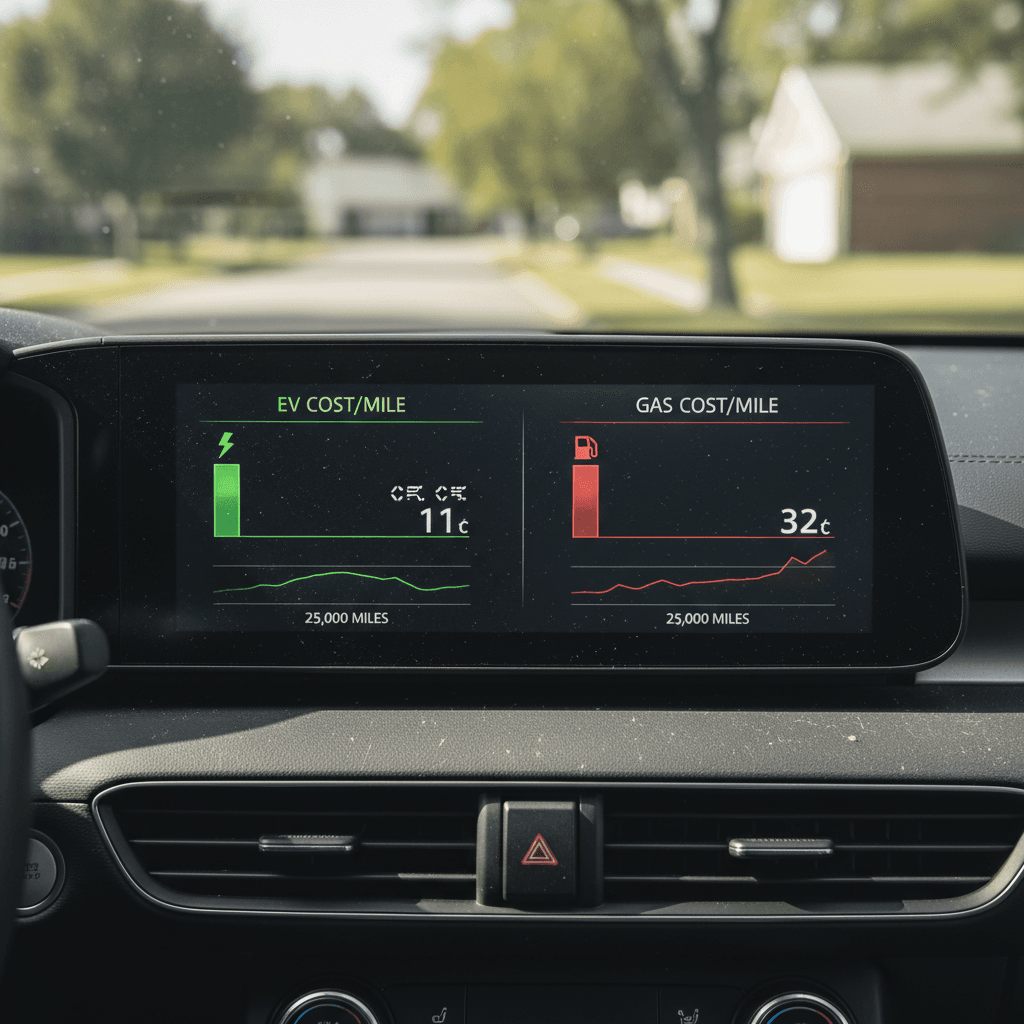
Fuel is where the CX-5 and Ioniq 5 live on different planets. A gasoline CX-5 is efficient for its class, but an Ioniq 5 sipping electrons is playing a different game entirely. Let’s turn that into **cost per mile**, which is the easiest way to think about long‑term driving costs.
Estimated energy cost per mile: Mazda CX-5 vs Hyundai Ioniq 5
Assumes 12,000 miles per year, $3.75/gallon gasoline, and $0.16/kWh electricity at home. Numbers rounded for simplicity.
| Vehicle | Energy use | Assumed price | Energy cost per 100 miles | Approx. cost per mile |
|---|---|---|---|---|
| Mazda CX-5 (gas) | ~26 mpg combined | $3.75/gal | $14.40 | $0.14 |
| Hyundai Ioniq 5 (EV) | ~28 kWh/100 miles | $0.16/kWh | $4.50 | $0.05 |
Real‑world energy spend will vary with driving style, temperature, and local prices, but the EV advantage is consistent.
- CX-5 fuel: about $0.14/mile × 12,000 ≈ $1,700/year
- Ioniq 5 electricity: about $0.05/mile × 12,000 ≈ $600/year
Off‑peak rates can tilt the math even more
Maintenance and repairs: where EVs pull ahead
The Mazda CX-5 is not an expensive vehicle to service, but it still has all the usual gasoline‑car hardware: oil changes, transmission fluid, exhaust, belts, spark plugs, dozens of moving parts in the engine itself. The Ioniq 5 replaces that with an electric motor, reduction gear, and power electronics, dramatically fewer wear items and fluids.
Mazda CX-5 typical maintenance (first 5 years)
- Oil and filter changes 2–3× per year
- Transmission service (depending on mileage)
- Engine air filter, cabin filter, spark plugs
- Brake service (pads/rotors) as mileage climbs
- More frequent emissions‑system checks and potential repairs
Across 5 years and 60,000 miles, a CX-5 owner can easily see **$3,000–$4,000** in routine maintenance and minor repairs with dealer pricing.
Hyundai Ioniq 5 typical maintenance (first 5 years)
- No engine oil or timing belt to replace
- Far fewer moving parts in the drivetrain
- Brake pads often last longer thanks to regenerative braking
- Mostly tire rotations, cabin filters, brake fluid, inspections
For the same 5 years and 60,000 miles, you’re more likely in the **$1,000–$2,000** range, largely tires and scheduled checks. Big repairs are rare early on, especially with the battery and drivetrain under long warranties.
Warranty advantage for Ioniq 5 owners
Insurance, taxes, and fees
Insurance is where many shoppers get a surprise. The Ioniq 5 is newer, more complex, and generally more expensive to repair after a crash than a CX-5, so **premiums can be higher**, especially when the car is new. The CX-5, being a mainstream compact crossover with a long history, is usually cheaper to insure trim‑for‑trim.
- Expect the CX-5 to be a bit cheaper to insure on average, especially for younger drivers or in high‑cost metro areas.
- The Ioniq 5 may carry higher comprehensive/collision rates, but some insurers discount for EVs or advanced safety tech, which can help.
- Registration, property taxes, and fees vary widely by state; some EV‑friendly states reduce or waive certain fees for EVs, while others add modest EV road‑use fees.
Net effect over 5 years
Depreciation and resale value
Depreciation, the silent budget killer, is simple on paper and emotional in real life. Historically, compact gas crossovers like the CX-5 hold value well because they’re the default choice for families. Early EVs lost value faster. But vehicles like the Ioniq 5 are changing that picture as demand for used EVs grows and more buyers get comfortable with electric.
How CX-5 and Ioniq 5 tend to lose value
Ballpark patterns for buyers keeping cars 5+ years
Mazda CX-5 depreciation
Compact gas SUVs are resale darlings. Over 5 years, a CX-5 typically loses **40–50%** of its value, depending on miles and trim. It’s predictable and relatively gentle compared with sedans or larger SUVs.
Hyundai Ioniq 5 depreciation
EV pricing has been more volatile. Early Ioniq 5s saw faster depreciation as incentives, interest rates, and supply shifted. But as more shoppers seek used EVs, well‑cared‑for Ioniq 5s are starting to hold value more like popular gas crossovers.
Where you win as a used buyer
If you’re buying **used**, some of that earlier depreciation is good news. A 2–3‑year‑old Ioniq 5 can often be had for far less than new, while offering low running costs and, in many cases, access to used‑EV tax credits.
On Recharged, every used EV includes a **Recharged Score Report** with verified battery health, so you’re not guessing about the most expensive component on the car. That’s the piece missing from many traditional used‑EV deals, and it’s crucial when you’re comparing long‑term value against a conventional gas SUV like a CX-5.
5‑year Mazda CX-5 vs Hyundai Ioniq 5 total cost
Let’s pull the major buckets together. These are **illustrative 5‑year estimates** for a typical U.S. driver putting 12,000 miles per year on each vehicle, financing a fairly equipped model, and mostly charging the Ioniq 5 at home. The exact figures will vary, but the **relative differences** are what matter.
Illustrative 5‑year total cost of ownership: CX-5 vs Ioniq 5
Rounded estimates for a well‑equipped Mazda CX-5 vs a long‑range Hyundai Ioniq 5, driven 60,000 miles over five years. Financing, taxes, and some fees simplified for clarity.
| Cost category (5 years) | Mazda CX-5 (gas) | Hyundai Ioniq 5 (EV) |
|---|---|---|
| Purchase price & financing | Higher teens to low‑$20,000s in payments/interest, depending on loan and options | Low‑$20,000s to mid‑$20,000s in payments, generally higher than CX-5 for similar equipment |
| Fuel vs electricity | ~$11,000 in gasoline | ~$6,000–$7,000 in electricity (mostly home charging) |
| Routine maintenance & minor repairs | ~$3,000–$4,000 | ~$1,000–$2,000 |
| Insurance | Often slightly lower than Ioniq 5 | Often slightly higher than CX-5 |
| Depreciation hit (paper loss) | Moderate; strong for a compact SUV | Can be steeper early but levels out; great opportunity when buying used |
| Estimated 5‑year out‑of‑pocket total (excluding depreciation) | Roughly **$35,000–$40,000** | Roughly **$36,000–$41,000** before incentives; often **less** if you buy used and qualify for EV credits |
Think of these as ballpark ranges, not quotes. The pattern, higher purchase, lower running costs for the Ioniq 5, holds in most scenarios.
Don’t forget incentives
Stretching to 10 years & buying used
Five years captures the steepest part of the depreciation curve, but many owners keep their SUVs far longer. That’s where an EV like the Ioniq 5 can really shine, especially if you’re **starting from a used purchase price** instead of absorbing the biggest new‑car hit yourself.
What changes over a 10‑year CX-5 vs Ioniq 5 horizon?
1. Fuel vs electricity gap widens
If you push past 100,000 miles, the CX-5 keeps burning gasoline at roughly the same cost per mile, while your electricity cost remains dramatically lower. The longer you own the car and the more you drive, the more the Ioniq 5’s energy advantage compounds.
2. Maintenance stacks up for gas engines
By year 8–10, a CX-5 is more likely to need bigger‑ticket items, exhaust work, suspension components, transmission services, and age‑related engine repairs. The Ioniq 5’s simpler drivetrain and regenerative braking can keep major service bills at bay for longer.
3. Battery health becomes the key EV question
A decade in, the Ioniq 5’s battery capacity and DC fast‑charging behavior matter a lot. That’s why a verified battery report, like the <strong>Recharged Score</strong>, is so valuable when you’re buying used or planning to keep an EV long‑term.
4. Tech and charging networks improve
An older CX-5 is essentially the same car it was on day one. A 10‑year‑old Ioniq 5, meanwhile, may have benefited from years of software updates and a denser fast‑charging network, making it easier to live with than early EV owners experienced.
If you’re stepping into a **3–5‑year‑old Ioniq 5** with a documented healthy battery and a fair price, it’s entirely possible for your **10‑year total cost of ownership** (from that point forward) to undercut a similarly aged CX-5, while giving you lower running costs, smoother driving, and the ability to skip gas stations entirely.
Charging, convenience, and lifestyle factors
The spreadsheet may say the Ioniq 5 wins, but your daily life has veto power. If you can’t reliably charge at home or work, a gas SUV like the CX-5 is still simpler. If you can, the Ioniq 5 starts to feel like a personal appliance that’s always ready to go, and that convenience is hard to give up once you’ve lived with it.
- Home charging: A Level 2 charger in your garage or driveway turns the Ioniq 5 into a “full tank every morning” device. That’s ideal if you own your home or have dedicated parking.
- Apartment life: If you rely on street parking or shared garages without outlets, you’ll need a solid plan for workplace or public charging. That doesn’t kill the EV idea, but it does change the math.
- Road trips: The Ioniq 5 is road‑trip capable with fast DC charging and an expanding network, but you’ll spend longer at charging stops than at a gas pump. If you drive cross‑country constantly, factor in that time.
- Weather: Cold winters hit both vehicles, gas engines warm up slowly; EVs lose some range. But the Ioniq 5 still tends to beat the CX-5 on per‑mile energy cost even in winter, especially if you pre‑condition while plugged in.
Cold‑weather caveat for EVs
Mazda CX-5 vs Hyundai Ioniq 5: which suits you financially?
When a Mazda CX-5 still makes more sense
- You can’t install home charging and don’t have reliable workplace options.
- Your driving is highly irregular, lots of spontaneous long road trips through areas with sparse charging.
- You’re shopping at the very low end of the used‑car market, where older CX-5s are cheaper than nearly any used Ioniq 5.
- You value traditional service networks and don’t want to think about range or chargers at all.
In those cases, the CX-5’s **lower up‑front cost** and familiar fueling routine may outweigh the long‑term fuel and maintenance savings of going electric.
When a Hyundai Ioniq 5 is the smarter long‑term bet
- You can charge at home or work most of the time.
- You drive **10,000–15,000+ miles per year** and plan to keep the car at least 5–8 years.
- You’re open to a **used Ioniq 5** with a verified battery report and potential tax credits.
- You care about smooth, quiet driving and lower maintenance hassle almost as much as dollars.
For that owner, the Ioniq 5’s **lower energy and service costs** can match or beat a CX-5’s total cost of ownership, and it delivers a very different, more modern driving experience along the way.
How Recharged can help you run the numbers
Ready to find your next EV?
Browse VehiclesFAQ: Mazda CX-5 vs Hyundai Ioniq 5 ownership costs
Frequently asked questions
If you’re deciding between a Mazda CX-5 and a Hyundai Ioniq 5, you’re really choosing which costs you want to pay: **more up front for the EV and less every month**, or a lower sticker price for the gas SUV and a steady drip of fuel and maintenance. For many drivers with dependable charging and average‑to‑high mileage, the Ioniq 5’s total cost of ownership is already competitive, and buying used can tilt the scale in its favor. Take the time to run your own numbers, then let tools like the **Recharged Score Report**, EV‑savvy financing, and battery health diagnostics turn what feels like a gamble into a confident long‑term decision.