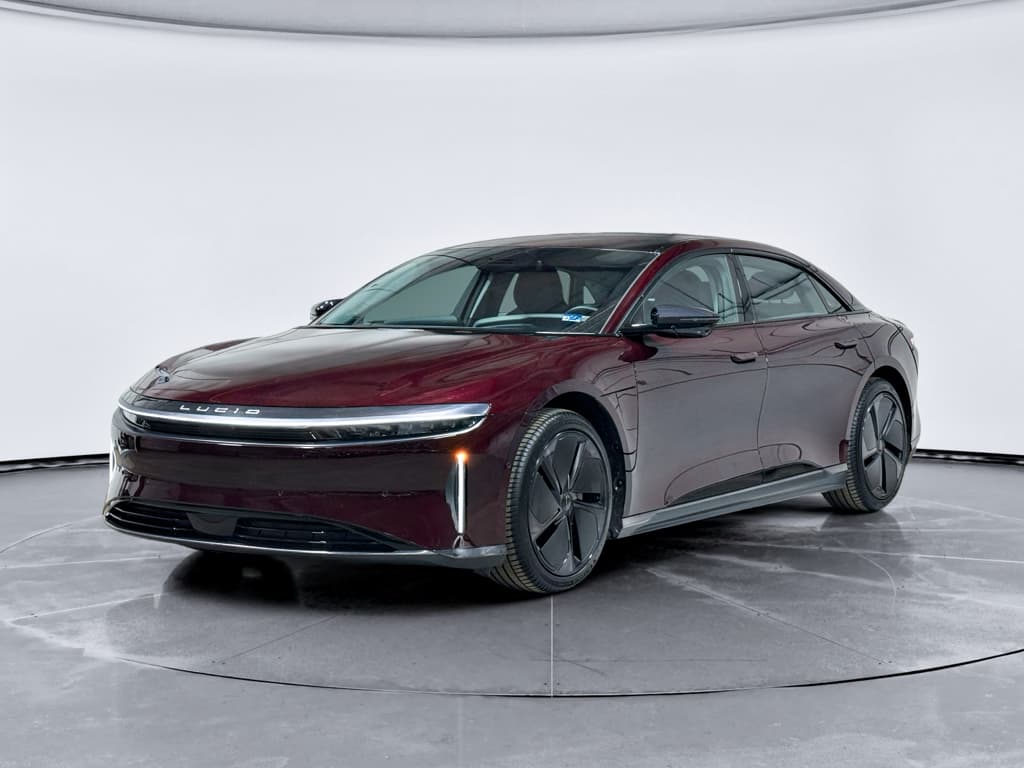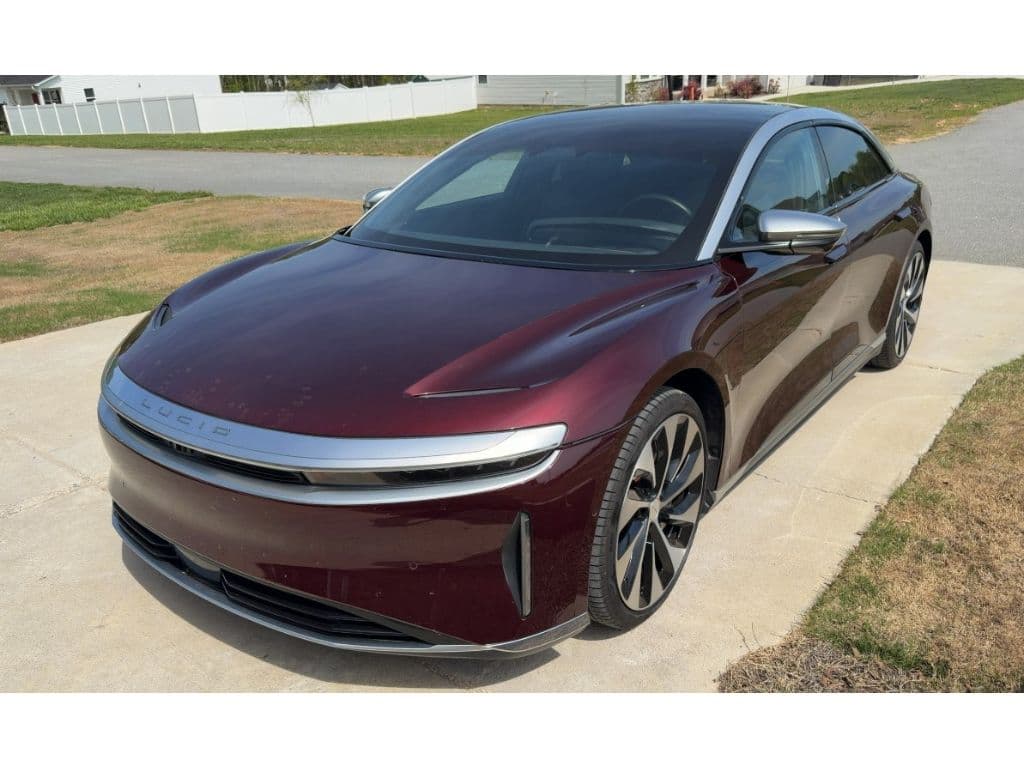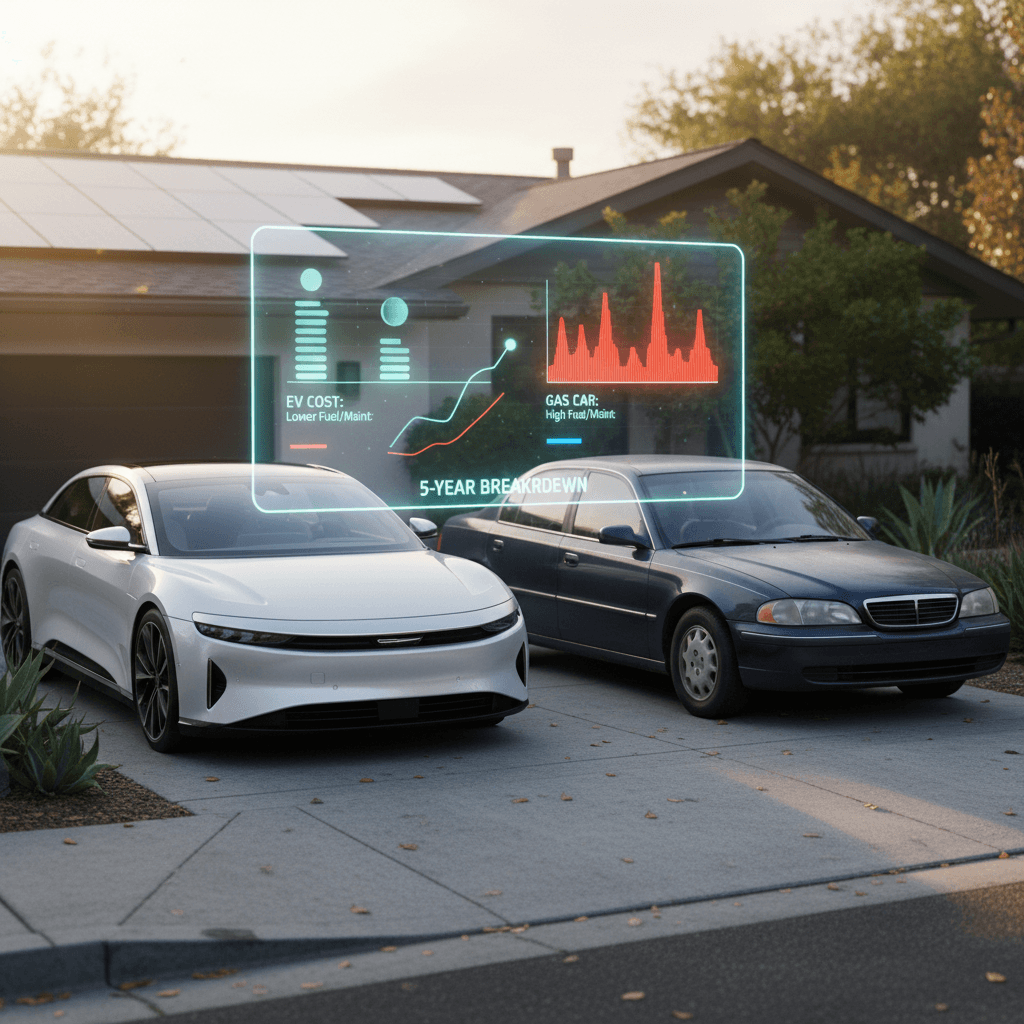
If you’re cross‑shopping a Lucid Air against a gas luxury sedan like a Mercedes‑Benz E‑Class or BMW 5 Series, the sticker prices can look intimidating. But once you zoom out to total cost of ownership over 5 years, the question becomes more interesting: does a Lucid Air actually cost more than an equivalent gas car, or less?
In this guide
Why Lucid Air vs gas total cost actually matters
Luxury EVs like the Lucid Air live at the intersection of technology product and status symbol. That makes it easy to get lost in 0–60 times and giant screens while ignoring what really drives ownership satisfaction: how much it costs you, per year, to actually live with the car. With gas flirting around $4 per gallon nationally in spring 2026 and electricity averaging roughly $0.16–$0.17 per kWh in the U.S., the operating‑cost gap between efficient EVs and thirsty gas sedans has never been more relevant.
Lucid has leaned hard into efficiency; the Air Pure RWD, for example, is rated around 5 miles per kWh under ideal conditions, and many owners report real‑world averages in the 3.8–4.6 mi/kWh range depending on speed, climate, and wheel choice. That efficiency is the foundation for the Lucid Air’s running‑cost advantage. The rest of the story comes down to depreciation, maintenance, and how you buy.
Lucid Air vs gas luxury sedan: quick 5‑year snapshot (typical U.S. driver)
The baseline: what gas cars actually compare to a Lucid Air
To make the comparison meaningful, you have to line the Lucid Air up against the right gas cars. A base Lucid Air Pure doesn’t really compete with a mainstream Camry; it competes with well‑equipped midsize luxury sedans and "entry" full‑size flagships.
Gas equivalents to compare with the Lucid Air
Think in terms of size, performance and brand position, not just MSRP
Mercedes‑Benz E‑Class / EQE
Mid‑size luxury benchmark. A well‑optioned E 450 or plug‑in hybrid often lands in similar transaction‑price territory to an Air Pure or Touring.
BMW 5 Series
Another realistic alternative. A 530i or 540i xDrive with packages routinely stickers in the $70k+ range, right where many Lucid shoppers are looking.
Genesis G80 / Audi A6
High‑content trims from these brands offer similar comfort and performance. Fuel economy is usually in the mid‑20s mpg combined at best.
In other words, if you’re cross‑shopping a Lucid Air honestly, you’re not replacing a $32,000 commuter; you’re replacing a $60,000–$90,000 luxury sedan that burns premium fuel. That frame makes the total‑cost math look very different.
Key assumptions behind the 5‑year cost comparison
To keep the math transparent, let’s spell out the assumptions used in the scenarios below. You can adjust these mentally for your own situation, but this baseline gives you a solid starting point.
Core assumptions for Lucid Air vs gas sedan cost model
You can plug in your own numbers later, but this is a realistic 2026 U.S. baseline.
| Factor | Lucid Air (example) | Gas luxury sedan (example) |
|---|---|---|
| Purchase price (new) | $80,000 (Air Touring‑like) | $70,000 (well‑equipped E‑Class/5‑Series) |
| Purchase price (used) | $55,000 (3‑yr‑old Air) | $45,000 (3‑yr‑old gas sedan) |
| Miles per year | 12,000 | 12,000 |
| Holding period | 5 years | 5 years |
| Electricity price (home) | $0.16/kWh (U.S. avg 2024–25) | , |
| Gasoline price | , | $4.00/gal (spring 2026 national avg) |
| Lucid efficiency | 4.0 mi/kWh real‑world | , |
| Gas efficiency | , | 25 mpg combined |
| Home vs DC fast charging | 80% home / 20% DC fast | N/A |
| Finance term / rate | 72 months @ 5.5% APR (example) | 72 months @ 5.5% APR |
Assumptions are rounded to keep the examples readable.
Your local prices will vary
Energy costs: Lucid Air electricity vs gasoline spend
Let’s start with the line item you feel every week: fuel. Using the assumptions above, we can calculate annual energy spend for each vehicle.
Lucid Air energy cost
Step 1: kWh per year
- 12,000 miles/year ÷ 4.0 mi/kWh ≈ 3,000 kWh/year from the battery
- Assume ~10% charging losses → about 3,300 kWh from the wall
Step 2: annual cost
- 80% of energy at home: 2,640 kWh × $0.16 ≈ $422
- 20% at fast chargers: 660 kWh × ~$0.35 ≈ $231
Total annual “fuel” cost ≈ $650
Gas luxury sedan fuel cost
Step 1: gallons per year
- 12,000 miles/year ÷ 25 mpg ≈ 480 gallons/year
Step 2: annual cost
- 480 gallons × $4.00/gal ≈ $1,920
Total annual fuel cost ≈ $1,920
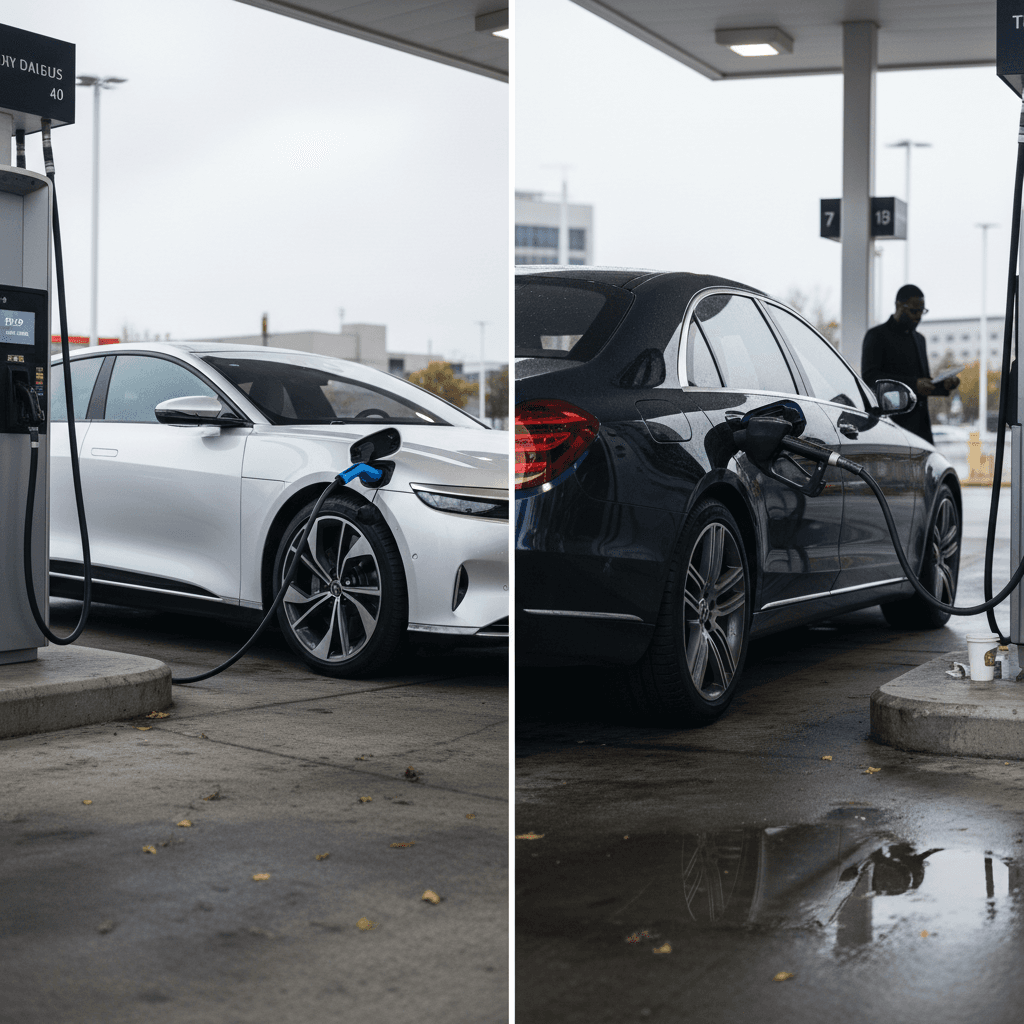
Annual fuel vs electricity cost: typical U.S. driver
Maintenance, repairs, and warranty coverage
On the maintenance side, Lucid Air owners benefit from the same basic EV advantages you see with Tesla and other BEVs: no oil changes, no spark plugs, no exhaust or emissions hardware, and far less brake wear thanks to strong regenerative braking. You’re mostly dealing with tires, cabin filters, brake fluid intervals, and occasional alignment work.
Typical 5‑year maintenance picture
Lucid Air vs gas luxury sedan (12,000 miles/year)
Lucid Air (EV)
- No oil changes or transmission service
- Long brake life due to regen
- Tire rotations, alignment, fluid checks
- Cabin filters and occasional software‑driven service items
Rule of thumb: 30–50% lower scheduled‑maintenance cost vs similar gas sedan.
Gas luxury sedan
- Regular oil and filter changes
- Transmission fluid service
- More frequent brake pad/rotor replacement
- Complex exhaust and emissions systems
Rule of thumb: easily $1,500–$2,000+ more over 5 years vs a comparable EV.
Factor in out‑of‑warranty risk
Insurance, taxes, and fees
Insurance is one place where EVs don’t always win. A Lucid Air’s aluminum body structure, advanced driver‑assist systems and low build volumes can make collision repairs expensive, and insurers price that risk in. Compared to a similarly priced gas sedan, expect insurance premiums to be roughly similar to moderately higher, depending on your market and the service network in your area.
- If your Lucid Air’s MSRP is higher than the gas car you’d otherwise buy, expect higher property taxes or registration fees in states that scale charges with vehicle value.
- Some states and utilities offer EV‑specific registration fees or road‑use surcharges; others offer rebates on charging equipment that can offset home‑charger installation costs.
- If you’re buying used, prior depreciation means lower insurance and tax bases than a new car with the same badge and features.
Net effect on total cost
Depreciation and resale value: EV vs gas luxury sedan
Depreciation is where the story gets nuanced. Early EVs and some luxury BEVs have taken steep residual‑value hits, especially when new prices fall or incentives change. Lucid Air is no exception: early cars have already seen sizeable used‑market discounts compared with original MSRPs, bad news if you bought new at launch, but a potential opportunity if you’re shopping used today.
If you buy new
- New luxury sedans of any kind, gas or EV, often lose 45–60% of their value in the first 5 years.
- Because Lucid is a newer brand, the market may price in extra risk, leading to somewhat steeper early depreciation than a Mercedes‑Benz badge.
- However, EV technology and range leadership can support residuals if the brand builds a reputation for reliability and software support.
If you buy used
- Let the first owner absorb the biggest drop. A 2–3‑year‑old Lucid Air can sometimes be had for 35–45% off original MSRP, depending on trim and mileage.
- At that point, further depreciation can look similar, or sometimes better, than a comparable 5‑Series or E‑Class that continues burning expensive fuel.
- Battery health becomes crucial; a strong battery means more range, better usability, and stronger resale.
Why battery health is the pivot point
5‑year total cost scenarios: new vs used Lucid Air
Now let’s put the pieces together. Below are simplified, directional 5‑year total‑cost snapshots using the assumptions from earlier. These aren’t quotes; they’re frameworks you can adjust. The point is to see how the levers, purchase price, fuel, maintenance, and depreciation, interact.
Illustrative 5‑year total cost of ownership (TCO) comparison
All numbers rounded for simplicity; financing cost approximated assuming similar APR/term on both vehicles.
| Scenario | Key assumptions | 5‑yr energy | 5‑yr maint. | 5‑yr depreciation | Approx. 5‑yr total* |
|---|---|---|---|---|---|
| New Lucid Air vs new gas sedan | Air: $80k; gas: $70k; 12k mi/yr; 5 yrs | Lucid ≈ $3.3k | Gas ≈ $9.6k | Lucid ≈ $3.0k | Gas ≈ $5.0k | Lucid −$40k | Gas −$35k | Lucid ≈ $86–90k | Gas ≈ $90–95k |
| Used Lucid Air vs used gas sedan | Air: $55k (3‑yr old); gas: $45k (3‑yr old) | Lucid ≈ $3.3k | Gas ≈ $9.6k | Lucid ≈ $3.0k | Gas ≈ $5.0k | Lucid −$20–25k | Gas −$20k | Lucid ≈ $63–66k | Gas ≈ $79–82k |
| High‑mileage driver (20k mi/yr) | Same prices; 20k mi/yr; 5 yrs | Lucid ≈ $5.5k | Gas ≈ $16k | Lucid ≈ $3.5k | Gas ≈ $6.5k | Similar % depreciation | Lucid often clearly cheaper despite higher MSRP |
Energy, maintenance, and depreciation are directional, adjust based on your local prices and exact model.
Don’t ignore purchase price shocks
When a Lucid Air clearly beats a gas car on cost
The Lucid Air doesn’t magically win every scenario. But there are clear patterns where it becomes the rational economic choice, not just the exciting tech toy.
Situations where the Lucid Air usually “wins” on total cost
You drive 12,000–20,000+ miles per year
The more you drive, the more you benefit from ~3–5x lower per‑mile energy cost. High‑mileage commuters and frequent road‑trippers see the fuel savings snowball quickly.
You can charge at home at reasonable electricity rates
Reliable Level 2 home charging at ~$0.12–$0.20/kWh is the secret sauce. If most of your energy comes from expensive DC fast charging, the cost advantage shrinks.
You’re shopping used rather than new
Letting the first owner absorb the steepest depreciation can turn the Lucid Air into a <strong>used‑car bargain</strong> relative to its performance, range, and tech, especially compared to thirsty V6 or V8 sedans.
You’d otherwise buy a well‑equipped gas luxury sedan
If you’re already shopping in the $60k–$90k bracket, fuel and maintenance savings can offset Lucid’s new‑brand risk and sometimes even a slightly higher purchase price.
You care about long‑term tech value
Over‑the‑air software updates, cutting‑edge efficiency, and huge real‑world range all help keep a Lucid Air desirable on the used market, especially if the battery is healthy.
Run your own numbers
Buying a used Lucid Air: how Recharged changes the math
On the used market, the Lucid Air’s story flips from “expensive science experiment” to “quietly compelling value”, if you can be confident about the battery, software, and prior ownership history. That’s exactly where Recharged focuses.
Why a used Lucid Air through Recharged can be a smart money play
Lower entry price + verified battery health = powerful combo
Recharged Score battery diagnostics
Every Recharged vehicle gets a Recharged Score Report with verified battery health and range insights, so you’re not guessing about the most expensive component in the car.
Fair market pricing
Recharged benchmarks pricing against the used EV market, depreciation curves, and battery condition, helping you avoid overpaying for early Lucid Airs that have already taken their big depreciation hit.
Digital buying, nationwide delivery
Shop, finance, trade‑in and sign entirely online, then have your Lucid Air delivered. If you’re near Richmond, VA, you can also visit the Recharged Experience Center for in‑person support.
Ready to find your next EV?
Browse VehiclesBecause Recharged specializes in used EVs, you also get guidance on home charging, road‑trip planning, and incentives, pieces that directly influence your real‑world cost of ownership, not just the day‑one price tag.
FAQ: Lucid Air total cost vs gas car equivalent
Frequently asked questions
Bottom line: is a Lucid Air worth it vs a gas equivalent?
If you only look at window stickers, the Lucid Air can seem like an indulgence, especially against discounted gas sedans wearing establishment badges. But when you zoom out to total cost of ownership, factor in $4/gallon gasoline, and assume realistic annual mileage, the picture shifts. For many drivers, especially those who can charge at home and are open to a well‑priced used example, a Lucid Air’s combination of ultra‑low energy cost, reduced maintenance, and massive real‑world range makes it cost‑competitive with, or even cheaper than, an equivalent gas luxury car over 5 years.
The key is to be honest about your driving, your local energy prices, and your appetite for a newer brand. If you want help running the numbers on a specific used Lucid Air, including verified battery health, fair pricing, and financing options, you can start your search with Recharged and let our EV specialists walk you through the cost story car by car.