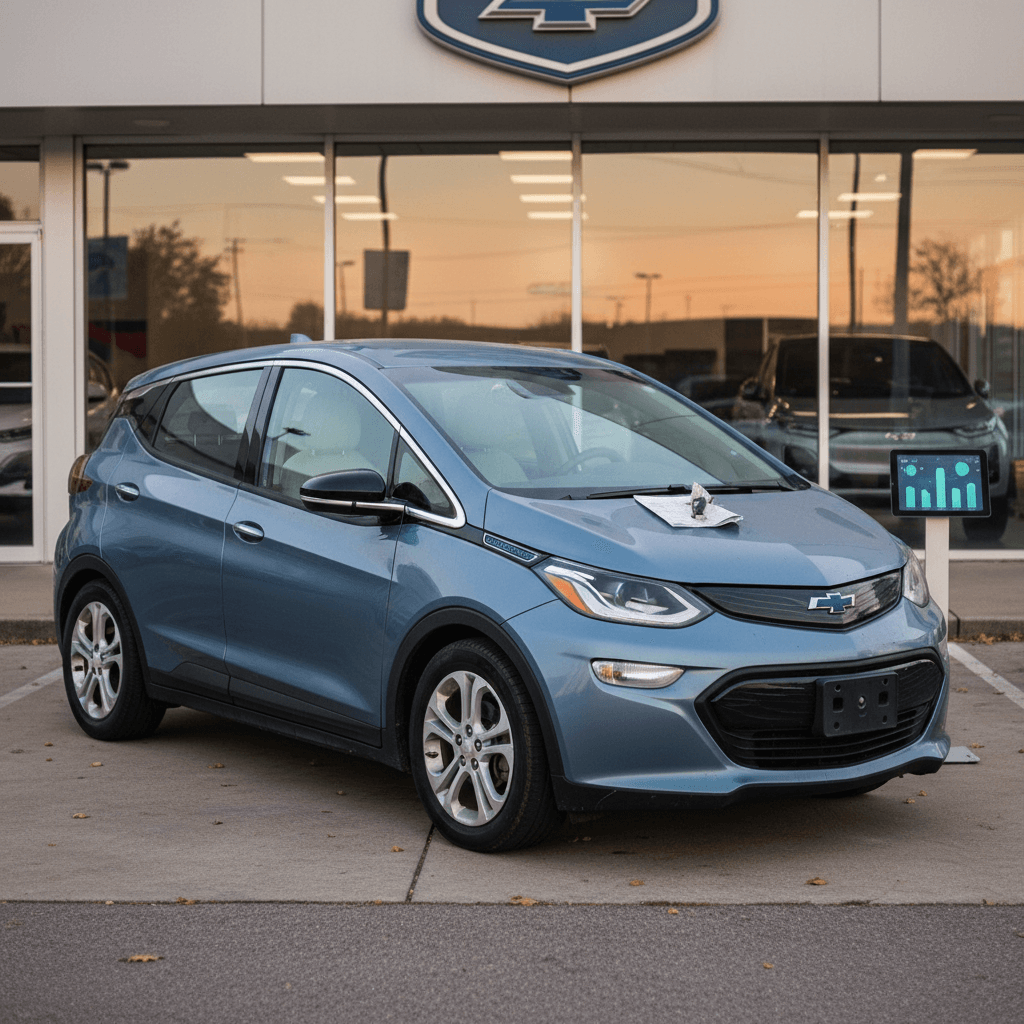
If you own a 2021 Chevrolet Bolt EV, you’re sitting on one of the most affordable long‑range EVs on the used market. But between the well‑publicized battery recall and fast‑moving used‑EV prices, it’s hard to know what a fair 2021 Chevrolet Bolt EV trade in value really looks like in 2025–2026. This guide walks through current pricing, how dealers think, and what you can do to squeeze every last dollar out of your Bolt.
Quick take
2021 Chevy Bolt EV trade-in value at a glance
Typical 2021 Bolt EV numbers in 2025–2026
Those are broad national ranges. Your number will swing higher or lower based on six main factors: mileage, cosmetic condition, battery recall status, remaining battery warranty, DC fast‑charge history, and whether you’re trading at a franchise Chevy store, non‑Chevy dealer, or selling through a dedicated used‑EV marketplace like Recharged.
How much is a 2021 Chevrolet Bolt EV worth today?
Let’s anchor the discussion with real market data. By late 2025, multiple pricing sources and marketplace data show 2021 Chevy Bolt EVs typically retailing in the mid‑teens to low‑$20,000s depending on mileage and trim. Recharged’s own used‑EV pricing research for the Bolt family points to roughly $17,000–$23,000 for a 2021 Bolt EV with 30,000–60,000 miles at a dealership, with slightly lower ranges at independent lots or online‑only retailers.
Representative 2021 Bolt EV price bands (U.S., early 2026)
These are directional national ranges compiled from dealer listings, valuation guides, and marketplace data. Local conditions will vary.
| Mileage / Condition | Likely Dealer Retail Price | Realistic Trade-In or Instant-Offer Range | Notes |
|---|---|---|---|
| Under 25,000 miles, very clean, new recall battery | $20,000–$23,000 | $15,000–$18,000 | Top of the market; strong CPO candidate at Chevy stores. |
| 25,000–50,000 miles, average wear, new recall battery | $17,000–$21,000 | $12,000–$16,000 | The sweet spot for many buyers; easiest to price and sell. |
| 50,000–80,000 miles, average wear, original battery | $14,000–$18,000 | $10,000–$14,000 | Value depends heavily on battery health and warranty dates. |
| 80,000+ miles, cosmetic issues, unknown battery history | $11,000–$15,000 | $8,000–$11,000 | More of a value play; dealers will price conservatively. |
Use these as starting points when evaluating offers, not as guaranteed prices.
Don’t fixate on a single number
If you want a very rough sanity check, you can expect retail value to be somewhere around 45% below your original MSRP after three years, and then to slide more gently as the vehicle ages. But the Bolt is not a typical gas hatchback, its high‑value battery pack and well‑publicized recall give it a more complex story than most used cars.
What dealers really look at when pricing a 2021 Bolt EV trade-in
1. What a 2021 Bolt actually sells for at auction
Most franchise and independent dealers look first at recent wholesale auction results for 2021 Bolt EVs that match your car’s mileage and condition. That number, what they think they could get if they wholesaled your Bolt tomorrow, sets the floor for any trade‑in offer.
If auctions show similar Bolts landing around $12,000, a dealer can’t realistically pay you $15,000 on trade unless they plan to keep and retail your car at a healthy markup.
2. What they can retail it for locally
Next, they’ll scan local listing prices for 2021 Bolt EVs. If retail prices sit around $18,000 in your region, a store might target paying roughly $12,000–$14,000 on trade, leaving room for reconditioning, transport, and profit.
That spread, often $3,000–$5,000 between trade‑in and retail, is how most dealers stay in business, especially on EVs where battery risk still makes a lot of managers nervous.
- Your car’s exact year, mileage, trim, and options
- Battery recall and warranty status (they’ll often run your VIN)
- Tire condition and obvious cosmetic issues
- Accident history (via Carfax/AutoCheck)
- Local EV demand and tax‑credit environment
- Their own comfort level with used EVs and battery risk
Know their playbook before you walk in
How the battery recall and warranty affect your trade-in value
You can’t talk about 2021 Bolt EV values without talking about the high‑voltage battery recall. In August 2021, GM expanded its earlier recall to cover every Chevrolet Bolt EV and EUV built from 2017 through 2022 because of rare but serious battery fire risks. Many cars, including a large share of 2021s, have already received replacement battery packs, while others have had software updates and selective module replacements.

Case 1: 2021 Bolt with a new recall battery
If your 2021 Bolt EV received a full pack replacement under the recall, you’re holding a major selling point. Replacement packs generally match the updated 259‑mile range and come with an 8‑year/100,000‑mile warranty that starts from the date of the new battery’s installation, not the car’s original in‑service date. For a buyer, that’s essentially a “new” battery in a used car, and for a trade‑in appraiser, it’s a reason to pay more and worry less.
Why a replacement pack is a big plus
Case 2: 2021 Bolt with original battery and recall open or just software
If your car still shows an open recall, or only interim software applied, expect dealers to shade their offers down. They’re on the hook to finish the recall (or explain why the battery wasn’t replaced), absorb any downtime, and sell the car into a market that is now trained to ask: "Has the battery been replaced?" Even if GM ultimately decides not to replace your specific pack, uncertainty alone puts downward pressure on what stores are willing to pay.
Don’t trade with an open recall if you can avoid it
Condition, mileage, and options that move your number up or down
Once battery status is clear, your 2021 Bolt EV is graded like any other used car, on mileage, cosmetics, options, and how easy it will be for the next owner to live with. Here are the levers that tend to matter most for this specific model year.
Key value drivers for a 2021 Bolt EV
Small differences here add up to big swings in trade-in value.
Mileage band
Most buyers still view 30k–60k miles as the sweet spot for a 2021 Bolt EV. Crossing 80k miles can noticeably drag down offers, even if the battery looks good.
Cosmetic condition
Curbed wheels, hail dings, cracked glass, and worn interiors all hit your appraisal. Light wear is expected; visible reconditioning work gives dealers an excuse to knock $500–$1,500 off.
DC fast-charge history
Heavy DC fast‑charging and frequent high‑SOC storage aren’t always visible to a dealer, but a detailed battery‑health report (like a Recharged Score) can reassure buyers and support higher pricing.
Trim & options
Premier‑equipped 2021 Bolts with nicer seating, active safety tech, and DC fast‑charge hardware generally earn more than bare‑bones LT cars.
Climate & corrosion
Rust belt cars, or ones that lived through harsh winters without underbody protection, may see lower offers than clean southern or West Coast examples.
Documentation
Complete service records, recall paperwork, and a recent battery‑health diagnostic can justify pushing back on lowball offers.
Bring proof, not just opinions
Trade it in, sell to a dealer, or list it yourself?
A 2021 Bolt EV is liquid enough that you’ve got options: a traditional trade‑in at a Chevy or non‑Chevy dealer, an instant‑offer from a national buyer, or a retail sale through a consumer‑facing marketplace. Each path comes with a different mix of price, hassle, and risk.
Traditional trade-in
- Pros: Easiest path, saves sales tax in many states, one trip.
- Cons: Usually the lowest dollar outcome, especially if the store is skittish about EVs.
- Best for: Convenience‑focused sellers who value time over squeezing every dollar.
Instant offer / wholesale buyer
- Pros: Fast online quotes, payment in days, no need to buy another car.
- Cons: Offers are benchmarked to auctions; rejections for incomplete recall work or unclear battery history are common.
- Best for: Sellers who want cash quickly and don’t mind accepting a wholesale price.
Selling through Recharged
- Pros: EV‑specialist pricing, Recharged Score battery‑health reporting, national buyer pool, and support with paperwork, financing, and delivery.
- Cons: Takes more time than a same‑day trade‑in; you’ll participate more actively in the sale.
- Best for: Owners who want retail‑level pricing without having to meet strangers in parking lots.
Where Recharged fits in
7 steps to maximize your 2021 Bolt EV trade-in value
Pre‑trade checklist for 2021 Bolt EV owners
1. Confirm recall completion and battery status
Run your VIN on Chevrolet’s recall site and gather paperwork showing whether your 2021 Bolt received a full pack replacement or module work. If the recall is still open, schedule the repair before visiting dealers.
2. Get an independent battery-health report
A third‑party diagnostic, like the <strong>Recharged Score</strong> battery health report that comes with every car on Recharged, translates raw data into a simple score buyers and dealers actually understand.
3. Clean, detail, and fix cheap cosmetic issues
A professional interior detail, headlight restoration, and touch‑up paint for obvious scratches can cost a few hundred dollars and protect far more than that in trade‑in value.
4. Gather maintenance and charging records
Print service receipts, tire rotations, and any documentation that shows mostly Level 2 home charging and responsible use. This is especially persuasive for EV‑shy appraisers.
5. Get multiple offers within a tight window
Collect <strong>at least 2–3 written offers</strong> within the same week: one from a Chevy store, one from a used‑car chain or instant‑offer service, and one from an EV‑focused buyer such as Recharged.
6. Separate trade-in negotiation from new-car price
When buying another vehicle, negotiate the new car’s price first. Then bring in your competing Bolt offers and ask the dealer to beat them on trade or match them as a straight buy.
7. Consider selling retail if the spread is big
If trade‑in offers come in $4,000–$6,000 below realistic retail pricing for your 2021 Bolt, it’s worth exploring a retail‑oriented marketplace where Recharged can help you capture more of that gap.
Watch the tax-credit math
Getting an offer vs selling through Recharged
For many 2021 Bolt EV owners, the right answer isn’t “trade in or sell”, it’s “get the trade‑in offer, then decide whether to beat it.” That’s where a specialist marketplace like Recharged can change the math.
How a typical dealer treats your 2021 Bolt
A conventional dealer, especially one that doesn’t regularly retail EVs, sees your 2021 Bolt EV as a battery risk wrapped in a compact hatchback. They’ll lean heavily on conservative auction data, discount for any uncertainty around the recall, and often send the car straight to wholesale if they’re not comfortable stocking it.
That risk haircut shows up directly in your trade‑in offer.
How Recharged evaluates a 2021 Bolt EV
Recharged is built only around EVs. Instead of guessing at battery health, every vehicle is backed by a Recharged Score Report that measures pack condition, charging history, and fair‑market pricing. That lets Recharged price a good 2021 Bolt EV more precisely, market it confidently to EV‑savvy buyers nationwide, and handle financing, trade‑ins, and delivery end‑to‑end.
The result: you keep more of the car’s true value, without taking on all the headaches of selling it yourself.
Two ways Recharged can help
Ready to find your next EV?
Browse Vehicles2021 Chevrolet Bolt EV trade-in value: FAQ
Common questions about 2021 Bolt EV trade-in values
Bottom line: what your 2021 Bolt EV is really worth
A 2021 Chevrolet Bolt EV sits at an interesting crossroads: it’s old enough to be affordable, new enough to feel modern, and, if it has a replacement battery, potentially protected by years of additional warranty. That combination keeps demand surprisingly strong, even after the recall headlines.
For most owners, a realistic trade-in value today lands in the low‑ to mid‑teens, with clean, low‑mileage, recall‑completed cars pushing higher. The smartest move is to treat that dealer offer as one data point, then compare it against EV‑savvy alternatives. With a little prep, documentation, and a proper battery‑health report, your 2021 Bolt EV can command a price that reflects what it really is: a capable long‑range EV, not just an aging compact hatchback.
If you’re ready to see what your 2021 Bolt EV could bring, Recharged can help you get an instant offer, line up financing for your next EV, or list your Bolt with a Recharged Score and nationwide exposure, all from your laptop or from our Experience Center in Richmond, VA.