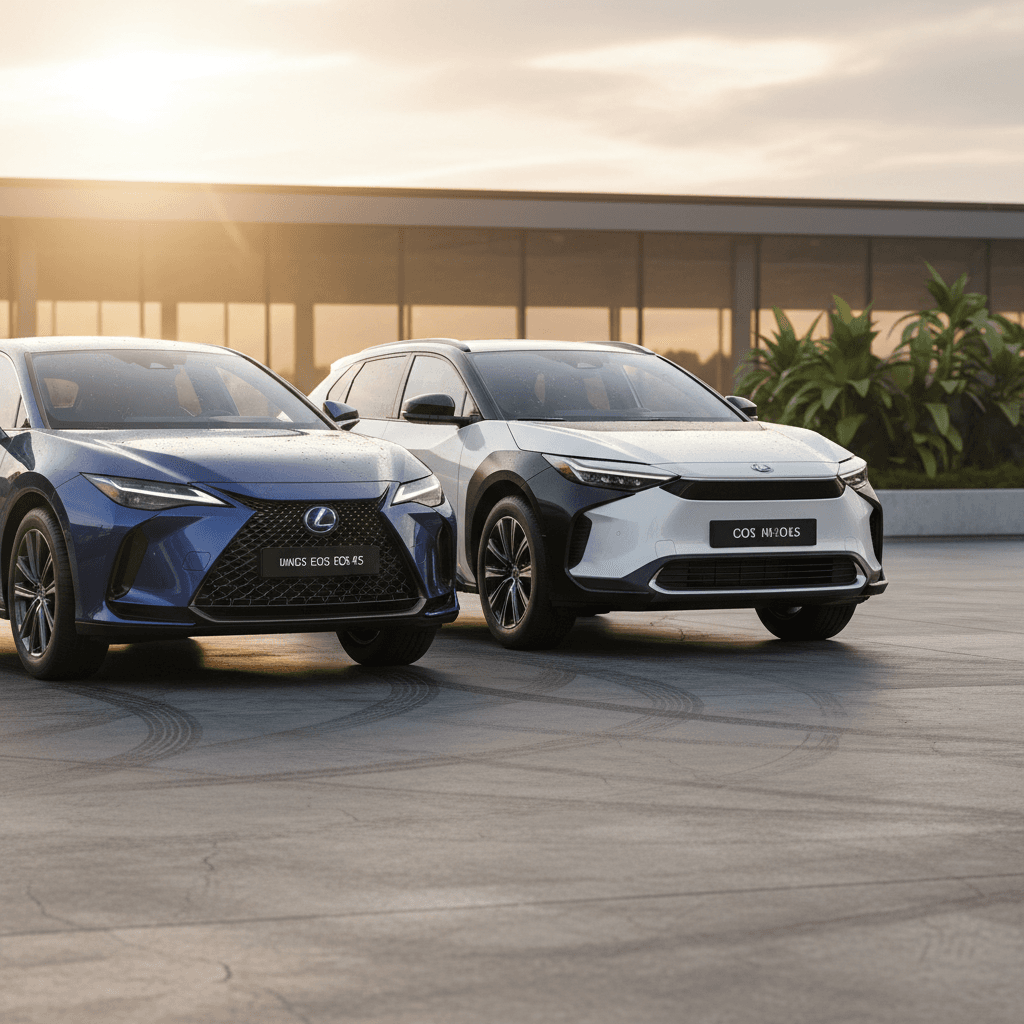
If you’re cross‑shopping the Lexus RZ vs Toyota bZ4X, you’ve probably noticed something odd: these cousins share the same e‑TNGA platform and a lot of hardware, yet they feel very different on the road and on your monthly payment. One leans hard into comfort and luxury, the other into value and practicality. The question is which one fits the way you actually drive, and, if you’re buying used, which is the smarter long‑term bet.
Platform twins, different personalities
Lexus RZ vs Toyota bZ4X: quick overview
How the Lexus RZ and Toyota bZ4X compare at a glance
Luxury experience versus value‑oriented practicality
Lexus RZ (300e / 450e / 550e)
Positioning: Luxury compact electric SUV.
- More power and sharper handling, especially in 450e and 550e F SPORT trims.
- Quieter, more upscale interior with Lexus‑grade materials and tech.
- Historically higher pricing, but recent cuts and incentives make it surprisingly close to, or even below, bZ4X when new.
- Better cargo space and rear‑seat room than bZ4X.
Toyota bZ4X / bZ
Positioning: Mainstream compact electric SUV.
- Lower starting price, especially in newer model years.
- Simple, easy‑to‑use cabin and Toyota familiarity.
- Good efficiency and a less complex feature set.
- More conservative tuning and performance; feels closer to a comfortable commuter than a sporty EV.
Model years to focus on
Pricing, incentives, and value for money
Lexus and Toyota have both been aggressive on pricing to move these EVs, but in very different ways. Early on, the Lexus RZ looked a lot more expensive than the Toyota bZ4X. That changed quickly as Lexus slashed MSRPs for 2025 and added base trims that actually undercut some Toyota configurations.
Typical new‑MSRP ranges (recent U.S. model years)
Approximate MSRP bands before dealer discounts or incentives; real‑world transaction prices can be lower, especially on remaining inventory.
| Model / Trim | Drivetrain | Approx. new MSRP band | Positioning |
|---|---|---|---|
| Lexus RZ 300e | FWD | Low–mid $40Ks to low $50Ks | Entry‑level Lexus EV, efficient but slower |
| Lexus RZ 450e | AWD | High $40Ks to high $50Ks | More power, AWD, traditional Lexus luxury |
| Lexus RZ 550e F SPORT* | AWD | Expected high $50Ks+ | High‑performance, sport‑tuned (limited availability) |
| Toyota bZ4X XLE | FWD | High $30Ks to low $40Ks | Value‑oriented base trim |
| Toyota bZ4X/bZ Limited | FWD or AWD | Low–mid $40Ks | Better equipment, still mainstream |
| 2026 “bZ” XLE Plus | FWD | Low–mid $40Ks | Larger battery, more range, improved charging |
Use this as a directional guide, always check current offers in your area.
Don’t ignore discounts and tax credits
If you’re looking at the used market, depreciation tilts the value equation. Luxury badges like Lexus tend to drop faster early on, which means you can often buy a lightly used RZ for not much more than (and sometimes less than) a late‑model bZ4X. That’s where marketplaces like Recharged shine: pricing is benchmarked to fair market values, and every used EV comes with a Recharged Score battery health report, so you’re not guessing about how much usable range you’re really getting.
Range, battery, and efficiency comparison
Both SUVs launched with modest range and only average fast‑charging performance by modern standards. Subsequent model‑year updates have nudged numbers upward, especially for the Toyota, but if you’re coming from a Tesla or Hyundai/Kia EV, keep your expectations grounded.
Typical EPA range figures by variant (recent years)
Real‑world range can be much lower
Battery and efficiency details: Lexus RZ vs Toyota bZ4X
Similar chemistry, different tuning and options
Lexus RZ battery and efficiency
- Early RZ 450e models used a ~71 kWh pack with modest efficiency and a 6.6 kW onboard charger.
- RZ 300e introduced a larger ~72.8 kWh pack with slightly better range when paired with front‑wheel drive.
- 2026 updates significantly improve efficiency and raise the onboard charger to around 11 kW, reducing home‑charging times.
- Still limited to roughly 150 kW DC fast‑charging under ideal conditions, fine for occasional road trips but not class‑leading.
Toyota bZ4X / bZ battery and efficiency
- Early U.S. bZ4X FWD models offered an EPA range in the mid‑200‑mile band; AWD trims were lower.
- Later updates in other markets use packs in the low‑70‑kWh range with improved range and better cold‑weather preconditioning.
- 2026 U.S. “bZ” updates bring a larger 74.7 kWh battery on some trims and estimated range into the 300‑mile neighborhood.
- DC fast‑charging is improved on newer versions, especially in cold weather, but still not the quickest in the segment.
How to judge a used EV’s real range
Performance, ride quality, and driving feel
On paper, the Lexus RZ and Toyota bZ4X don’t look radically different. In reality, tuning and power output give the Lexus a clear edge if you care about acceleration and handling feel. The Toyota is perfectly adequate for commuting, while the Lexus tries to feel like a proper luxury EV, even if its specs don’t rival the quickest Teslas or German rivals.
Lexus RZ: more power, more polish
- RZ 300e (FWD): ~201 hp and front‑wheel drive. Adequate, not exciting, but refined and efficient for daily use.
- RZ 450e (AWD): Dual‑motor setup around 308 hp, with 0–60 mph in roughly 5 seconds when new. Noticeably quicker than any bZ4X variant.
- RZ 550e F SPORT (AWD): Performance‑focused trim with over 400 hp, simulated gear‑shift sounds, and more aggressive tuning for drivers who want some theater with their EV.
- RZ’s suspension tuning favors a smooth, quiet ride but maintains better body control than the Toyota cousin. Steering is light but more precise.
Toyota bZ4X / bZ: relaxed and familiar
- Single‑motor FWD trims sit around 201 hp, with calm, predictable acceleration.
- Dual‑motor AWD bumps power modestly, but the bZ4X never feels truly quick; it’s tuned for smoothness, not thrills.
- Ride quality is comfortable and compliant, much like a RAV4 Hybrid or other Toyota crossovers. Noise isolation is decent but not at Lexus levels.
- Handling is secure and predictable, though body roll and steering feel remind you this is a family crossover first and foremost.
Braking and handling differences
Interior space, comfort, and features
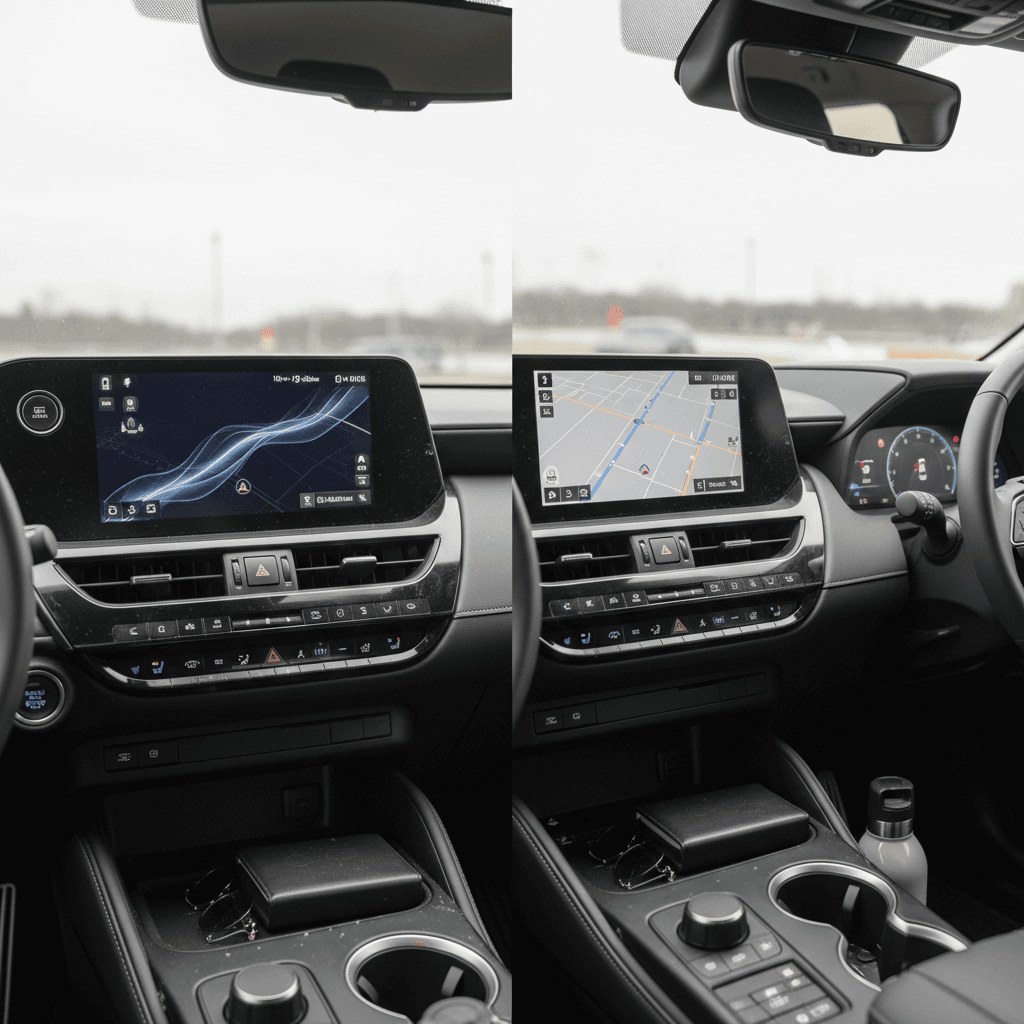
This is where the family resemblance shows, but so does the badge hierarchy. The Toyota bZ4X cabin is simple and durable, almost utilitarian in some trims. The Lexus RZ adds noise‑cancellation tricks, nicer materials, and a more cohesive design that actually feels like a purpose‑built luxury EV rather than a retrofitted crossover.
Space and comfort: where Lexus RZ pulls ahead
Same platform, different priorities
Lexus RZ interior strengths
- Quieter cabin thanks to additional sound deadening and active noise‑cancellation tech.
- More rear headroom and legroom than bZ4X, making it friendlier for adults in the second row.
- Richer materials, more cohesive design, and available features like a dimmable glass roof.
- More cargo volume behind the rear seats than bZ4X, plus a slightly more usable shape.
Toyota bZ4X interior strengths
- Straightforward control layout and traditional Toyota ergonomics.
- Easy‑to‑clean materials that may withstand kids and pets better in lower trims.
- Available heated seats and wheel, plus a sensible mix of physical buttons and screen‑based controls.
- Generally lower replacement costs for interior wear items compared with Lexus parts.
Steer‑by‑wire and tech quirks
Charging experience and road‑trip usability
Both the Lexus RZ and Toyota bZ4X are perfectly fine for home charging and regional driving. For serious road‑trip use, they lag behind the best in class. Charging speeds are adequate rather than impressive, and earlier versions in particular struggled in cold conditions.
Home and workplace charging
- Earlier RZ models used a 6.6 kW onboard charger, making a 0–100% charge on a 240V Level 2 station an overnight affair. Newer versions move closer to 11 kW, cutting that time significantly.
- bZ4X and later bZ models support typical Level 2 charging and often ship with dual‑voltage portable cables, letting you plug into 120V or 240V outlets.
- If you can install a 240V Level 2 charger at home, both vehicles work best as “charge overnight, forget about it” EVs.
Public fast‑charging and road trips
- Both families top out around 150 kW DC fast‑charging in ideal conditions, meaning 10–80% in roughly 30–40 minutes on a good station.
- Cold‑weather charging has been a sore spot, though newer Toyota bZ and RZ updates add battery preconditioning to improve performance.
- Some recent model years begin adopting the North American Charging Standard (NACS) port, unlocking access to Tesla Superchargers without an adapter. Earlier cars rely on CCS public networks.
- For frequent cross‑country travel, you’ll want to plan conservatively and expect occasional 45–60‑minute stops.
How to make either EV road‑trip friendly
Ownership costs, reliability, and warranties
Because these EVs are still relatively new, long‑term reliability data is evolving. That said, Toyota and Lexus have strong track records with hybrids and generally conservative engineering. Neither the RZ nor the bZ4X is pushing the bleeding edge of charging speeds or battery chemistries, which can actually be a positive for durability.
Key ownership considerations for RZ and bZ4X buyers
Battery warranty coverage
Both brands typically offer an 8‑year/100,000‑mile battery warranty (sometimes more on certain components). On a used example, confirm how many years and miles remain and whether the warranty transfers to subsequent owners.
Maintenance and service costs
EVs don’t need oil changes or complex transmissions, but tires, brakes, cabin filters, and coolant still matter. Lexus parts and labor usually cost more than Toyota’s; factor that into your long‑term budget.
Software updates and recalls
Early bZ4X units famously had wheel‑hub recalls, and both vehicles have received software updates to improve charging and range. Make sure any candidate vehicle is fully up to date and recall‑free before you buy.
Insurance and registration
Luxury branding can increase insurance premiums for the RZ compared with the Toyota. Get real quotes for both before deciding, especially if you’re a younger driver or live in a high‑cost insurance state.
Resale and depreciation
Lexus models tend to depreciate faster early on but maintain desirability as used luxury EVs. Toyotas may have stronger brand recognition with mainstream shoppers. In both cases, documented battery health and service history are huge value drivers when you resell.
How Recharged can de‑risk ownership
Used‑market insights: Lexus RZ vs Toyota bZ4X
The used market is where the Lexus RZ vs Toyota bZ4X comparison gets especially interesting. Because both launched with lukewarm reviews around range and charging, they haven’t enjoyed the same resale strength as some rivals, and that can be a real opportunity for value‑focused buyers who understand the trade‑offs.
Used‑market pros and cons
High‑level view of what you gain and give up with each model when shopping used.
| Aspect | Used Lexus RZ | Used Toyota bZ4X / bZ |
|---|---|---|
| Purchase price | Stronger early depreciation means you can sometimes buy a 1–2‑year‑old RZ for a big discount vs new. | Lower new MSRP but slightly firmer used prices, especially on well‑equipped, newer trims. |
| Luxury vs simplicity | More features, softer materials, quieter ride; better perceived value as a used luxury EV. | Simpler interior, fewer gadgets to break, and more familiar feel for Toyota owners. |
| Range expectations | Earlier years have modest highway range; newer 2026 models improve things but may be pricey used at first. | Later bZ variants with larger batteries offer the best range of the bunch, but early bZ4X models are modest. |
| Buyer perception | Less name recognition as an EV, which can translate into better deals for savvy shoppers. | Toyota badge reassures mainstream used buyers, supporting demand. |
Specific pricing will vary by year, mileage, options, and local incentives.
Watch for heavy DC fast‑charging use
Who should buy which? Practical recommendations
Lexus RZ: best for comfort‑first buyers
- You want a quiet, refined EV that feels like a true luxury product on the inside.
- You care more about ride comfort, interior quality, and features than absolute maximum range.
- You’re open to buying lightly used to take advantage of strong depreciation and stretch into a Lexus budget.
- You plan to charge mostly at home and use the car for commuting, family duty, and regional trips rather than cross‑country drives.
If that sounds like you, a used RZ 450e or updated 350e is a strong fit. Shop for smaller wheels to maximize range, and look for later model years with the improved onboard charger if home‑charging speed matters to you.
Toyota bZ4X / bZ: best for value and simplicity
- You want a straightforward, affordable EV from a brand you already know and trust.
- You’re okay with modest performance as long as the car is comfortable and easy to live with.
- You value simple controls and lower maintenance/repair costs over fancy features.
- You’re shopping the updated bZ variants with larger batteries and improved charging for more highway range.
If that’s you, a well‑specced bZ4X or newer bZ XLE Plus can be a solid everyday EV, especially if you find one with documented software updates and a clean recall history.
How Recharged fits into the decision
Ready to find your next EV?
Browse VehiclesFrequently asked questions
Lexus RZ vs Toyota bZ4X: FAQs
Ultimately, comparing the Lexus RZ vs Toyota bZ4X is less about which is “better” and more about which matches your priorities. If you want a quiet, comfortable, genuinely premium EV and you’re charging mostly at home, the RZ is the more satisfying choice, especially as a lightly used buy. If you want a straightforward, value‑oriented electric crossover from a familiar brand, the bZ4X or updated bZ lineup can be a sensible, low‑drama way into EV ownership. Either way, taking the time to understand range realities, charging behavior, and battery health will pay off long after the new‑car smell fades, and that’s where tools like the Recharged Score and EV‑specialist support can turn a complicated first‑gen EV decision into a confident one.