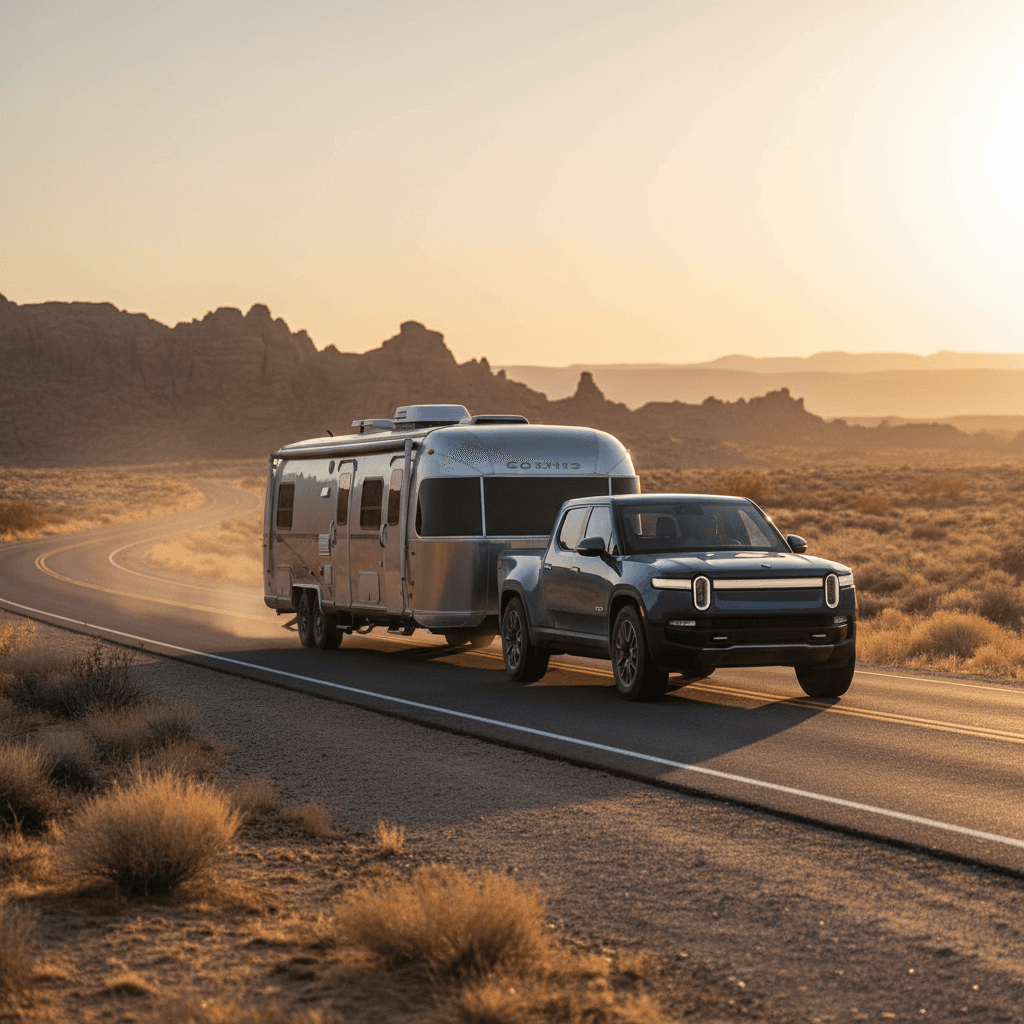
You don’t buy a Rivian R1T because you secretly want a crossover. You buy it because you want an electric truck that can haul toys, tow a camper, and still feel like a sci‑fi concept that escaped the auto show. But towing is where EV reality hits: the Rivian R1T towing capacity and range on paper look heroic, while real-world range with a trailer can drop by half. This guide unpacks both numbers and lived experience so you can plan smart road trips, not white‑knuckle experiments.
Headline numbers, real-world caveats
Rivian R1T towing capacity at a glance
Rivian engineered the R1T to tow like a half‑ton truck, not a science project. The maximum rating is validated on the same brutal Davis Dam grade standard used for gas pickups, in triple‑digit desert heat. The badge on the tailgate isn’t marketing fluff; it’s SAE math.
Gen 1 vs. Gen 2 Rivian R1T towing capacity
Official factory tow ratings vary slightly by generation, motor layout, and battery pack. Here’s how they break down.
| Generation / Configuration | Battery pack | Official tow rating | Notes |
|---|---|---|---|
| Gen 1 R1T Dual‑Motor AWD | Standard / Standard+ / Large / Max | 11,000 lb | All dual‑motor packs rated the same |
| Gen 1 R1T Quad‑Motor AWD | Large | 11,000 lb | Halo setup, strong off‑road bias |
| Gen 2 R1T Dual‑Motor AWD | Standard / Large | 7,700 lb | Tow rating reduced vs. Gen 1 |
| Gen 2 R1T Dual‑Motor AWD | Max / Large+ | 11,000 lb | Max and Large+ unlock full rating |
| Gen 2 R1T Tri‑Motor AWD | Max | 11,000 lb | Launch‑control rocket that can still tow |
Always check the specific truck’s door jamb label and owner’s manual for exact figures.
Check which R1T you’re actually buying
Key Rivian R1T towing and payload stats
How much range you really lose when towing
The uncomfortable truth with any EV truck is simple: a trailer is a parachute. The R1T has the power to drag 11,000 lb up a desert grade in 110‑degree heat, but the battery has to push that weight and aero drag through the air. Rivian engineers have openly said they see about a 50% reduction in range at full-rated tow in their internal testing. That lines up eerily well with owner anecdotes.
- At or near the full 11,000‑lb rating with a boxy trailer: plan for ~50% of your normal highway range.
- With a 4,000–6,000‑lb, reasonably aero travel trailer: expect 35–45% loss depending on speed, terrain, and weather.
- With light duty, say a 2,000‑lb utility trailer or pair of dirt bikes: you may only see 20–30% loss on the highway.
Think in hours, not just miles
Battery packs, motors, and their impact on towing range
Not every R1T is spec’d the same, and that matters a lot once you hitch up. Between Standard, Large, and Max (plus software‑locked Large+ on some later trucks) and dual‑, tri‑, or quad‑motor layouts, you’re really buying a choice between tow rating, efficiency, and straight‑line theatrics.
How different R1T setups behave when towing
Bigger batteries don’t increase tow rating, but they do change usable tow range.
Standard / Standard+ pack
Best for: Short‑haul towing, weekend toys, homeowners who rarely tow far.
- Lowest capacity, so the most sensitive to range loss.
- On Gen 2, paired with 7,700‑lb tow rating.
- Road‑trip towing is possible but requires tighter planning.
Large / Large+ pack
Best all‑rounder: Balance of price, weight and capacity.
- Gen 1: rated to 11,000 lb.
- Gen 2: Large often 7,700 lb; Large+ (locked Max) can be 11,000 lb.
- Real‑world tow legs in the ~110–150 mile window with mid‑size trailers.
Max pack (incl. Large+ Max)
Road‑trip tower’s choice: Maximum usable range.
- Rated to 11,000 lb in most configurations.
- Big battery weight actually helps stability.
- Owners report 120–180 mile legs with sensible speeds and aero trailers.
Dual‑Motor AWD
The dual‑motor R1T is the efficiency play. It gives you plenty of shove for towing, north of 500 hp, but with less parasitic drag than the older quad‑motor setup. If your main goal is maximizing range between chargers, dual‑motor plus a Large or Max pack is the sweet spot.
Tri‑ & Quad‑Motor AWD
The tri‑motor and early quad‑motor trucks feel like silent muscle cars that happen to have beds. Towing, they’re overkill in the best way: effortless merges, instant throttle on grades, high confidence in crosswinds. The price is slightly worse efficiency. If you tow heavy but don’t chase maximum range, they’re sublime.
Range isn’t just battery size
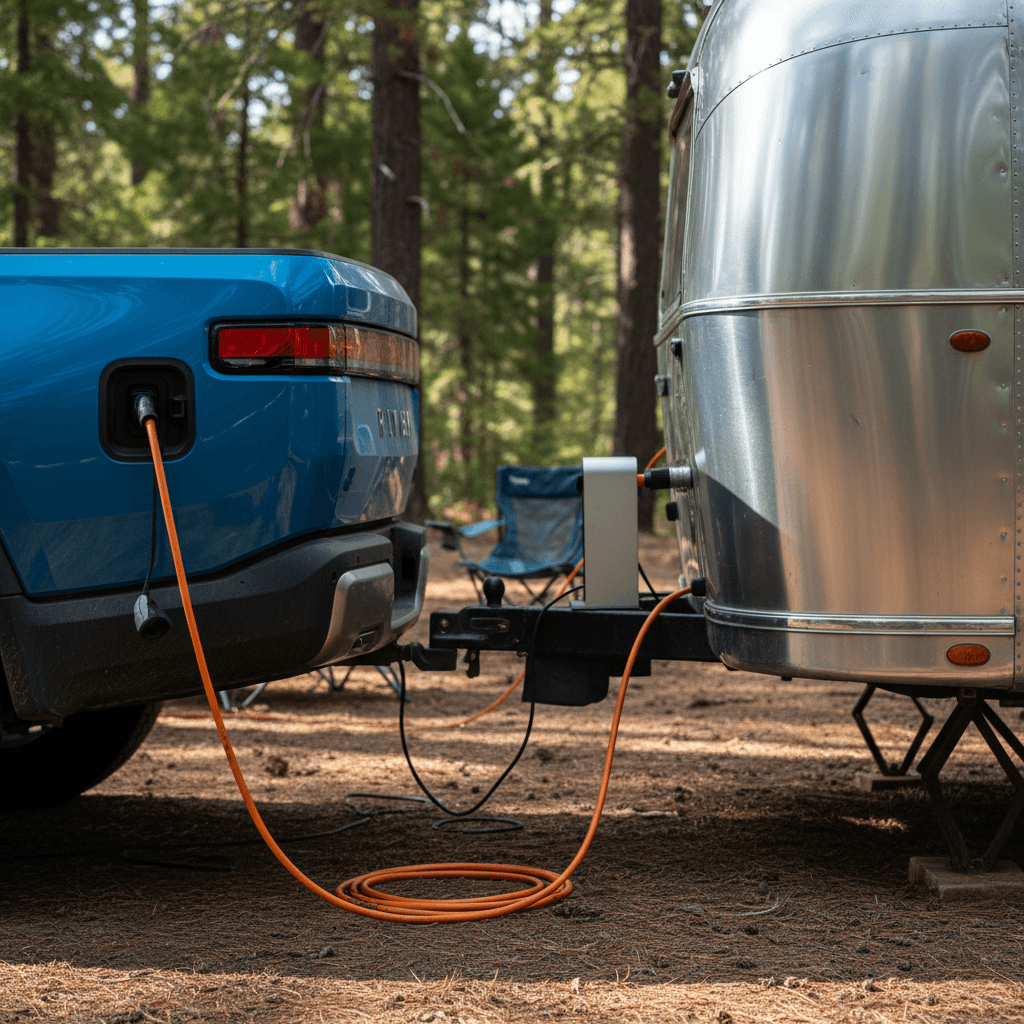
Real-world R1T towing scenarios
Specs are comforting, but what you feel in your spine is real‑world behavior: grades, headwinds, kids asking if you’re there yet. Here’s how the R1T behaves in common use cases, assuming sensible driving at 60–70 mph and moderate conditions.
Sample Rivian R1T towing scenarios
Illustrative scenarios to help you benchmark trip planning. Actual results will vary with speed, terrain, temperature, and how much you like passing people uphill.
| Scenario | Approx. trailer weight | Highway speed | Typical range impact | Practical planning range |
|---|---|---|---|---|
| Two dirt bikes on open trailer | 2,000 lb | 65 mph | 20–25% loss | 190–230 mi (Max pack), 160–190 mi (Large) |
| Single‑axle cargo trailer full of gear | 3,500 lb | 65 mph | 30–40% loss | 150–190 mi (Max), 120–160 mi (Large) |
| Mid‑size, fairly aero travel trailer | 5,000–6,000 lb | 65 mph | 40–50% loss | 120–160 mi (Max), 100–130 mi (Large) |
| Tall, boxy RV near max tow rating | 9,000–11,000 lb | 60–65 mph | ~50% loss or more | 90–130 mi (Max), 80–110 mi (Large) |
Assumes a dual‑ or tri‑motor R1T with Large or Max pack in good health.
Steep grades + headwinds = quick battery
How to plan charging stops when towing
The R1T’s raw capability matters less than your charging rhythm. A good plan turns towing in an EV from a nail‑biter into a series of coffee breaks with a trailer attached.
Step-by-step: Planning a tow trip in a Rivian R1T
1. Start with your unloaded highway range
Use what you actually see at 65–70 mph when the truck is empty, not the EPA number. That’s your baseline before the trailer penalty.
2. Estimate your towing range hit
For a medium travel trailer, assume <strong>40–50% range loss</strong>. For lighter, more aero loads, start with <strong>25–35%</strong>. If you’re new to the combo, be conservative on your first leg.
3. Build legs around DC fast chargers
Use the Rivian navigation, PlugShare, or similar apps to chain together <strong>reliable 150–350 kW stations</strong> roughly every 90–140 miles along your route. Prefer sites with room to pull in while towing or easy back‑in options.
4. Aim for 10–80% charge windows
The R1T charges fastest between about 10% and 60–70%, then slows as it approaches full. Towing days usually go smoother with more, shorter stops in that sweet spot than one giant 0–100% pull.
5. Pre‑condition the battery before fast charging
Use navigation to a DC fast charger so the truck can warm or cool the pack ahead of arrival. A pre‑conditioned pack means <strong>higher initial charge speeds</strong>, which really matter when you’re stopping more often with a trailer.
6. Know your unplug‑and‑go threshold
On tow days, it often makes sense to unplug once you have <strong>just 10–15% more than the next leg requires</strong>, plus margin. Chasing the last few percent is slow and rarely worth it.
Good news for used buyers
Setting up your R1T for safe, efficient towing
The R1T’s software does a lot of the heavy lifting: trailer profiles, trailer brake gain, hitch assist, ride‑height changes. But a few setup decisions make the difference between feeling like a beta tester and feeling like a pro.
Dial in your R1T before you hit the road
Think of this as putting the truck in ‘tow mindset’ right alongside you.
Hitch, tongue weight & payload
- Use a properly rated Class V hitch and the correct drop so the trailer sits level.
- Target 10–15% tongue weight of trailer weight; too light causes sway, too heavy overloads the rear axle.
- Remember: payload includes passengers, bed gear, and tongue weight. The R1T’s ~1,760‑lb payload can disappear fast.
Trailer profile & brakes
- Create a trailer profile in the R1T so the truck knows when you’re towing.
- Adjust the integrated trailer brake gain in an empty parking lot until stops feel natural, not grabby.
- Confirm your lights and breakaway switch work before every long leg.
Ride height & drive modes
- Use Tow/Haul mode for a heavier steering feel and more stable damping.
- Raise ride height only when you need clearance, higher stance means more aero drag and slightly less range.
- Regeneration is great, but don’t rely on it as a substitute for proper trailer brakes.
Speed and aero discipline
- Every 5 mph over 65 can take a shocking bite out of range when towing.
- Roof boxes, bed racks, and rooftop tents stack aero losses. If range matters, keep the truck as clean as possible.
- When shopping trailers, prioritize rounded noses and lower profiles.
Don’t exceed any rating, ever
Shopping used: what to look for on a towing R1T
If you’re considering a used Rivian R1T as a tow vehicle, you’re buying both capability and history. How the previous owner towed, what, how often, and how they charged, matters more than odometer alone.
- Confirm the exact tow rating. Use the VIN and build sheet to see whether the truck is an 11,000‑lb or 7,700‑lb configuration.
- Inspect the hitch and rear structure. Surface rust on a receiver is normal; bent hardware, elongated pin holes, or cracked welds are not.
- Ask about towing use. Occasional boat trips are different from full‑time RV duty across the Rockies.
- Review charging habits. Long‑term battery health is typically better on trucks that didn’t live at 100% or 0% SOC, especially while baking in the sun with a trailer attached.
- Check tire history. Frequent heavy towing on P‑metric tires vs. LT‑rated rubber tells you how seriously the previous owner took load ratings.
How Recharged helps de‑risk a used R1T
FAQ: Rivian R1T towing capacity and range
Common questions about Rivian R1T towing
Bottom line: is the Rivian R1T a good tow vehicle?
The Rivian R1T is one of the few EVs that treats towing not as a party trick but as a core talent. With up to 11,000 lb of capacity, stout payload, and a chassis that shrugs off grades which make gas trucks sweat, it absolutely can do real truck work. The trade is that when you hang a big wall of trailer in the wind, your effective range shrinks, often to half of what you see solo. If you’re willing to plan legs around 100–160 miles, embrace a few more coffee stops, and respect the truck’s ratings, the R1T can be a brilliant companion for boats, campers, and toys.
If you’re shopping for a used R1T as your tow rig, matching the right configuration to the right use case is everything, battery pack, tow rating, and battery health all matter. That’s where tools like the Recharged Score Report, EV‑savvy financing, and expert guidance come in. They turn a pile of specs and anecdotes into a clear answer: this specific truck, on this specific route, with this specific trailer, will it work for you?