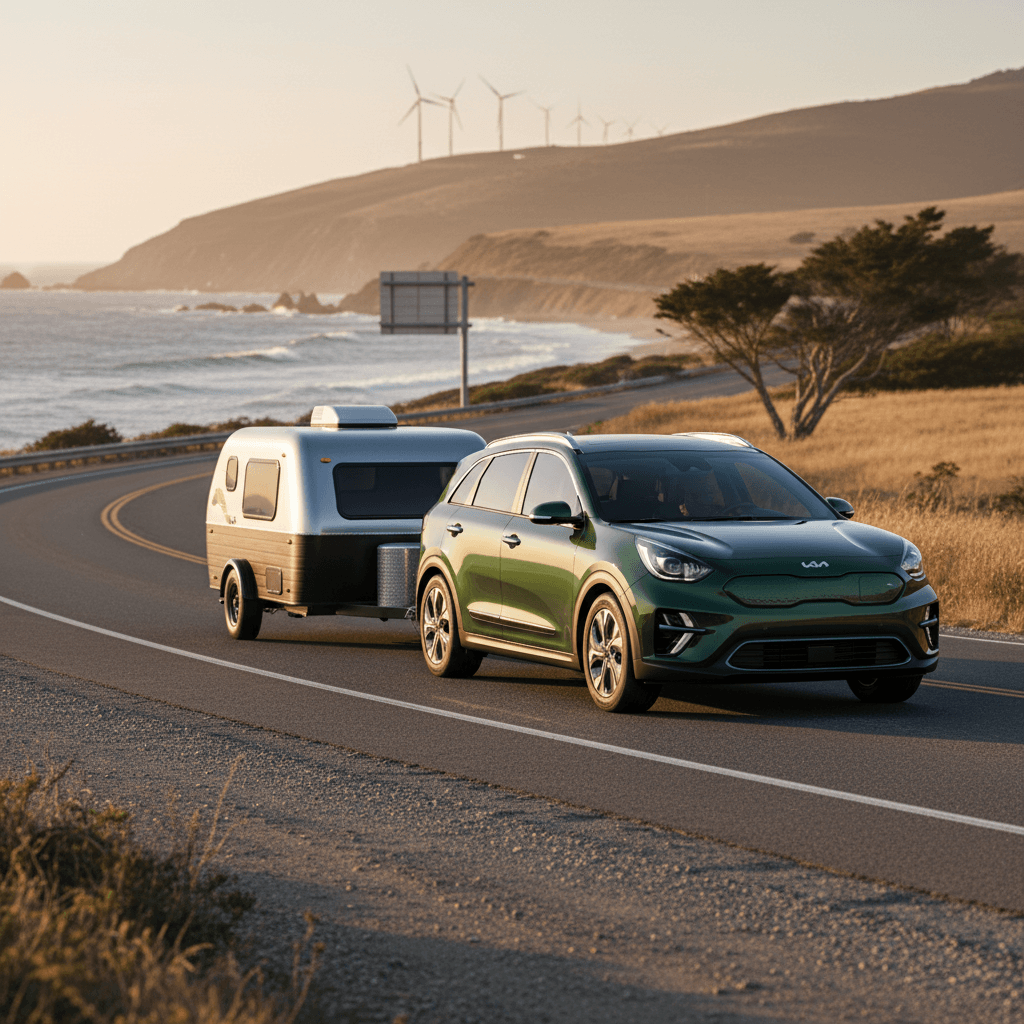
If you own, or are shopping for, a Kia Niro EV, you might be wondering how much it can tow and how badly a trailer will chew through your range. The good news: light‑duty towing is absolutely possible. The fine print: you need to respect the Kia Niro EV towing capacity and understand how much range loss to expect so you’re not stranded on the side of the highway with a camping trailer in tow.
Quick answer
Can the Kia Niro EV actually tow?
This is where things get confusing, because the answer depends on model year and which country the car was originally sold in. Early U.S. versions of the Niro EV were sold with no official tow rating, while European versions of the same vehicle received a factory rating for light trailers. Later generations have become more tow‑friendly, especially in markets where small trailers and caravans are common.
Factory-rated Niro EVs
- Later model years (especially in Europe) have a published tow rating for light trailers.
- Typically rated around 750–1,300 kg braked in those markets, which translates to roughly 1,650–2,900 lb, though U.S. ratings are usually more conservative.
- May offer accessory hitches and wiring kits through Kia dealers.
U.S. models with no official rating
- Many early U.S. Niro EVs list “towing not recommended” in the manual.
- Owners still add aftermarket hitches for light utility trailers and bike racks.
- If your manual says “no towing,” any towing you do is technically at your own risk.
Check your specific car first
Official towing capacity by model year
Because tow ratings and marketing priorities have changed, think of the numbers below as a guiding framework. Always defer to the sticker in your door jamb and your owner’s manual for exact limits.
Kia Niro EV towing capacity overview
Typical published or practical towing guidance by generation and market, with conservative guidance for U.S. owners.
| Model / Market | Factory tow rating | Realistic safe use | Notes |
|---|---|---|---|
| 2019–2022 Niro EV (U.S.) | Often “towing not recommended” | Up to 1,000–1,500 lb light utility trailer if owner chooses, at their own risk | Many owners add hitches for small cargo or one‑axle trailers. |
| 2019–2022 Niro EV (EU/UK) | Around 300–750 kg unbraked / up to ~1,300 kg braked (varies by spec) | Light camping or utility trailers within published limits | European documents offer more detailed ratings. |
| 2023+ Niro EV (2nd gen, selected markets) | Generally similar light‑duty rating; some trims explicitly list towing | Small caravans, pop‑up campers, or cargo trailers with good aero | Check your trim; some U.S. manuals still discourage towing. |
If your exact model lists different numbers, follow Kia’s documentation, never exceed the lowest limit published for your vehicle.
Don’t confuse payload with towing
How much range do you lose towing with a Kia Niro EV?
Towing hits every EV where it hurts: aerodynamics and rolling resistance. The Niro EV’s sleek shape and efficient front‑wheel‑drive powertrain are tuned for solo efficiency, not for pushing a box through the air. Add a trailer and you’ve suddenly turned your tidy crossover into a moving wall.
Typical Kia Niro EV range loss while towing
For many Niro EV owners, a realistic planning rule is: expect to use about half your rated range while towing. So if your Niro EV usually returns 230 miles on the highway in good weather, budgeting 110–140 miles between charging stops with a moderate trailer is a safe, stress‑reducing way to travel.
Use your trip computer as your guide
Real‑world range examples with common trailers
Every setup is different, but these scenarios will give you a feel for how the Kia Niro EV towing capacity and range loss play out in the real world. We’ll assume a Niro EV that normally gets around 230 miles of usable highway range when driven solo in mild weather.
Sample towing setups and expected range
These are ballpark numbers, ideal for planning, not for pushing your luck.
Light utility trailer (~800–1,200 lb)
Use case: Dump‑run loads, moving household items, one motorcycle or ATV.
- Range hit: ~25–35%
- Realistic range: 150–175 mi
- Biggest factor: speed. Stay near 60 mph for sane efficiency.
Teardrop or narrow camper (~1,500–2,000 lb)
Use case: Weekend camping with a compact, relatively low‑profile trailer.
- Range hit: ~35–45%
- Realistic range: 125–150 mi
- Biggest factor: height and frontal area vs. the car.
Boxy cargo or small RV (~2,000+ lb)
Use case: Tall box trailer or small square‑sided camper, near the top of your rating.
- Range hit: 45–60%+
- Realistic range: 90–130 mi
- Biggest factor: wind and hills, these can tank efficiency fast.
When your numbers look scary
6 factors that change towing range loss
- Speed: Aerodynamic drag rises with the square of speed. Jumping from 60 to 75 mph can be the difference between a comfortable 140‑mile towing leg and white‑knuckling it to a charger 100 miles away.
- Trailer shape and height: A low, narrow trailer tucked in the Niro’s slipstream hurts far less than a big, square utility box or RV that’s taller than your roofline.
- Weight: Mass matters most when you’re climbing or constantly stopping and starting. Flat highway cruising is more about aero than pounds, but every extra 100 lb still costs energy.
- Weather: Headwinds, crosswinds, rain, and cold temperatures all add drag or increase HVAC use. A winter headwind can feel like you doubled your trailer size.
- Terrain: Long climbs burn energy quickly, but you’ll recover some on the way down with regen. Don’t count on full payback, gravity never quite gives back what it took.
- Driving style: Smooth inputs, gentle acceleration, and letting your regen work instead of stabbing the brakes can claw back a surprising amount of efficiency. Towing is the perfect time to become a range nerd.
Use Eco mode when towing
Setting up your Kia Niro EV for towing
If your manual allows towing, or you accept the risks and choose to tow light anyway, the setup matters as much as the trailer weight. A sloppy install or under‑specced hitch can undo all that careful planning.
Pre‑towing setup checklist for Niro EV owners
1. Confirm tow rating and limits
Read the <strong>towing section</strong> of your owner’s manual and any supplemental guides. Note maximum trailer weight, tongue weight, and roof‑rack limits if you’re carrying gear up top.
2. Choose a quality hitch
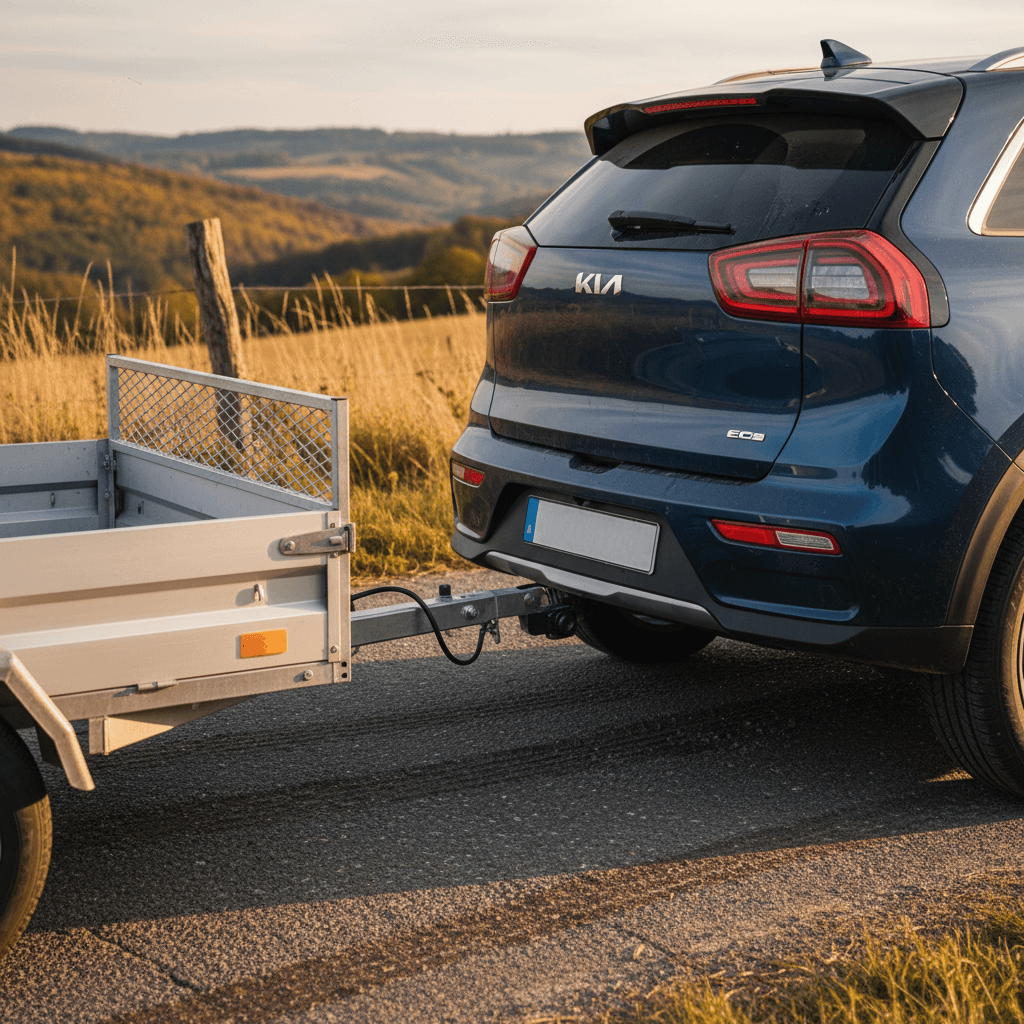
Use a hitch that’s <strong>rated at or above</strong> your Kia’s published limits and designed specifically for the Niro EV’s mounting points. Avoid universal hitches that require questionable modifications.
3. Install proper wiring
Have a <strong>7‑pin or 4‑pin wiring harness</strong> installed by a professional so your trailer lights work correctly. If your trailer has brakes, make sure you have the proper brake controller solution.
4. Mind tongue weight and loading
Aim for a tongue weight around <strong>10–15% of the trailer’s total weight</strong>, and load heavy items low and between the axles. Too much weight at the back of the trailer can cause dangerous sway.
5. Check tire pressures (car and trailer)
Set your Niro EV’s tires to the <strong>higher load setting</strong> if your door sticker lists one, and inflate trailer tires to their sidewall spec. Under‑inflated tires waste energy and run hot.
6. Test locally before a big trip
Do a shakedown run close to home: check for <strong>sway, brake feel, connector issues, and abnormal noises</strong>. Watch your energy use so you’re not estimating range for the first time on a 500‑mile holiday weekend drive.
Planning trips and charging while towing
You can absolutely road‑trip a Kia Niro EV with a trailer, but you’ll need more charging stops and a bit more flexibility than you’re used to. The biggest difference from towing with a gas SUV is that your refueling options are fewer and farther between, so you need a plan.
1. Re‑calculate your real range
Once you’ve done a local test with your trailer, take that energy use, say, 45 kWh/100 mi instead of 28, and use it to estimate how far you can comfortably go between DC fast‑charging stops. Build in a 20–30% state of charge buffer so you’re not sweating every mile.
As a rough rule, if your solo range is 230 miles, plan towing legs around 100–140 miles depending on your trailer and conditions.
2. Map chargers that are trailer‑friendly
Look for pull‑through DC fast‑charging sites or chargers located on the edge of lots where you can park without unhooking. Apps like PlugShare often include user photos and comments about trailer access.
In a pinch, you may need to drop the trailer briefly in an adjacent space while you charge, but don’t count on that as your only plan on a busy holiday weekend.
Slow down to speed up
Protecting your battery when you tow
Towing adds load and heat, but if you stay within your limits, the Niro EV’s thermal management system is designed to cope. The trick is to avoid the habits that are rough on any EV battery and drivetrain, then add a little extra margin because of the trailer hanging off the back.
- Avoid running the pack from 100% to nearly empty every towing day; live in the 20–85% window when you can.
- Keep an eye on power‑limit warnings or temperature alerts on the dash; if you see them, back off your speed or stop to cool down.
- Don’t floor it just because EV torque makes it easy, gentle launches protect your battery, tires, and passengers’ snacks.
- After a hard towing day, give the car a break. Let it cool before DC fast charging again if you’ve been climbing or driving in high heat.
- Stick to the manufacturer’s service schedule, and keep an ear out for unusual drivetrain noises under load.
How Recharged looks at used EVs that have towed
Ready to find your next EV?
Browse VehiclesWhen a Kia Niro EV is, and isn’t, a good tow vehicle
The Niro EV is a compact, efficient crossover first and a tow vehicle very much second. If you picture it as a scaled‑down electric minivan or pickup, you’ll be disappointed. If you treat it as a commuter that can handle occasional light towing duty, it starts to look like a smart multitasker.
Where the Niro EV shines, and where it doesn’t
Match your expectations to the car’s strengths.
Great towing use cases
- Small utility trailers for yard work, bikes, or home projects.
- Compact, well‑designed teardrop or micro campers for weekend trips.
- Occasional longer trips where you’re OK with extra charging stops.
- Drivers who value quiet, efficient daily driving more than maximum tow muscle.
Poor towing use cases
- Routine towing near the upper limit of the vehicle’s rating.
- Large, tall RVs or toy haulers with huge frontal area.
- Truck‑like, cross‑country towing where fast turnarounds are critical.
- Regular heavy towing in extreme heat or mountainous terrain.
Frequently asked questions: Kia Niro EV towing
Kia Niro EV towing FAQs
Bottom line on Kia Niro EV towing capacity and range loss
The Kia Niro EV was never meant to replace a full‑size pickup, but within its lane it’s a surprisingly capable little tow rig. If you treat the published towing capacity as a hard ceiling, pick a well‑designed, lightweight trailer, and budget for a 30–50% range hit, you can haul gear, toys, or a compact camper with confidence. The key is to be honest about what you’re asking of the car, and to plan your routes and charging like a pro.
If you’re considering a used Kia Niro EV specifically because you want an efficient daily driver that can still handle the occasional weekend trailer, that’s exactly the kind of nuance Recharged is built for. Every vehicle on our marketplace includes a Recharged Score battery health report, transparent pricing, and EV‑savvy guidance so you can find the right Niro EV, and use it the way you actually live, trailer and all.