If you’re looking at a three-row electric SUV, the Kia EV9 is probably on your shortlist. But before you sign a contract, it’s worth asking what Kia EV9 long term ownership cost actually looks like, beyond the window sticker. Between charging, insurance, maintenance, and depreciation, the math can swing thousands of dollars in either direction.
Important context
Why Kia EV9 ownership costs matter
The EV9 is a big, tech-heavy family SUV with a price tag to match. That makes total cost of ownership just as important as monthly payment. Many shoppers are comparing it against gas models like the Kia Telluride, Hyundai Palisade, Toyota Grand Highlander, and mainstream luxury SUVs. On paper, the EV9 can cost more up front, but fuel and maintenance savings can be substantial over 5–10 years, especially if you buy a used EV9 at a discount.
Kia EV9 ownership snapshot (5-year estimate)
Kia EV9 price, trims, and incentives
The Kia EV9 launched as a 2024 model in the U.S. with multiple trims and rear- and all-wheel-drive options. Depending on configuration, a new EV9 generally transacts from the high-$60,000s into the $80,000s before incentives. Higher trims with dual motors, more range, and luxury features can push close to $90,000 with options.
Typical Kia EV9 pricing by configuration (new)
Approximate real-world transaction ranges before incentives and taxes.
| Configuration | Drivetrain | Approx. Price New | Key Highlights |
|---|---|---|---|
| Light / Light Long Range | RWD | High $60k–Low $70k | Lower price, solid range, 3-row practicality. |
| Wind / Land | RWD or AWD | Mid–High $70k | More features, larger battery, popular sweet spot. |
| GT-Line | AWD | Low–Mid $80k+ | Performance, highest equipment, most expensive to buy new. |
Always confirm current pricing and incentives with your dealer or online marketplace.
Don’t forget incentives
If you’re open to a used Kia EV9, early off-lease and low-mileage examples will start to appear more often as we move through 2026 and beyond. That’s where a retailer like Recharged can help you compare used EV9s with verified battery health, transparent pricing, and expert guidance on long-term costs.
5-year Kia EV9 long-term ownership cost estimate
Let’s pull the big pieces together for a ballpark 5-year cost-of-ownership picture. To keep it simple, we’ll assume 12,000 miles per year, a mix of home and public charging, and a buyer who finances part of the purchase. Numbers below are directional, not a universal rule.
Major 5-year cost categories
- Depreciation: The big one. Large EV SUVs can lose tens of thousands in the first 5 years.
- Charging (electricity): What you pay your utility plus any public fast-charging fees.
- Insurance: Often higher than a gas SUV because of price and repair complexity.
- Maintenance & repairs: Typically lower than gas, but tires and potential out-of-warranty issues matter.
- Taxes & fees: Sales tax, registration, and any EV-specific road-use fees in your state.
Directional 5-year totals (new EV9)
Think of these as ranges, not promises:
- Depreciation: $25,000–$40,000
- Charging: $4,000–$6,500 (home heavy) or $6,000–$9,000 (fast-charge heavy)
- Insurance: $7,500–$11,000
- Maintenance & tires: $3,000–$5,000
- Taxes & fees: Highly state-dependent, often several thousand dollars up front.
Buying a used EV9 can dramatically shrink the depreciation piece of this pie.
Charging costs: home, fast charging, and road trips
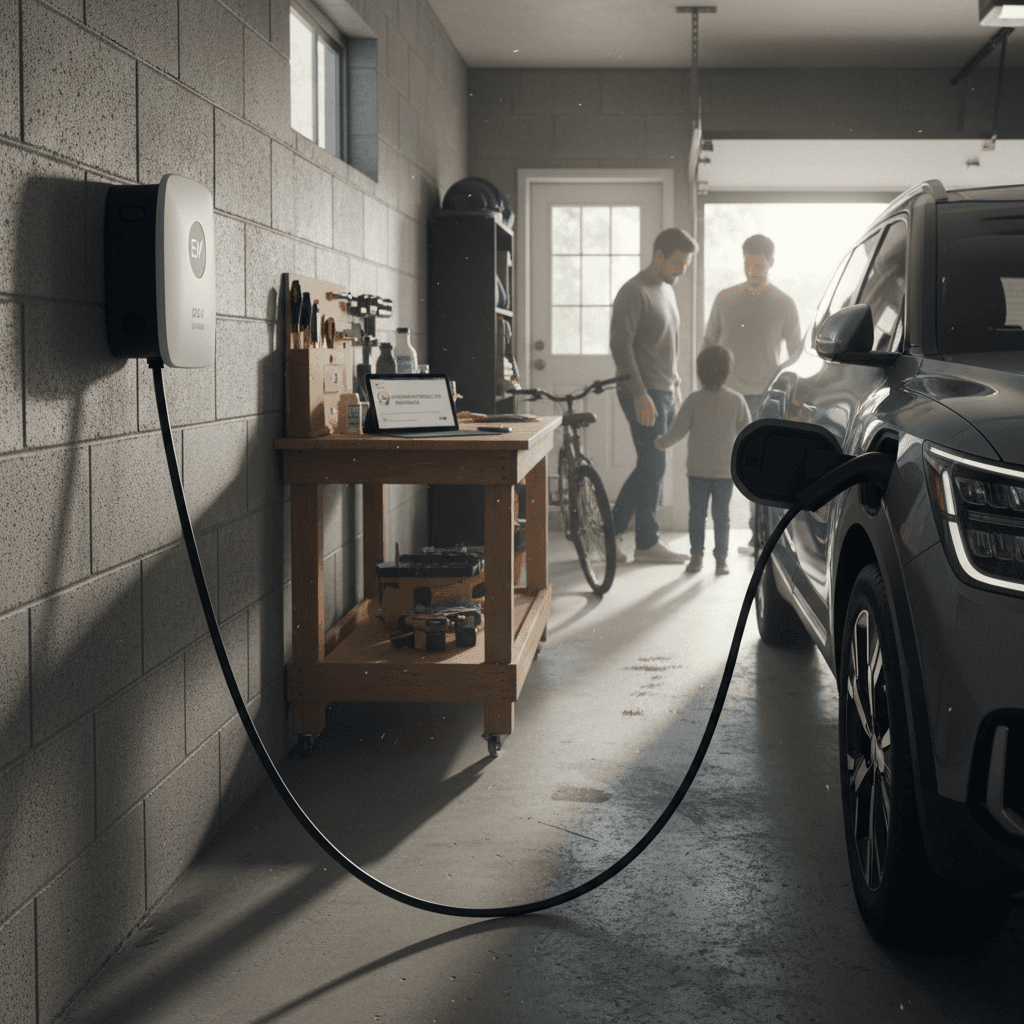
Most Kia EV9 owners try to do the bulk of their charging at home, using public fast charging on road trips or when they’re away from their garage. Your electricity rate and mix of home vs. DC fast charging are the two big levers that drive long-term charging costs.
What shapes your EV9 charging bill?
Home rates, driving habits, and how often you fast-charge all matter.
Home electricity rate
At $0.13–$0.18/kWh, an EV9 is typically far cheaper per mile than a comparable gas SUV.
Fast-charging habits
Frequent DC fast charging can double your per-mile energy cost versus mostly home charging.
Miles and driving style
High annual mileage and aggressive driving will increase your electricity use over time.
Beware all-fast-charging lifestyles
In typical U.S. conditions, many EV9 owners land around $600–$1,200 per year in electricity for 12,000–15,000 miles if most charging happens at home. That can easily undercut a similar gas SUV by $800–$1,500 a year at current fuel prices.
Maintenance and repairs: where EV9 owners save
The EV9 shares a key EV advantage: far fewer moving parts than a gas SUV. There’s no engine oil, spark plugs, or complicated exhaust system, and the big traction battery is covered by a long warranty. Over 5 years, that usually translates into meaningfully lower maintenance and repair bills.
Typical Kia EV9 maintenance over 5 years
1. Tire replacements
A heavy three-row EV on big wheels will eat through tires faster than a compact car. Budget for at least one full set, possibly two, especially if you drive aggressively or in harsh climates.
2. Brake service
Because of regenerative braking, pads and rotors often last longer than on gas SUVs. Still, you may need inspections and occasional service, especially in rust-prone regions.
3. Cabin filters & fluids
You’ll still replace cabin air filters and may have occasional fluid services (like brake fluid) according to Kia’s maintenance schedule.
4. Alignment & suspension checks
Heavy EVs are sensitive to alignment. Regular checks help extend tire life and keep handling sharp.
5. Software updates
Many software updates are handled over the air or during routine service visits, often at no or low cost.
Where the EV9 tends to win
Insurance and taxes: what to budget for an EV9
Insurance for the Kia EV9 tends to run higher than for an equivalent gas SUV simply because you’re insuring a more expensive, tech-heavy vehicle. Battery-electric SUVs also often have higher repair costs if there’s significant body, battery, or electronics damage.
Insurance factors
- Vehicle value: A loaded EV9 costs more to replace than a mid-trim gas SUV.
- Repair network: EV-certified shops and parts availability can affect premiums.
- Driver profile: Your age, record, and location still dominate the quote.
Many EV9 owners will see premiums in line with other $70k–$80k SUVs; plan around that level.
Taxes & state EV fees
- Sales tax: On a $75,000 EV9, the dollar amount is significant in high-tax states.
- Registration: Some states add EV-specific road-use fees instead of fuel taxes.
- Personal property tax: In states that charge it, a higher initial vehicle value hits harder early on.
If you buy used, lower vehicle value can soften both tax and insurance impacts.
Depreciation, resale value, and buying used
Depreciation is the single largest line item in most EV9 ownership stories. Large, expensive EVs can lose a lot of value in the first few years, whether they burn gasoline or electrons. The difference is that the EV9’s long battery warranty and growing demand for three-row EVs can help support resale if the vehicle is well cared for.
Why depreciation matters most
That’s exactly why shoppers are eyeing the used Kia EV9 market. The first owner absorbs the steepest part of the curve, while the second owner still enjoys a modern cabin, strong range, and plenty of remaining battery warranty. With Recharged, every used EV9 comes with a Recharged Score battery health report, pricing benchmarked against market data, and EV specialists who can walk you through long-term cost scenarios for each VIN.
Battery health and warranty impacts on costs
Battery health is the backbone of EV9 ownership costs. Kia backs the EV9’s high-voltage battery with a long warranty (commonly 8 years or 100,000 miles on many Kia EVs; always confirm specifics for your model year). That coverage shields you from the most expensive potential failure for much of the typical ownership window.
How battery health affects long-term EV9 costs
Capacity, charging habits, and climate all play a role.
Range and usability
A healthy pack maintains usable range for commutes and road trips, avoiding the need to swap vehicles or charge more often.
Charging behavior
Heavy DC fast charging and frequent 0–100% cycles can accelerate degradation over many years.
Climate impacts
Extreme heat and cold can affect long-term capacity. Garage parking and preconditioning help mitigate that.
How Recharged reduces battery-risk surprises
Kia EV9 vs gas SUV: real-world cost comparison
On day one, the EV9 will usually cost more than a similar gas SUV. The question is whether lower fuel and maintenance can claw that back over 5–10 years. For many households driving average-to-high annual miles and doing most of their charging at home, the answer leans yes, especially if they buy a used EV9 instead of new.
Directional 5-year cost comparison: Kia EV9 vs. comparable gas SUV
Illustrative example for a family driving 12,000 miles per year with mostly home EV charging.
| Category (5 years) | Kia EV9 (new) | Comparable gas 3-row SUV |
|---|---|---|
| Fuel / energy | $4,000–$6,500 (home-heavy) | $9,000–$13,000 (gas) |
| Maintenance & repairs | $3,000–$5,000 | $5,000–$8,000 |
| Insurance | $7,500–$11,000 | $6,500–$10,000 |
| Depreciation | $25,000–$40,000 | $20,000–$35,000 |
| Total (excluding tax/fees) | $39,500–$62,500 | $40,500–$66,000 |
Exact numbers vary widely by state, fuel prices, trims, and how you buy and finance.
Key risk to watch: tech and policy shifts
How to lower your Kia EV9 long-term ownership costs
You can’t control everything, markets move, incentives change, but you do have real levers to pull on cost of ownership. Some you decide before buying, others you manage during day-to-day use.
Practical ways to cut EV9 ownership costs
1. Consider a used EV9 with verified battery health
Let the first owner take the biggest depreciation hit, then buy through a marketplace like Recharged that can show you a full battery and pricing report for each vehicle.
2. Maximize home charging on off-peak rates
Ask your utility about EV-specific or time-of-use plans. Shifting charging to cheaper hours can save hundreds of dollars over five years.
3. Right-size your trim and options
If you don’t need dual motors or the most expensive tech package, a mid-trim EV9 can deliver similar daily experience with lower up-front cost and smaller depreciation.
4. Protect your tires and alignment
Rotate tires regularly, keep them properly inflated, and get alignments checked after pothole hits or suspension work. Tire costs add up on a heavy EV.
5. Shop insurance broadly
Get quotes from multiple insurers and ask about EV-specific discounts, telematics, and bundling with home or other policies.
6. Plan charging for road trips
Use trip planners to avoid expensive or slow chargers and to minimize unnecessary detours that add miles and cost.
Where Recharged fits into the picture
Ready to find your next EV?
Browse VehiclesFAQ: Kia EV9 long-term ownership cost
Frequently asked questions about Kia EV9 ownership costs
Bottom line: Is a Kia EV9 worth it long term?
Over a 5–10-year span, the Kia EV9 long term ownership cost story is nuanced but promising. New buyers pay a premium up front and shoulder the heaviest depreciation, but they benefit from low day-to-day energy and maintenance costs. Used buyers can step into a still-modern EV9 after the steepest part of the curve, often ending up with total costs that compare favorably to gas SUVs, especially when they charge mostly at home and keep an eye on tire and insurance expenses.
If you’re serious about an EV9, the next step is to look at specific vehicles, not just averages. That means comparing trims, mileage, battery health, and pricing side by side. Recharged was built for exactly that: helping you shop used EVs with transparent data, a clear Recharged Score battery report on every car, flexible financing, and nationwide delivery so you can focus on what matters, driving home the right EV9 at the right long-term cost for your family.