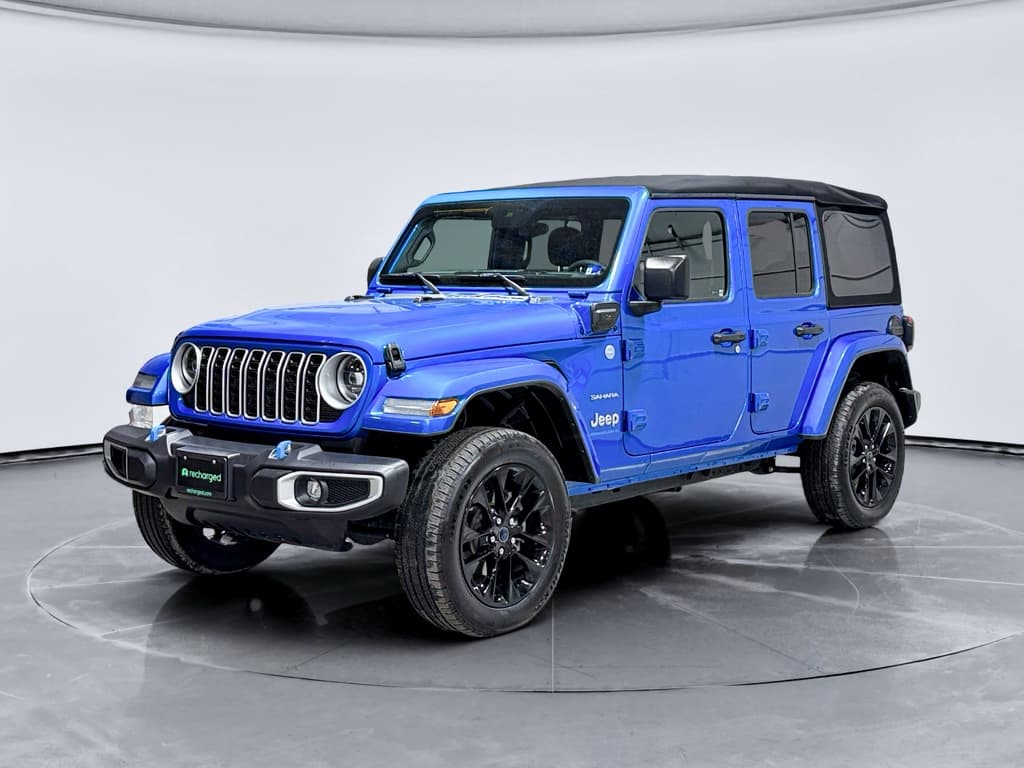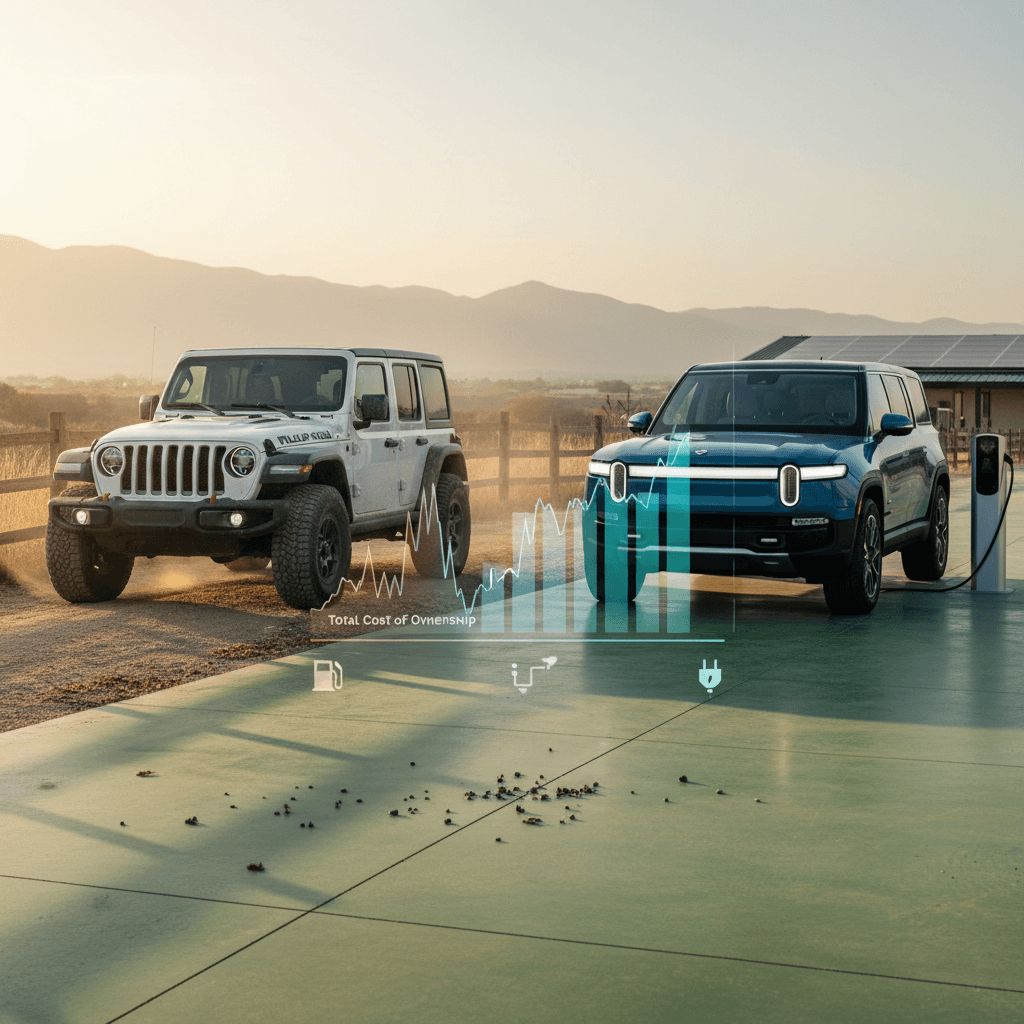
If you love off‑road adventure but are tired of gas station receipts, you’ve probably wondered how a Jeep Wrangler vs. Rivian R1S total cost of ownership comparison really plays out. One is an icon of open‑air, go‑anywhere driving; the other is a high‑tech, all‑electric SUV with serious off‑road credentials of its own. The surprising part is how close their 5‑year costs can be once you factor in fuel, depreciation, and tax credits.
Same mission, very different hardware
Why compare a Jeep Wrangler and Rivian R1S?
At first glance, a Wrangler and an R1S don’t look like natural rivals. The Jeep starts tens of thousands of dollars cheaper, and it’s smaller. But if you’re an outdoors‑oriented driver who wants real off‑road capability, tows occasionally, and needs to haul family or friends, these two end up on the same cross‑shop list more often than you might think.
- Both offer real off‑road hardware: low‑range gearing (Wrangler) or sophisticated off‑road drive modes and air suspension (R1S).
- Both appeal to buyers who care more about capability and adventure than about squeezing into a compact crossover.
- Both can be optioned into the $70,000–$90,000 range when you spec a high‑trim Wrangler 4xe or a well‑equipped R1S.
Where they start to diverge is in day‑to‑day running costs. The Wrangler’s lower sticker price is offset by thirsty fuel consumption and higher routine maintenance. The Rivian R1S asks more up front but pays you back in cheaper energy and fewer moving parts to service. Your real question is: over five years, which one leaves more money in your pocket?
How we built the Wrangler vs. R1S total cost of ownership numbers
To make this Jeep Wrangler vs. Rivian R1S total cost of ownership comparison useful, we’ll lean on published cost‑of‑ownership data, federal fuel‑economy guides, and realistic assumptions about how people actually drive these vehicles. Think of this as a framework you can tweak with your own numbers, gas prices, electricity rates, mileage, and loan terms.
Baseline 5‑year ownership assumptions
Key assumptions used throughout this Wrangler vs. R1S comparison. Adjust these to match your own situation.
| Category | Assumption |
|---|---|
| Timeframe & mileage | 5 years, 15,000 miles/year (75,000 miles total) |
| Gas price | $3.75 per gallon (national‑average style number) |
| Home electricity price | $0.16 per kWh (blended U.S. residential average) |
| Public fast charging | Used occasionally; effective cost blended into electricity estimate |
| Financing | 5‑year loan, 10% down, average credit |
| Location | U.S. national averages for taxes, insurance, and maintenance |
All figures are approximate and rounded for clarity.
These are estimates, not promises
Headline 5‑year cost estimates: Wrangler vs. R1S
Approximate 5‑year ownership cost snapshot (new, 2024/2025 models)
Multiple third‑party ownership calculators put a new 2024 Rivian R1S in the mid‑$80,000 range for 5‑year cost to own at 15,000 miles per year, with nearly $49,000 of that in depreciation alone. A comparably priced Wrangler 4‑door typically comes in somewhat lower in total cost, but not by as much as the window stickers might lead you to believe, largely because of fuel.

Fuel vs. electricity: Where the big swing happens
Energy is the most visible difference between these two. A Wrangler drinks gasoline (or a gas–electric mix in the case of the 4xe plug‑in hybrid). The R1S runs on electrons. Over 75,000 miles, that difference adds up.
Estimated 5‑year fuel vs. electricity costs (75,000 miles)
Simple, rounded energy‑cost comparison for a typical Wrangler and an R1S.
| Vehicle | Assumed efficiency | Energy price | 5‑year energy cost |
|---|---|---|---|
| Wrangler 4‑door gas (V6 / turbo‑4) | 18–20 mpg combined | $3.75/gal | $14,000–$16,000 |
| Wrangler 4xe PHEV | Real‑world mix ≈ 40–60% electric, ≈ 20 mpg on gas miles | Blend of gas + electricity | ≈$11,000–$13,000 |
| Rivian R1S (electric) | ≈75–85 MPGe (about 2.1–2.4 mi/kWh) | $0.16/kWh home, more on road | ≈$6,000–$8,000 |
Wrangler numbers assume mostly highway/combined driving; R1S assumes mostly home charging with some public fast charging.
How to personalize this math
When the Wrangler looks worse
- Long highway commutes at 70+ mph, where boxy aerodynamics hurt mpg.
- High gas prices in coastal or remote regions.
- Lots of stop‑and‑go traffic with idling and low speeds.
When the R1S advantage narrows
- Heavy reliance on expensive public fast chargers.
- Very low local electricity rates aren’t available.
- You drive few miles per year, so fuel isn’t a big cost driver either way.
Depreciation and resale value
Depreciation, the value your vehicle loses as it ages, is usually the single largest component of total cost of ownership. Here, the Wrangler has history on its side. Used Jeeps, especially Wranglers, have long enjoyed strong resale value. The Rivian R1S is newer to the market, and like most luxury EVs, it has seen steeper early‑life depreciation.
Very rough 5‑year depreciation picture
Illustrative 5‑year depreciation ranges based on market data and third‑party ownership tools.
| Vehicle & purchase scenario | Approx. 5‑year depreciation |
|---|---|
| New Wrangler 4‑door, mid/high trim | $30,000–$38,000 lost value |
| New Wrangler 4xe plug‑in hybrid | $32,000–$40,000 lost value |
| New Rivian R1S (new, 2024/2025) | ≈$45,000–$50,000 lost value |
| Used Rivian R1S bought at 2–3 years old | Often $20,000+ of depreciation already “baked in” |
These are broad ranges; exact values depend on spec, market conditions, and mileage.
Why a used R1S can be a smart play
Ready to find your next EV?
Browse VehiclesIf you’re comparing brand‑new MSRP‑for‑MSRP, the Wrangler typically wins on depreciation. Compare a new Wrangler against a 2‑ or 3‑year‑old R1S, and the story can flip, because much of the R1S’s depreciation is already behind you.
Insurance, taxes, and fees
Insurance can be the stealth cost in this equation. Wranglers are relatively simple to repair but have high theft and crash‑damage statistics in some markets. The Rivian R1S, on the other hand, is packed with expensive sensors, aluminum bodywork, and a sizable battery pack, all of which can push premiums higher.
Typical 5‑year insurance, taxes, and fees
Directionally useful ranges for a clean‑record driver with full coverage.
| Category | Jeep Wrangler 4‑door | Rivian R1S |
|---|---|---|
| Annual insurance | ≈$1,500–$2,000 | ≈$2,500–$3,500 |
| 5‑year insurance total | ≈$7,500–$10,000 | ≈$12,500–$17,500 |
| Initial taxes & fees on a new vehicle | Lower (lower MSRP) | Higher (higher MSRP) |
| Ongoing registration | Similar, often slightly higher for R1S in weight‑based states | Similar, sometimes higher due to weight/value |
Assumes mainstream U.S. state with average rates, not the lowest or highest in the country.
Don’t forget EV tax credits and incentives
Maintenance, repairs, and tires
On maintenance, the two vehicles trade punches. The Wrangler’s mechanical layout is familiar to any shop: internal‑combustion engine, traditional transmission, and solid axles. That means regular fluid services, belts, spark plugs, and so on. The R1S, as an EV, skips oil changes and a lot of traditional wear items, but its air suspension, heavy curb weight, and large wheels make tires and out‑of‑warranty repairs an important consideration.
Typical 5‑year maintenance and repair costs
What you’re likely to spend before major wear‑out items hit.
Jeep Wrangler
- Routine maintenance (oil, fluids, filters, etc.): often $700–$900 per year.
- 5‑year total: roughly $3,500–$4,500, not counting big off‑road damage.
- Repairs are generally straightforward and parts are widely available.
Rivian R1S
- Scheduled maintenance estimates under $2,000 for the first five years on recent models.
- EVs avoid many traditional services, but software updates and tire wear matter.
- Heavy curb weight + aggressive tires can mean pricey tire replacements.
Tires: The silent budget killer
Other factors: Range, utility, and driving experience
Jeep Wrangler strengths
- Iconic open‑air experience: Removable doors and roof, fold‑down windshield.
- Trail capability: Locking differentials, solid axles, and aftermarket support.
- Simple refueling: 5 minutes at any gas station, no planning around chargers.
Rivian R1S strengths
- Instant torque and sophisticated traction control off‑road.
- Three‑row interior with far more passenger and cargo space.
- Quiet, smooth commute with one‑pedal driving and no engine vibration.
You don’t buy either of these vehicles just because a spreadsheet says so. The Wrangler offers a back‑to‑basics, mechanical feel that no other modern SUV matches. The R1S offers a near‑luxury, high‑tech experience with serious off‑road credentials of its own. As we look at when each one “wins” on total cost, keep your personal priorities front and center.
When a Rivian R1S actually beats a Wrangler on total cost
Even though the Wrangler often comes out ahead on pure depreciation and sometimes on insurance, the R1S can absolutely win the total‑cost‑of‑ownership battle in the right circumstances. The key variables are how far you drive, how you charge, and whether you buy new or used.
Scenarios where an R1S can be cheaper to own than a Wrangler
1. You drive a lot every year
At 15,000–20,000 miles per year, the R1S’s lower per‑mile energy cost really compounds, especially if you can charge at home during off‑peak hours.
2. You can charge mostly at home or work
If 80–90% of your charging happens on reasonably priced Level 2 electricity, your “fuel” cost per mile will be dramatically lower than a Wrangler’s.
3. You buy a used R1S
Let the first owner absorb that steep initial depreciation, then buy a used R1S whose battery health has been independently verified, something Recharged’s <strong>Recharged Score</strong> can help with.
4. You qualify for strong EV incentives
If you can stack federal and state EV incentives or sales‑tax breaks, your effective R1S purchase price drops, narrowing or erasing its MSRP disadvantage vs. a loaded Wrangler.
5. You plan to keep it a long time
Over 8–10 years, low maintenance and fuel costs can outweigh higher initial depreciation, especially as more shops become comfortable servicing Rivian vehicles.
Used EVs are where spreadsheets get interesting
Tips for lowering your Jeep or Rivian ownership costs
Practical ways to shrink your 5‑year bill
Whether you end up in a Wrangler or an R1S, a few smart moves can save thousands.
Right‑size your spec
Optimize home energy
Shop financing & insurance
- Plan tire purchases instead of waiting for a blowout bill, pricing them out early gives you room to shop deals.
- If you buy used, insist on documentation: battery‑health reports for an R1S and service records for a Wrangler.
- Consider total monthly outlay, not just payment. A slightly higher loan payment on an R1S can be offset by lower fuel and maintenance.
FAQ: Jeep Wrangler vs. Rivian R1S ownership costs
Frequently asked questions
Bottom line: Which is cheaper to live with?
If you’re buying new, driving average miles, and you value simplicity above all else, a Jeep Wrangler 4‑door is usually the safer bet financially. Its lower purchase price, familiar maintenance, and strong resale value help keep 5‑year ownership costs in check, even if you pay more every month at the pump.
If you’re willing to think longer‑term, or shop the used market, a Rivian R1S starts to look very compelling. Lower energy and maintenance costs, plus the ability to avoid early‑life depreciation by buying used, can pull its total cost of ownership in line with, or below, a comparable Wrangler. And you get a quiet, powerful, three‑row SUV with serious off‑road chops in the bargain.
Whichever way you’re leaning, the smartest move is to run the numbers with your own mileage, energy prices, and budget. On Recharged, you can browse used Rivian R1S listings, see a transparent Recharged Score with verified battery health, explore financing without impacting your credit, and even trade in your current vehicle. That way, your next adventure rig, electric or not, fits both your lifestyle and your long‑term budget.