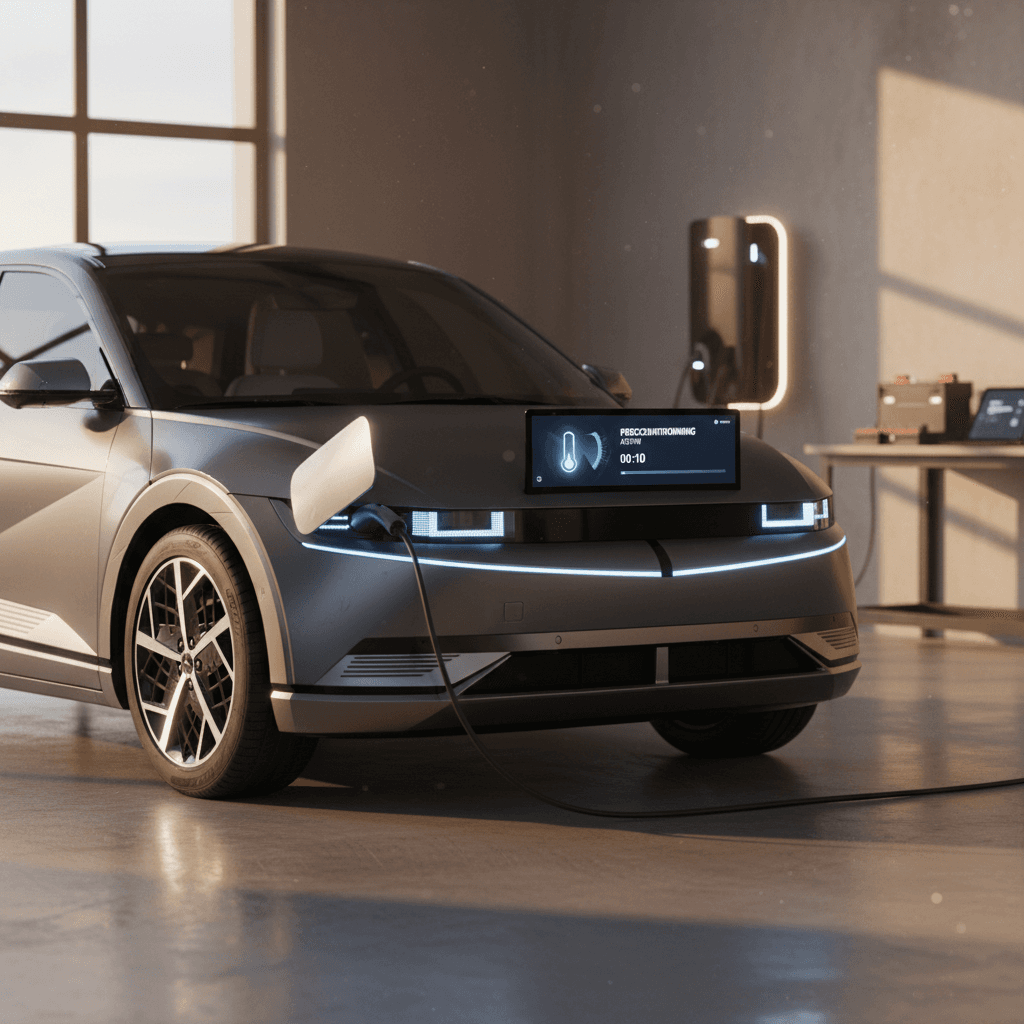
If you own, or are thinking about buying, a Hyundai Ioniq 5, understanding preconditioning is one of the easiest ways to unlock faster DC fast charging and better winter performance. The feature is powerful, but the way Hyundai implemented it can be confusing. This guide explains exactly how Ioniq 5 preconditioning works, how to turn it on, and how to know if it’s actually doing anything.
Big picture
What is Ioniq 5 preconditioning?
In the Ioniq 5, battery preconditioning is a software-controlled mode that uses electric heaters and the thermal management system to bring the battery pack to an optimal temperature before you plug into a DC fast charger. When the pack is warm enough, the car can hit the impressive ultra‑fast charging speeds that Hyundai advertises, often over 200 kW in good conditions, rather than crawling along at 30–50 kW on a cold pack.
Hyundai originally marketed this as a winter‑driving convenience feature, and later documentation simply calls it Battery Conditioning Mode. The principle is the same: when you tell the car you’re heading to a DC fast charger, it prepares the pack so you spend less time waiting at the station.
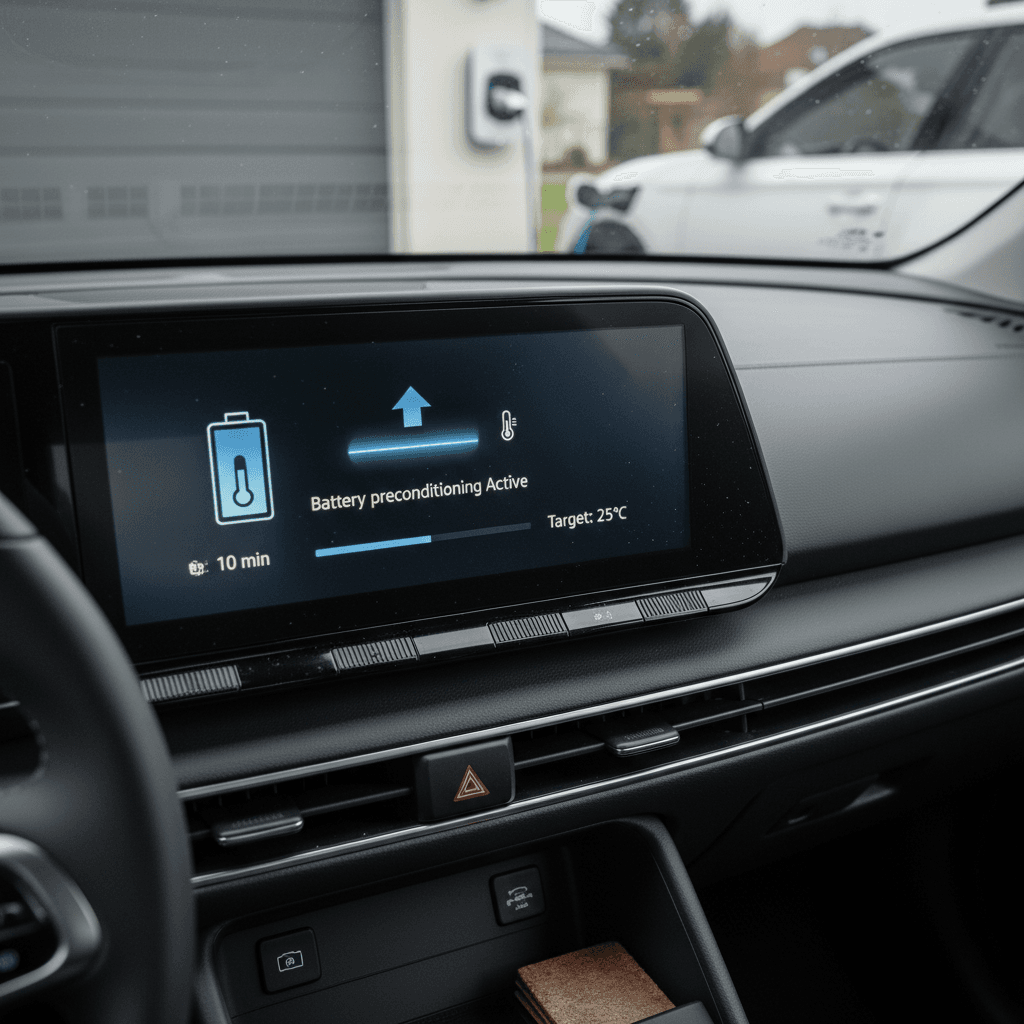
How Ioniq 5 battery conditioning works
What preconditioning actually does under the skin
Understanding the basics makes the quirks much less frustrating.
Targets ideal battery temperature
Uses heaters while you drive
Raises your charging curve
Importantly, the Ioniq 5’s preconditioning logic is conservative. The car will only run the heaters when several conditions are met: the feature is enabled in settings, state of charge (SoC) is above roughly 20%, pack temperature is low enough to justify heating, and you’re actively navigating to a recognized DC fast charger using the built‑in navigation.
Don’t expect it to help at home
Model years, winter mode, and software differences
Hyundai has quietly evolved how preconditioning is labeled and controlled on the Ioniq 5. That’s why owners talk about both Winter Mode and Battery Conditioning, they’re closely related, but not identical.
Ioniq 5 preconditioning by model year (North America)
Exact menus can vary slightly by market and software level, but this captures the main differences you’re likely to see.
| Model year | Label in menus | Key behavior | Notes |
|---|---|---|---|
| 2022 (early builds) | Winter Mode only | Maintains pack temperature in cold, but no true nav‑linked preconditioning to DC chargers in many regions. | Some early cars lacked full conditioning logic; dealer software updates improved behavior over time. |
| 2023 | Winter Mode + Battery Conditioning | Battery Conditioning appears in EV settings on updated cars; when enabled, nav to DC station can trigger active preheating. | Winter Mode becomes more of an underlying cold‑weather protection behavior. |
| 2024 | Battery Conditioning (prominent) | Most US cars offer a clear Battery Conditioning toggle in EV settings, replacing or de‑emphasizing Winter Mode. | Some owners still see Winter Mode references in manuals or menus, but DC preconditioning is the main feature. |
| 2025 (incl. 5 N, NACS‑port cars) | Battery Conditioning / Preconditioning | Same basic logic, but with additional options on the 5 N and new screens on the updated UX. | N‑specific modes can precondition more aggressively for track use and repeated fast‑charging. |
Always check your owner’s manual and in‑car help for the latest on your specific build.
Why this matters if you’re shopping used
How to enable preconditioning in your Ioniq 5
The car will not precondition the battery unless you explicitly enable it in settings. The exact wording can vary slightly, but the path is similar on most 2023–2025 Ioniq 5s.
Turn on Battery Conditioning in the menus
1. Go to the EV screen
From the main infotainment screen, tap the <strong>EV</strong> icon to open the electric‑drive overview. On some trims you may need to swipe to find it.
2. Open EV settings
Tap the <strong>gear icon</strong> or Settings button on the EV screen. This takes you to vehicle‑specific EV options rather than general system settings.
3. Find Battery Conditioning / Winter Mode
Look for a toggle labeled <strong>Battery Conditioning</strong>, <strong>Battery Conditioning Mode</strong>, or <strong>Winter Mode</strong>. On updated cars, Winter Mode may be hidden or combined into the conditioning setting.
4. Enable the toggle
Turn the feature on. You may see a brief description that mentions <strong>optimizing fast charging in cold weather</strong>. If you never enable this, the car will only warm the pack slowly as needed for safety.
5. Confirm it stays on
Some owners have reported that changing charge limits or certain settings can unset the checkbox. It’s worth re‑checking this menu at the start of winter or after dealer software updates.
Quick check
Step-by-step: Using preconditioning for DC fast charging
Here’s how to reliably trigger Ioniq 5 preconditioning on a cold day before a DC fast‑charging stop. This assumes you’ve already turned on Battery Conditioning in the EV settings.
- Aim to arrive at the charger between 10–40% SoC. Below ~20% SoC, some cars won’t start preconditioning; above ~60%, you don’t gain much from higher charge power.
- Start driving and warm the cabin normally. After 5–10 minutes, open the built‑in navigation (not Apple CarPlay or Android Auto).
- In the navigation, go to POI Categories → EV Charging Stations. Choose a station that shows DC or DC+ (or similar) in the icon, not just AC.
- Select that DC fast charger and start guidance. On many cars, preconditioning only works if the charger is selected from this specific EV Charging list, not entered as a generic address.
- Keep driving for at least 20–30 minutes with guidance active. It can take a few minutes for the car to run self‑checks and start the coolant pump and heaters, don’t cancel and restart the route right away.
- Watch for signs that preconditioning has started: a coil or snowflake overlay on the battery icon, fan or pump sounds from the battery cooling system, and increased energy usage for battery care in the energy screen.
- When you’re within a short distance of the charger, the preconditioning icon will usually disappear. That’s normal, the pack should already be at or near target temperature when you plug in.
The “destination must be out of range” quirk
When to use preconditioning, and when to skip it
Use preconditioning when…
- Outside temps are below about 45°F (7°C) and you plan to DC fast charge.
- You’re on a road trip and want to minimize time spent at chargers.
- You’re relying on a high‑power station (150–350 kW) and want to see triple‑digit kW, not 30–50 kW.
- You know the charger is often busy and want to move on quickly once a stall opens.
Skip or ignore it when…
- You’re charging overnight at home on Level 1 or Level 2, warming the battery won’t make charging faster and just wastes energy.
- Weather is mild or warm and the pack is already at a comfortable temperature: the car may not activate conditioning anyway.
- You’re only adding a quick top‑up on a low‑power DC charger (50 kW). The gain from preheating is smaller.
- You’re above ~70–80% SoC; charge power will taper regardless of battery temperature.
Rule of thumb
Troubleshooting Ioniq 5 preconditioning issues
Many Ioniq 5 owners assume preconditioning is broken because they never see an icon or can’t tell what’s happening. In reality, the behavior is just finicky. Here are common failure modes and how to fix them.
If preconditioning won’t start, check these first
Work through them in order, most problems are simple setup or navigation issues.
Is Battery Conditioning actually enabled?
Did you choose the charger from EV POI?
Is your state of charge too low?
More subtle causes
If the basics look right but you still don’t see results.
Battery might already be warm
Drive needs to be long enough
Software updates or hardware limits
Preconditioning still won’t work?
Preconditioning, Tesla Superchargers, and NACS
From 2025 onward, the Ioniq 5 in North America enters a new phase: access to the Tesla Supercharger network via the North American Charging Standard (NACS). Some 2025 Ioniq 5s ship with a native NACS port; earlier cars use a Hyundai‑provided adapter. The good news is that preconditioning still matters at Superchargers for the same reason it does at CCS sites: battery temperature dictates how much power the pack will accept.
The wrinkle is that, unlike a Tesla, your Ioniq 5 can’t talk directly to the Supercharger network to start preconditioning based on a Supercharger you select in the Tesla app. Instead, you’re still relying on the Ioniq’s own navigation and logic.
- If your 2025 Ioniq 5 has a native NACS port, treat Superchargers like any other DC fast charger: enable Battery Conditioning and set the charger as a destination in the Hyundai navigation if it appears in the POI list.
- If you’re using a CCS car with a NACS adapter, preconditioning rules don’t change. The car only cares that you’re heading to a high‑power DC site and that the pack is cold, not which connector style is at the other end.
- Because the Ioniq 5 can’t yet start conditioning from the Tesla app, you may need to rely on longer drives and conservative expectations if the built‑in nav doesn’t know about your chosen Supercharger.
Planning mixed‑network road trips
Preconditioning tips for winter road trips
On a multi‑stop winter trip, preconditioning is about more than a single big charging session. You’re managing battery temperature, state of charge, and your own time at once.
Make the most of preconditioning in cold weather
Start the day plugged in
If possible, leave your Ioniq 5 plugged in overnight and use scheduled cabin pre‑heat. Warming the cabin while on shore power leaves more battery energy free for driving and conditioning.
Plan longer first legs
Your first hop from a cold soak will always be the slowest charger stop. Plan that stop at a <strong>reliable high‑power site</strong> after at least 60–90 minutes of driving so the pack has time to warm up.
Trigger conditioning early
Once you’re 20–40 minutes from your planned DC stop, set the charger as your destination from the EV Charging POI list so the car can start heating the pack.
Keep SOC in the sweet spot
Aim to arrive under about <strong>30–40% SoC</strong> and leave around 70–80% on each stop. This keeps you in the highest part of the charging curve and makes preconditioning pay off.
Re‑trigger if you’re stuck in line
If there’s a queue at the charger and your preconditioning shuts off as you arrive, you can sometimes pick another nearby DC station in the nav while you wait to keep the heaters running.
What to look for when buying a used Ioniq 5
If you’re considering a used Ioniq 5, understanding how that specific car handles preconditioning is part of evaluating its real‑world charging performance, especially if you live in a colder climate.
Questions to ask or test
- Model year and trim: 2023+ cars generally have more polished Battery Conditioning behavior; some early RWD trims may be more limited.
- Software history: Ask whether major software updates and recalls have been performed. Updated firmware often improves thermal management logic.
- Heat pump & cold‑weather package: These don’t directly control preconditioning, but they help overall winter efficiency and comfort.
- Fast‑charging behavior: If you can, do a supervised DC fast‑charge test from ~20–70% on a cold day and watch how quickly power ramps up.
How Recharged helps
When you buy an Ioniq 5 through Recharged, you get a Recharged Score Report that includes:
- Verified battery health diagnostics so you’re not guessing about degradation.
- A review of charging behavior and any relevant software campaigns.
- Fair market pricing, EV‑specialist guidance, and nationwide delivery.
If you’re trading in an older EV or moving from a gas car, our team can walk you through what winter charging and preconditioning will look like in day‑to‑day use.
Ioniq 5 preconditioning FAQ
Frequently asked questions about Ioniq 5 preconditioning
Key takeaways
The Hyundai Ioniq 5’s preconditioning system is one of the reasons this car can charge so impressively in the real world, but only if you understand its rules. Enable Battery Conditioning in the menus, use the built‑in navigation to select DC fast chargers (especially in cold weather), and give the car enough time and state of charge to warm the pack. Do that consistently and you’ll see far fewer 30 kW winter charging sessions and far more fast, efficient stops.
If you’re moving into an Ioniq 5 from another EV, or from gas, your expectations for winter charging and road trips will shape how happy you are with the car. That’s why Recharged pairs every used EV with transparent battery‑health data, fair pricing, and EV‑specialist support. Whether you’re buying, trading in, or just planning your first cold‑weather road trip, understanding preconditioning is one of the cleanest ways to make Ioniq 5 ownership feel effortless.