If you own or are shopping for a Hyundai Kona Electric, you might be wondering two things: “What can it safely tow?” and “How much range loss will I see with a trailer or bike rack?” The answers are a little nuanced, especially because official towing ratings differ by market and generation. This guide walks you through towing capacity, real‑world range impacts, and how to set up a Kona Electric so you don’t end up stranded or risking your warranty.
Short answer
Kona Electric towing overview
Before we dive into numbers, it helps to separate three different use cases that all get lumped under “towing”:
- Using a receiver hitch only for a bike rack or small cargo tray, with no trailer attached.
- Towing a very light, low-profile utility trailer (yard waste, small hardware-store trailer, etc.).
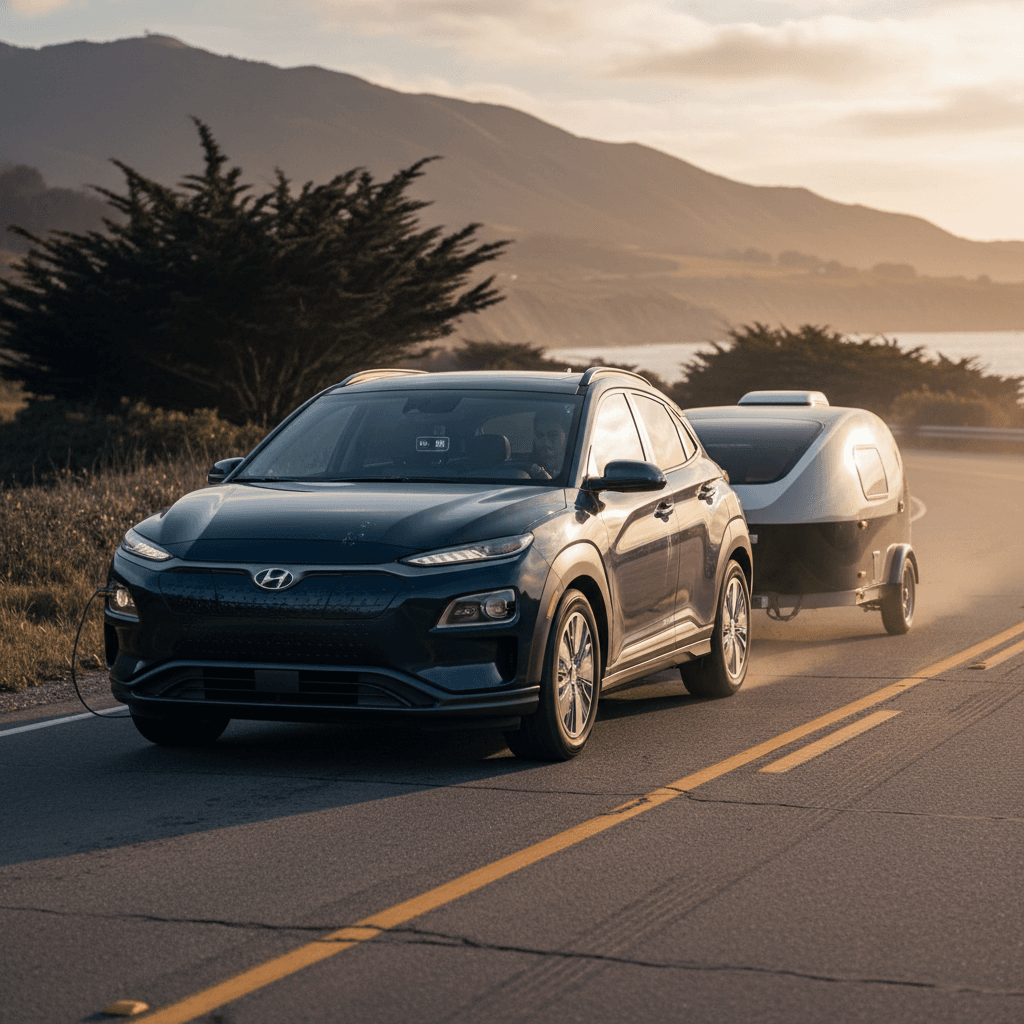
- Towing a larger boxy trailer such as a camping trailer or tall cargo box.
From the car’s point of view, the hitch‑only setup is relatively easy on the drivetrain and battery but can hurt aerodynamics. Light, low trailers add weight and a bit of drag. Tall or heavy trailers add a lot of aerodynamic drag, which is what really hammers your Kona Electric’s range, especially at highway speeds.
Check your exact model year
Official Hyundai Kona Electric towing capacity
Hyundai’s published towing guidance for the Kona Electric is a bit confusing because it’s different by region and generation:
How Hyundai rates Kona Electric towing
Regional and generational differences you should know
First‑generation Kona Electric (2019–2023 in the U.S.)
In many markets, especially earlier model years, the Kona Electric was listed as “not rated for towing” or had no official braked towing capacity. Some brochures explicitly list braked towing capacity as “Not rated for towing.”
In practice, owners often still add a hitch for bike racks only, and that’s what most U.S. dealers are comfortable with.
Second‑generation Kona Electric (2024–2025+)
For the redesigned Kona Electric, some technical data sheets outside North America show a braked towing capacity around 750 kg (about 1,650 lb) and a lower or zero unbraked rating in certain trims.
In North America, Hyundai marketing still emphasizes the car as a compact city EV rather than a tow vehicle, so read your manual carefully and assume light-duty towing only at most.
When the manual says “no towing”
Even where a small braked towing capacity is listed, remember this: the Kona Electric is engineered first as a compact crossover, not a dedicated tow vehicle. Light trailers for occasional use are one thing; pulling a tall 3,000‑lb travel trailer across the Rockies is another, and that’s outside this car’s comfort zone.
Hitch-only use: bike racks and cargo carriers
Most Kona Electric owners in North America install a hitch not to tow, but to carry bikes or extra cargo. Hyundai and many aftermarket hitch makers allow a modest tongue weight for this purpose, even on vehicles that are “not rated for towing.”
- A platform rack with 1–2 bikes might add 80–120 lb to the hitch.
- A hanging‑style rack is often lighter but can put more leverage on the receiver.
- A cargo tray with gear or a cooler can easily reach 150–200 lb if you’re not careful.
Mind your tongue weight
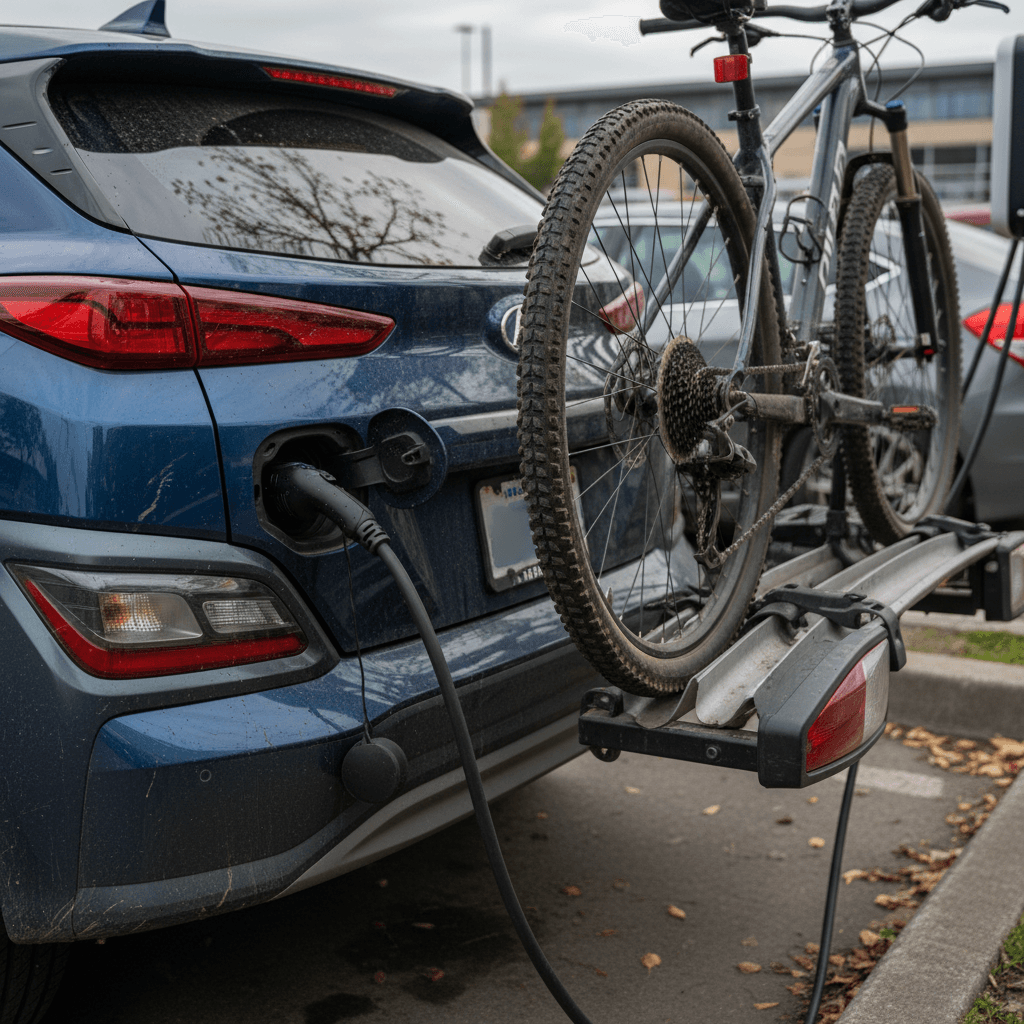
From a range standpoint, a clean, close‑in rack with two bikes might cost you 5–15% of your normal highway range, mainly from added drag. A big cargo box sticking out in the airflow can push that penalty higher, especially at 70+ mph.
How towing affects Kona Electric range
Range loss when towing isn’t unique to the Kona Electric, every EV and gas vehicle suffers. What’s different with an EV is that you notice it more because total range is smaller and you plan around chargers instead of fuel stations on every corner.
Baseline Kona Electric range and efficiency
When you add a trailer or even a couple of bikes, the biggest hit comes from aerodynamic drag and, to a lesser extent, weight. Drag goes up with the square of speed, which is why 60 mph vs. 75 mph can be the difference between a manageable towing day and constantly hunting for chargers.
Typical towing range loss
Realistic Kona Electric range examples when towing
Let’s assume a recent Kona Electric with the 64.8‑kWh battery and an EPA rating around 260 miles in mixed driving. In calm weather and moderate temps, many careful drivers see about 3.5–4.2 miles per kWh in real use. Here’s how that changes with common towing setups.
Illustrative Kona Electric range scenarios with towing
Approximate ranges assuming a healthy 64.8‑kWh battery and normal conditions. These are estimates, not guarantees.
| Scenario | Load | Estimated efficiency | Usable battery | Approx. range |
|---|---|---|---|---|
| No hitch / no load | Driver + light cargo only | 3.8 mi/kWh | ~60 kWh usable | ~225–230 mi real‑world |
| Two bikes on hitch rack | ~100 lb + moderate drag | 3.2–3.4 mi/kWh | ~60 kWh usable | ~190–205 mi |
| Small low utility trailer | ~600–900 lb loaded | 2.4–2.8 mi/kWh | ~60 kWh usable | ~145–170 mi |
| Tall camping trailer | 1,200–1,600 lb, boxy shape | 1.8–2.2 mi/kWh | ~60 kWh usable | ~110–130 mi |
Your exact numbers will vary based on speed, temperature, elevation, wind, tire choice, and how you drive.