If you’ve heard that the Hyundai Kona Electric is one of the most efficient EVs on sale, you might be wondering whether that frugality actually translates into a relaxed road trip. This Hyundai Kona Electric road trip review focuses on real-world highway range, charging behavior, comfort, and planning strategy, with a particular eye on U.S.-spec cars and what to look for if you’re shopping used.
Quick take
Who this Hyundai Kona Electric road trip review is for
- Drivers considering a used Hyundai Kona Electric as a primary car that will see occasional long trips.
- Existing Kona Electric owners planning their first 300–800 mile road trip.
- EV shoppers cross‑shopping the Kona Electric with cars like the Chevy Bolt EUV, Nissan Leaf, or Kia Niro EV.
- Anyone trying to understand how highway range and charging curves feel in the real world, not just in spec sheets.
This article leans heavily on real‑world owner feedback, published testing, and the Kona’s official specs to paint a practical picture of life on the road. We’ll also weave in what matters if you buy a used Kona Electric through a marketplace like Recharged, where verified battery health and DC fast‑charge performance are critical for road‑trippers.
Hyundai Kona Electric versions and key specs that matter for trips
The Kona Electric has gone through two main generations in the U.S., plus continuous tweaks. For road trips, three things matter most: usable range, battery size, and DC fast‑charge speed.
Hyundai Kona Electric versions relevant for road trips (U.S.-focused)
Approximate specs; always confirm for your specific model year and trim.
| Model / Generation | Battery (usable est.) | EPA range (approx.) | Max DC fast charge (claimed) | AC onboard charger |
|---|---|---|---|---|
| 2019–2023 Kona Electric ("first gen") | ~64 kWh | 258 miles | Up to ~77–100 kW (10–80% in ~45–55 min) | 7.2–11 kW |
| 2024–2025 Kona Electric SE (short-range) | ~48 kWh | 200 miles | DC 10–80% in ~43 min | ~10 kW |
| 2024–2025 Kona Electric SEL / Limited (long-range) | ~65 kWh | 261 miles | DC 10–80% in ~43 min | ~10 kW |
Earlier Kona Electrics have more range on paper than some rivals, but all versions share relatively modest DC fast‑charge power compared with newer EVs.
Spec sheet vs. reality
On paper, the long‑range Kona Electric’s ~260‑mile EPA rating (for 2024–2025 SEL/Limited) looks competitive with bigger crossovers. But highway driving, cold weather, roof boxes, and full loads will all cut into that theoretical range. The good news is that the Kona Electric is consistently praised as one of the most efficient EVs on sale, returning around 4.0–4.3 mi/kWh in mixed use, which helps offset the modest pack size.
Real-world road trip range: what you can actually expect
Realistic highway range expectations
Use these as planning baselines, not promises.
Older 64 kWh (2019–2023)
Mild weather, 65–70 mph: 210–230 miles from 100–10%.
Cold or very hot: 170–200 miles is more realistic.
2024–2025 Long Range (65 kWh)
Mild weather: ~220–240 miles from 100–10%.
Mixed speeds / hills: 190–220 miles.
Short Range (48 kWh)
Mild weather: ~150–170 miles from 100–10%.
Cold or headwinds: plan around 130–150 miles.
Easy planning rule of thumb
Because the Kona Electric is so efficient, it often beats heavier crossovers in real range per kWh. Where it lags is the speed of replenishing that range. On a brisk 75‑mph interstate, expect to run between 120 and 180 miles between fast‑charge stops depending on your pack size and weather, arriving with around 10–20% remaining.
Hyundai Kona Electric by the numbers for road trips
Charging the Kona Electric on the road
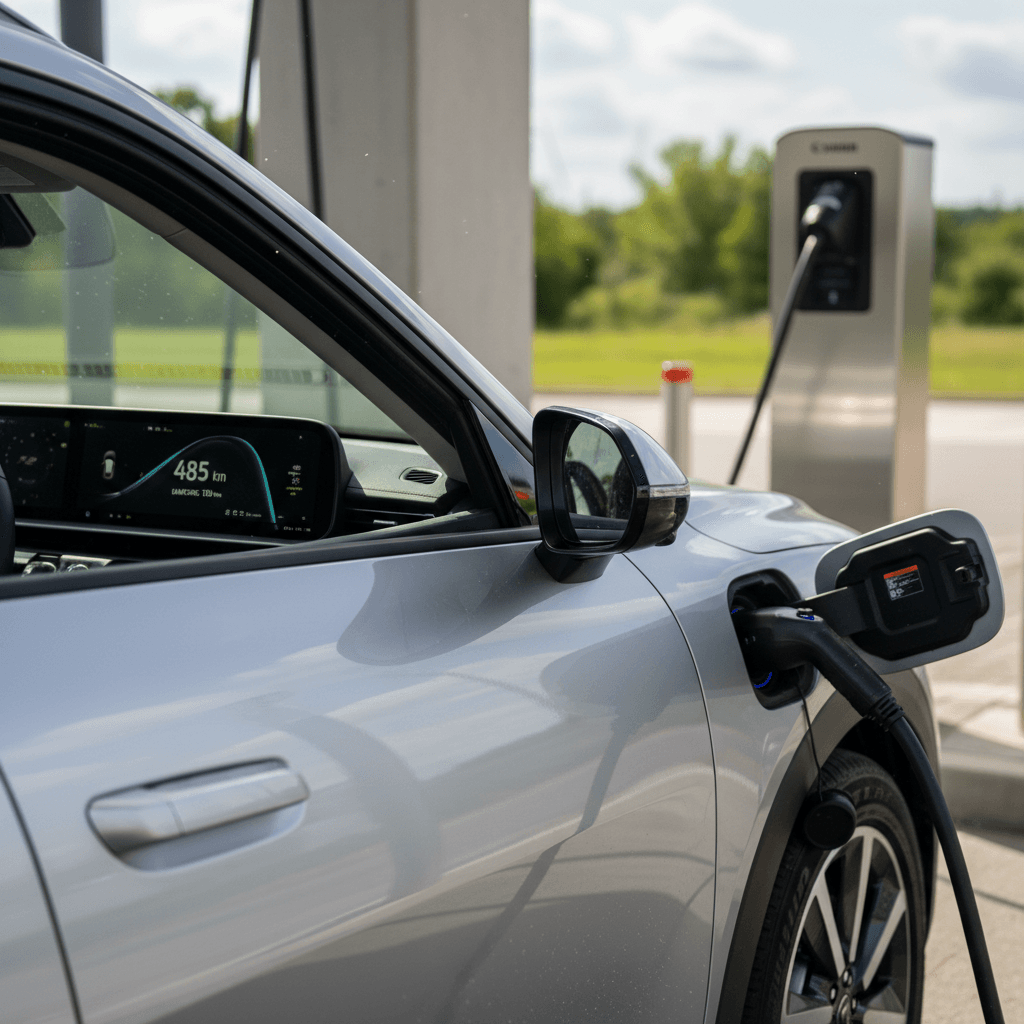
The Kona Electric uses CCS for DC fast charging and a J1772/Type 1 plug for Level 2 in North America. That means you can use most major U.S. networks, Electrify America, EVgo, ChargePoint DC, and many regional operators, without adapters. The trade‑off is that the Kona’s pack and software prioritize efficiency and longevity over headline‑grabbing charging speeds.
Typical Kona Electric road-trip charging scenarios
Approximate times on a healthy charger with a warmed-up battery.
| Battery & model | Charger type | State of charge window | Approx. time | Notes |
|---|---|---|---|---|
| 64–65 kWh (all years) | 100–150 kW DC | 10–80% | ~40–50 min | Often peaks in the 70–85 kW range, then tapers. |
| 48 kWh (short range) | 100–150 kW DC | 10–80% | ~35–45 min | Smaller pack, similar 10–80% time. |
| Any Kona Electric | 50 kW DC | 10–80% | ~50–65 min | Common in rural areas; plan longer coffee or meal stops. |
| Any Kona Electric | Level 2 (7–11 kW) | 10–90% | ~6–8 hours | Overnight at hotel or relative’s house. |
Times are approximate and assume you’re not sharing a stall and the charger is delivering its rated power.
Don’t rely on 0–100%
DC fast-charging tips for a smoother Kona Electric road trip
1. Start charges low, not high
Aim to arrive at fast chargers with 10–25% state of charge. You’ll see better average power over the session and shorten your stop.
2. Target 70–80% max
Unless your next leg is very long or chargers are sparse, stop charging around 75–80%. That’s where the charging curve starts to slow dramatically.
3. Precondition when possible
Later‑model Konas can warm the battery when navigating to a fast charger. Warm packs charge faster, especially in cold weather, reducing stop times.
4. Cross-check charger status
Use the network app (EA, EVgo, etc.) and PlugShare-style review apps to confirm chargers are online before you commit to a stop.
5. Favor big travel hubs
Where you can, choose multi‑stall travel plazas over single‑stall city chargers. Redundancy matters if one unit is down.
6. Have a Level 2 backup plan
For rural trips, look for RV parks, hotels with Level 2, or destination chargers on your route as a safety net if DC options are thin.
Comfort, storage, and tech on long drives
On a road trip, range is only half the story. You’re also going to live with the seats, suspension, noise levels, and driver‑assist tech for hours at a time. Here’s how the Kona Electric fares.
Cabin comfort & noise
- Seats: Supportive enough for most drivers on 3–4 hour stints, but some owners wish for more thigh support on very long days.
- Ride quality: Firm but controlled. It can feel a bit busy on broken pavement compared with larger EVs on longer wheelbases.
- Noise: At 70–75 mph, wind and road noise are noticeable but not intrusive. It’s quieter than most gas subcompacts, louder than premium EV crossovers.
Space, cargo & tech
- Cargo: Enough room for a couple and luggage without issue. A family of four can make it work with smart packing, but it’s not a cavernous SUV.
- Infotainment: Modern Konas have CarPlay/Android Auto and a clear EV energy screen, which makes monitoring range simple.
- Driver aids: Highway drive assist, lane centering, and adaptive cruise reduce fatigue when they’re well‑tuned and used with attention.
Sweet spot use case
Hyundai Kona Electric road trip pros and cons
Kona Electric on road trips: what it does well, and where it frustrates
A quick snapshot if you’re deciding between EVs.
Road trip strengths
- Class-leading efficiency: You’ll use less energy per mile than in many larger EVs.
- Respectable real‑world range: ~200+ miles per leg is doable on long‑range versions in moderate weather.
- Compact footprint: Easy to maneuver in city centers and tight hotel parking lots.
- DC fast compatibility: Works on most CCS networks across the U.S.
- Value in the used market: Often more affordable than newer dedicated EV-platform crossovers.
Road trip drawbacks
- Average fast‑charge speeds: Peaks are modest, and taper comes early vs. newer EVs.
- Small-ish battery: You don’t get the 300+ mile cushions of larger EVs.
- Compact cabin: Rear‑seat comfort and cargo volume can feel tight for growing families.
- Limited DC charging redundancy in some regions: Not a Kona issue per se, but something you’ll feel in non‑urban corridors.
How the Kona Electric compares to other road-trip EVs
If you’re road‑trip focused, you’re probably comparing the Kona Electric with other efficient, relatively affordable EVs rather than six‑figure luxury crossovers. Think Chevy Bolt/Bolt EUV, Kia Niro EV, Nissan Leaf, and newer models like the Volvo EX30 or Volkswagen ID.4.
Kona Electric vs. common alternatives for long trips (high-level)
Broad comparisons focusing on road-trip traits, not every spec.
| Model | Highway range (realistic) | DC fast-charging feel | Interior & space | Best for |
|---|---|---|---|---|
| Hyundai Kona Electric (long-range) | ~190–230 miles per leg | Adequate, mid‑pack; 10–80% in ~40–50 minutes | Subcompact; fine for 2–3 people + luggage | Efficiency‑minded drivers, value seekers, urban dwellers who road trip a few times a year. |
| Chevy Bolt/Bolt EUV | Similar or slightly less than Kona in bad weather | Similar 50–55 kW peaks; slower overall than Kona on modern chargers | Cabin feels airy, but cargo is similar or slightly smaller | Affordability first, occasional trips, strong DC fast‑charge planning. |
| Kia Niro EV | Similar pack, similar range | Comparable charging but with different tuning | A bit more rear‑seat and cargo space | Families who want just a bit more space than Kona. |
| Newer 800V EVs (IONIQ 5/6, EV6, etc.) | Similar or longer legs depending on pack | Much faster, 10–80% sometimes in 18–25 minutes on big chargers | Roomier, more comfortable for long stints | Frequent long‑distance travelers who can budget for a newer platform. |
For many buyers, the trade‑off is simple: Kona Electric offers excellent efficiency and value, while newer EVs offer faster charging and more space.
Where Kona Electric still shines
Road trip strategy example in a Kona Electric
Let’s put this into a concrete scenario. Say you’re driving a long‑range Kona Electric (64–65 kWh pack) from Washington, D.C. to Atlanta, about 640 miles, mostly interstate, in mild weather. How might the day unfold?
Sample Washington, D.C. → Atlanta day in a Kona Electric
Energy & charging timeline
Start D.C. suburbs at 100%. First leg: ~200 miles at 70–75 mph, arrive near Roanoke around 15–20% SOC.
DC fast charge from ~15% to 75%: ~35–40 minutes. Grab coffee and a snack.
Second leg: ~180–190 miles into eastern Tennessee, arrive near 15–20% again.
Second fast charge to 75%: another ~35–40 minutes over lunch.
Final leg: ~170–190 miles into Atlanta. Arrive with 10–15% and Level 2 charge overnight.
Practical travel timeline
Leave around 7:00 a.m. with a full battery from overnight Level 2.
Morning stop around 10:30 a.m. for a bathroom break and quick top‑up.
Lunch and longer stretch break around 2:00 p.m. during second DC fast charge.
Arrive in Atlanta early evening, around 7:00–8:00 p.m., depending on traffic and stop length.
Aim for 2–3 DC fast‑charge stops per 600–700 miles
Buying a used Kona Electric for road trips
If you’re reading a Hyundai Kona Electric road trip review, there’s a good chance you’re shopping used. That’s where the Kona can be an especially sharp buy, provided you pay close attention to battery health, DC fast‑charge performance, and prior usage patterns.
Used Hyundai Kona Electric road-trip buyer checklist
1. Verify battery health, not just mileage
Two Konas with the same odometer reading can have very different battery histories. Look for a verified battery report and pay attention to remaining capacity and cell balance. On Recharged, every vehicle includes a Recharged Score battery health report so you’re not guessing.
2. Ask about DC fast-charging history
Occasional DC fast charging is fine. A car that lived on rapid chargers every day could show more degradation. A good diagnostic (or detailed Recharged Score report) will flag unusual patterns.
3. Check highway efficiency on a long test drive
Take the car on a 30–40 mile freeway loop at your typical road‑trip speed. Reset trip data and confirm it delivers close to the expected mi/kWh for that model year.
4. Inspect charging hardware & ports
Make sure the CCS flap and J1772 port are clean and undamaged. Ask the seller or dealer to demonstrate a Level 2 charge, and, if possible, a short DC fast‑charge session.
5. Confirm driver-assist features work smoothly
Adaptive cruise and lane‑keeping are big fatigue reducers on road trips. Confirm they’re present on your trim and that they track lanes and traffic smoothly during a test drive.
6. Run the numbers on total trip cost
Factor in charging prices along your common routes. Even with paid DC fast charging, a Kona Electric will usually beat gas crossovers of similar size on per‑mile cost, especially if you can start each leg with cheap home charging.
How Recharged can help
Ready to find your next EV?
Browse VehiclesFrequently asked questions about Kona Electric road trips
Hyundai Kona Electric road trip FAQ
Bottom line: Is the Hyundai Kona Electric a good road trip car?
If you’re looking for a small, efficient EV that can still pull off serious highway miles, the Hyundai Kona Electric deserves a spot high on your list. It won’t match the blistering fast‑charge times of the latest 800‑volt flagships, and its compact cabin won’t thrill every family, but it quietly excels where it counts: turning kilowatt‑hours into real‑world miles at a price point that’s especially attractive on the used market.
For drivers who road trip a few times a year but spend most of their time commuting, running errands, and taking weekend getaways, the Kona Electric is a well‑balanced choice. Pair it with solid trip planning, realistic range assumptions, and a charging strategy built around 2–3 stops per 600–700 miles, and it becomes an easy companion for cross‑state drives. If you’re shopping used, a marketplace like Recharged, with verified battery health reports, transparent pricing, and EV‑savvy support, can help you find a Kona Electric that’s genuinely ready to go the distance.