What an instant offer actually means
An instant offer is a rapid purchase quote based on the vehicle information you submit, not a promise of immediate cash without verification. The buyer still needs to confirm the car, its title or loan payoff, and the condition you described before completing the transaction. If the submitted facts match the vehicle, the process can move from quote to payment and pickup without you advertising the car or meeting private buyers.
Information to have ready
Vehicle identity
Provide the VIN, model, model year, mileage, configuration, and current location.
Ownership documents
State whether you hold the title or whether a lender has an outstanding payoff.
Condition details
Disclose cosmetic damage, accidents, warning lights, glass damage, and tire condition.
EV-specific equipment
List charging equipment, software or driver-assistance features, seating options, and other transferable equipment.
Photos or video
Use clear, current visuals so the buyer can remotely verify the exterior, cabin, wheels, and displays.
Battery information
Share available battery-health or diagnostic information rather than estimating the battery’s condition.
An instant quote is not instant cash
What Recharged’s seller data shows
Recharged’s own data shows active seller demand alongside a wide and changing used-EV retail market. The latest seller-demand snapshot logged 5,854 offer requests; that figure signals that Recharged is actively buying, but it contains no dollar amounts and cannot predict your individual offer. Across 1,796 EVs sold at retail by Recharged during the trailing 12 months, buyers paid an average of $29,901 and a median of $27,297. The monthly retail median moved from $29,049 in October 2025 to $30,998 in September 2026, illustrating why a current appraisal matters.
Those retail prices are market evidence, not estimates of what a seller takes home. A Recharged instant offer or trade-in will land below retail, typically by several thousand dollars, because the retail figure is what a later buyer paid. Your model, configuration, mileage, battery condition, history, and physical condition determine where your offer falls, so use retail data as context rather than a payout promise.
What can change the offer after verification?
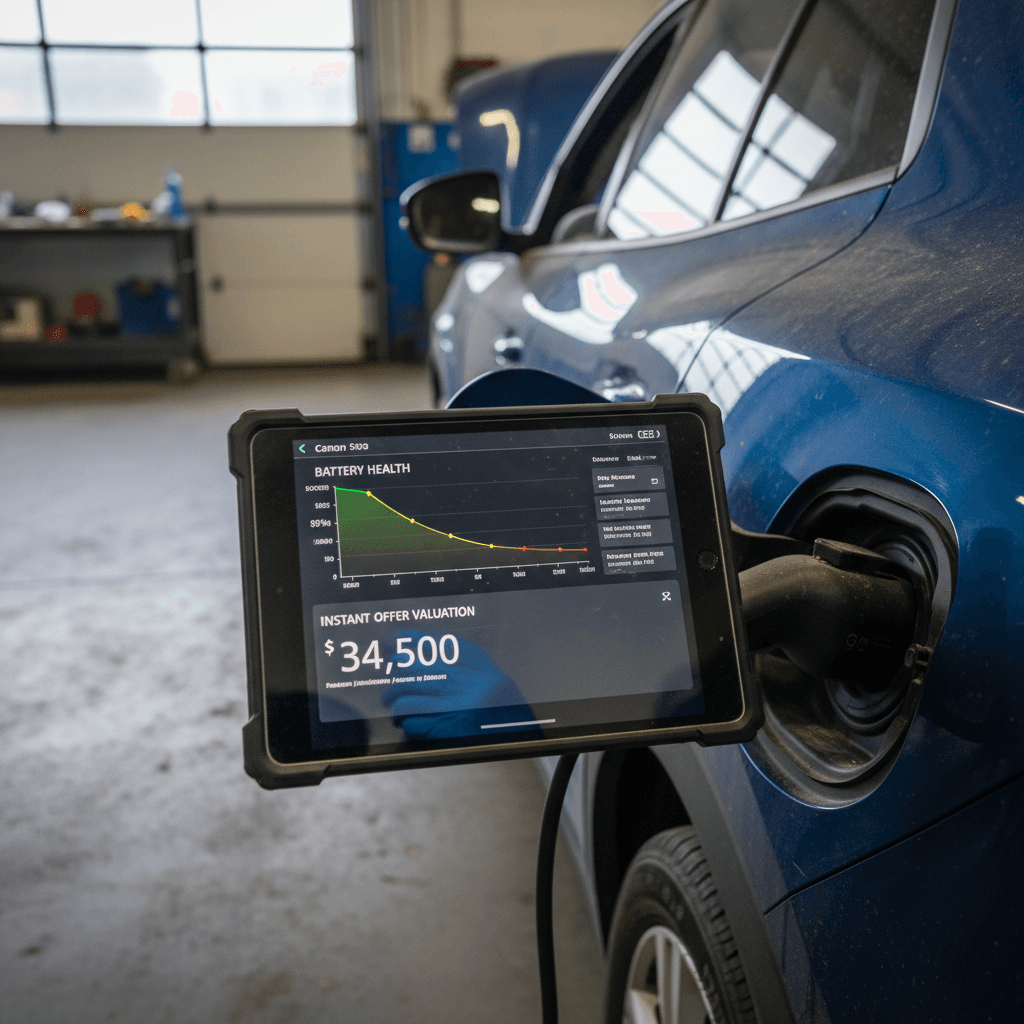
Verification can raise, preserve, or lower the initial quote when it uncovers details that were missing from the online submission. A reported accident, worn tires, cracked glass, title issue, warning light, or unexpected cosmetic damage may change the value; desirable equipment and accurately documented recent maintenance can also matter. For an EV, battery condition and model-specific equipment deserve more attention than they might receive in a generic appraisal. If you’re establishing a realistic baseline first, see how much your electric car may be worth.
- VIN-confirmed model and configuration
- Current mileage and battery information
- Accident, title, and ownership history
- Exterior, interior, glass, wheel, and tire condition
- Transferable software, charging, and vehicle equipment
- Title in hand or a verified lender payoff
An online offer gets sharper when the title status, options, damage, tires, and overall condition are clear from the start. Complete facts make it easier to keep the quote aligned through verification and pickup.
Your main ways to sell an EV
The right selling route depends on how you balance price, effort, and certainty. An instant offer minimizes seller work, while consignment or a private listing can expose the car to retail shoppers but requires more time or coordination. Compare the practical differences before choosing between an EV trade-in, direct sale, or consignment path.
Ways to sell a used electric car
Compare the routes by speed, seller effort, and how the vehicle is evaluated.
| Selling option | Typical speed | Seller effort | Valuation approach |
|---|---|---|---|
| Recharged offer or consignment | Fast to medium (days to weeks) | Low | EV-specific review |
| Dealer trade-in | Varies | Low | Bundled with purchase |
| General online buyer | Varies | Low | Broad-market review |
| Private sale | Seller-dependent | High | Buyer negotiation |
Recharged speed includes both its fast instant-offer path and its longer consignment option.
Choose the Recharged instant-offer path when convenience, EV-specific review, payment coordination, and pickup matter most. Consignment may make more sense if you want Recharged to market the car to a retail buyer and can accept a longer process. A private sale gives you direct control, but you handle the listing, questions, verification, paperwork, and buyer coordination yourself.
How the Recharged offer process works
The Recharged process moves from vehicle details to verification, paperwork, payment, and pickup. You begin online with the VIN and condition information, after which the inventory team evaluates the EV and may request photos, records, or a video review. Once the car and title details are verified, the parties execute the bill of sale, Recharged wires the funds, and transportation is arranged. If you still owe money, disclose the payoff at the start so it can be handled as part of the transaction.
From request to pickup
Request the offer
Enter the VIN, mileage, location, condition, ownership status, and contact details.
Review the quote
Check the amount and any conditions or information requests attached to it.
Verify the EV
Complete the requested photo or video review and supply supporting documents.
Confirm the title
Provide title documentation or accurate lender and payoff information.
Execute the sale
Review and sign the bill of sale after the vehicle details are confirmed.
Receive payment and schedule pickup
Recharged coordinates the wire and transportation after verification and paperwork.
Recharged data
Selling to Recharged
We're actively buying EVs
Final purchase amounts are set after inspection and review.
Based on Recharged purchase offers
Recharged data
Recent EV sold prices
$27,297
median sold price
What buyers actually paid through Recharged, not list price.
- Lowest
- $500
- Average
- $29,901
- Highest
- $129,998
Monthly median sold price
Based on Recharged sales in the last 12 months
Instant offer, trade-in, or consignment. Pickup available.
Accuracy prevents most offer surprises
The best way to protect an online offer is to describe the car exactly as it sits today. Photograph every side in daylight, include close-ups of known damage, show the odometer and dashboard, and disclose accident history even when the repair seems minor. Don’t assume expensive tires, accessories, software, or repairs add their full purchase cost to resale value; document them and let the valuation team decide. For a deeper look at the EV-specific part of an appraisal, read how an EV battery-health report works.
Don’t hide a problem to protect the quote
Every EV is battery-tested with a Recharged Score. Nationwide delivery.
Instant-offer FAQ
A strong offer starts with complete facts
A strong instant offer starts with an accurate VIN, current mileage, honest condition details, ownership documents, and EV-specific information. Treat the first number as a quote to be verified, not as guaranteed cash based on a few generic fields, and judge the deal by the final amount, conditions, payment process, and pickup support together. Recharged combines online valuation with EV-specialist review, nationwide delivery and pickup capabilities, and a digital sale process designed to remove the usual private-sale friction.