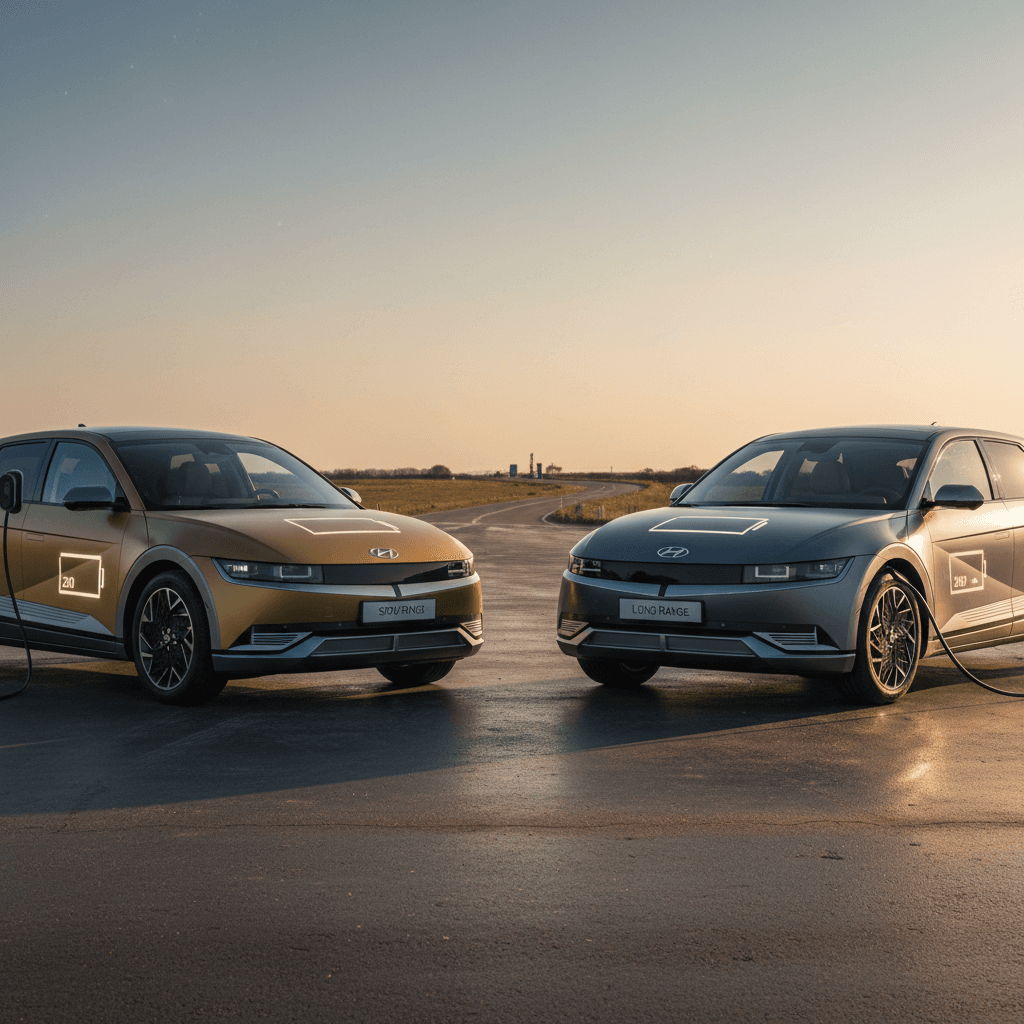
If you’re shopping for a Hyundai IONIQ 5, one of the most important choices you’ll make is between the Standard Range battery and the Long Range pack. The decision affects how far you can drive, how much you’ll pay, and how confident you’ll feel on longer trips, especially if you’re considering a used IONIQ 5 from a marketplace like Recharged.
Standard Range vs Long Range in one sentence
Hyundai IONIQ 5 Standard Range vs Long Range: quick overview
IONIQ 5 Standard Range vs Long Range at a glance (U.S. models)
Key differences between common U.S. IONIQ 5 Standard Range and Long Range configurations, focusing on 2024–2026-style specs so you can compare them apples-to-apples.
| Spec | Standard Range (SE RWD) | Long Range RWD | Long Range AWD |
|---|---|---|---|
| Battery capacity (usable / system) | ~58–63 kWh (Hyundai lists 63 kWh system for 2025) | ~77–84 kWh (Hyundai lists 84 kWh system for 2025) | Same 77–84 kWh pack |
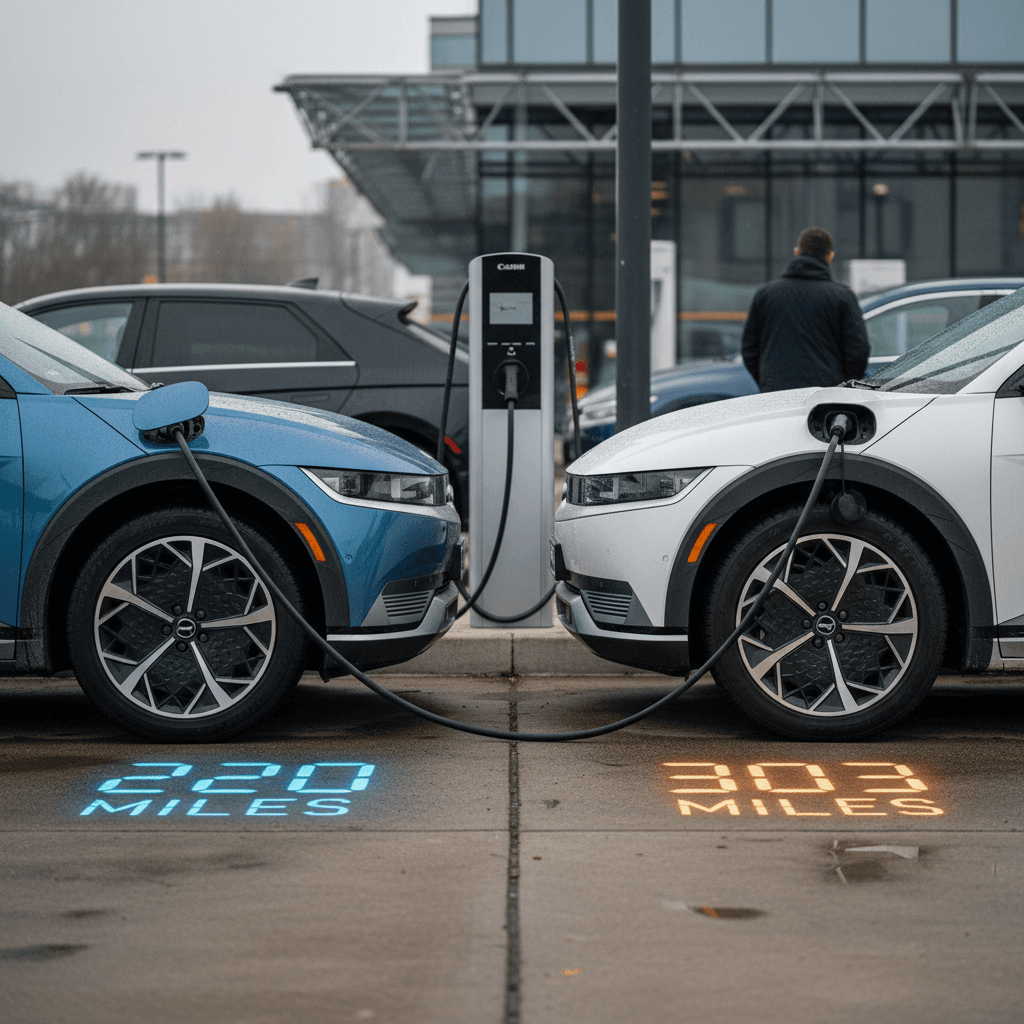
| EPA range (typical recent ratings) | 220–245 miles | 290–318 miles | 259–266 miles |
| Drive configuration | Single motor RWD only | Single motor RWD | Dual motor AWD |
| Horsepower | ~168 hp | 225 hp | 320 hp |
| 0–60 mph (approx.) | ~7.5–8.0 seconds | ~7.0 seconds | ~5.0 seconds |
| DC fast charge 10–80% (max charger) | ~18–24 minutes | ~18–20 minutes | ~18–20 minutes |
| Rated efficiency (combined MPGe) | Around 110–115 MPGe | Around 106–115 MPGe | Around 98–107 MPGe |
| Typical trim availability | Base SE / SE Standard Range | SE, SEL, many Limited | SEL, Limited, some XRT and N variants (performance models differ) |
Exact figures vary slightly by model year and wheel size, but this captures the typical spread you’ll see in the real world.
Model-year details
Battery size and real-world range
The biggest practical difference between the Hyundai IONIQ 5 Standard Range vs Long Range is the usable battery energy. Earlier U.S. Standard Range models use roughly a 58 kWh pack, while newer spec sheets quote a 63 kWh system. Long Range models use a much larger battery (roughly 77–84 kWh depending on model year). That extra capacity translates directly into more highway and winter buffer, something you’ll feel every day if you drive farther than a short commute.
How much range do you really get?
EPA numbers are a starting point, real life depends on speed, climate, and driving style.
Standard Range (SE RWD)
EPA: about 220–245 miles depending on year.
- Best fit if your daily driving is under ~80 miles.
- Limited buffer for winter or high‑speed road trips.
Long Range RWD
EPA: roughly 290–318 miles.
- Substantial jump in usable range vs Standard Range.
- Comfortable for regional trips with one fast‑charge stop.
Long Range AWD
EPA: typically 259–266 miles.
- Less efficient than RWD but still strong overall.
- Extra traction for snow and bad weather.
Rule of thumb for range
Typical real‑world range differences
If you mostly do city and suburban driving, the Standard Range battery can easily cover a typical American round‑trip commute and errands. But if you frequently see 150–200 mile days, the Long Range pack isn’t just a luxury, it’s peace of mind. On the used market, that often means a modest jump in purchase price for a noticeably more relaxed ownership experience.
Performance, acceleration, and driving feel
Range isn’t the only difference between IONIQ 5 Standard Range vs Long Range models. The battery you choose also determines which motors and drivetrains are available. Standard Range cars are single‑motor rear‑wheel drive only, while Long Range models can be had as rear‑drive or dual‑motor all‑wheel drive with substantially more power.
Standard Range: perfectly adequate
- Single rear motor with roughly 168 hp.
- 0–60 mph in the high‑7 to ~8‑second range.
- Lightest versions of the IONIQ 5, helps efficiency and ride.
- Still feels punchy around town thanks to instant EV torque.
For most daily driving, the Standard Range IONIQ 5 doesn’t feel slow. It just doesn’t offer the same muscle you get in the higher‑power dual‑motor versions.
Long Range: smoother and stronger
- Long Range RWD: about 225 hp, quicker than Standard Range but still efficiency‑focused.
- Long Range AWD: ~320 hp, with 0–60 mph near 5 seconds in many tests.
- More confident passing at highway speeds.
- Available towing capacity (around 2,300 lbs on many trims).
If you care about brisk acceleration, towing a small trailer, or extra traction, the Long Range AWD variants are the clear winners.
Where value peaks
Charging speed, NACS access, and road trips
Here’s some good news: no matter which IONIQ 5 battery you choose, this is one of the quickest‑charging EVs on the road. Thanks to its 800‑volt architecture, both Standard Range and Long Range versions can go from about 10–80% in roughly 18–20 minutes on a powerful DC fast charger. Later model years also support the North American Charging Standard (NACS), opening up Tesla Superchargers in addition to CCS sites via an adapter.
- AC home charging is essentially the same: both packs accept up to around 10.9 kW on a Level 2 charger, so the Long Range car simply takes a bit longer to fill.
- On a road trip, the larger battery lets you stretch between stops, but the time you spend at the charger is similar for both packs when you arrive at similar low state of charge.
- Because the car can make excellent use of powerful chargers (250–350 kW), planning around high‑power sites pays off more than agonizing over which battery is a few minutes quicker.
Think in legs, not minutes
Price, used-market value, and incentives
When new, Hyundai typically prices the SE Standard Range as the entry point, with Long Range trims stepping up in both battery and features. For the 2026 model year, Hyundai cut prices aggressively; a 2026 SE RWD Standard Range now starts in the mid‑$30Ks, while many Long Range trims land several thousand dollars higher. In today’s used market, that gap isn’t always as wide as you might expect, especially if you’re shopping across multiple model years.
How pricing usually shakes out
Exact numbers depend on mileage, condition, and local incentives, but these patterns are common.
Standard Range advantages
- Lower purchase price when new.
- Often the least‑expensive used IONIQ 5 on the lot.
- Good fit for buyers prioritizing payment over range.
Long Range value story
- Higher sticker, but stronger resale because demand is higher.
- Smaller relative price jump in the used market than on the new‑car window sticker.
- Better long‑term flexibility if your driving needs grow.
How Recharged fits in
At Recharged, every used IONIQ 5 includes a Recharged Score battery health report. That means you’re not guessing how much capacity is left in either Standard or Long Range packs, and you can see fair market pricing without haggling.
Don’t chase the cheapest IONIQ 5
Which IONIQ 5 battery is right for you?
Choosing between Hyundai IONIQ 5 Standard Range vs Long Range starts with how, and where, you actually drive. Both are excellent EVs, but they solve slightly different problems. Here’s a practical way to decide without getting lost in spec sheets.
Match your driving profile to the right battery
1. Choose Standard Range if…
Your daily driving typically stays under 70–80 miles, you can charge at home most nights, and you’re especially price‑sensitive. You rarely take 200+ mile trips by car, or you have another gas vehicle for those weeks. In that case, the Standard Range IONIQ 5 offers plenty of capability at a lower cost.
2. Choose Long Range RWD if…
You want the most efficient version with lots of buffer, ideal if you routinely do 120–180 mile days, live in a colder climate, or simply dislike watching the state‑of‑charge drop on the highway. Long Range RWD is the sweet spot for many buyers.
3. Choose Long Range AWD if…
You value performance, all‑weather traction, or occasional towing, and you’re willing to trade a bit of efficiency for power. If you ski, drive in heavy rain or snow, or want brisk acceleration, the dual‑motor setup is worth the range penalty.
4. You’re range‑anxious today
If you’re already worried about range before you buy, that’s your signal to lean toward the Long Range pack. The best EV is the one you’re comfortable using for every trip you want to take, not just the short ones.
Used IONIQ 5 shopping tips: Standard vs Long Range
In the used market, the difference between Hyundai IONIQ 5 Standard Range vs Long Range models isn’t just about what’s under the floor. You also need to think about battery health, trim content, and how the previous owner used the car. That’s where a transparent marketplace like Recharged can make the choice much easier.
Key checks on any used IONIQ 5
- Battery health: Ask for data on remaining capacity, not just a generic “battery is good.” A Recharged Score report, for example, quantifies pack health using deep diagnostics.
- Fast‑charging history: Occasional DC fast charging is fine, but heavy ultra‑fast use on a Standard Range car that lived on the highway may matter more.
- Tires and brakes: Long Range AWD models carry more weight and power; inspect wear items carefully.
- Software and recalls: Make sure updates and campaigns are up to date; some improve charging behavior and safety systems.
Trim and equipment considerations
- Standard Range cars are usually base SE trims with fewer luxury features.
- Long Range SEL and Limited models add amenities like upgraded seats, more driver‑assist tech, and sometimes a heat pump, all of which improve comfort and winter efficiency.
- When comparing two used cars, a nicely equipped Long Range SEL might only be a modest payment bump over a bare‑bones Standard Range SE.
On Recharged, you can filter by battery size, drivetrain, and features so you’re comparing like with like, then lean on expert EV specialists to talk through the trade‑offs.
Don’t ignore battery health on a bargain
Frequently asked questions
Hyundai IONIQ 5 Standard Range vs Long Range: FAQ
Bottom line: how to decide with confidence
If your life is built around shorter daily driving and you have easy home charging, the Hyundai IONIQ 5 Standard Range can be a smart, budget‑friendly way to step into a modern EV. But if you want one vehicle that can comfortably handle commuting, weekend trips, winter weather, and evolving needs, the Long Range battery, especially in RWD form, hits the sweet spot for most shoppers.
In the used market, the smartest move is to compare total value, not just list price. Look at battery health, trim level, and how much range you’ll realistically use. On Recharged, every IONIQ 5 listing includes a Recharged Score battery health report, fair market pricing, and access to EV specialists who live and breathe questions like “Hyundai IONIQ 5 Standard Range vs Long Range, which one is right for me?” That way, you’re not just buying the right car on paper; you’re buying the right EV for the way you actually drive.