If you’re looking at a Hyundai Ioniq 5 in 2026, new or used, you’re probably wondering what the Hyundai Ioniq 5 maintenance cost in 2026 really looks like. The good news: as a battery‑electric SUV with no oil changes or exhaust system, the Ioniq 5 is generally cheaper to maintain than a comparable gas crossover. But you’ll still want a realistic budget for service, tires, brakes and the occasional surprise.
Key takeaway for 2026 shoppers
Why Hyundai Ioniq 5 maintenance is different from a gas SUV
The Ioniq 5’s electric powertrain eliminates many of the most expensive regular services that come with a traditional internal‑combustion SUV. There’s no engine oil, spark plugs, timing belt, transmission fluid changes, or emissions system to worry about. That’s a big reason EVs typically run 30–40% lower in routine maintenance costs than comparable gas vehicles over time.
What the Ioniq 5 doesn’t need vs. a gas SUV
Fewer moving parts, fewer routine services
Eliminated with the Ioniq 5
- No engine oil or oil filter changes
- No spark plugs or ignition components
- No timing belt or timing chain service
- No exhaust system repairs or emissions checks
- No multi‑speed automatic transmission service
Still part of your budget
- Tire rotations and replacements
- Brake fluid changes and occasional pads
- Cabin air filter and A/C service
- Coolant for the battery and electronics (long‑interval)
- Alignments, suspension and steering wear
Real‑world comparison
Scheduled service intervals and typical 2026 costs
Hyundai publishes a maintenance schedule for the Ioniq 5 that’s based on mileage and time. For U.S. owners driving average mileage, you’ll typically see multi‑point inspections and tire rotations every 7,500 miles or so, plus a few fluid and filter changes as the vehicle ages. Dealers sometimes push more frequent visits (every 5,000 miles), but the owner’s manual is your baseline.
Typical Hyundai Ioniq 5 maintenance numbers (2026 estimates)
Common Hyundai Ioniq 5 service intervals and 2026 cost estimates
Approximate U.S. dealer or reputable independent shop pricing; actual costs vary by region and dealer markup.
| Mileage / Time | Service items | Typical 2026 cost (USD) | Notes |
|---|---|---|---|
| Every 7,500 mi / 12 months | Tire rotation, multi‑point inspection, software updates if needed | $80–$150 | Many owners combine this with a visual brake and suspension check. |
| 15,000–22,500 mi | Tire rotation, inspections, possible cabin air filter | $120–$220 | Cabin filter can often be replaced DIY for less than $40 in parts. |
| 30,000–45,000 mi | Tire rotation, inspection, cabin air filter, brake fluid check | $150–$300 | Budget for first tire replacement somewhere in this window if you drive aggressively. |
| 60,000 mi+ | Brake fluid replacement, coolant checks, potential brake pad replacement | $250–$500 | Regenerative braking means pads often last much longer than on a gas SUV. |
| Every visit | Software / navigation updates | Usually included or $0–$100 | Some updates are performed over‑the‑air; others require a service visit. |
Use this as a budgeting guide, then verify specifics with the service department you plan to use.
Watch for dealer “EV packages”
Wear items: tires, brakes, alignment and more
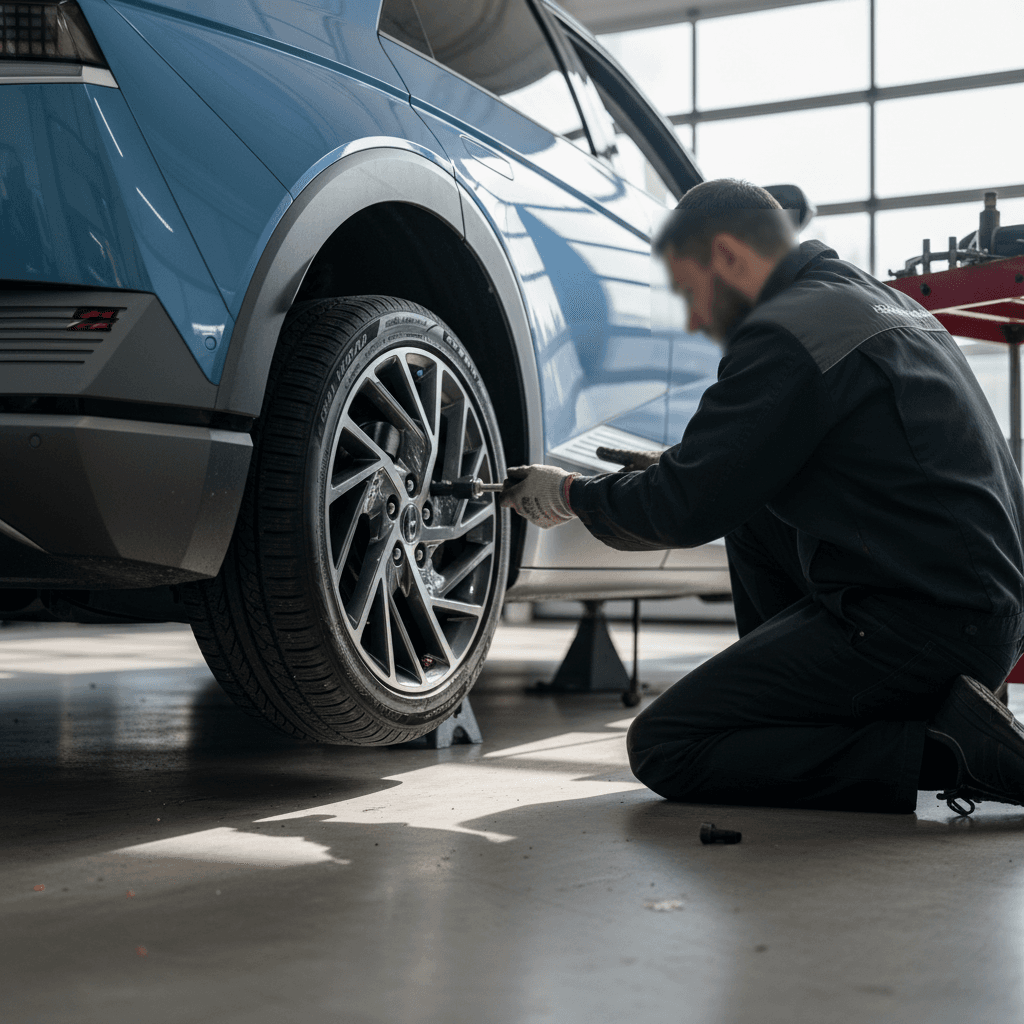
Even with low routine service needs, your Hyundai Ioniq 5 is still a 4,000‑plus‑pound SUV with instant torque. Over 5–7 years, tires, brakes, and suspension components will be your biggest maintenance expenses. How you drive matters as much as what you drive.
Main Ioniq 5 wear items and 2026 price ranges
Biggest out‑of‑pocket costs for most owners
Tires
Cost: $800–$1,400 for a full set of quality all‑season tires, mounted and balanced.
Heavy curb weight and strong acceleration can wear factory tires in as little as 25,000–35,000 miles, especially on dual‑motor AWD models.
Brakes
Cost: $350–$700 per axle for pads and rotors if needed.
Regenerative braking means many Ioniq 5 owners won’t need pads until well past 60,000 miles, but city driving or mountain descents can shorten that window.
Alignment & suspension
Cost: $120–$200 for a four‑wheel alignment; $300–$800+ if suspension parts wear prematurely.
Potholes and rough roads are the usual culprits. Misalignment accelerates tire wear, so catching it early can save money.
Easy ways to stretch tire and brake life
Unexpected repairs, recalls and warranty coverage
No vehicle is completely maintenance‑free, and the Hyundai Ioniq 5 is no exception. While the electric drivetrain has fewer failure points than a gas engine, you still have complex electronics, infotainment hardware, door handles, HVAC components, and more. The good news for 2026 buyers is that warranty coverage on the Ioniq 5 is among the strongest in the industry for major components.
Factory warranty coverage to know
- 5‑year/60,000‑mile new‑vehicle limited warranty covers many non‑wear items.
- 10‑year/100,000‑mile powertrain warranty on original owners typically covers the electric motor and related components.
- High‑voltage battery warranty (often 8 years/100,000 miles) protects against certain battery failures or excessive capacity loss.
- Corrosion and roadside assistance coverage can reduce out‑of‑pocket expenses for towing if something goes wrong.
Where surprise costs can appear
- Out‑of‑warranty infotainment or HVAC repairs.
- Body and glass work from road debris or parking‑lot mishaps.
- Failed sensors, charge‑port doors, or window regulators as the car ages.
- Towing and diagnostic fees if you’re out of warranty and not covered by roadside assistance.
On a relatively new Ioniq 5, these are the exceptions, not the rule, but they’re worth budgeting for once the vehicle is 6–8 years old or more.
How Recharged helps with the unknowns
Ready to find your next EV?
Browse VehiclesHow much to budget per year for Ioniq 5 maintenance in 2026
Let’s translate all of this into a realistic annual budget. Hyundai Ioniq 5 owners in 2026 fall into a few common usage patterns. Your costs will depend mostly on how much you drive, where you live, and whether you’re still under warranty.
2026 annual maintenance budget scenarios for Hyundai Ioniq 5
Estimated averages over several years, excluding insurance, charging and registration.
| Driver profile | Miles per year | Typical annual maintenance | What’s included |
|---|---|---|---|
| Low‑mileage commuter | 8,000–10,000 | $400–$600 | One paid service visit, plus a tire rotation and occasional cabin filter; tire set may last 5+ years. |
| Average family driver | 12,000–15,000 | $600–$900 | One or two service visits, tire rotation(s), portion of tire and brake wear, occasional alignment. |
| High‑mileage road‑tripper | 20,000+ | $900–$1,300+ | More frequent tire replacements, extra service visits, higher likelihood of alignment and brake work. |
Use these as planning benchmarks and adjust up or down based on your mileage and road conditions.
How this compares with a gas SUV
Saving on maintenance with a used Hyundai Ioniq 5
If you’re shopping in 2026, a used 2022–2024 Ioniq 5 can be a sweet spot: much of the initial depreciation has already happened, yet you’re still within the factory battery and powertrain warranties for most examples. Maintenance costs aren’t dramatically different from a new Ioniq 5, but the condition of the specific vehicle matters far more.
Advantages of a used Ioniq 5
- Lower purchase price offsets maintenance and charging costs.
- Battery and powertrain warranties often still active.
- Previous owner has already handled early‑life recalls and software updates.
- You can see real‑world range and tire wear history, not just brochure numbers.
What to verify before you buy used
- Service history: look for documented tire rotations, brake checks and software updates.
- Battery health: confirm that usable capacity and fast‑charge speeds are still strong.
- Tire and brake condition: worn tires or rotors can add $800–$1,500 immediately.
- Accident and recall history: make sure repairs were done at a qualified shop.
Buying from an EV‑focused retailer like Recharged means this homework is largely done for you, with a battery‑health report and expert guidance built in.
Leverage EV expertise when buying used
Simple maintenance checklist for Hyundai Ioniq 5 owners
Hyundai Ioniq 5 owner maintenance checklist (2026 and beyond)
1. Follow the owner’s manual, not just the dash reminder
Use Hyundai’s official maintenance schedule as your primary guide. Service reminders are helpful, but dealers sometimes recommend more frequent visits than necessary for revenue, not reliability.
2. Rotate tires every 7,500–10,000 miles
The Ioniq 5’s weight and torque can chew through tires if they’re never rotated. Regular rotations, plus proper inflation, easily pay for themselves in extra tire life.
3. Check brake fluid and pads every 2–3 years
Regenerative braking reduces pad wear, but the fluid still ages. Ask your service advisor to measure pad thickness and fluid condition instead of replacing parts on a fixed schedule.
4. Keep software up to date
Many drivability and efficiency improvements arrive via software. Allow over‑the‑air updates when possible, and ask for any outstanding updates during in‑person service visits.
5. Protect the cooling system
The battery, inverter and onboard charger rely on coolant to stay at the right temperature. When the manual calls for coolant service, don’t skip it, it’s cheap insurance against much larger repair bills.
6. Inspect tires, wipers and lights monthly
A quick visual walk‑around catches uneven tire wear, worn wipers and burnt‑out bulbs before they become safety issues or cause premature tire replacement.
Avoid this costly mistake
FAQs: Hyundai Ioniq 5 maintenance cost in 2026
Frequently asked questions about Hyundai Ioniq 5 maintenance in 2026
Is the Hyundai Ioniq 5 cheap to own in 2026?
When you add it all up, the Hyundai Ioniq 5 maintenance cost in 2026 is one of the bright spots of ownership. You’ll still spend real money on tires, brakes and the occasional alignment, but you’re largely skipping the engine and transmission headaches that come with a traditional SUV. For most drivers, that means predictable, relatively low service costs, especially if you stay ahead of basic maintenance instead of reacting to problems.
If you’re considering a used Ioniq 5, working with an EV‑focused retailer like Recharged can take much of the guesswork out of the equation. From battery‑health diagnostics and transparent pricing to financing, trade‑ins and nationwide delivery, Recharged is built to make EV ownership simpler, and to help you choose an Ioniq 5 that will be affordable to maintain for years, not just months, after you bring it home.