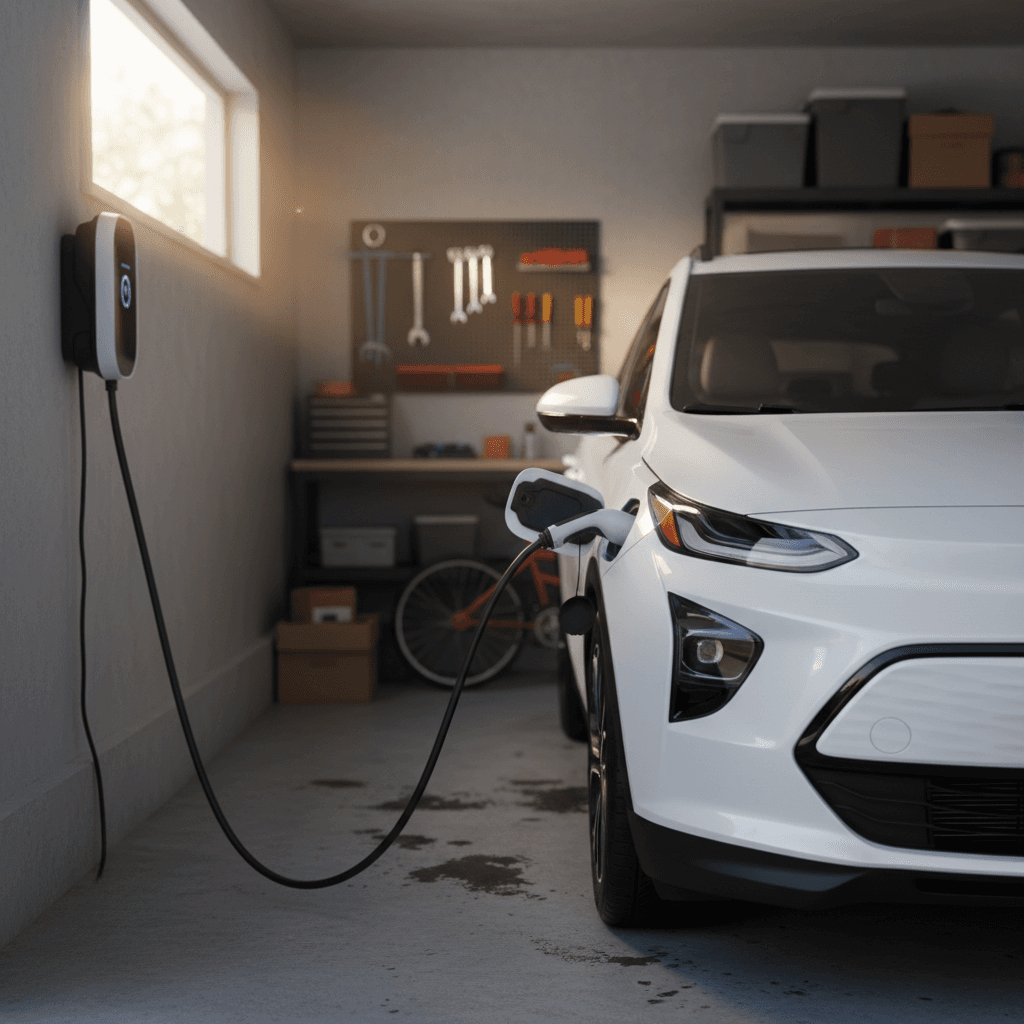
If you own a Chevrolet Bolt EUV or you’re thinking about buying one, learning how to charge your Bolt EUV at home is the difference between EV ownership feeling effortless or fussy. The good news: once you’re set up, home charging is boring in the best possible way, you plug in, walk away, and wake up to a full battery.
Good to know
Why home charging matters for your Bolt EUV
The Bolt EUV’s appeal lives and dies on home charging. With about 247 miles of EPA-rated range and a modest DC fast‑charge rate, it’s designed around the idea that you’ll do nearly all of your charging where the car sleeps: your driveway or garage. Public fast charging is a road-trip tool; home charging is your daily fuel pump.
What home charging does for you
Three everyday wins once your Bolt EUV is plugged in at home
Time back in your day
Instead of detouring to a gas station or hunting for a working DC fast charger, you plug in once you’re home. The car charges while you sleep, watch TV, or ignore emails.
Lower fuel costs
On typical U.S. electricity rates, a full charge in a Bolt EUV often costs less than a single stop at the pump in a comparable gas crossover. Off‑peak rates can drop your cost per mile dramatically.
Battery-friendly
Frequent Level 1 and Level 2 charging at home is much easier on the battery than leaning heavily on DC fast charging. That’s key if you’re planning to keep the car, or resell it for a strong price later.
Chevy Bolt EUV charging basics
Before we talk outlets and electricians, it helps to know what the Bolt EUV can actually accept.
Chevy Bolt EUV charging specs that matter at home
- The size of the circuit (amperage) your electrician installs.
- The rating of the home EVSE (charger) you buy or use.
- Battery temperature and state of charge.
Level 1 vs. Level 2 charging at home
Home charging comes in two flavors: Level 1 (120 V) and Level 2 (240 V). Both use the same J1772 inlet on your Bolt EUV; the difference is the outlet and the speed.
Level 1 vs. Level 2 charging for Chevrolet Bolt EUV
How the two home charging options compare in the real world.
| Feature | Level 1 (120 V) | Level 2 (240 V) |
|---|---|---|
| Typical outlet | Standard 3‑prong household outlet | Dedicated 240 V circuit (NEMA 14‑50, 6‑50, or hardwired) |
| Power (approx.) | ~1.4 kW at 12 A | Up to 7.7–11.5 kW depending on circuit and charger |
| Miles of range added per hour | ~3–5 miles/hour | ~25–35+ miles/hour |
| Full 0–100% charge | Roughly 2+ days from empty | About 7–9 hours from low state of charge |
| Best for | Low-mileage driving, overnight top‑ups | Daily driving, road‑trip prep, households with variable schedules |
| Upfront cost | Usually $0 extra if you use existing outlet | $500–$2,000 installed, depending on home electrical work |
Numbers are approximate and assume healthy equipment and moderate temperatures.
Which should you choose?
What equipment you actually need
Chevrolet typically supplied Bolt EUV buyers with a dual‑level portable charge cord on 2022–2023 models, one cable that can plug into either a 120 V household outlet or a 240 V outlet with the right plug. Some used cars, however, are missing that cord, and not every trim or market got the same bundle.
Bolt EUV home charging options
Decide whether to lean on the included cord or add a dedicated wallbox.
Option 1: Use the dual‑level portable cord
If your used Bolt EUV still has its GM portable charger, you can:
- Plug into a 120 V outlet for Level 1.
- Have a 240 V outlet installed (often NEMA 14‑50) and use the cord at 240 V for Level 2.
This is the lowest‑cost path into faster home charging.
Option 2: Install a dedicated Level 2 wallbox
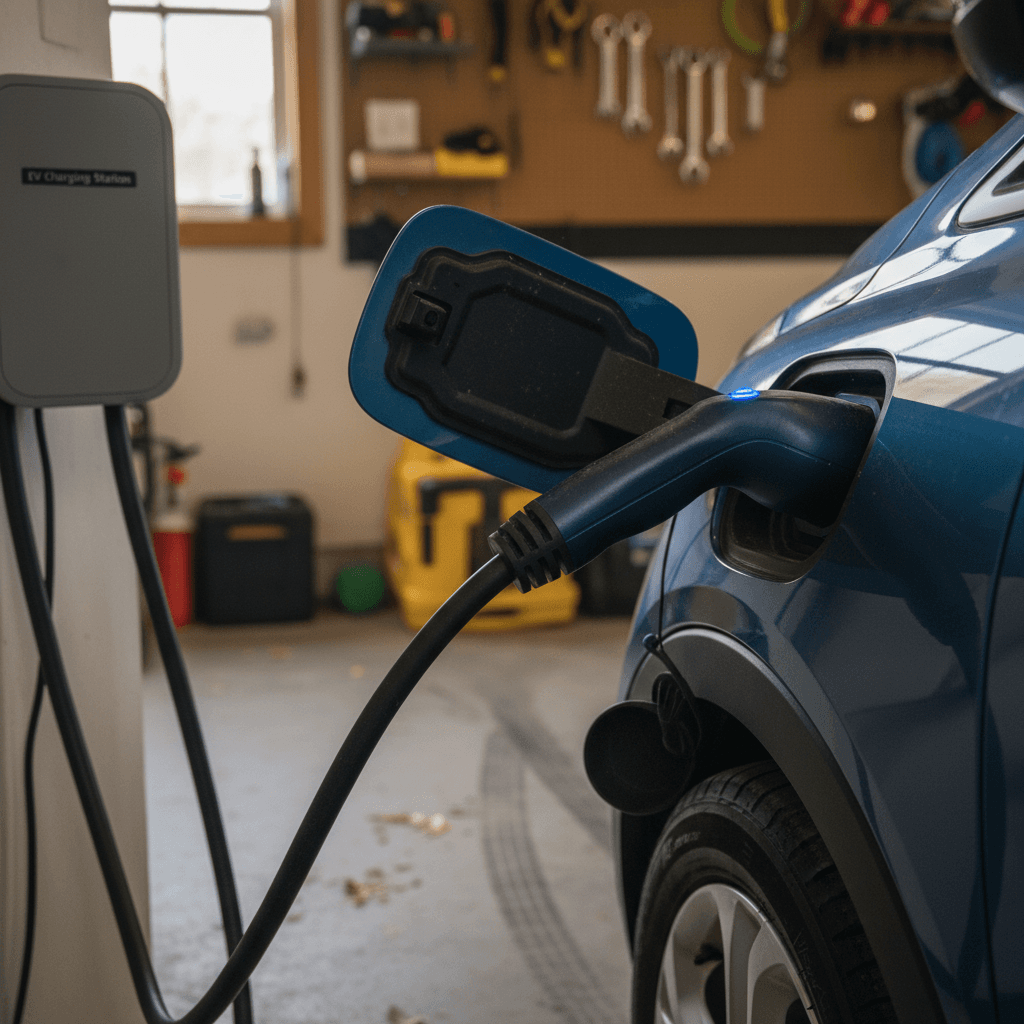
A wall‑mounted EVSE gives you:
- Clean cable management and better weather resistance.
- Higher amperage options (40–48 A typical).
- Smart features like Wi‑Fi, usage tracking, and scheduling.
It costs more up front but is the nicest long‑term solution.
Don’t cheap out on adapters
Setting up Level 1 charging (step by step)
If you’re just getting started, Level 1 is the easy on‑ramp. It may even be all you need.
How to set up Level 1 charging for your Bolt EUV
1. Find the right outlet
Look for a <strong>grounded 3‑prong outlet</strong> (NEMA 5‑15 or 5‑20) that’s in good condition, ideally in a garage or near your parking spot. Avoid outlets that already run space heaters, freezers, or other heavy loads.
2. Check the circuit rating
Locate the corresponding breaker in your panel, most standard circuits are 15 or 20 amps. For continuous charging, the car should draw no more than 80% of that rating. Your Bolt EUV lets you limit the current in the charging menu; use it if needed.
3. Inspect the outlet and cord
If the outlet looks worn, cracked, or discolored, have an electrician replace it before you plug in. Make sure the charger’s plug blades are clean and the cord insulation is intact.
4. Plug in the GM portable charger
Connect the portable charge cord to the outlet first, then plug the J1772 handle into the car. You should see the charge indicator lights on the dash cycle and then begin pulsing as charging starts.
5. Set charging limits in the car
In the infotainment system, set your <strong>target charge level</strong> (often 80–90% for daily use) and, if your utility offers cheaper overnight power, schedule charging to start off‑peak.
6. Monitor the first few sessions
For your first long Level 1 session, feel the outlet and plug after an hour or two. Warm is normal; hot to the touch is a red flag. If anything seems off, stop charging and call an electrician.
Setting up Level 2 charging (step by step)
When you’re ready to treat your Bolt EUV like a true daily driver, or you share it in a busy household, Level 2 is the move. This is also where a lot of owners get in over their heads with DIY electrical work. Don’t.
Path A: Use the GM dual‑level cord on 240 V
- Hire an electrician to install a 240 V outlet (often NEMA 14‑50) near your parking spot.
- Have them confirm the breaker and wire size support at least 32 amps continuous if you plan to use the cord at full speed.
- Mount a simple hook or holster so the portable cord isn’t dragging on the floor.
This is cost‑effective and still plenty quick: roughly 7–9 hours from low to full.
Path B: Install a dedicated wallbox
- Choose a 32–48 amp Level 2 charger from a reputable brand (ClipperCreek, ChargePoint, Emporia, etc.).
- Have it hardwired or plug‑in mounted on its own dedicated 240 V circuit.
- If you might own a higher‑powered future EV, consider a 40–48 A unit now; your Bolt EUV will just charge at its maximum supported rate.
This is the cleanest solution, and smart models can track energy use and integrate with solar.
Safety first, always
How long does a Bolt EUV take to charge at home?
Real‑world charging time depends on how low you run the battery, the temperature, and the exact amperage of your setup. But we can ballpark it so you know what to expect.
Approximate Chevrolet Bolt EUV home charging times
From a low state of charge to near full, under moderate conditions.
| Setup | Circuit / Charger | Typical use case | Time from ~10% to ~90% |
|---|---|---|---|
| Level 1 – standard outlet | 120 V, 12 A (~1.4 kW) | Apartment parking, low‑mileage driver | ~24–36 hours |
| Level 2 – modest | 240 V, 24–30 A (~5–7 kW) | Upgraded garage on existing panel | ~8–10 hours |
| Level 2 – robust | 240 V, 32–40 A (~7.7–9.6 kW) | Dedicated EV circuit, wallbox or GM dual‑level cord | ~6–8 hours |
These are estimates, not promises, your numbers will float based on climate and driving habits.
The practical takeaway
Smart charging settings in your Bolt EUV
GM quietly did a nice job with the Bolt EUV’s charging software. Take ten minutes to set it up once and you barely have to think about it again.
- Charge limit: In the Energy or Charging menu, set your everyday cap around 80–90%. Save 100% charges for road trips or days when you truly need maximum range.
- Location-based charging: The car can remember different settings for “home” versus “away.” At home, you might schedule charging for off‑peak hours. On the road, set it to charge immediately when plugged in.
- Departure times: Tell the car when you plan to leave in the morning. It will time charging so it finishes close to departure and can precondition the cabin using wall power instead of the battery.
- Charging current limit: If you’re on a marginal 120 V circuit, use the in‑car menu to drop from 12 A to 8 A. It’s slower, but easier on old wiring and shared circuits.
Use the car’s app when possible
Home charging safety checklist
An EV will happily pull power for hours at a time. That’s the job. Your job is making sure the house can handle it gracefully.
Quick safety checklist for charging a Bolt EUV at home
Confirm your panel has capacity
Have an electrician verify your main service and panel can support an added 240 V circuit for Level 2. In older homes, you may need a panel upgrade or load management device.
Use dedicated circuits for Level 2
Your EV charger should be on its own breaker, with no other major appliances sharing that circuit. That’s non‑negotiable for long, continuous loads.
Avoid extension cords
Extension cords are for leaf blowers, not cars. If you absolutely must use one temporarily on Level 1, it needs to be a heavy‑gauge, outdoor‑rated cord, and you should treat that as a short‑term fix, not a lifestyle.
Check for heat and discoloration
Every few weeks, feel the outlet faceplate, plug, and charger handle after an hour or two of charging. If anything is hot, buzzes, or smells odd, stop and call a pro.
Protect the cable path
Route the cable where it won’t be run over, pinched by garage doors, or tripped on in the dark. Cable guards or simple hooks can keep things tidy and safe.
Label breakers clearly
Make sure the EV charger circuit is clearly labeled in your panel. If something ever goes wrong, you or first responders should be able to find and shut it off quickly.
Managing costs and using your electric bill to your advantage
One of the quiet pleasures of owning a Bolt EUV is watching your monthly “fuel” bill collapse. But you still want to be thoughtful about when and how you charge.
Know your rate plan
Look at your utility bill or website and find out if you’re on a time‑of‑use (TOU) plan. Many utilities now offer cheaper rates late at night specifically to support EV charging and grid smoothing.
- If TOU is available, enroll and set the Bolt EUV to charge between those hours.
- If not, charging overnight still spreads load away from daytime peaks.
Estimate your cost per mile
The Bolt EUV is efficient, roughly 3–4 miles per kWh in mixed driving. Multiply your cost per kWh by 0.3 to 0.35 to ballpark your cents per mile.
At $0.15/kWh, that’s around 4.5–5.5 cents per mile. Compare that to a 30 mpg gas crossover at $3.50/gallon: about 11.7 cents per mile.
Thinking about solar?
Charging a used Bolt EUV: what to watch for
If you’re shopping used, how the previous owner charged and maintained the car matters. The Bolt EUV’s pack is robust, but it isn’t magic.
- Ask how the car was typically charged. A car that lived on home Level 1 or Level 2, with only occasional DC fast charging, is ideal. Heavy reliance on fast chargers isn’t an automatic deal‑breaker, but it’s not as gentle on the battery.
- Check that a portable charger is included. Replacing the missing GM cord or buying a third‑party Level 2 unit will add to your real purchase price. Factor that into any “too good to be true” listing.
- Look for evidence of panel or outlet upgrades. A cleanly installed 240 V outlet or wallbox in the listing photos often signals an owner who took charging seriously.
- Review any battery or charging service records. GM replaced packs on many Bolts as part of its battery recall campaign. A documented pack replacement can actually be a plus for a used buyer.
How Recharged helps here
Ready to find your next EV?
Browse VehiclesFAQ: Chevrolet Bolt EUV home charging
Frequently asked questions about charging a Bolt EUV at home
Bottom line: getting the most from home charging
A Chevrolet Bolt EUV with solid home charging is an unfussy, low‑drama commuter that sips electrons and mostly disappears into your life. Set up a safe, dedicated circuit, decide whether the dual‑level cord or a wallbox makes more sense, and use the car’s scheduling tools to chase the cheapest electricity your utility offers. Do that, and the ritual becomes simple: park, plug, forget.
If you’re still shopping for a Bolt EUV, or comparing it to other used EVs, Recharged can help you make sure the car you pick matches the charging reality at your home. Every vehicle on our marketplace comes with a Recharged Score Report so you can see battery health and charging behavior up front, and our EV specialists can talk through what Level 1 or Level 2 would look like in your actual driveway before you commit.