If you’re trying to decide whether an electric car really saves money, the first question is usually, “How much does it cost to charge an EV at home per month?” The honest answer: most U.S. drivers land somewhere between the price of a couple streaming subscriptions and a low car payment. Let’s walk through the math so you can plug in your own numbers, no guesswork, no hype.
Key takeaway in one line
What most drivers actually pay per month
Typical monthly home EV charging costs
Those ranges aren’t theoretical. They line up with typical EV efficiency (often 27–33 kWh per 100 miles for many modern EVs) and the recent U.S. residential average electricity price around 17 cents per kWh. If your power is cheap and your car is efficient, you may beat those numbers; if you live somewhere like California or New England with high rates, or you drive a big truck, you’ll be toward the top of the range.
Your state matters a lot
The simple formula for EV home charging cost
You don’t need a fancy calculator to estimate how much it costs to charge an EV at home per month. There’s a simple three-step formula that works for any electric car:
- Find your monthly miles. Look at your current odometer over a month, or use a rough estimate (e.g., 1,000 miles/month).
- Find your car’s efficiency. Use its rating in kWh per 100 miles (on the window sticker or in the EPA/energy label). Many EVs fall between 27–33 kWh/100 miles; big trucks can be 45–70+ kWh/100 miles.
- Multiply energy use by your home electric rate in dollars per kWh (from your utility bill).
Here’s the formula written out: Monthly EV charging cost ≈ (Monthly miles ÷ 100) × (kWh per 100 miles) × (Electric rate in $/kWh)
Quick rule of thumb
Monthly cost ≈ Miles per month × 0.30 × electricity rate.
Real-world monthly cost examples by EV type
Let’s translate that formula into something you can feel in your wallet. We’ll assume a typical U.S. electricity rate of $0.17/kWh and an average 1,000 miles per month. Then we’ll adjust for a small, efficient EV; a mainstream crossover; and a heavy electric truck.
Approximate monthly home charging cost by EV type
Assumes 1,000 miles per month and $0.17 per kWh residential rate. Your exact numbers will vary, but the relative differences by vehicle type are accurate.
| Vehicle type | Example models (similar class) | Efficiency (kWh/100 mi) | Energy per month (kWh) | Approx. monthly cost |
|---|---|---|---|---|
| Efficient compact sedan | Hyundai Ioniq 6, Tesla Model 3, Chevy Bolt EUV | 26 | 260 | ≈ $44 |
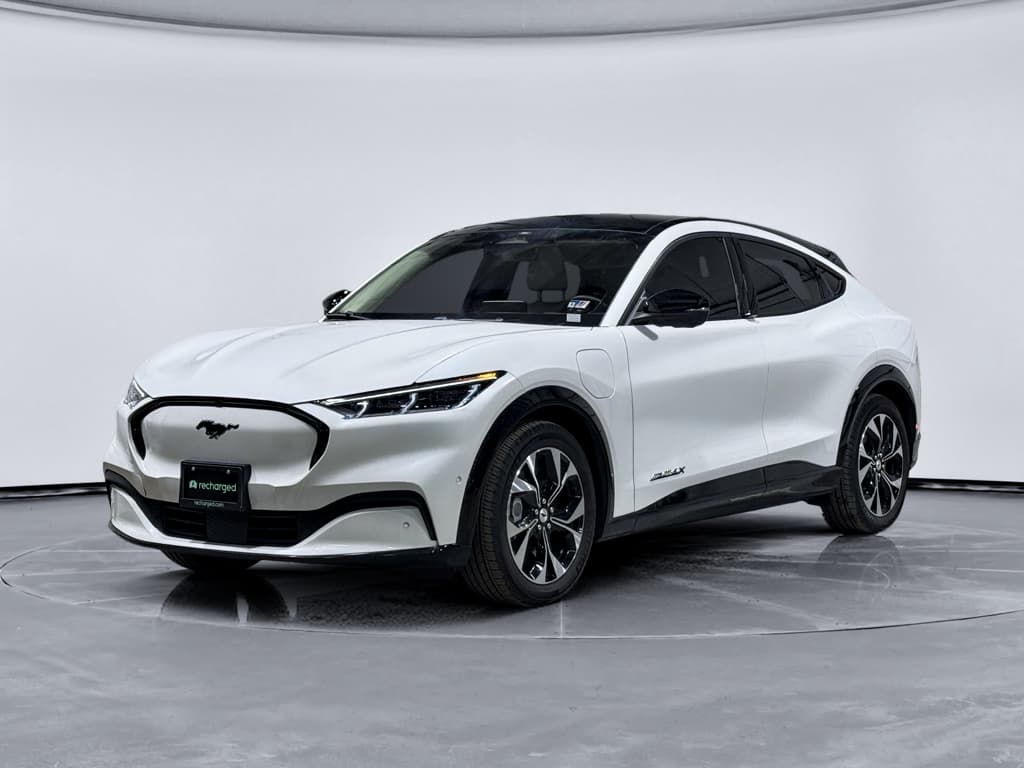
| Typical midsize crossover/SUV | Tesla Model Y, VW ID.4, Hyundai Ioniq 5 | 30 | 300 | ≈ $51 |
| Large 3-row SUV | Kia EV9, Mercedes EQS SUV | 40 | 400 | ≈ $68 |
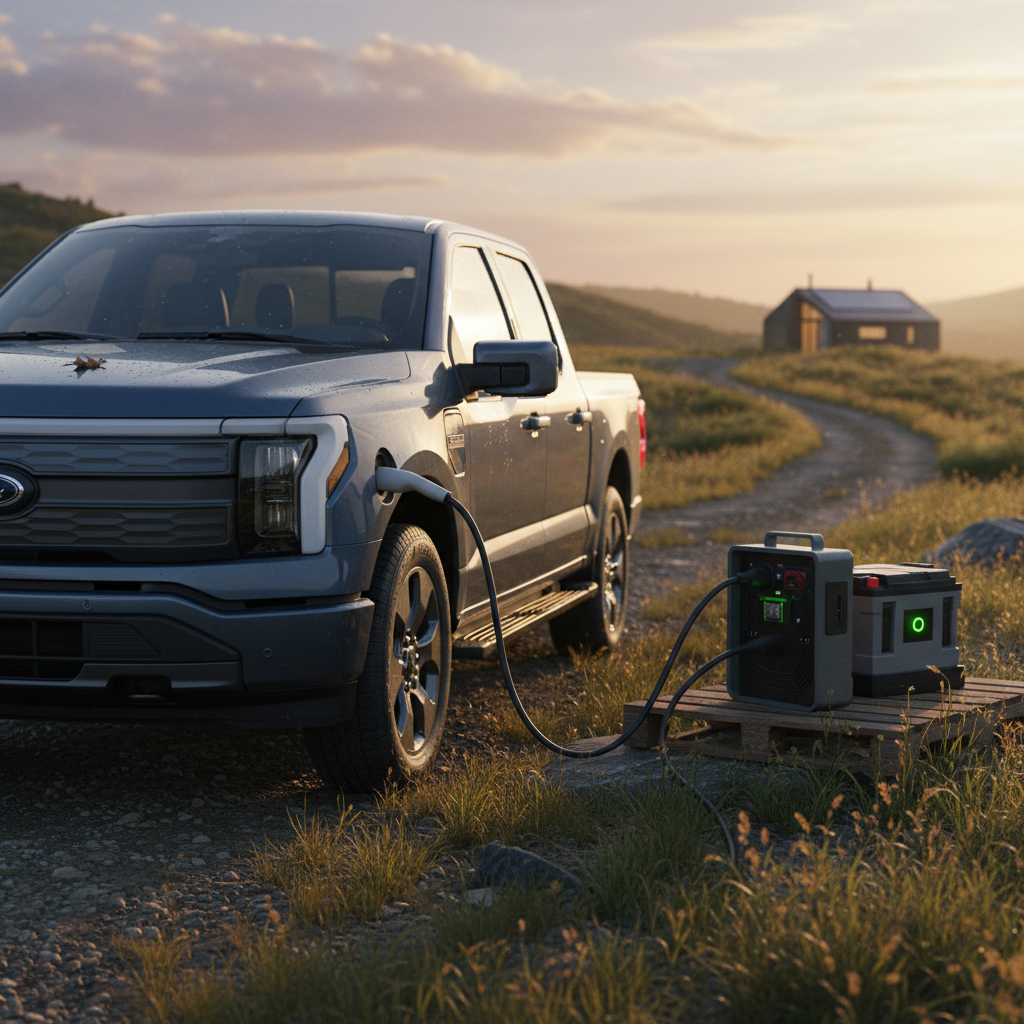
| Electric pickup | Ford F‑150 Lightning, Chevy Silverado EV, Rivian R1T | 50 | 500 | ≈ $85 |
| Very heavy or lifted truck | Hummer EV, off-road builds | 60+ | 600+ | $100+ |
Use this as a baseline, then swap in your EV’s efficiency and your own electric rate.
Why trucks cost so much more to charge
Light driver: 600 miles/month
If you only drive about 600 miles a month in a reasonably efficient EV (30 kWh/100 mi) at $0.17/kWh:
Cost ≈ (600 ÷ 100) × 30 × $0.17 ≈ $31/month.
That’s in the “forget it’s even there” category for many budgets.
Heavy commuter: 1,500 miles/month
Drive 1,500 miles/month in the same EV, same rate:
Cost ≈ (1,500 ÷ 100) × 30 × $0.17 ≈ $77/month.
Still typically far below what the average American spends on gasoline for that mileage.
How your electric rate changes the math
If those example numbers look nothing like what your neighbor is paying, it’s probably not the car, it’s the electric rate. In the U.S., the national residential average is around 17¢/kWh, but some states sit near 11¢ while others live in the 30–40¢ neighborhood. That spread can triple your monthly EV charging bill for the same car and mileage.
Same EV, three different electricity rates
1,000 miles/month in a 30 kWh/100 mi EV
Low-rate state
11¢/kWh (some Midwest/Northwest states)
Energy use: 300 kWh
Monthly cost ≈ $33
Average rate
17¢/kWh (recent U.S. average)
Energy use: 300 kWh
Monthly cost ≈ $51
High-rate state
32¢/kWh (parts of CA & New England)
Energy use: 300 kWh
Monthly cost ≈ $96
Check for off-peak or EV-specific rates
Does Level 1 or Level 2 change your monthly cost?
There’s a common misconception that a faster home charger (Level 2) is more “expensive” to run. In reality, electricity is billed by energy, not time. Whether you sip 20 kWh slowly overnight on Level 1 or gulp it in a couple hours on Level 2, the cost in kWh is the same.
Level 1 (120V household outlet)
- Adds ~3–5 miles of range per hour.
- Slow but fine for short commutes and plug-in hybrids.
- Same cost per kWh as any other home use.
The real limitation: you may simply not restore all the miles you drive in a day if you have a long commute.
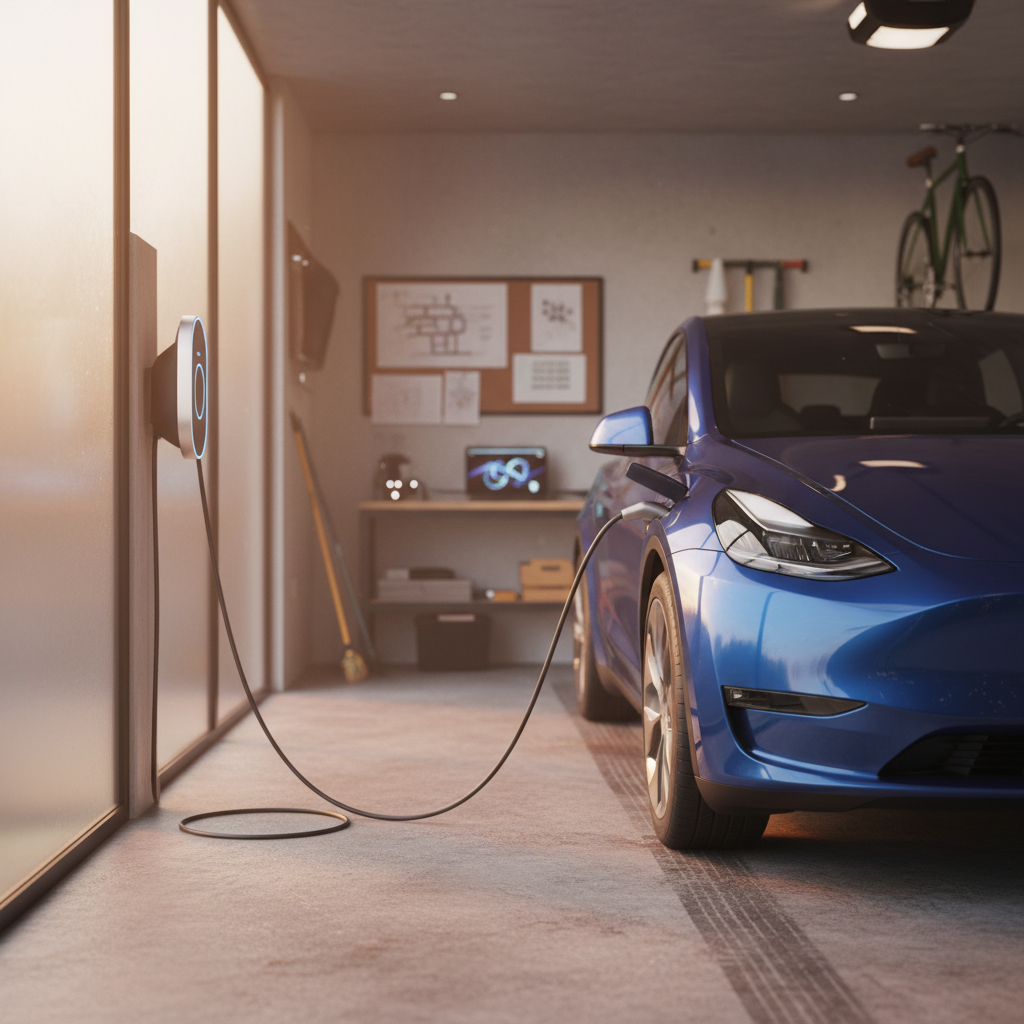
Level 2 (240V home charger)
- Usually 20–40+ miles of range per hour.
- Makes full overnight charges easy even for long commuters.
- Lets you schedule off-peak charging reliably.
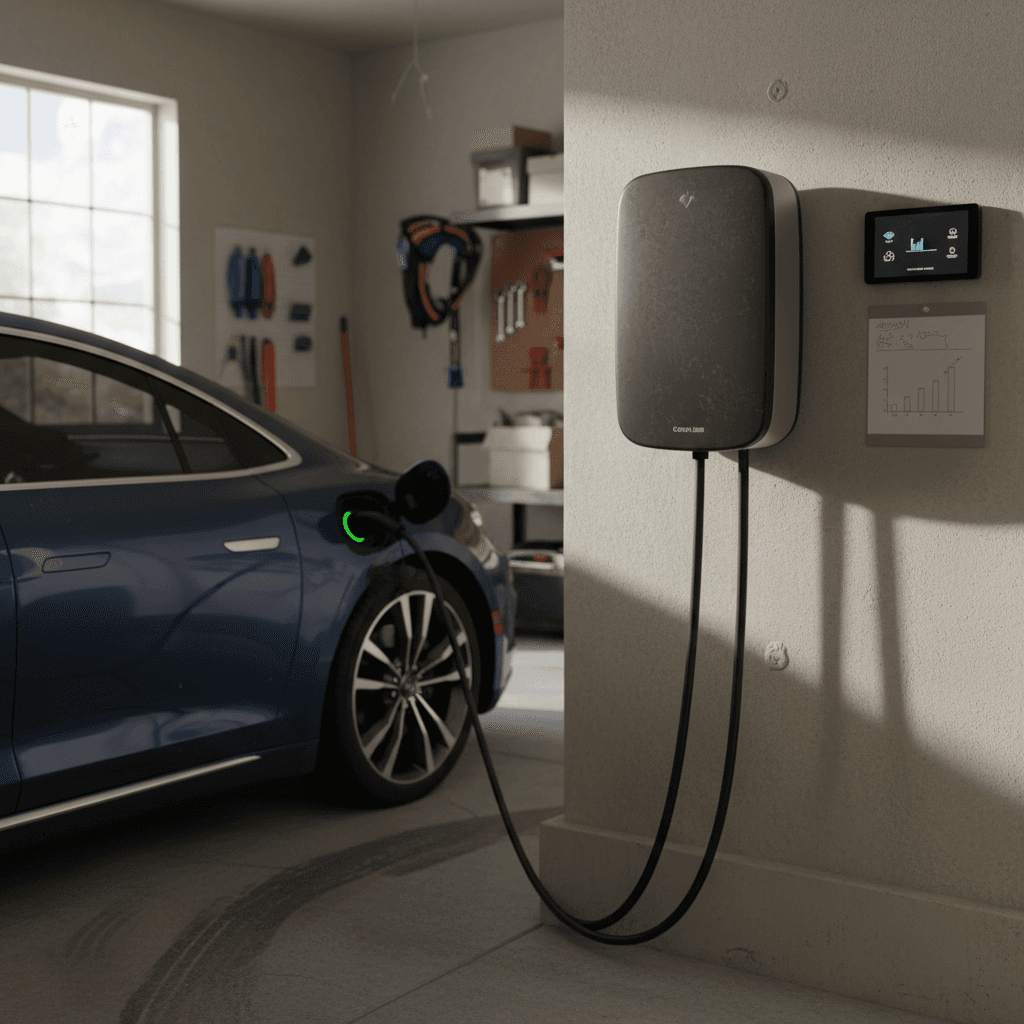
The installation and equipment cost more up front, but the monthly energy cost is the same per kWh. You’re just getting the energy faster.
Don’t DIY your 240V circuit
Six ways to lower your home EV charging bill
Practical ways to cut your monthly EV charging costs
1. Enroll in an EV or off-peak rate plan
Call or log into your utility account and see if they offer a <strong>time-of-use or EV-specific rate</strong>. If nights are significantly cheaper, set your car to start charging after the off-peak window begins.
2. Use built-in charge scheduling
Most EVs and many smart chargers let you schedule charging. Pair this with off-peak rates so your car automatically charges when electricity is cheapest, no late-night alarms required.
3. Keep tires inflated and drive smoothly
Underinflated tires and hard launches chew through energy. A calmer driving style and proper tire pressure can noticeably reduce kWh per 100 miles, especially on larger EVs and trucks.
4. Precondition while plugged in
In extreme heat or cold, use your EV’s preconditioning feature <strong>while the car is still charging</strong>. That energy comes from the grid, not the battery, so you waste less energy on the road.
5. Avoid unnecessary fast charging
DC fast charging away from home is convenient but usually much more expensive per kWh than residential rates. Treat it like you would overpriced highway gas, use it when you must, not by default.
6. Right-size your EV for your life
If you almost never haul heavy loads or tow, you’re paying in kWh for size and weight you don’t use. A smaller, more efficient EV can knock <strong>tens of dollars per month</strong> off your charging bill.
Where Recharged fits in
Ready to find your next EV?
Browse VehiclesEV home charging vs gas: monthly cost comparison
Knowing your monthly EV charging cost is good. Knowing what that replaces in gasoline spend is better. Let’s compare an electric crossover to a 30-mpg gas SUV over 1,000 miles per month.
Monthly cost: EV home charging vs gasoline
1,000 miles/month, 30 mpg gas car, 30 kWh/100 mi EV, $0.17/kWh home rate, $3.50/gal gas.
| Scenario | Key assumptions | Energy used per month | Approx. monthly cost |
|---|---|---|---|
| Gas SUV | 30 mpg, $3.50/gal gasoline | ≈ 33 gallons | ≈ $116 |
| EV crossover – low electric rate | 30 kWh/100 mi, $0.11/kWh | 300 kWh | ≈ $33 |
| EV crossover – average rate | 30 kWh/100 mi, $0.17/kWh | 300 kWh | ≈ $51 |
| EV crossover – high-rate state | 30 kWh/100 mi, $0.32/kWh | 300 kWh | ≈ $96 |
Even with today’s higher electricity prices in some regions, home EV charging is usually much cheaper per mile than gasoline.
In the best-case electricity scenario, you’re looking at roughly a 70% reduction in “fuel” cost versus the gas SUV. Even in an expensive electricity state, you often still come out ahead, just by a smaller margin. That’s why getting a handle on your rate plan is as important as picking the right EV.
Budgeting home charging when you’re buying a used EV
If you’re shopping for a used EV, your monthly home charging cost should sit right next to insurance and maintenance in your budget spreadsheet. The good news: EV energy use and battery health are fairly predictable once you have the right information.
Questions to ask before you buy a used EV
Get your monthly charging picture before you fall in love on the test drive.
How efficient is this specific EV?
Don’t just look at a generic “MPGe” number. Ask for the kWh per 100 miles rating for the trim and wheel size you’re considering. Bigger wheels and performance variants can use noticeably more energy.
What’s the battery health like?
A healthy battery doesn’t necessarily change monthly cost (kWh is kWh), but it does affect real-world range. That matters if you’re trying to avoid public fast charging, which is usually more expensive than home charging.
What’s my real home rate?
Take five minutes to pull a recent utility bill. Note the all-in price per kWh including fees, and whether any EV or time-of-use program is available.
Do I need a Level 2 charger now or later?
Some buyers over-spend on charging hardware they don’t immediately need. If your daily driving is light, you may start with Level 1 and add a Level 2 later once you understand your patterns.
Leaning on Recharged for the math
Frequently asked questions about EV home charging cost
EV home charging cost: quick answers
The bottom line on monthly EV home charging costs
When you strip away the mystery, how much it costs to charge an EV at home per month comes down to three knobs: how far you drive, how efficient your EV is, and what your utility charges for each kWh. For most U.S. drivers, that translates to something like $35–$90 per month, a line item that usually undercuts gasoline by a comfortable margin, especially if you can tap into off-peak or EV-specific rates.
If you’re new to EVs or shopping used, you don’t have to run the numbers alone. Recharged was built to make EV ownership simple and transparent, from Recharged Score battery health reports to expert guidance on real-world charging costs and financing. When you’re ready, you can browse used EVs, get an instant offer for your trade, and even arrange nationwide delivery, knowing exactly what your home charging bill is likely to look like once the car is in your driveway.