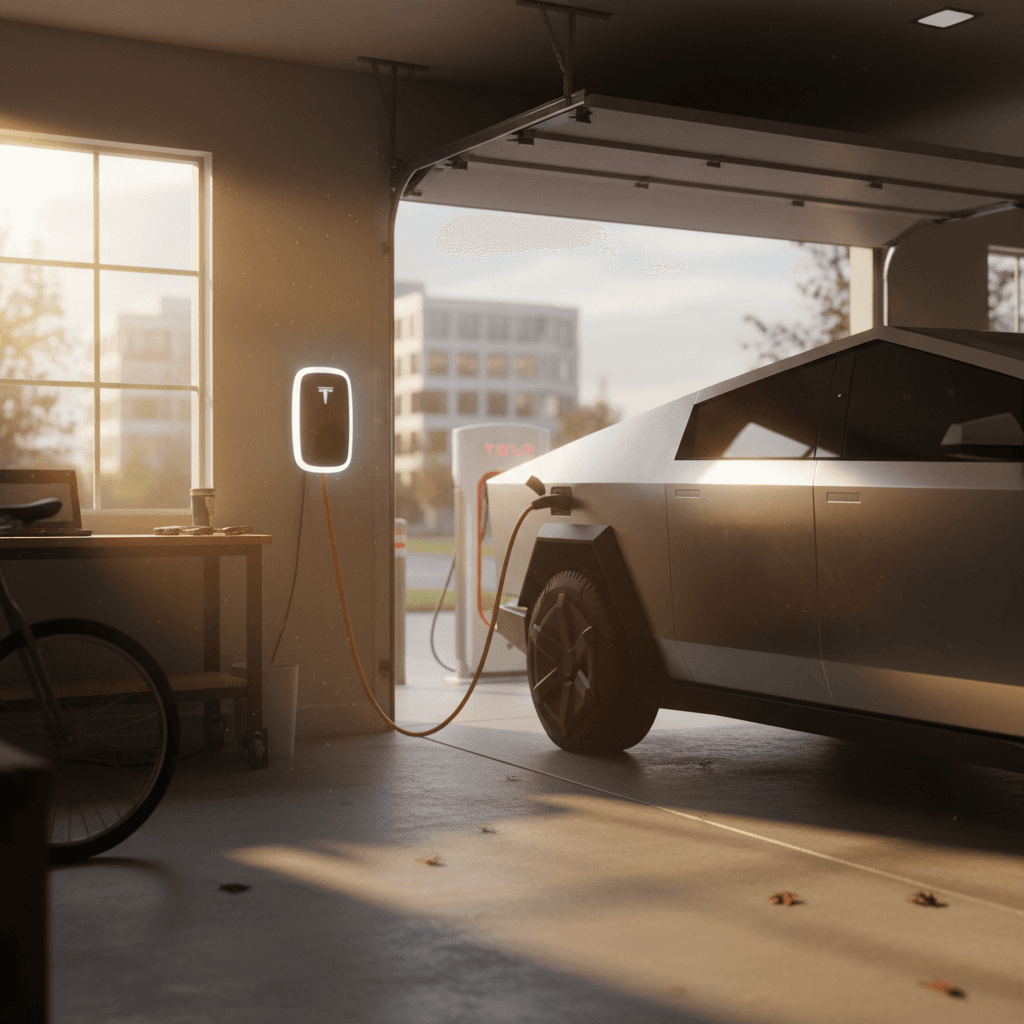
If you’re considering a Tesla Cybertruck, or you just took delivery, one of your first questions is probably **how long it takes to charge a Tesla Cybertruck** at home, at work, and on road trips. Because the Cybertruck is heavy, powerful, and packs a big battery, charging times look a bit different than a Model 3 or Model Y.
Quick answer
Tesla Cybertruck charging basics in 30 seconds
- Cybertruck battery is ~120–130 kWh depending on trim, far larger than most EVs.
- Onboard AC charger supports up to **11.5 kW** on a properly sized Level 2 circuit, similar to other Teslas.
- Cybertruck uses **NACS (Tesla connector)** and supports up to about **250–325 kW DC fast charging** at V3/V4 Superchargers.
- At home, most owners see **30–40 miles of range per hour** on a 240V Level 2 setup.
- On a Supercharger, Cybertruck can add **roughly 120–140 miles in about 15 minutes** under ideal conditions.
About the numbers in this guide
Key Cybertruck specs that affect charging time
Cybertruck specs that drive charging time
Large battery + strong onboard charger = long range but longer fill-ups
Big battery pack
11.5 kW onboard charger
800V DC fast charging
Usable vs. gross battery
Home charging times: Level 1 vs Level 2
At home, you control two main variables: **voltage** (120V vs 240V) and **amperage** (how many amps your circuit can safely deliver). Those determine how long it takes to charge your Tesla Cybertruck from empty or from your daily driving level back up to your target state of charge.
Level 1: 120V household outlet
This is the standard wall outlet in U.S. homes.
- Power: ~1.3–1.4 kW (120V × 12A typical)
- Speed: roughly 3–4 miles of range per hour on a Cybertruck
- 0–100% time: on the order of 80+ hours
- Best for: occasional top‑ups, very low daily mileage, or emergencies.
With a pack around 120+ kWh, Level 1 is simply too slow to be your primary solution unless you drive very little and charge every night.
Level 2: 240V circuit
This covers Tesla Wall Connectors and most home EVSEs running from a 240V breaker.
- Common sizes: 30A, 40A, 48A circuits
- Power range: ~5.8 kW (24A) up to ~11.5 kW (48A)
- Speed: about 20–40 miles of range per hour, depending on circuit size
- 0–100% time: roughly 11–20 hours depending on the circuit.
For most Cybertruck owners, **Level 2 is non‑negotiable** if you want true "set it and forget it" overnight charging.
Think in daily miles, not 0–100%
Tesla Wall Connector vs common outlets
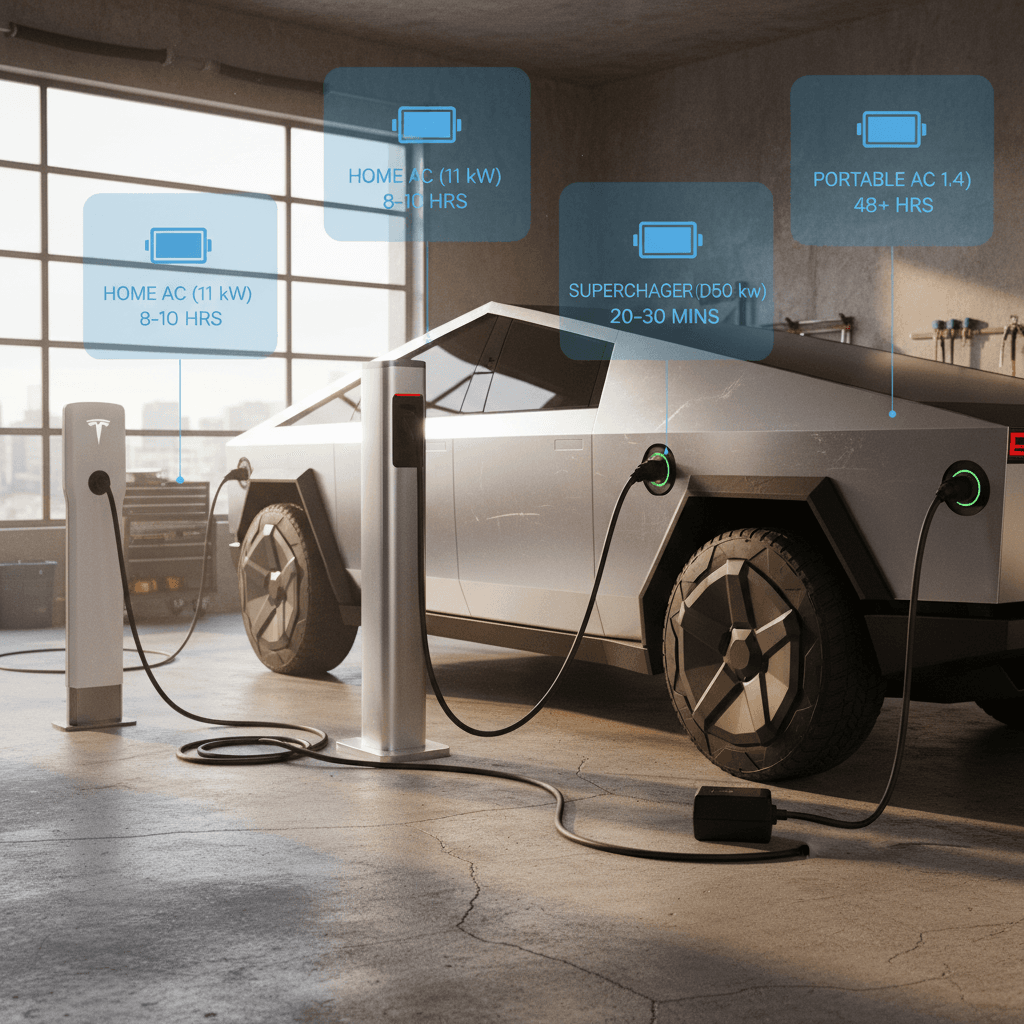
The same Cybertruck can charge at very different speeds depending on how you wire your garage. Here’s how long it takes to charge a Tesla Cybertruck on popular home setups, assuming ~122 kWh usable battery and charging from **10% to 80%** (about 70% of the pack, or ~85 kWh). Numbers are rounded to keep things practical.
Approximate Cybertruck home charging times by outlet
10–80% charging session (about 70% of pack, ~85 kWh) under typical conditions.
| Home setup | Voltage & amps (continuous) | Approx. power | Miles of range per hour* | Time 10–80% |
|---|---|---|---|---|
| Standard outlet (Level 1) | 120V / 12A | ≈1.4 kW | ≈3–4 mi/hr | ≈55–70 hours |
| NEMA 6-20 or 5-20 (dedicated 20A) | 120–240V / 16A | ≈3.8 kW (at 240V) | ≈10–12 mi/hr | ≈18–22 hours |
| NEMA 14-30 (older dryer outlet) | 240V / 24A | ≈5.8 kW | ≈15–18 mi/hr | ≈12–15 hours |
| NEMA 14-50 (RV / range outlet) | 240V / 32–40A** | ≈7.7–9.6 kW | ≈22–30 mi/hr | ≈8–11 hours |
| Tesla Wall Connector on 60A breaker | 240V / 48A | ≈11.5 kW | ≈30–40 mi/hr | ≈6.5–8.5 hours |
Exact times vary with temperature, driving efficiency, and electrical losses, but these ranges are realistic planning figures.
Asterisks explained
Supercharger & DC fast charging: real-world times
On road trips, you’ll rely on **DC fast charging**, primarily Tesla Superchargers in North America. Because Cybertruck uses a higher‑voltage architecture than Tesla’s older cars, it can hit **very high peak power** on the latest V3/V4 Superchargers. But what actually matters is **time from A to B**, not the biggest kW number on the screen.
Tesla Cybertruck DC fast‑charging at a glance
Fast part of the charge (10–50%)
From a low state of charge, Cybertruck can quickly climb into the **200–300+ kW** range on a strong Supercharger. That’s when you see the dramatic “100+ miles in 10–15 minutes” type numbers.
If you’re road‑tripping, this is your sweet spot: arrive low, leave when the curve starts to taper.
Slower top‑off (50–80%+)
As the battery fills up, charge power naturally tapers to protect longevity. Above ~50–60%, you’ll see the power step down, stretching out the last 20–30% of the charge.
That’s why most trip planners, Tesla’s included, aim for **multiple short charges to ~60–80%** instead of sitting for an hour to reach 100%.
Don’t plan around 0–100% DC sessions
How much range you add per hour of charging
Instead of thinking in percentages, it’s often easier to think in **miles of range added per hour** of charging. That’s what actually determines whether your overnight setup is enough for your commute, and how much time you’ll spend at Superchargers on road trips.
Approximate Cybertruck range added per hour
Assuming ~2.5–3.0 mi/kWh and mixed real‑world driving
Level 1 (120V)
- Power: ~1.4 kW
- Range: ≈3–4 miles per hour
- Use when: No 240V available; low daily miles.
Level 2 (240V, 30–48A)
- Power: ~5.8–11.5 kW
- Range: ≈15–40 miles per hour
- Use when: Primary home/work charging.
DC fast / Supercharger
- Power: typically 100–250+ kW sustained over much of the session
- Range: functionally 400+ miles per hour during the fast part of the curve
- Use when: Highway travel and long trips.
What most owners actually see
Charging time cheat sheet for Cybertruck
Here’s a consolidated cheat sheet for how long it takes to charge a Tesla Cybertruck in the scenarios most owners care about. Again, these are **ballpark, real‑world ranges**, not lab‑perfect numbers.
How long to charge a Tesla Cybertruck?
Typical charge times for common scenarios, assuming an AWD/Cyberbeast‑class pack around 120+ kWh and mixed driving efficiency.
| Scenario | Charger type | Start → End | Approx. time |
|---|---|---|---|
| Overnight at home, strong setup | Level 2, 240V / 48A Wall Connector | 10% → 80% | ≈6.5–8.5 hours |
| Overnight at home, 14‑50 outlet | Level 2, 240V / 32–40A | 10% → 80% | ≈8–11 hours |
| Workplace L2 during the day | Level 2, 240V / 30A | 30% → 80% | ≈5–7 hours |
| Emergency top‑off at home | Level 1, 120V outlet | 10% → 50% | ≈25–35 hours |
| Typical road‑trip stop | Tesla Supercharger (V3/V4) | 10% → 60% | ≈20–30 minutes |
| Longer highway leg | Tesla Supercharger (V3/V4) | 10% → 80% | ≈30–40 minutes |
Use this as a planning tool; your exact times will vary with temperature, elevation, speed, and how full the pack already is.
How to choose the right home charging setup
Checklist: picking a Cybertruck‑friendly home charger
1. Calculate your real daily miles
Look at a typical week and figure out your **average daily mileage**. Multiply that by two for some buffer. This is the range you need to comfortably replace overnight, not your entire pack size.
2. Check for existing 240V circuits
See whether you already have a nearby **NEMA 14‑30, 14‑50, or other 240V outlet** (dryer, range, RV). Adapters plus Tesla’s Mobile Connector or a Level 2 EVSE can often get you into the 7–9 kW range without a full panel upgrade.
3. Decide if you want full 11.5 kW
If you want the **fastest home charging Cybertruck allows**, plan for a Tesla Wall Connector or similar EVSE on a **60A breaker** (48A continuous). That’s usually enough to go from low SOC to your daily limit in a single night.
4. Plan for future EVs
If you might add a second EV, another Tesla or a non‑Tesla, consider a setup that supports **load sharing** or multiple ports. It’s often cheaper to oversize conduit and wiring now than to redo everything later.
5. Get a proper electrical inspection
A licensed electrician should confirm your panel capacity, breaker sizing, and wire gauge. Cybertruck can draw serious current; you want the installation done to code and with appropriate safety margin.
6. Use smart scheduling
Once your hardware is in place, use the Tesla app’s **scheduled charging** to target off‑peak hours or, if you’re on Tesla Electric in supported regions, take advantage of deals like **free overnight home charging** when available.
Don’t DIY big 240V circuits
Tips to charge faster and protect your battery
- **Aim for 10–80% on road trips.** You’ll spend less total time stopped by chaining shorter fast‑charging sessions instead of one big 10–100% session.
- **Use Level 2 for most charging.** Reserve DC fast charging for travel; rely on Level 2 at home or work for the bulk of your energy. It’s easier on the battery and your wallet.
- **Precondition before fast charging.** When you navigate to a Supercharger in the Tesla app or on the truck’s screen, Cybertruck will warm or cool the battery to the right temperature, improving DC charge speed.
- **Don’t fear daily charging.** Lithium‑ion packs actually prefer smaller, regular top‑ups over deep cycles. Keeping your daily limit around 70–85% is a good balance of range and longevity.
- **Watch your efficiency.** Aggressive driving, oversized tires, and heavy loads reduce mi/kWh, which in turn makes each hour of charging give you fewer miles of range. If your range per hour seems low, check your consumption numbers.
- **Take advantage of home energy plans.** Many utilities offer cheaper off‑peak rates. Combining a Cybertruck with the right time‑of‑use plan can materially cut your cost per mile, even if the charge time itself doesn’t change.
FAQ: Tesla Cybertruck charging times
Frequently asked questions about Cybertruck charging time
Bottom line: How long to charge a Tesla Cybertruck?
If you’re trying to figure out **how long it takes to charge a Tesla Cybertruck**, the honest answer is that it depends a lot on **where you plug in**. On a strong 240V Level 2 setup at home, most owners can comfortably go from a low state of charge to their daily limit in **one overnight session**. On the road, a modern Tesla Supercharger can get you from **nearly empty to road‑trip ready in well under an hour**, often in the time it takes to stretch, use the restroom, and grab food.
The bigger decision isn’t whether Cybertruck charges “fast enough”, it’s which **home charging setup** and **ownership experience** fit your life. If you’re exploring a Cybertruck or other used EV, platforms like Recharged can help you compare real‑world charging behavior, battery health, and total cost of ownership across vehicles, so you spend more time driving and less time watching a charger tick upward.