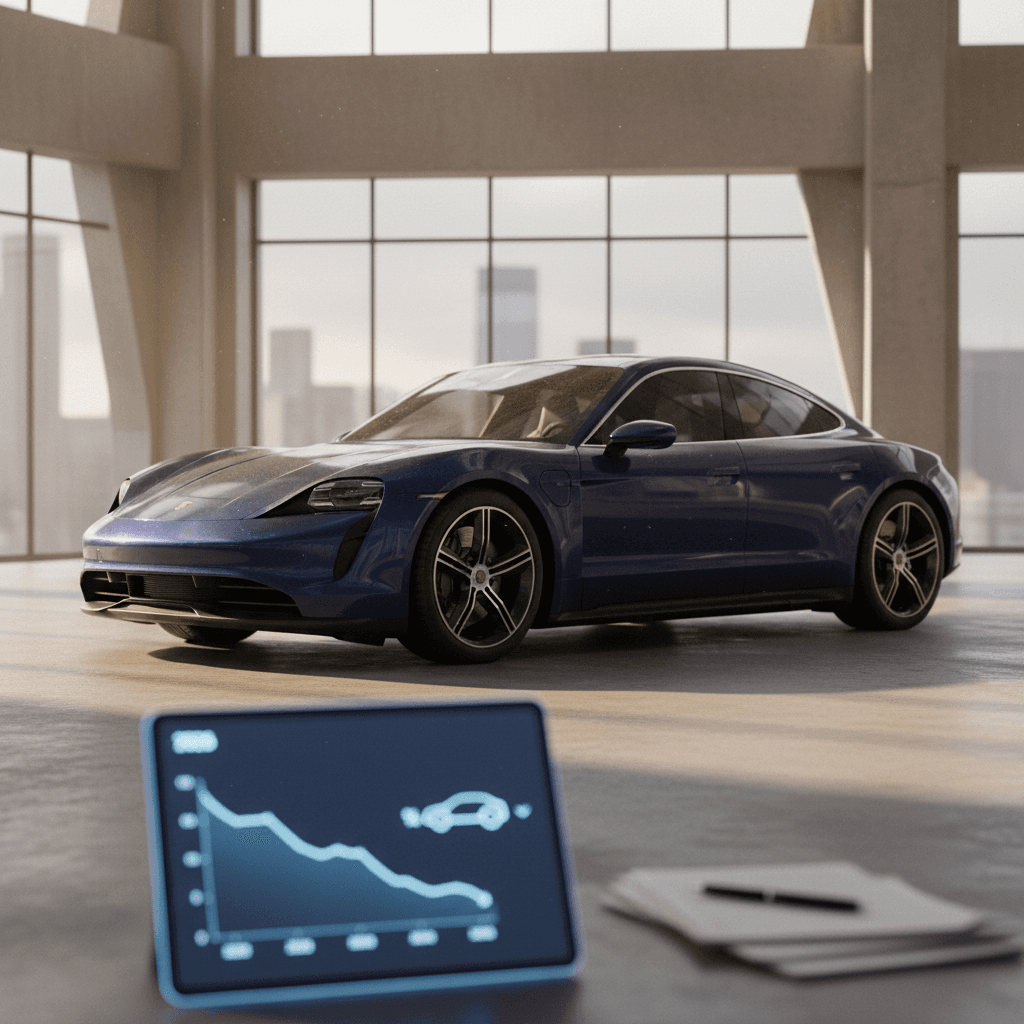
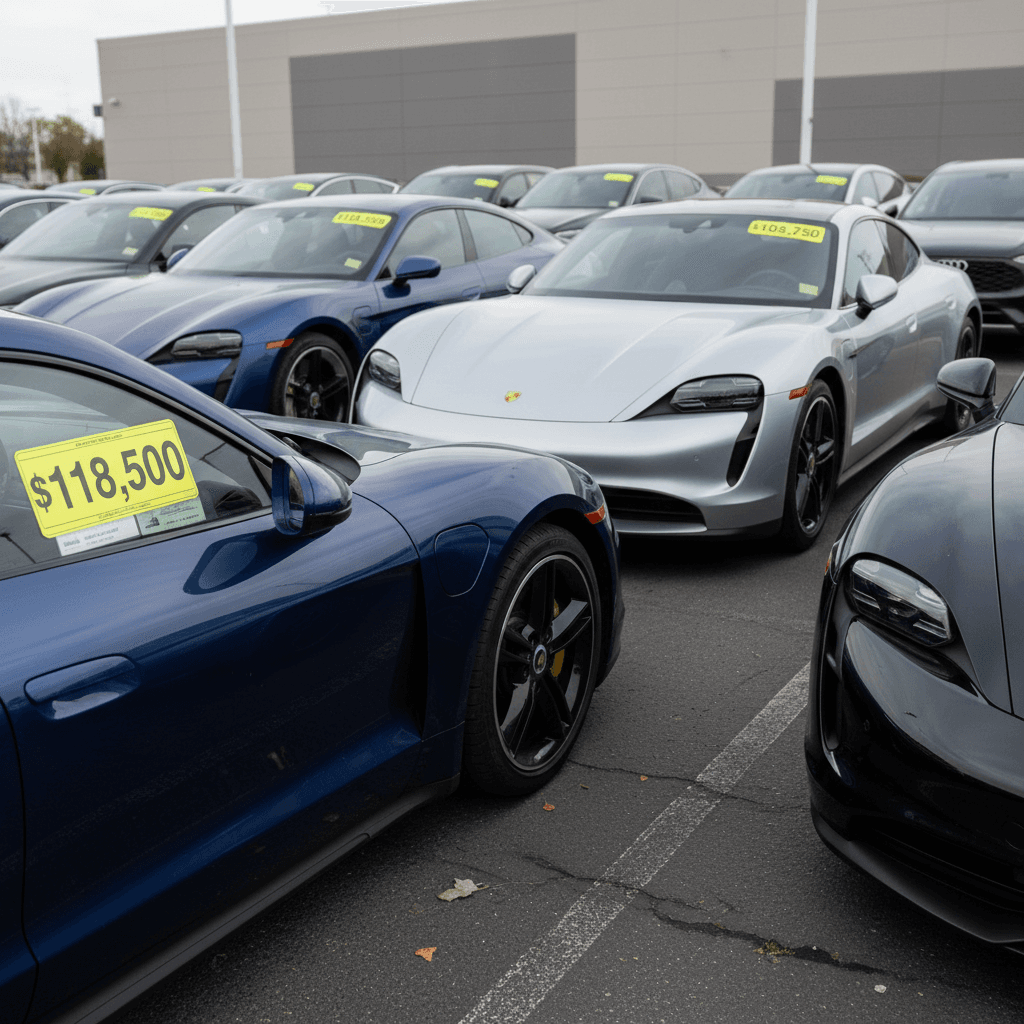
If you’ve looked at used listings lately, you already know the uncomfortable truth: the **Porsche Taycan depreciates fast**. Asking prices that started well into six figures just a few years ago are now showing up in the $60,000s and even below, depending on trim and miles. For some owners that’s painful. For savvy buyers, it’s an opportunity.
Big picture
Overview: How fast does a Taycan depreciate?
Typical Porsche Taycan depreciation at a glance
Those headline numbers can sound brutal, but they also hide a lot of nuance. A lightly optioned Taycan 4S that was discounted heavily when new will behave differently from a Turbo S ordered at full pop. The **way the first owner bought the car** (cash vs. lease, discounts, tax credits) matters almost as much as what the car is.
Think in dollars, not just percentages
Why does the Porsche Taycan depreciate so fast?
Four big forces behind Taycan depreciation
Luxury EV, high MSRP, and a fast-moving segment make for serious early drops.
1. High initial MSRP + options
The used market doesn’t pay anything close to dollar‑for‑dollar on those options, so loaded cars fall harder from their original MSRP.
2. Rapid EV tech evolution
3. Luxury EV stigma on resale
4. Incentives and discounting
Not all trims fall equally
Year-by-year Porsche Taycan depreciation
No two cars follow the exact same curve, but we can sketch out a **typical path** for a new Taycan purchased in the U.S. and then look at what that means if you’re buying used in 2025–2026. To keep the math manageable, let’s start with an example car that had a $120,000 sticker when new.
Illustrative Taycan depreciation curve (new $120,000 car)
This isn’t a quote sheet; it’s a realistic, directional example based on observed market behavior and cost‑to‑own models.
| Age | Estimated % of original MSRP | Approx. market value | What’s happening |
|---|---|---|---|
| Year 1 | ~70–80% | $84,000–$96,000 | First‑year hit as the car leaves "new" status and early incentives get priced in. |
| Year 2 | ~60–70% | $72,000–$84,000 | More lease returns and demos enter the market; heavy supply on higher‑volume trims. |
| Year 3 | ~50–55% | $60,000–$66,000 | Many Taycans sit **around half their original sticker** by year three, especially if miles are average. |
| Year 5 | ~40–45% | $48,000–$54,000 | Depreciation slows, but you’re still looking at roughly **55–60% total loss** from MSRP. |
| Year 8 | ~30–35% | $36,000–$42,000 | Battery warranty is expiring; value leans heavily on verified battery health and service history. |
Actual values depend on trim, miles, condition, incentives, and market timing, but the shape of the curve tends to look like this.
Kelley Blue Book’s cost‑to‑own modeling for a recent Taycan model year pegs 5‑year depreciation at **roughly the high‑50% range**, which lines up with this example. On the flip side, some trims and years have been discounted so aggressively from MSRP that early depreciation, measured from *transaction price*, can look less scary than the headline numbers suggest.
The “double whammy” to watch
Taycan vs. Tesla and other luxury EVs
Taycan vs. Tesla Model S
The natural comparison is the Porsche Taycan vs. Tesla Model S, because both are fast, expensive electric sedans. In one 5‑year retained‑value comparison, the Model S was shown losing around 65% of its value over five years, while the Taycan lost roughly 59%. On paper, that makes the Taycan look slightly better on depreciation.
In practice, though, Model S volumes are higher and the buyer pool is broader. Clean, low‑mile Taycans tend to attract a narrower audience, which can mean more price volatility but also some great bargains if you’re patient.
Taycan vs. gas Porsches and other EVs
Compared with a 911 or even a Panamera, the **Taycan typically depreciates faster in the early years**. The combination of luxury‑EV stigma and higher operating‑cost fears (out‑of‑warranty repairs, battery replacement myths) keeps used values under pressure.
Versus other luxury EVs, think Audi e‑tron GT, Mercedes‑Benz EQS, BMW i7, the Taycan is right in the thick of the pack: strong when new, steep early drops, then a slower glide once it finds its second or third owner.
Where the Taycan shines
How battery health affects Taycan resale value
With any EV, depreciation isn’t just about age and miles, it’s about **battery health**. For the Taycan, this is doubly true because replacement packs and high‑voltage repairs are expensive and buyers know it.
- Porsche’s U.S. high‑voltage battery warranty is **8 years or 100,000 miles**, which covers excessive capacity loss and defects.
- Many real‑world Taycan owners report **modest degradation** in the first 3–5 years when the car is driven and charged normally.
- Edge‑case failures, things like bricked packs or control‑module issues, make headlines and forum posts, but they are not the norm.
- Once the car ages out of the battery warranty, **proof of remaining capacity** becomes a major lever on resale value.
Why Recharged insists on a battery health report
What this depreciation means if you buy new vs. used
New Taycan vs. used Taycan: how depreciation hits you
Same car, very different ownership math depending on when you step in.
Buying new (years 0–5)
- Pros: You pick the exact spec, enjoy full warranties, and experience the car at its best.
- Cons: You eat that 20–30% first‑year hit plus the bulk of the five‑year depreciation yourself.
- Best for: Long‑term owners planning to keep the car 8+ years, or buyers who simply want what they want and accept the cost.
Buying 2–4 years used
- Pros: Someone else already paid for the steepest drop; prices often settle around **45–55% of original MSRP**.
- Cons: You inherit someone else’s options and color choices; you must be picky about history and battery health.
- Best for: Value‑minded enthusiasts who care more about how the car drives than what its original sticker was.
The sweet spot for many buyers
Real-world scenarios: what you might actually lose
Let’s walk through a couple of real‑world‑style scenarios so you can translate percentages into something that feels like your bank account instead of a spreadsheet.
Sample ownership scenarios
Scenario 1: New Taycan 4S, 5 years
You buy a new Taycan 4S in 2026 with a $120,000 sticker and modest discounts. Five years later, typical market behavior suggests it might be worth **around $50,000–$55,000** if miles and condition are average. You’ve effectively burned **$65,000–$70,000** in depreciation alone, before insurance, tires, and service.
Scenario 2: 3‑year‑old Taycan today, keep 5 years
Instead, you buy a 3‑year‑old Taycan in 2026 that originally stickered for $120,000 but now trades in the low $60,000s. You keep it for five more years, out to year eight of the car’s life. If it lands near **$35,000–$40,000** then, you’ve lost roughly **$20,000–$25,000** to depreciation over your tenure, less than half of Scenario 1.
Scenario 3: High‑spec Turbo kept short‑term
You stretch for a nearly new Turbo or Turbo S, paying, say, $150,000. You decide to sell in three years. Even if the car still feels spectacular, a realistic resale in the **$70,000–$80,000** range isn’t hard to imagine in this market. That’s **$70,000+ gone** in three years if you bought near MSRP and don’t time the market perfectly.
Short‑term ownership is where people get hurt
How to shop for a used Taycan without getting burned
The good news is that **steep early depreciation turns into a buying advantage** if you arrive at the right moment, ask the right questions, and lean on real battery data instead of hope and screenshots.
Used Taycan buying checklist
1. Target 2–4 years old
This is where the price drop has done most of its work, but you still have several years of battery warranty left. A 2022 or 2023 car bought in 2026 usually hits a nice balance of value and remaining coverage.
2. Verify battery health, don’t guess
Ask for a recent **battery health report** or capacity test rather than trusting “it charges fine.” On Recharged, the Taycan’s Recharged Score includes this data so you can compare cars objectively.
3. Read the service history closely
Look for consistent dealer or specialist maintenance, software updates, and any high‑voltage work. A car that’s had its recalls and campaigns handled on time is a better long‑term bet.
4. Be realistic about options
Porsche options don’t hold anywhere near 100 cents on the dollar. Carbon ceramic brakes, wild paint‑to‑sample colors, and special interior trims are fun, but don’t pay a massive premium unless they matter deeply to you.
5. Cross‑shop trims with your use case
A Taycan 4 or 4S might be more than quick enough for you and cheaper to buy and insure than a Turbo. Don’t let the spec sheet talk you into performance you’ll never use if it means kneecapping your budget.
6. Factor in long‑term exit value
Before you buy, sketch your own exit plan. Will you keep the car to the end of the battery warranty, or longer? A solid plan helps you choose the right age and mileage today so you aren’t forced into a fire‑sale later.
Where Recharged fits in
Ready to find your next EV?
Browse VehiclesIs the Porsche Taycan a good used buy?
The Taycan is one of those cars where the emotional and rational stories collide. On paper, it’s a high‑depreciation luxury EV with complex hardware and serious repair costs if things go badly. Behind the wheel, it’s one of the most satisfying electric cars you can buy, period.
When a used Taycan makes sense
- You’re buying **after the steepest depreciation**, ideally years 2–4.
- You care about driving feel and build quality more than having the latest spec sheet bragging rights.
- You have a plan for ownership length and know you can absorb normal EV maintenance.
- You value **transparent battery data and a clean history** enough to walk away from cars that don’t have it.
When you should probably pass
- You plan to flip the car again in 1–2 years and hate the idea of losing money.
- You’re stretching to make the payment work and have no margin for unexpected repairs.
- You’re uneasy about EVs in general and hoping this car will change your mind.
- You expect a Taycan to behave, financially, like a Camry. It won’t.
So **how fast does a Porsche Taycan depreciate?** Fast enough that buying new and trading often will sting, but also fast enough that a smart used buyer in 2025–2026 can end up with an astonishing amount of car for the money. If you’re considering a Taycan, do it with clear eyes: insist on verified battery health, understand the depreciation curve you’re stepping into, and use marketplaces like Recharged that are built to make those pieces transparent.