If you’re looking at a new compact electric SUV, the obvious question is: how fast does the Chevrolet Equinox EV depreciate? With EV prices whipsawing, incentives shifting, and new models arriving every quarter, understanding depreciation is the difference between a smart Equinox EV move and lighting thousands of dollars on fire.
Quick context
Chevy Equinox EV depreciation at a glance
Chevy Equinox EV: early depreciation snapshot (U.S. market)
Those numbers won’t be perfect for every trim or buyer, but they’re a realistic starting point for thinking about how quickly an Equinox EV might lose value compared with both gas crossovers and other EVs.
What we actually know so far about Equinox EV pricing
To make sense of depreciation, you first need a handle on what Equinox EVs actually cost in the real world, not just the headline “from $34,995” price GM likes to highlight.
Chevy Equinox EV pricing reality check
MSRP is just the starting point for depreciation math
MSRP & trims
For 2025, Chevy positions the Equinox EV as a relatively affordable compact electric SUV. Many U.S. buyers will see window stickers in the mid‑$30,000s to mid‑$40,000s depending on LT vs RS trim and options.
Incentives & rebates
Depending on your income and tax situation, a new Equinox EV may qualify for federal and state EV incentives. That effectively lowers your real purchase price even though the book value still starts from MSRP.
Dealer discounts & supply
In some regions, especially where dealers ordered heavy inventory, buyers are already seeing discounts, aggressive leases, or bonus cash on Equinox EVs. That’s great for buyers, less great for long‑term resale.
Put simply: two people can buy nominally identical Equinox EVs but start from very different effective prices. The one who stacked incentives and discounts has a built‑in depreciation buffer. The one who paid full sticker, or signed a fat lease on hype day, doesn’t.
How fast does the Chevrolet Equinox EV depreciate?
- GM’s and KBB’s cost‑to‑own modeling for the 2025 Equinox EV.
- Fresh data showing that EVs as a segment are now losing roughly 55–60% of value in 5 years in the U.S. market.
- Chevy’s own history with the Bolt EV, which has seen 5‑year depreciation in the roughly 55–60% range after prices were cut.
Projected Chevrolet Equinox EV depreciation
Illustrative projections for a typical 2025–2026 Equinox EV LT purchased new near MSRP, assuming average U.S. mileage and stable incentives.
| Ownership duration | Estimated value loss vs MSRP | Estimated value retained | What that means in practice |
|---|---|---|---|
| 1 year | ~25–30% | ~70–75% | Early‑year EV depreciation is steep. A $40,000 Equinox EV might be worth $28,000–$30,000 after year one. |
| 3 years | ~45–55% | ~45–55% | By year three, many EVs are trading around half of original sticker, especially if new‑car incentives stay strong. |
| 5 years | ~60–65% | ~35–40% | KBB’s model for the 2025 Equinox EV implies roughly mid‑60% cumulative depreciation, similar to many mass‑market EVs. |
These are high‑level estimates, not guarantees. Real‑world resale depends heavily on incentives, mileage, condition, battery health, and local demand.
These are forecasts, not guarantees
If those ranges hold, the Equinox EV will depreciate faster than a typical compact gas SUV, but roughly in line with other volume EVs that don’t have a premium badge or cult‑like following.
Why the Equinox EV may depreciate faster or slower than average
Forces that could accelerate depreciation
- Rapid tech change: As newer GM EVs arrive with longer range, faster charging, or better software, older Equinox EVs can feel outdated faster than a comparable gas Equinox.
- Heavy incentives on new EVs: If GM keeps discounting new stock or bundling low‑APR financing, used prices get pulled down.
- High supply from fleets and leases: If lots of 2‑ or 3‑year lease returns hit the market at once, values drop until the pipeline clears.
- Policy whiplash: Changes to tax credits (especially used‑EV credits) can suddenly make a 3‑year‑old Equinox EV more or less attractive overnight.
Forces that could slow depreciation
- Reasonable starting price: The Equinox EV is already priced more aggressively than many early EVs, leaving less room for a catastrophic collapse.
- Compact SUV sweet spot: Americans love compact crossovers. If charging keeps improving, used‑Equinox‑EV demand should stay healthier than for quirky niche EVs.
- Improving battery confidence: If Equinox EV packs age gracefully and avoid high‑profile recalls, buyers and lenders will get more comfortable with older examples.
- Gas price volatility: Another spike in fuel prices tends to make efficient EV crossovers more desirable, supporting resale.
Think in scenarios, not single numbers
Tax credits, discounts and how they distort depreciation
- Loss from MSRP: What valuation tools measure, how far today’s price is from the original sticker.
- Loss from what you actually paid: The number that matters to your wallet.
How to think clearly about Equinox EV depreciation
1. Separate MSRP from your net price
Start with the window sticker, then subtract federal and state incentives you actually receive, plus any dealer discounts or manufacturer cash. That’s your true cost basis.
2. Compare resale to your cost basis
If valuations in 5 years say your Equinox EV is worth $15,000, the impact is very different if you effectively paid $40,000 vs $30,000.
3. Remember opportunity cost
Heavy early depreciation doesn’t automatically make an EV a bad deal if your fuel and maintenance savings are large enough. Look at <strong>total cost of ownership</strong>, not just resale.
4. Watch policy changes
Congressional tweaks to EV credits, and state‑level programs, can reshape both new and used demand. Check current rules when you buy, and again when you’re thinking about selling.
Good news for savvy buyers
Leasing vs buying to manage Equinox EV depreciation
Given how volatile EV values have been since 2022, leasing a Chevrolet Equinox EV is basically outsourcing depreciation risk to GM Financial. That can be smart, but not for everyone.
Leasing vs buying a Chevrolet Equinox EV
How each strategy handles depreciation risk
Leasing an Equinox EV
- Upside: GM (or the lessor) takes the residual‑value risk. If EV resale tanks, you hand back the keys.
- Cash‑flow friendly: Lower payments than a short‑term loan, especially if the captive finance arm passes the federal credit into the lease.
- Downside: You never capture any upside if the Equinox EV holds value better than expected. You also face mileage limits and wear‑and‑tear charges.
Buying an Equinox EV
- Upside: You own the depreciation curve. If the model ends up being desirable used, good range, solid reliability, you can benefit.
- Flexibility: Easier to sell or trade early if your needs change.
- Downside: You’re fully exposed if the market re‑prices EVs again (for example, if cheaper GM EVs with better specs hit showrooms quickly).
A simple rule of thumb
How to protect your Equinox EV’s resale value
You can’t control the entire EV market, but you can absolutely influence where your individual Equinox EV lands within that depreciation range.
Practical ways to slow Equinox EV depreciation
Pick the right trim and options
Mainstream colors, mid‑level LT or nicely‑equipped RS trims, and popular comfort packages tend to be easier to sell than oddball specs or bare‑bones fleet builds.
Stay on top of service and recalls
Keep digital and paper records of every service visit and recall fix. EV‑savvy buyers and lenders want proof that software updates and campaigns are up to date.
Mind mileage and usage patterns
EVs tolerate miles well, but a 5‑year‑old Equinox EV with 120,000 miles will still be a harder retail sell than one with 65,000 miles and a gentle commute history.
Protect the interior & exterior
Crossovers live hard lives with kids, pets, and gear. Regular detailing and basic paint protection can move your car up a price band when you go to sell.
Optimize charging habits
Mostly charging at home on Level 2, avoiding frequent DC fast charging and minimizing time spent at 100% state of charge can support healthier long‑term battery data.
Sell into the right channel
A clean, well‑documented Equinox EV with strong battery health may do better on an EV‑focused marketplace like <strong>Recharged</strong> than as a random trade‑in at a non‑EV‑specialist store.
Battery health: why it matters more than the odometer
With EVs, depreciation isn’t just about age and miles. It’s about how much usable battery capacity the car still has. Two Equinox EVs with identical odometers can have very different market values if one pack has lived on DC fast charging and the other has had an easy home‑charging life.
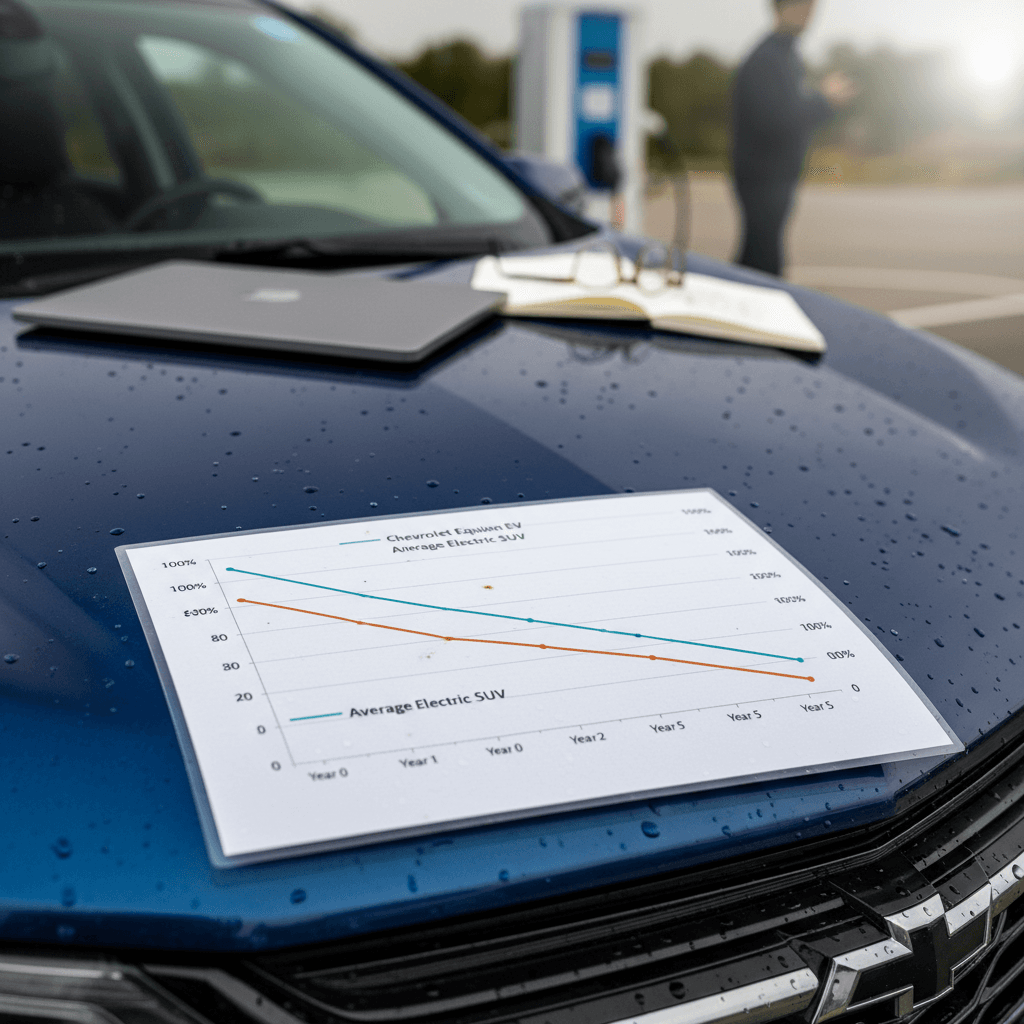
That’s why Recharged builds every listing around a Recharged Score that includes verified battery diagnostics rather than just mileage and cosmetics. For an Equinox EV, seeing strong state‑of‑health (SOH) numbers can justify a higher asking price and make lenders more comfortable with longer loan terms.
Don’t ignore battery data when buying used
Is a used Chevrolet Equinox EV a good buy?
If today’s EV trend continues, the Equinox EV is likely to be one of those vehicles that’s brutal to own new but compelling to buy used. Heavy front‑loaded depreciation, plus aggressive incentives on newer models, tends to push 3–5‑year‑old examples into a relative bargain zone.
Why used buyers may win
- Someone else has eaten that initial 40–60% loss from MSRP.
- You still get a modern compact SUV with competitive range and DC fast‑charging speeds.
- If you buy through an EV‑specialist like Recharged, you get transparency on battery health, pricing, and history.
Risks to manage
- Early‑build software or hardware quirks may not be fully ironed out in first‑year models.
- Out‑of‑warranty repairs on high‑voltage components can be costly if they’re not covered by state or OEM programs.
- Future GM EVs on the same platform could reset price expectations if they’re dramatically better for the money.
How Recharged fits in
Chevy Equinox EV depreciation FAQ
Frequently asked questions about Equinox EV depreciation
Bottom line: what Equinox EV depreciation means for you
The Chevrolet Equinox EV is shaping up to be a solid, mainstream electric SUV with depreciation that’s neither best‑in‑class nor catastrophic, roughly in line with the current EV pack. Expect something like 45–55% value loss in three years and around 60–65% over five, but remember that your effective loss depends heavily on what you actually pay and how you treat the car.
If you buy smart, stacking incentives, choosing a broadly appealing spec, and caring for the battery, you can keep Equinox EV depreciation from becoming a financial gut punch. And if you’d rather let someone else absorb the ugly part of the curve, keep an eye on EV depreciation trends and consider shopping for a used Equinox EV on Recharged once a few model years are in the books.