You don’t need a fancy app to figure out whether a gas or electric car will be cheaper for you in 2026. With a simple **gas vs electric car calculator**, built from a few realistic assumptions about fuel economy, electricity rates, and how you drive, you can get to a solid answer in 10 minutes and a couple lines of math.
2026 cost snapshot
Why you need a 2026 gas vs electric car calculator
Car commercials will tell you everything except what you really care about: **what will this thing cost me to drive, year after year?** A 2026 gas vs electric car calculator makes the decision less emotional and more numerical. Instead of guessing, you can compare a gas car and an EV using your own commute, your own fuel prices, and your own budget timeline.
What a good gas vs electric calculator actually tells you
It’s not just about today’s gas price, it’s about the next five years.
Real cost per mile
Annual and 5‑year fuel spend
Payback period
In this guide, you’ll get simple formulas you can drop into a spreadsheet or a notes app. We’ll walk through **realistic 2026 assumptions**, show a **5‑year ownership example**, and call out **extra factors for used EVs**, like battery health and financing.
Key 2026 assumptions: gas prices, electric rates, and efficiency
Typical 2026 U.S. numbers for your calculator
You’ll want to plug in your **local** numbers, but you need a starting point. For a rough 2026 calculator, you can safely use: - **Gas price:** $4.00 per gallon (national ballpark; many states are higher) - **Home electricity:** $0.18 per kWh - **Gas car efficiency:** 30 mpg (compact/small SUV). If you drive a truck or big SUV, 20–25 mpg is more honest. - **EV efficiency:** 3.0–3.5 miles per kWh for a crossover or sedan. - **Miles per year:** 12,000–15,000 for a typical American driver. Grab your last gas receipt or utility bill and swap in your actual prices when you’re ready to calculate.
Pull real numbers in 2 minutes
Step 1: Calculate gas car cost per mile
Let’s start with the familiar. To figure out what your gas car really costs to fuel, you just need **what you pay per gallon** and **your MPG**. Here’s the basic formula to put in a spreadsheet or calculator:
Gas car cost‑per‑mile formula
Use this in any spreadsheet or calculator app.
| Variable | Meaning | Example 2026 value |
|---|---|---|
| Gas price per gallon | What you pay today for regular gas | $4.00 |
| MPG | Your real‑world combined miles per gallon | 30 mpg |
| Gas cost per mile | Gas price ÷ MPG | $4.00 ÷ 30 = $0.133 / mi (13.3¢) |
You can flip this formula around to figure out what MPG a gas car would need to match your EV’s running cost.
If you’re more of a plain‑English person, think of it like this: **take what you pay at the pump and spread that cost across every mile.** That’s the only number that matters when you line it up against an EV.
Highway vs city matters less than you think
Step 2: Calculate EV cost per mile
For an EV, the math looks different but feels the same. Instead of gallons and MPG, you’re working with **kilowatt‑hours (kWh)** and **miles per kWh**. Here’s the parallel formula:
EV cost‑per‑mile formula
Same idea as the gas formula, just with electricity.
| Variable | Meaning | Example 2026 value |
|---|---|---|
| Electricity price per kWh | Your home rate for electricity | $0.18 |
| Miles per kWh | Your EV’s efficiency (mi/kWh) | 3.2 mi/kWh |
| EV cost per mile | Electricity price ÷ miles per kWh | $0.18 ÷ 3.2 ≈ $0.056 / mi (5.6¢) |
Most EVs will land somewhere between 3.0 and 4.0 miles per kWh in daily driving.
With those assumptions, you’re looking at **13.3¢ per mile for gas** vs **5.6¢ per mile for electric**. Over a year of 12,000 miles, that’s the difference between **about $1,600** in gas and **about $670** in electricity, nearly a **$1,000 gap every year** before you’ve even touched maintenance or oil changes.
Public fast charging changes the math
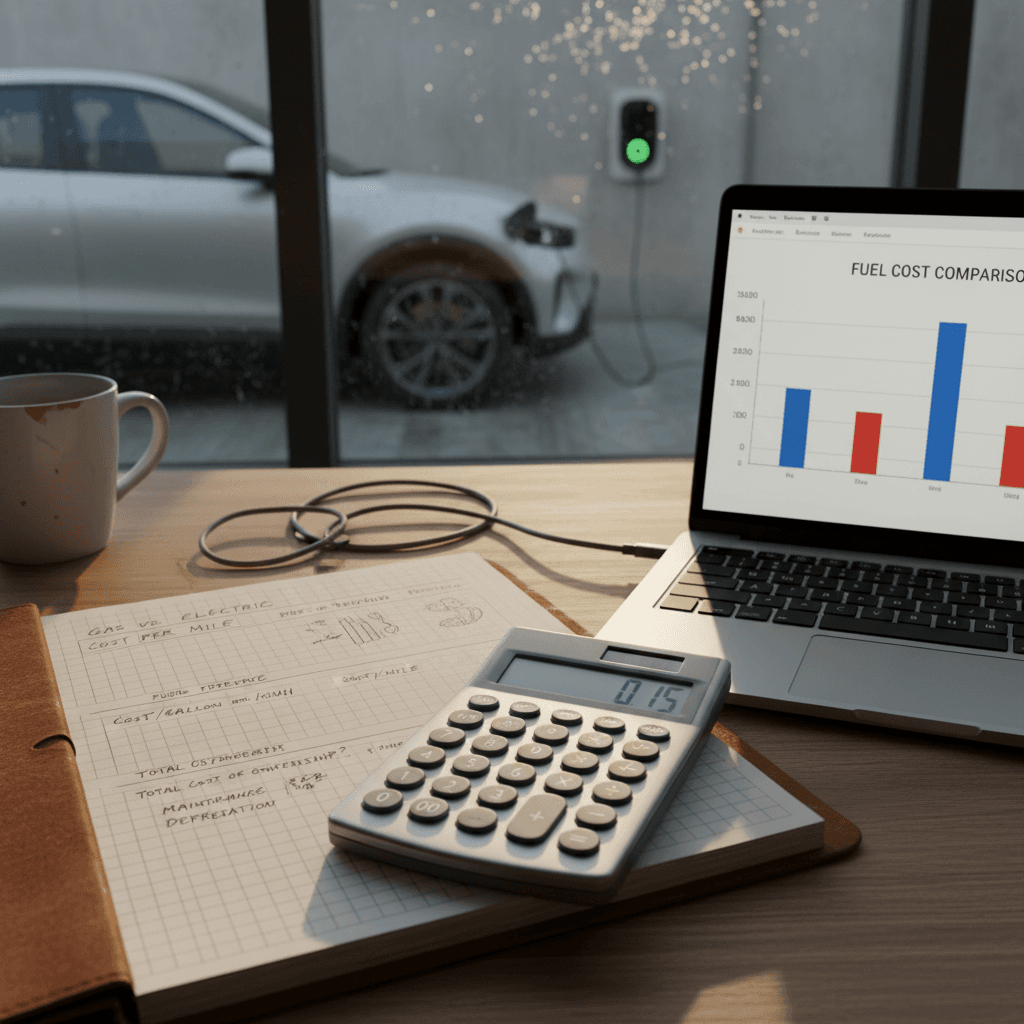
Step 3: Build your own gas vs electric car calculator
Column setup (in any spreadsheet)
- Input cells
- Gas price per gallon
- Gas car MPG
- Electricity price per kWh (home)
- EV miles per kWh
- Miles driven per year
- Calculated cells
- Gas cost per mile
- EV cost per mile
- Gas annual fuel cost
- EV annual fuel cost
- Annual savings with EV
Sample formulas (plain language)
- Gas cost per mile = gas price per gallon ÷ gas MPG
- EV cost per mile = electricity price per kWh ÷ EV miles per kWh
- Gas annual fuel cost = gas cost per mile × miles per year
- EV annual fuel cost = EV cost per mile × miles per year
- Annual savings with EV = gas annual fuel cost − EV annual fuel cost
Once that’s working, add purchase price, financing, and maintenance to turn it into a full **total cost of ownership** calculator.
Shortcut: use an online cost‑per‑mile calculator, then tweak it
5-year ownership example: gas vs electric in 2026
Let’s put the math to work. Imagine you’re choosing between a well‑equipped gas compact SUV and a similar used electric crossover in 2026. We’ll keep the numbers clean and focus on **fuel + basic maintenance** over five years.
Example: 5‑year cost comparison (12,000 miles/year)
These are ballpark numbers to illustrate the method, not quotes for any specific model.
| Line item (per year) | Gas SUV (30 mpg, $4/gal) | Electric crossover (3.2 mi/kWh, $0.18/kWh) |
|---|---|---|
| Miles driven | 12,000 | 12,000 |
| Fuel / energy cost per mile | $0.133 | $0.056 |
| Annual fuel / energy cost | ≈ $1,600 | ≈ $670 |
| Oil changes & basic engine service | ≈ $250 | $0 (no oil) |
| Other maintenance (tires, cabin filter, brake fluid) | ≈ $250 | ≈ $250 |
| Total running cost per year | ≈ $2,100 | ≈ $920 |
| Total running cost over 5 years | ≈ $10,500 | ≈ $4,600 |
You can recreate this same table with your own purchase price, MPG, electricity rate, and maintenance schedule.
Even if the EV costs **$4,000–$6,000 more up front**, the **5‑year fuel and basic maintenance savings of roughly $6,000** can cover most or all of that gap, especially if you finance the car and spread the higher purchase price over the same five years.
Use monthly numbers if that’s how you budget
How used EVs change the math (and why battery health matters)
New‑car comparisons are easy because everything starts at zero miles. In the **used EV world**, you get two big twists: a lower purchase price and a battery that’s already lived part of its life. Both can tilt the calculator heavily in your favor, or away from it, depending on the car.
Used EV vs used gas: what your calculator should include
The running‑cost gap usually widens in favor of EVs as vehicles age.
Battery health & range
Aging engines & transmissions
This is where Recharged leans in. Every used EV on Recharged comes with a **Recharged Score battery health report**, so you’re not guessing about degradation or future range. Because the **battery is the most expensive component in the car**, knowing its condition lets you plug realistic range and resale expectations into your calculator instead of hoping for the best.
How to adjust your calculator for a used EV
Common pitfalls when comparing gas vs electric
- Basing your math on **best‑case EPA numbers** instead of your real‑world MPG or mi/kWh.
- Using a **national average gas price** when your state is 60–80¢ higher per gallon.
- Ignoring **public charging costs** if you can’t install home charging right away.
- Forgetting to include **oil changes and routine engine service** on the gas side.
- Assuming EV maintenance is literally zero (tires, coolant, and brake fluid still exist).
- Comparing a budget gas sedan to a luxury EV SUV, keep vehicles **segment‑for‑segment**.
Don’t ignore how you’ll charge
Quick checklist to run your own numbers
Gas vs electric car calculator: 9‑step checklist
1. Grab your real gas price
Use the price from your last fill‑up, not a memory from six months ago. If you want to be conservative, bump it up by 25–50¢ to see how that changes the result.
2. Find your actual MPG
Check the trip computer or fuel‑tracking app for your long‑term combined MPG. If you’re shopping, use owner‑reported MPG from reviews, not just EPA stickers.
3. Look up your $/kWh
Open your utility bill or app and find your current **$/kWh**. If you have time‑of‑use rates, note both off‑peak and peak prices.
4. Estimate EV efficiency
For a realistic starting point, assume **3.0–3.5 mi/kWh** for most crossovers and sedans. Highway‑only commuters may be a bit lower; city‑heavy drivers may be higher.
5. Decide your miles per year
12,000–15,000 miles per year fits most U.S. drivers. If you know you do more (or far less), use your real number, this heavily affects your savings.
6. Calculate cost per mile
Run the simple formulas: gas price ÷ MPG, and electricity price ÷ mi/kWh. That gives you two clear cents‑per‑mile numbers to compare.
7. Project annual and 5‑year fuel costs
Multiply cost per mile by miles per year, then by 5. That’s your fuel/energy line item for each car over a five‑year ownership window.
8. Add maintenance and repairs
Layer in oil changes, routine engine service, and likely repairs on the gas side. For EVs, add tires and periodic fluid services. Use your past receipts as a guide.
9. Compare to your payment or budget
Now stack your **monthly running costs** next to your likely monthly payment. If an EV saves you $80–$150 per month in fuel and maintenance, that can justify a higher purchase price, especially for a quality used EV with verified battery health.
Gas vs electric car calculator 2026: FAQ
Frequently asked questions about gas vs electric calculators
Bottom line: should you go gas or electric in 2026?
In a world of swinging gas prices and headlines about electricity rates, the only way to cut through the noise is to run your **own** numbers. A straightforward **gas vs electric car calculator for 2026**, built on realistic fuel prices, your driving habits, and honest maintenance assumptions, will tell you more than any marketing campaign.
For many drivers who can charge at home, an EV still delivers **thousands of dollars in fuel and maintenance savings over five years**, especially when you shop smart in the used market. If you pair those savings with a **verified battery health report, fair pricing, and transparent financing**, you’re not just buying a car, you’re buying peace of mind about what it will cost to live with.
Run the numbers, then shop smarter
Ready to find your next EV?
Browse Vehicles