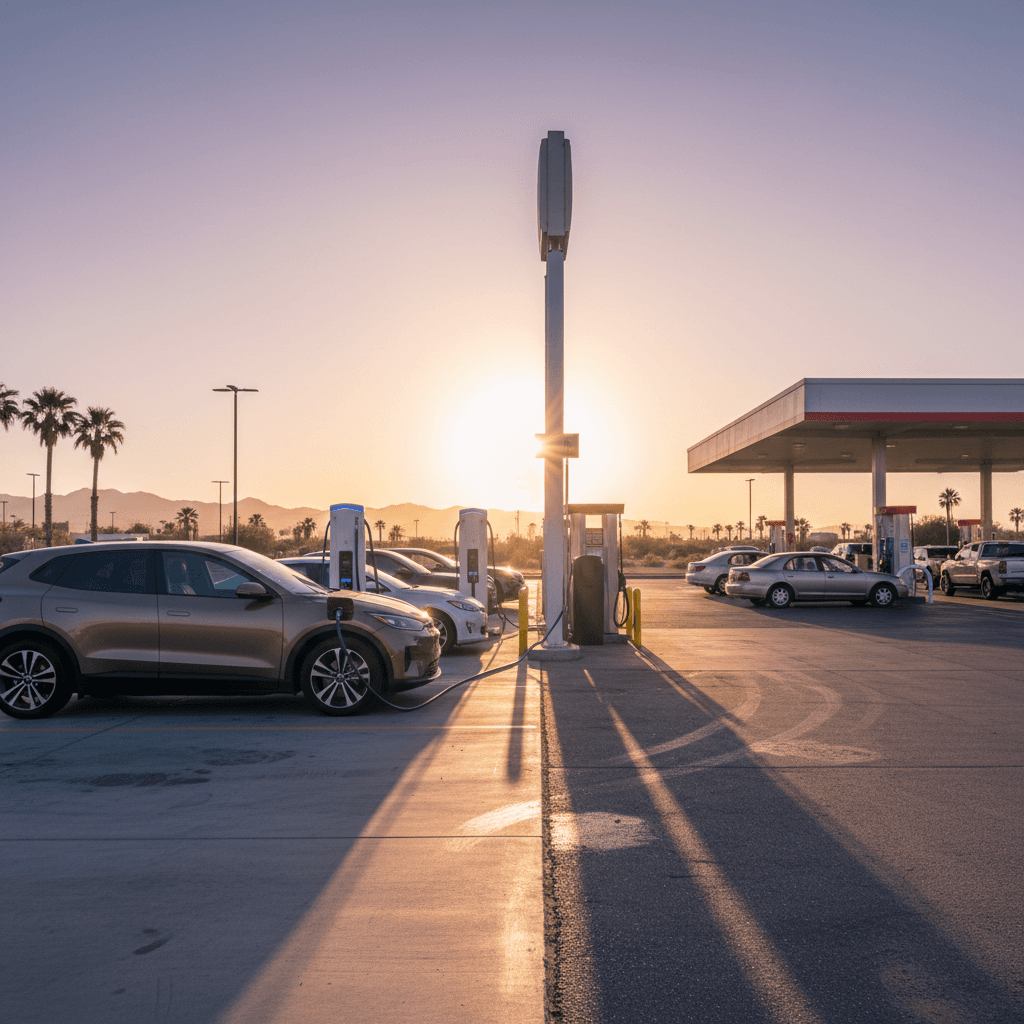
Phoenix drivers don’t need a spreadsheet to feel that 2026 hurts at the pump. With regular gas hovering in the high $4s and flirting with $5 a gallon across the Valley, more people are asking a simple question: how do gas prices vs. EV charging costs in Phoenix in 2026 really compare?
Quick snapshot for 2026
Why Phoenix drivers are rethinking gas in 2026
The Valley has always been a driving town. Long commutes, crosstown youth sports, weekend runs up to Prescott or Payson, that’s just life. When gas was $2.75, you grumbled and moved on. But with 2026 prices spiking well above that, every fill‑up feels like a car payment.
At the same time, electricity in Arizona is still cheaper than the national average on a per‑kWh basis, and local utilities now offer specific EV time‑of‑use plans that reward you for charging overnight. Add in the fact that most modern EVs get the equivalent of 90–120 mpg when you convert electricity to energy, and you’ve got a recipe for serious savings, if you understand how the numbers work.
Phoenix 2026: Fuel vs. electricity by the numbers
2026 gas prices in Phoenix: What you’re paying now
Let’s pin down what gas actually costs you today. In early April 2026, reports from AAA and local outlets show Phoenix’s average price for regular unleaded pushing close to $5.00 per gallon, after a run‑up that started in late winter. A few stations still sneak under $4, but only if you hunt for them and drive out of your way.
To make the comparisons in this guide concrete, we’ll use a conservative, round‑number assumption of $4.75 per gallon for Phoenix in 2026. That’s a reasonable middle ground between the bargain stations just under $4 and stretches where the citywide average approaches $5.
- If prices dip for a few weeks, your gas costs may land slightly lower than our examples.
- If tensions or supply issues spike, you could easily see $5+ again, pushing EV savings even higher.
- The important thing is the ratio: gas prices move up and down quickly, while electricity tends to move in slower, smaller steps.
Gas is volatile by nature
What electricity costs in Phoenix in 2026
Electricity pricing in metro Phoenix is calmer, but a bit more complicated, than gasoline. Two big utilities dominate the region: APS (Arizona Public Service) and SRP (Salt River Project). Both offer standard residential plans and special time‑of‑use (TOU) plans where power is cheaper at night and more expensive during peak hours.
Here are the key numbers for 2026 that matter when you’re thinking about EV charging:
Typical 2026 residential electricity rates in Phoenix
Approximate prices you’ll actually see on common APS/SRP plans. Exact rates vary by plan and change over time, but these figures are realistic working numbers for EV cost math.
| Provider / Plan Type | When | Approx. Price per kWh | What It Means for EV Charging |
|---|---|---|---|
| APS standard residential | Any time | $0.15–$0.16 | Simple to understand, but you pay the same to run your A/C at 5pm as to charge at 2am. |
| APS EV or TOU plan | Overnight “super off‑peak” | ~$0.03–$0.08 | Deeply discounted power if you let the car charge while you sleep. |
| APS EV or TOU plan | Peak late afternoon/early evening | $0.25–$0.30+ | Great motivation to avoid plugging in right when everyone’s cranking their A/C. |
| SRP EZ3 / EV‑friendly TOU | Off‑peak hours | ~$0.08–$0.13 | Cheaper power most of the day and overnight if you stay out of the peak window. |
| SRP EZ3 / EV‑friendly TOU | Peak window (e.g. 3–6pm) | $0.25–$0.30+ | Short, intense peak period, don’t schedule charging here if you can avoid it. |
Always check your own bill or utility website for current rates before doing a precise savings calculation.
TOU plans favor EV owners
Home EV charging costs in Phoenix: Real examples
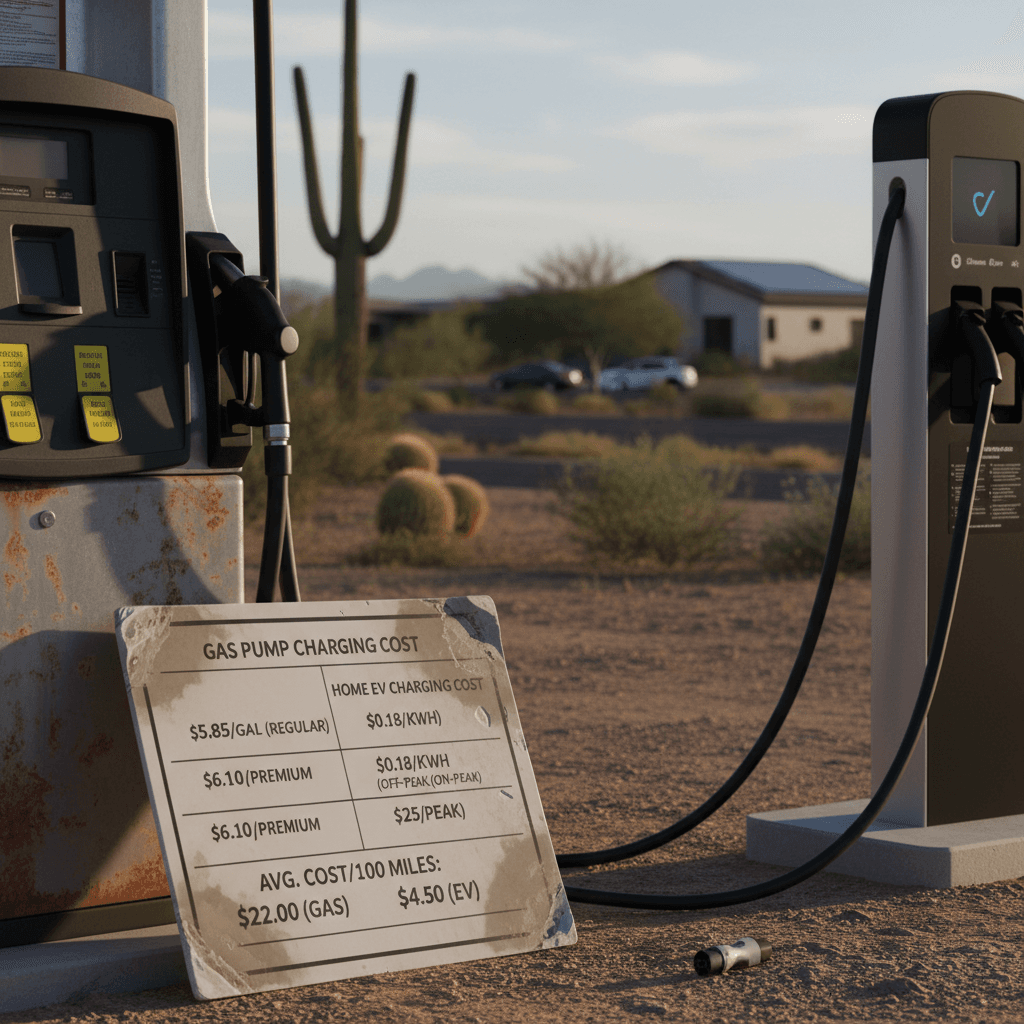
To keep things concrete, let’s look at three common driving and vehicle scenarios. We’ll assume 2026 Phoenix gas at $4.75/gal and two electricity price points: 15¢/kWh for “plain vanilla” residential power and 7¢/kWh for a good overnight EV rate.
Typical real‑world efficiency numbers
These are averages, your exact results will vary, but they’re close enough for honest math.
Compact gas sedan
30 mpg combined is a realistic, middle‑of‑the‑road figure for a modern Corolla / Civic type sedan.
Midsize crossover SUV
25 mpg is a fair assumption for a CR‑V / RAV4 class non‑hybrid crossover in Phoenix traffic.
Typical EV
Most newer EVs get around 3–4 miles per kWh in real‑world mixed driving. We’ll use 3.5 mi/kWh.
Example 1: 40‑mile daily round‑trip commute
Say you drive 40 miles per weekday, Buckeye to Tempe, or North Phoenix to Chandler, and a little extra on weekends. Call it 1,000 miles per month.
Monthly fuel cost: 1,000 miles in Phoenix
Comparing a compact gas sedan, a small crossover, and an EV charged at home.
| Vehicle | Efficiency Assumption | Energy Needed for 1,000 Miles | Energy Price | Monthly Fuel Cost |
|---|---|---|---|---|
| Compact gas sedan | 30 mpg | 33.3 gallons | $4.75/gal | ≈ $158 |
| Gas crossover SUV | 25 mpg | 40 gallons | $4.75/gal | ≈ $190 |
| EV @ standard 15¢/kWh | 3.5 mi/kWh | 285.7 kWh | $0.15/kWh | ≈ $43 |
| EV @ overnight 7¢/kWh | 3.5 mi/kWh | 285.7 kWh | $0.07/kWh | ≈ $20 |
Gas costs scale directly with the pump price; EV costs depend heavily on whether you use an EV‑friendly overnight rate.
What that commute really costs you
Example 2: 1,500 miles a month in a small SUV
Maybe you’re running kids all over the Valley, plus a monthly run to Flagstaff. Call it 1,500 miles per month in a popular non‑hybrid crossover that averages 25 mpg.
- Gas crossover at 25 mpg: 1,500 ÷ 25 = 60 gallons × $4.75 ≈ $285/month.
- EV at 3.5 mi/kWh on 15¢/kWh: 1,500 ÷ 3.5 ≈ 429 kWh × $0.15 ≈ $64/month.
- EV at 3.5 mi/kWh on 7¢/kWh: 429 kWh × $0.07 ≈ $30/month.
At that usage level, the fuel‑only savings from going electric can look a lot like an extra car payment you’re not making, especially if you’re in a thirsty SUV today.
Public fast‑charging costs around Phoenix
Home charging is where EVs really shine, but life happens. Road trips, apartment living, and the occasional forgotten overnight plug‑in mean you’ll use public charging too. Around Phoenix, DC fast charging networks like Electrify America, EVgo, ChargePoint and others typically bill by the kWh or by the minute, depending on location and local rules.
In 2025–2026, it’s common to see fast‑charging prices in the 45–70¢/kWh range around Arizona, with some variability by network, membership status, and station. For rough math, let’s pick 60¢/kWh as a typical Phoenix DC fast‑charging price.
What public fast charging really costs vs. gas
Cost per mile when you rely on fast charging instead of home charging.
| Scenario | Assumptions | Cost per Mile (Fuel Only) | Gasoline Equivalent |
|---|---|---|---|
| EV on DC fast charge only | 3.5 mi/kWh, 60¢/kWh | 60¢ ÷ 3.5 ≈ 17¢/mile | Like a gas car getting ~28 mpg at $4.75/gal |
| EV on home overnight + some fast charge | 80% of miles at 7¢/kWh, 20% at 60¢/kWh | Blended ≈ 6–8¢/mile | Like 60–80 mpg equivalent |
| Gas sedan at $4.75/gal | 30 mpg | $4.75 ÷ 30 ≈ 16¢/mile | Baseline 30‑mpg car |
Public fast charging can be similar to, or sometimes more than, gasoline on a pure fuel‑cost basis.
Use public fast charging as a backup, not a lifestyle
Side‑by‑side cost comparisons: Gas vs. EV
Everyday commuter, 12,000 miles/year
- Gas sedan (30 mpg): 12,000 ÷ 30 = 400 gal × $4.75 ≈ $1,900/year.
- EV on 15¢/kWh: 12,000 ÷ 3.5 ≈ 3,430 kWh × $0.15 ≈ $515/year.
- EV on 7¢ overnight: Same 3,430 kWh × $0.07 ≈ $240/year.
That’s a savings of roughly $1,400–$1,650 per year on fuel alone for the same mileage.
Busy family, 18,000 miles/year
- Gas crossover (25 mpg): 18,000 ÷ 25 = 720 gal × $4.75 ≈ $3,420/year.
- EV mix: 80% home @ 7¢, 20% DC fast @ 60¢: 18,000 ÷ 3.5 ≈ 5,145 kWh total.
- Home: 4,116 kWh × $0.07 ≈ $288
- Fast: 1,029 kWh × $0.60 ≈ $617
- Blended EV fuel cost: around $900/year.
Even with regular road trips and fast charging, you’re looking at about $2,500/year less in fuel than the gas crossover.
Cost per mile: the simplest metric
• Typical gas sedan: ~16¢/mile
• Typical gas crossover/SUV: ~19¢/mile
• EV on standard 15¢ power: ~4–5¢/mile
• EV on good overnight TOU rates: ~2–3¢/mile
Your exact numbers will move around these, but the pattern doesn’t change: properly charged EVs are much cheaper per mile than gas in the Valley’s current price environment.
Beyond fuel: Maintenance, parking and other costs
Fuel is the headline, but it’s not the whole story. EVs and gas cars have different cost profiles once you factor in maintenance, brake wear, and how Phoenix’s heat treats components.
Other cost differences Phoenix drivers actually feel
These won’t show up in a gas vs. kWh chart, but they matter over 5–10 years.
Maintenance
EVs skip oil changes, timing belts, spark plugs and a lot of exhaust pieces. You still have tires, cabin filters and brake fluid, but routine service visits usually drop.
Brakes in stop‑and‑go traffic
In Phoenix traffic, EVs use regenerative braking to slow the car, which can dramatically extend pad and rotor life compared to a gas car that turns heat into brake dust at every red light.
Heat and batteries
Desert heat is rough on any car battery, gas or electric. Modern EVs are designed with active cooling and sophisticated thermal management, but long‑term battery health still matters, especially when you’re buying used.
A Phoenix‑specific caution on EV batteries
How to lower your EV charging costs in the Valley
5 ways Phoenix drivers can keep EV charging cheap
1. Get on an EV‑friendly TOU plan
Call APS or SRP or check your online account for EV or time‑of‑use rate options. Shifting most of your charging into super off‑peak hours can cut your per‑mile cost in half compared with a flat‑rate plan.
2. Let the car charge while you sleep
Use your EV’s built‑in scheduling so it starts charging after off‑peak begins, often around 10pm. You don’t have to babysit it; set it once and forget it.
3. Treat DC fast charging as your backup plan
Lean on home Level 2 charging for your daily miles and keep those pricey 60¢/kWh sessions for road trips, unexpected detours, or when you truly need a quick top‑off.
4. Size the battery to your life
If your longest normal day is 70 miles, you don’t need a massive 400‑mile battery. A smaller, efficient used EV can be cheaper to buy and still slash your fuel bills.
5. Use route planners and charging apps
Apps like PlugShare, A Better Routeplanner and the native navigation in many EVs can help you avoid slow or expensive stations and keep you in that low‑cost, high‑speed charging sweet spot.
How Recharged helps Phoenix drivers run the numbers
Comparing gas prices vs. EV charging costs in Phoenix in 2026 is one part math and one part honesty about how you really drive. That’s why Recharged was built around transparency, especially for used EVs.
- Every vehicle on our marketplace comes with a Recharged Score Report, including verified battery health so you know how much real‑world range you’re buying, crucial in Arizona heat.
- Our pricing tools benchmark fair market values for used EVs, so you can see how fuel savings and purchase price fit together.
- If you’re trading in a gas car, we can give you an instant offer or help you consign it, then roll those dollars into an EV that fits your commute and budget.
- You can complete the process fully online, or visit our Experience Center in Richmond, VA if you want to talk through options in person. Either way, our EV specialists can help you estimate your monthly charging costs based on your actual utility plan and mileage.
Thinking about switching out of a gas guzzler?
Gas vs. EV costs in Phoenix: FAQ
Frequently asked questions for Phoenix drivers
Bottom line: Is an EV cheaper than gas in Phoenix?
In a 2026 Phoenix where regular gas hovers uncomfortably close to $5 a gallon, the math is surprisingly consistent: if you can charge at home and use an EV‑friendly time‑of‑use rate, your per‑mile energy cost is usually a fraction of what you pay for gasoline. Even on a simple flat‑rate plan, most Valley drivers will see meaningful fuel savings over a year of normal driving.
The big caveats are straightforward: if you live on public fast charging or buy an EV with more battery wear than you realize, those savings shrink. That’s why the smartest move is to pair a realistic charging plan, often overnight at home, with a used EV whose battery health, pricing and financing all pencil out in your favor.
Recharged exists to make that jump easier. With verified battery diagnostics, fair market pricing, financing, trade‑in options and EV‑savvy guidance from the first visit through delivery, you don’t have to guess whether an EV will beat your current gas bill in Phoenix, you can see it in black and white, before you ever plug in.