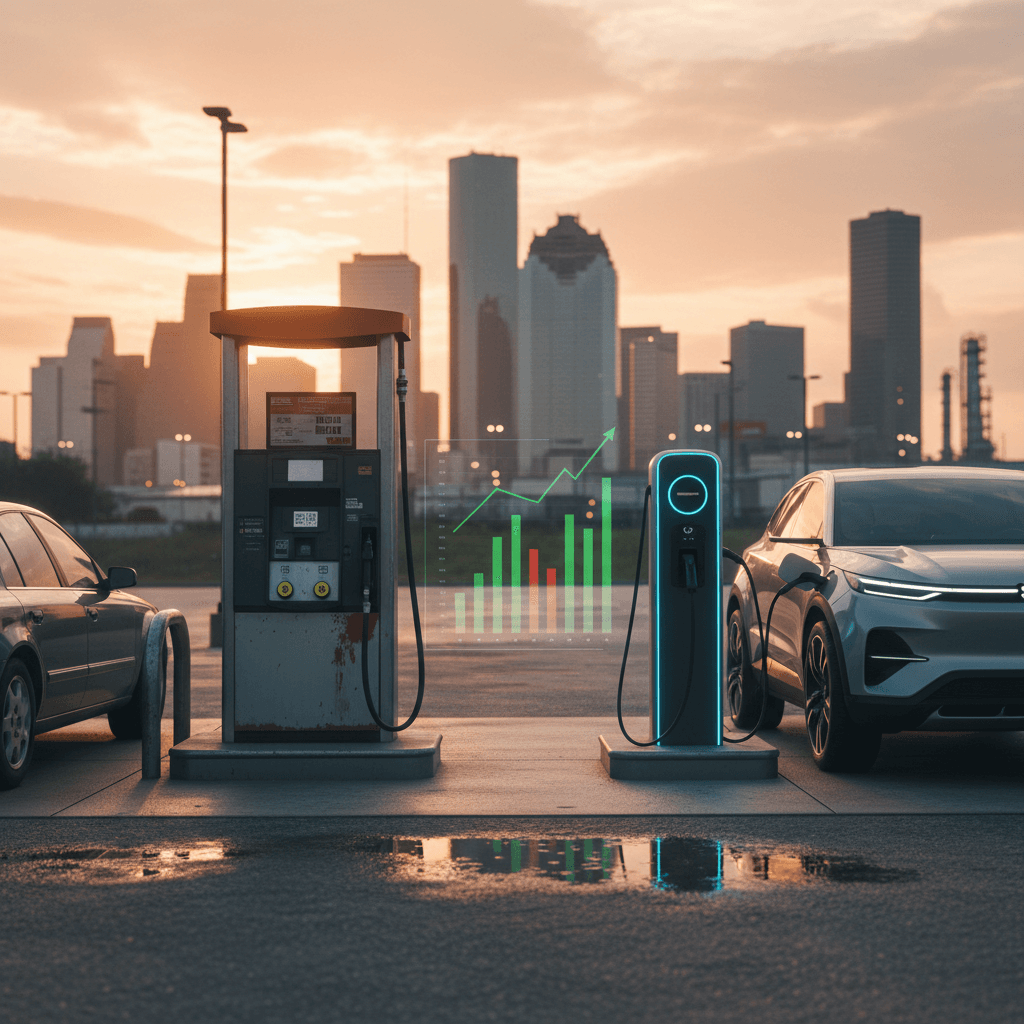
If you live in Greater Houston in 2026, you’re probably feeling whiplash at the pump. With regular gas hovering around the $4 mark nationally and Texas seeing some of the sharpest year‑over‑year price jumps, the natural question is simple: **are you better off paying gas prices or EV charging costs in Houston in 2026?**
Why this guide is Houston‑specific
Houston 2026 fuel costs at a glance
Quick 2026 Houston cost snapshot (estimates)
What Houston drivers actually want to know
You don’t need another national think‑piece. You want to know, in dollars and cents, **what you’ll spend each week** if you commute from Katy to Downtown, run kids around Pearland, or haul gear between job sites inside Beltway 8. This guide will walk through three things:
- Current **gas price context in 2026** for Houston
- Typical **electricity rates** you’ll pay to charge at home vs on the road
- Clear **cost‑per‑mile examples** for a compact crossover and a full‑size truck, plus what that means per month and per year
How to use this guide
Step 1: What are Houston gas prices in 2026?
Gas prices in 2026 have been volatile for reasons that have nothing to do with your daily routine, global conflicts, refinery capacity, and seasonal blends among them. Nationally, regular gasoline averaged about **$2.91 per gallon in February 2026**, then surged past **$4.00 a gallon** by late March as markets reacted to the Iran war and related fuel disruptions.
Houston, sitting in the Gulf Coast refining region, usually enjoys prices slightly below the national average. In early April 2026, a realistic working number for **Houston regular gas** is around **$3.60–$3.90 per gallon** on any given day, with rapid swings of 15–30 cents not unusual.
Gas prices move fast
Step 2: How much does electricity cost in Houston?
Unlike gasoline, **electricity prices move slowly**. Multiple 2025–2026 rate surveys put the **average Houston residential rate** in the **$0.14–$0.15 per kWh** range when you include both energy and delivery charges. Some fixed‑rate plans are cheaper, some apartments are more expensive, but 14–15¢/kWh is a solid planning number for home charging.
- Average residential rate (Houston metro, early 2026): **≈$0.14–$0.15/kWh**
- Cheaper fixed‑rate retail plans (good credit, 12‑month contract): often **$0.09–$0.12/kWh** at 1,000 kWh usage
- Luxury apartments / short‑term or variable plans: can effectively land **$0.18–$0.21/kWh+** once fees are baked in
Houston’s climate matters
Step 3: Cost per mile – gas vs EV in Houston
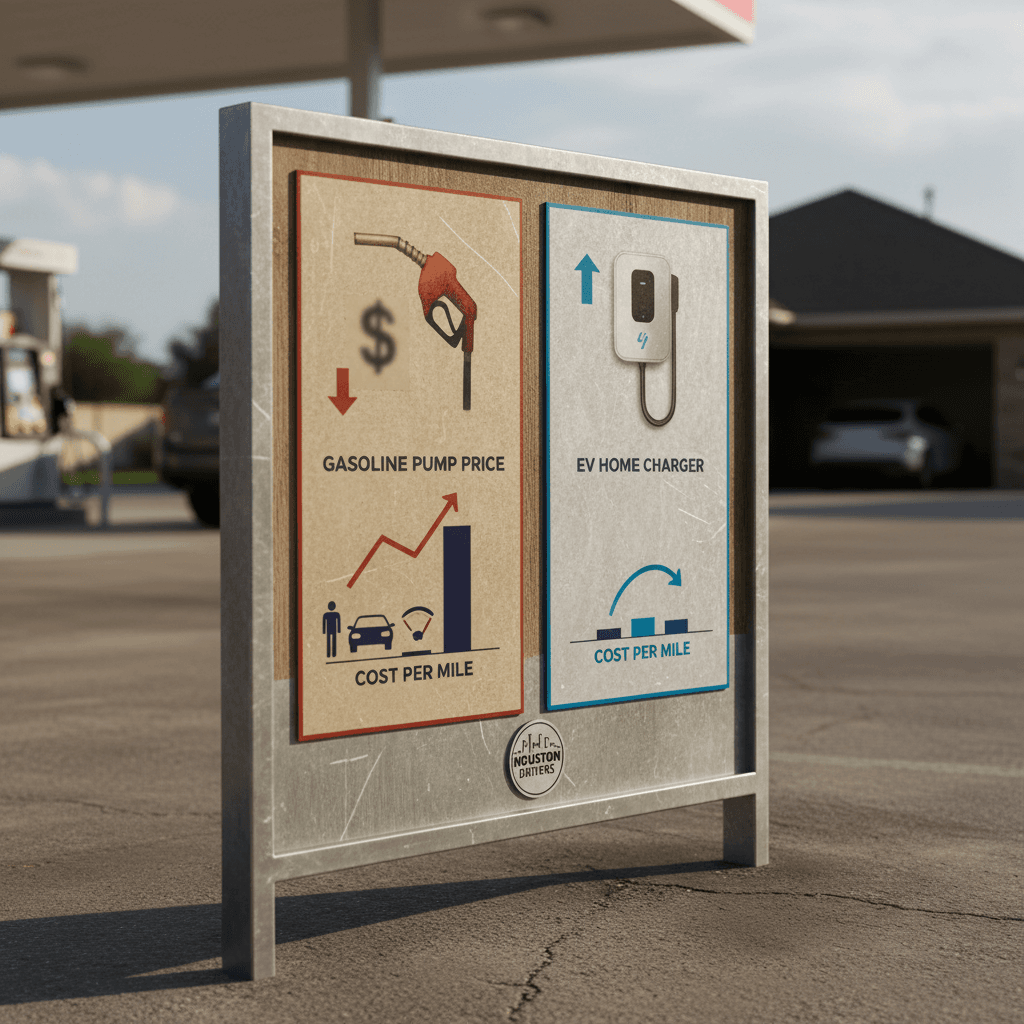
To compare gas prices and EV charging costs fairly, you want **fuel cost per mile**. Here’s how we’ll frame it for a “typical” 2024–2026 vehicle in each category:
- Average **gas car**: 30 mpg combined (compact crossover / sedan)
- Average **EV**: 34 kWh per 100 miles (about 2.9 mi/kWh) based on recent fleet averages of modern EVs
- Houston gas price assumption for 2026: **$3.75/gal** midpoint of recent local range
- Houston home electricity rate assumption: **$0.145/kWh** (14.5¢)
Core cost per mile – Houston 2026 (estimates)
Using mid‑range assumptions for gas price, efficiency, and home electricity rate.
| Vehicle type / fuel | Key assumption | Cost per mile |
|---|---|---|
| Gas car (30 mpg) | $3.75/gal gasoline | $0.125/mi |
| Efficient EV (city driving) | 30 kWh/100 mi, $0.145/kWh | $0.044/mi |
| Typical EV (mixed driving) | 34 kWh/100 mi, $0.145/kWh | $0.049/mi |
| Less efficient EV (larger SUV) | 40 kWh/100 mi, $0.145/kWh | $0.058/mi |
Actual numbers for your car will vary, but the gap between gas and home charging is consistently large.
The short version
Real‑world examples: small SUV and full‑size truck
Gas vs EV: two Houston‑style examples
Numbers below assume 12,000 miles per year and 75% of EV charging done at home.
Example 1: Compact crossover family car
Gas baseline: Think Toyota RAV4 / Honda CR‑V / Hyundai Tucson.
- Fuel economy: ~30 mpg
- Gas price used: $3.75/gal
- Cost per mile: ≈$0.125
- Annual fuel (12,000 mi): ≈$1,500
EV alternative: Think Hyundai Kona Electric, Chevy Equinox EV, Tesla Model Y RWD.
- Energy use (average): 32 kWh/100 mi
- Home rate: $0.145/kWh
- Cost per mile (home): ≈$0.046
- 12,000 mi, all home charging: ≈$550/year
- 12,000 mi, 75% home, 25% DC fast at $0.35/kWh: ≈$700–$750/year
Example 2: Full‑size pickup workhorse
Gas baseline: Think Ford F‑150 / Chevy Silverado / Ram 1500.
- Fuel economy: ~18 mpg combined
- Gas price: $3.75/gal
- Cost per mile: ≈$0.21
- Annual fuel (12,000 mi): ≈$2,520
EV alternative: Think Ford F‑150 Lightning, Chevy Silverado EV, Rivian R1T.
- Energy use (average): 45–50 kWh/100 mi
- Home rate: $0.145/kWh
- Cost per mile (home): ≈$0.065–$0.073
- 12,000 mi, mostly home charging: ≈$850–$900/year
- Heavy DC fast‑charging use at $0.35/kWh: ≈$1,300–$1,400/year
Reality check for your own vehicle
Home charging vs public fast charging in Houston
So far we’ve looked mostly at **home charging**, which is where EVs shine. Public DC fast chargers around Houston, whether at Buc‑ee’s, along I‑45, or near big shopping centers, price power very differently.
Houston charging cost comparison by charging type (2026)
These are typical ranges observed across major networks; always check the rate in your charging app before plugging in.
| Charging type | Typical Houston price | What it feels like in gas terms | Best use case |
|---|---|---|---|
| Home Level 2 (240V) | $0.10–$0.16/kWh all‑in | Equivalent of ~$1.00–$1.60 per “gallon” of energy | Nightly charging, topping up after commute |
| Workplace / free chargers | Often free or discounted | Like free or company‑paid fuel | Office commuters, fleets |
| Public Level 2 | $0.20–$0.30/kWh | Equivalent of ~$2.00–$3.00 per gallon | Apartments without home charging, longer daytime stops |
| DC fast charging (50–150 kW) | $0.30–$0.45/kWh | Equivalent of roughly $3.00–$4.50+ per gallon | Road trips, occasional quick top‑offs |
Fast charging is about convenience, not the cheapest possible electricity. Use it like you’d use a premium‑priced gas station on a road trip: when you need it, not every day.
If you fast‑charge all the time
Ways Houston EV owners keep charging costs low
1. Charge overnight at home
Most retail electricity plans in Houston spread costs evenly, but some offer cheaper energy in off‑peak hours. Either way, plugging in at night avoids higher‑priced public chargers.
2. Shop your electricity plan
If you’re in a deregulated area, use Texas comparison tools to look for 12‑ or 24‑month fixed plans. Dropping from 17¢ to 12¢/kWh can save you $150–$250 per year on EV charging alone.
3. Use free or low‑cost workplace charging
If your employer offers charging, that’s effectively subsidized fuel. Even a couple of days a week can cut your annual charging bill by 20–30%.
4. Treat DC fast charging like emergency fuel
Use fast charging when you’re on a long trip or pressed for time, not as your daily habit. Think of it as the EV equivalent of buying gas at the priciest station on the freeway.
How much can a Houston driver save per year?
Let’s translate cents per mile into **annual dollars**, using realistic Houston driving patterns.
Scenario A: 12,000 miles/year, compact crossover
- Gas SUV @ 30 mpg, $3.75/gal: ≈$1,500/year
- EV crossover, all home @ 14.5¢/kWh: ≈$550/year
- EV crossover, 75% home / 25% DC fast: ≈$700–$750/year
Annual savings: roughly $750–$950 vs gas.
Scenario B: 15,000 miles/year, full‑size pickup
- Gas truck @ 18 mpg, $3.75/gal: ≈$3,125/year
- EV truck, mostly home charging: ≈$1,050–$1,150/year
- EV truck, heavy DC fast use: ≈$1,600–$1,800/year
Annual savings: about $1,300–$2,000 vs gas, depending on your charging mix.
Where these savings really show up
Other cost factors Houston drivers should keep in mind
Beyond fuel: three cost angles Houstonians overlook
Total cost of ownership is more than just the pump vs the plug.
Maintenance and repairs
EVs have fewer moving parts than gas vehicles. No oil changes, no transmission fluid, no timing belts, and far fewer things under the hood to leak or fail.
In Houston’s stop‑and‑go traffic, regenerative braking also reduces brake wear, which can delay costly brake jobs.
Heat and range
Houston’s heat doesn’t hammer EV range the way extreme cold does, but heavy A/C use still consumes energy.
Expect some drop in range on the hottest summer days, but it rarely changes the cost per mile math enough to favor gas, electricity is still dramatically cheaper per unit of energy.
Home charging setup
Most Houston‑area EV owners eventually install a Level 2 home charger or 240V outlet. Depending on your panel and distance to the garage, that can run roughly $700–$1,500 installed.
For many drivers, that upfront cost is paid back in 2–3 years of fuel savings versus gasoline.
Electrical work is not DIY
How Recharged helps Houston buyers compare costs
Fuel savings are compelling, but only if the **EV you choose** actually fits your driving pattern, budget, and expectations. That’s where Recharged comes in for Houston‑area shoppers looking at the used EV market.
- Every vehicle on Recharged comes with a **Recharged Score Report**, which includes verified battery health so you’re not guessing about range or degradation.
- Our pricing tools benchmark **fair market pricing** for used EVs, factoring in local trends so you understand how your monthly payment compares with what you’re saving at the pump.
- If you’re trading out of a gas car or truck, Recharged offers **trade‑in, instant offer, or consignment options**, plus **financing** and **nationwide delivery**, so moving into an EV is as simple as possible.
- Not sure how home charging would work in your specific situation (house in Cypress vs apartment in Midtown)? Our EV‑specialist support team can walk you through real‑world scenarios and costs.
Use fuel savings to shape your budget
FAQ: Gas vs EV charging cost in Houston (2026)
Frequently asked questions for Houston drivers
Bottom line: Is an EV cheaper to “fuel” in Houston?
In 2026 Houston, the math keeps pointing in the same direction: **if you can charge an EV at home most nights, your per‑mile fuel cost is typically less than half that of a comparable gas vehicle**, even with electricity rates that have edged higher in recent years and gas prices that jump up and down with global headlines.
Where things get more nuanced is convenience and charging access. Drivers who depend heavily on DC fast charging will still see savings versus thirsty trucks and large SUVs, but not always versus the most efficient gas sedans. That’s why the best approach is to run the numbers for your actual commute, housing situation, and driving style.
If you’re considering swapping your current gas car or truck for a used EV, Recharged can help you line up **real Houston‑specific fuel costs** with the right vehicle, financing, and trade‑in options. Combine stable electricity rates, home charging, and a verified‑battery used EV, and you’ve got one of the most predictable fuel bills you can buy in Greater Houston today.