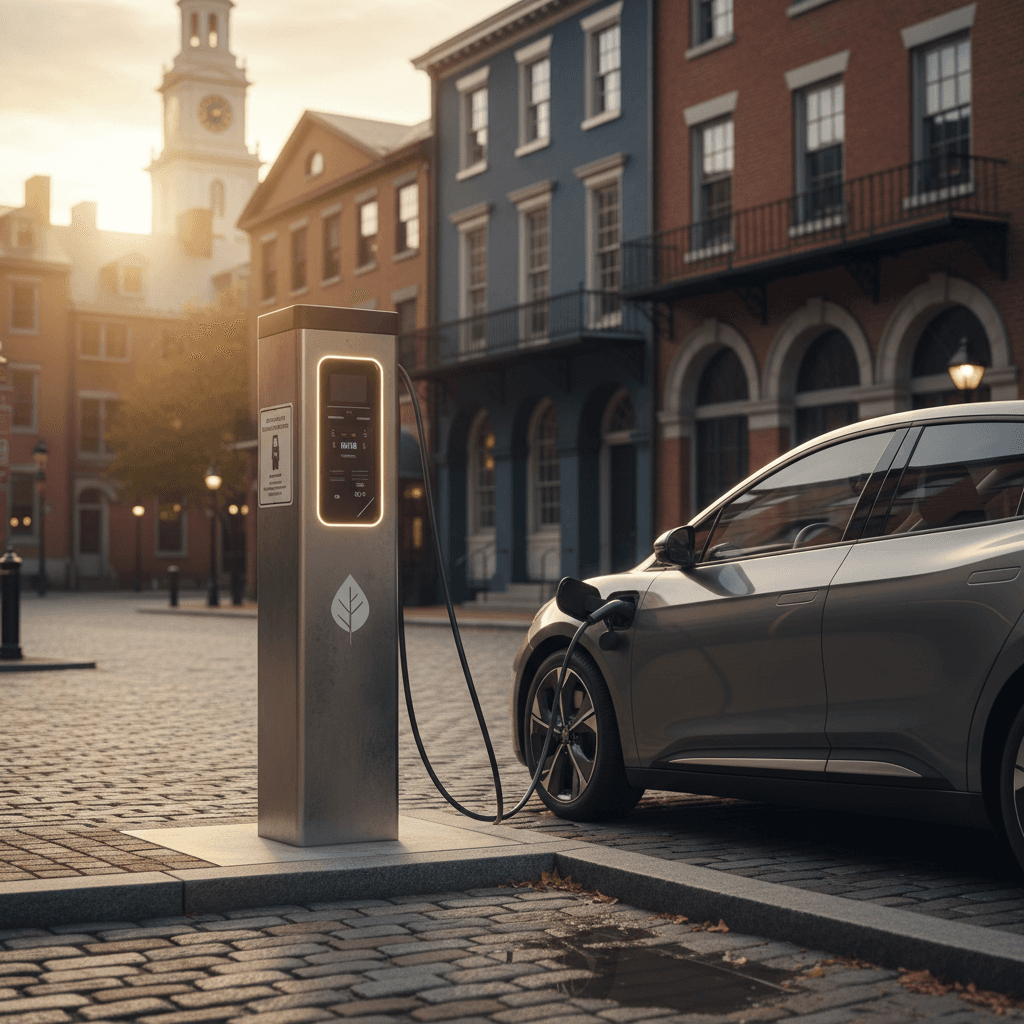
If you drive an electric car in Greater Boston, you’ve probably typed **“free EV charging Boston MA”** into Google more than once. Between pricey parking garages, utility rates, and limited curb space, every free kilowatt-hour helps. The reality in 2026: truly free public charging exists, but it’s scattered, so you’ll want a strategy that mixes free plugs, workplace perks, and utility rewards to keep your costs down.
Short answer
Why “free” EV charging in Boston is tricky
Before you go hunting for free EV charging in Boston, it helps to understand how the City and utilities think about access and pricing. Official documents from Boston’s zero‑emission vehicle planning make a clear distinction between **“publicly accessible”** chargers and **“free-to-access”** chargers: a public charger is available to the public, but it doesn’t have to be free, and often isn’t. City-owned and private operators typically charge either a per‑kWh or per‑hour fee, sometimes layered on top of paid parking.
Don’t confuse “public” with “free”
On top of that, rules change quickly. Cambridge, for example, has already increased fees at its city-owned EV stations, and Boston is rolling out new curbside chargers that may or may not be free during early pilot periods. What’s constant is this: **drivers who save the most treat “free charging” as a bonus, not a plan.** They rely on cheap, managed charging at home or work, and scoop up free sessions when it’s convenient, at a grocery store, workplace garage, or hotel.
Where you’re most likely to find free EV charging in Boston
Typical places to find free charging around Boston
None of these are guaranteed, but they’re where Boston‑area drivers most often report $0 charging sessions.
Grocery & big-box stores
Several supermarket chains and big-box retailers around Boston offer **complimentary Level 2 charging** while you shop. Individual locations decide pricing, so you’ll find:
- Store-owned ChargePoint or Flo stations set to $0.00/kWh
- Time-limited free sessions (e.g., first 1–2 hours free)
- Free energy but standard parking garage rates
Always check station notes in apps like PlugShare before you rely on a specific store.
Workplaces & universities
Large employers and campuses in Boston often treat EV charging as a perk. You may see:
- Free charging in employee garages with badge access
- Subsidized rates lower than public networks
- Priority spots for carpools or low‑emissions vehicles
If you’re job‑hunting or negotiating a return‑to‑office deal, ask directly about charging policies.
Hotels & monthly garages
Many downtown and Seaport hotels advertise **free EV charging for guests** as part of the nightly rate. Some private garages also waive charging fees for monthly parkers.
- Look for “EV charging included” in booking details
- Call the front desk to confirm plug type and pricing
- Factor in parking costs, "free" power doesn’t mean cheap overall
Look in the suburbs, too
Your odds of finding truly free public charging are higher **outside** the densest parts of the city. MBTA commuter rail lots and some municipal lots in neighboring communities have historically hosted Level 2 chargers that were free to use or discounted to encourage park‑and‑ride behavior. Policies have been shifting toward paid models, but you can still find a handful of no‑fee locations if you’re flexible on where you park and plug.
Using apps to locate free or discounted charging
You won’t find a single official “free EV charging Boston” map, but a mix of crowd‑sourced and network apps will get you close. The key is learning how to filter and read the details so you can spot $0 sessions before you drive across town.
Best apps for finding free or cheap charging in Boston
Use more than one app; each has gaps in coverage.
PlugShare
Strength: Crowd‑sourced detail.
- User reviews mention when stations are free, broken, or restricted to customers
- Filter by network, plug type, power level
- Comments often note “first 2 hours free” or “parking fee only”
Sort by "Free" in the pricing filter, then verify recent check‑ins.
ChargePoint, Flo & other networks
Network apps show official pricing, session history, and in some cases **promotional free sessions** sponsored by property owners.
- Look for $0.00/kWh or $0.00/hr entries
- Watch for parking fees listed separately in garage descriptions
- Enable notifications for rate changes where you charge often
Tesla & fast‑charging apps
If you drive a Tesla or a non‑Tesla that can access Superchargers, watch for **promos and off‑peak discounts** in the Tesla app.
For other DC fast networks (EVgo, Electrify America), free sessions are rare, but:
- Membership tiers sometimes include kWh credits
- New‑site promos may offer temporary free charging
How to quickly spot free stations in apps
Municipal and curbside EV charging in Boston
Boston is expanding **municipal and curbside EV charging**, especially in neighborhoods where residents don’t have driveways or garages. The City’s curbside program is adding Level 2 and some DC fast chargers on residential streets and in municipal lots, with a focus on environmental justice communities. Pricing is set to balance access, turnover, and grid impacts, so it’s not designed to be permanently free, even if some locations start out with intro rates or pilot discounts.
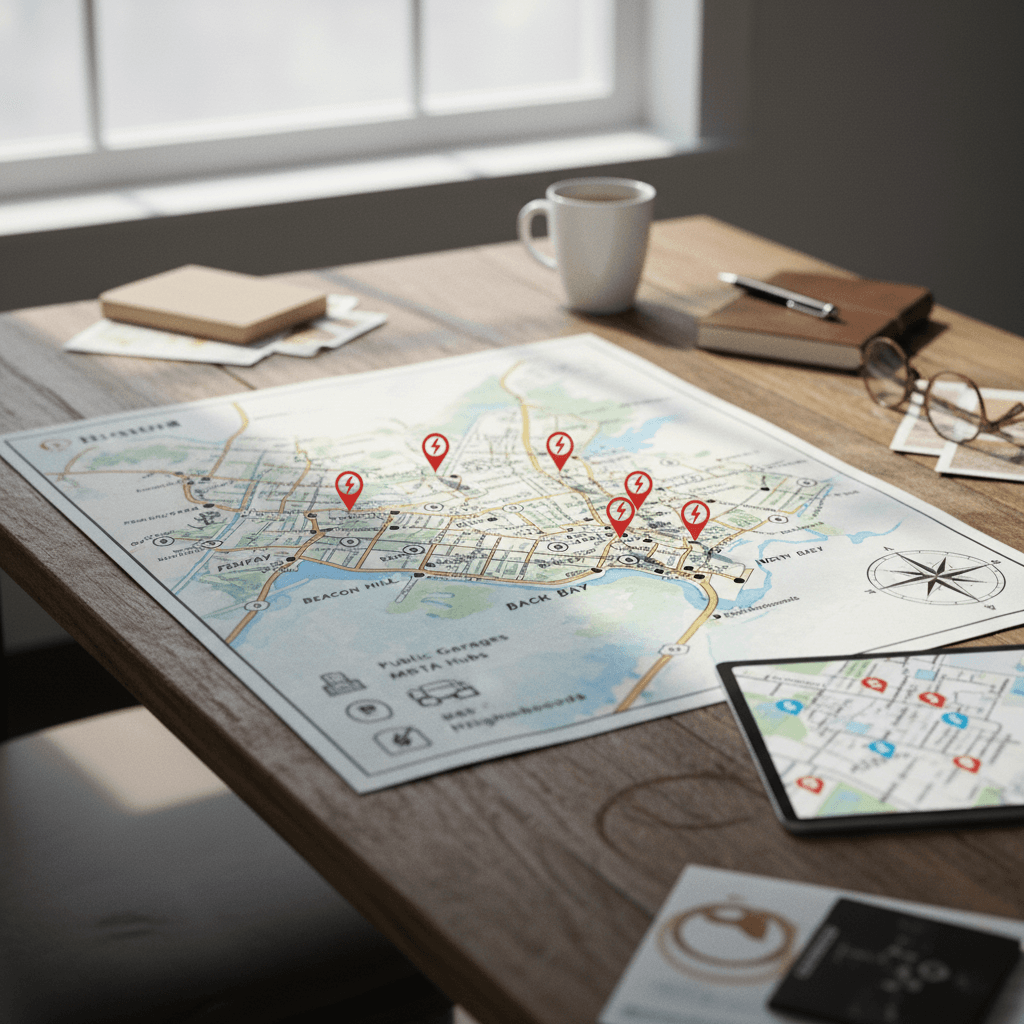
Typical city and public EV charging options you’ll see in Boston
These categories describe how public and semi‑public chargers around Boston usually work. Exact pricing is set by each operator.
| Location type | Typical plug & power | Who can use it | Usual pricing pattern |
|---|---|---|---|
| On‑street curbside chargers | Level 2; some DC fast | General public | Per‑kWh or per‑hour fees; standard street parking rules may also apply |
| Municipal lots & garages | Level 2, occasional DC fast | General public | Paid parking + per‑kWh or per‑hour charging; occasional free promos |
| MBTA park‑and‑ride lots | Mostly Level 2 | Commuters & transit riders | Standard parking fee; some lots historically offered free or reduced‑rate charging |
| University & hospital garages | Level 2, some DC fast | Staff, patients, students, sometimes public | Mix of free, discounted, or market‑rate charging; may require ID or ticket |
| Suburban town lots (Newton, Watertown, etc.) | Level 2 | General public | Often lower rates than downtown; occasional $0.00/kWh incentives |
Use this as a guide, always verify live pricing in your charging app.
Watch Boston’s pilot announcements
Utility programs that make home charging nearly free
If truly free public chargers are hit‑or‑miss, the most reliable way to cut your EV fueling costs in Boston is to **make home charging dirt cheap**. That’s where Massachusetts utilities come in. Eversource and National Grid both run managed or off‑peak EV charging programs that pay you to avoid charging during weekday peaks.
Why home charging with utility programs often beats chasing free public plugs
Eversource managed charging
- Uses a smart‑charging app (often ev.energy) linked to your EV or home charger.
- Pays a monthly incentive if you keep most charging during off‑peak hours.
- May offer extra bonuses for participating in occasional "demand response" events.
Ideal if you can plug in overnight and let the app decide when to charge.
National Grid off‑peak EV programs
- Offers rebates or bill credits for shifting charging away from peak evening hours.
- May require a compatible smart charger or a connected vehicle.
- Some programs include upfront rebates toward installing a 240‑volt circuit at home.
Great if you’re in National Grid territory and planning a Level 2 home install.
“Free” miles from the grid’s point of view
How to stack free charging with utility rewards
You don’t have to choose between free public charging and home charging discounts. The most cost‑effective Boston drivers treat every kWh as a line item: public sessions when someone else is paying, off‑peak home charging when they are.
Practical strategy: combine free public charging with cheap home charging
1. Enroll in your utility’s EV program first
Whether you’re with Eversource or National Grid, sign up for their managed or off‑peak EV charging program as soon as you install a Level 2 charger or buy an EV. That baseline discount turns every at‑home session into a bargain.
2. Set a strict off‑peak schedule at home
Use the car’s app or a smart‑charger app to limit charging to overnight or other off‑peak windows. That keeps your utility incentives flowing and lowers your base kWh rate.
3. Treat free public charging as a bonus, not a plan
If your workplace, grocery store, or gym offers free charging, use it, but don’t rely on it. Policies change quickly, and a once‑free charger can flip to market rates overnight.
4. Prioritize time over pennies in downtown Boston
In the Financial District or Back Bay, parking often costs more than electricity. Don’t burn 45 minutes hunting a free plug if it means paying an extra hour of garage time or circling for street parking.
5. Check for updated prices every few months
Save your favorite stations in PlugShare or your network apps and skim recent comments or rate updates. That’s usually where you’ll see reports of “no longer free” or “now pay-to-park only.”
6. Plan road trips around fast, not free
For I‑90 or I‑93 road trips, prioritize reliable DC fast chargers even if they cost more. Free Level 2 in a random garage isn’t worth it if it adds hours to your drive.
Sample Boston driver scenarios
South Boston renter, no driveway
You street‑park near Broadway and can’t install home charging. Here’s a realistic playbook:
- Lean on **curbside Level 2** chargers within a 5–10‑minute walk, treat them like a weekly “top‑off” session.
- Ask your employer about **garage charging**; even paid workplace Level 2 can be cheaper than DC fast in town.
- When grocery shopping or visiting friends in the suburbs, plug into any **free supermarket or town‑owned chargers** you find.
Your charging mix might be 60% city or workplace Level 2 (paid), 25% free opportunistic plugging, 15% DC fast for road trips.
Somerville condo owner with shared garage
You have access to a shared garage with a few Level 2 chargers:
- Work with the condo association to enroll the building or chargers in an **Eversource or National Grid managed charging program**.
- Charge overnight on a schedule that maximizes **off‑peak incentives**.
- Use **public fast chargers** only for weekend trips or when you mis‑plan.
Most of your energy will be very cheap, even if it’s not technically free, because incentives offset so much of the cost.
Checklist to cut your EV charging costs in Boston
Boston EV charging cost‑cut checklist
Confirm your utility and service territory
Look at your electric bill and confirm whether you’re with Eversource, National Grid, or a municipal light plant. That determines which EV programs you can join.
Enroll in an EV‑specific rate or managed charging program
Search your utility’s site for “EV charging program” or “managed charging.” Complete the enrollment and link your EV or smart charger so you start earning monthly credits.
Map all public chargers near your routine stops
Use PlugShare and network apps to mark chargers near your home, work, gym, and favorite stores. Flag any that are currently free or heavily discounted.
Check parking rules at every “free” spot
Read the fine print. A charger with $0.00/kWh but $15/hour garage parking isn’t really free, and on‑street chargers may have strict time limits or resident-only windows.
Standardize an overnight charging window
Pick a recurring window, say, 11 p.m. to 6 a.m., and program it into your car or charger. That habit alone can keep you inside off‑peak windows and in good standing for utility rewards.
Track your real monthly fueling cost
Compare your EV charging cost (after credits) to what you used to spend on gas. Even if you never find a free public charger, most Boston drivers still see a substantial drop in fueling expenses.
FAQ: Free EV charging in Boston, MA
Frequently asked questions about free EV charging in Boston
The bottom line for Boston EV drivers
In 2026, searching for **free EV charging in Boston, MA** is a bit like chasing happy‑hour deals. You can absolutely find them, especially at certain stores, workplaces, hotels, and in some nearby municipalities, but they shift, expire, and don’t cover every mile you drive. The smarter play is to use those free kWh opportunistically while building your daily routine around cheap, off‑peak home or workplace charging that’s backed by utility incentives.
If you’re planning your next EV, or moving from gas to electric for the first time, think about **where you’ll charge as carefully as what you’ll drive**. At Recharged, every used EV comes with a Recharged Score report, including verified battery health and fair‑market pricing, plus EV‑savvy guidance on how to charge efficiently in your specific situation. Whether you’re a condo owner in Somerville or a renter in Southie, pairing the right car with the right charging strategy will matter more for your wallet than any single free plug you find.