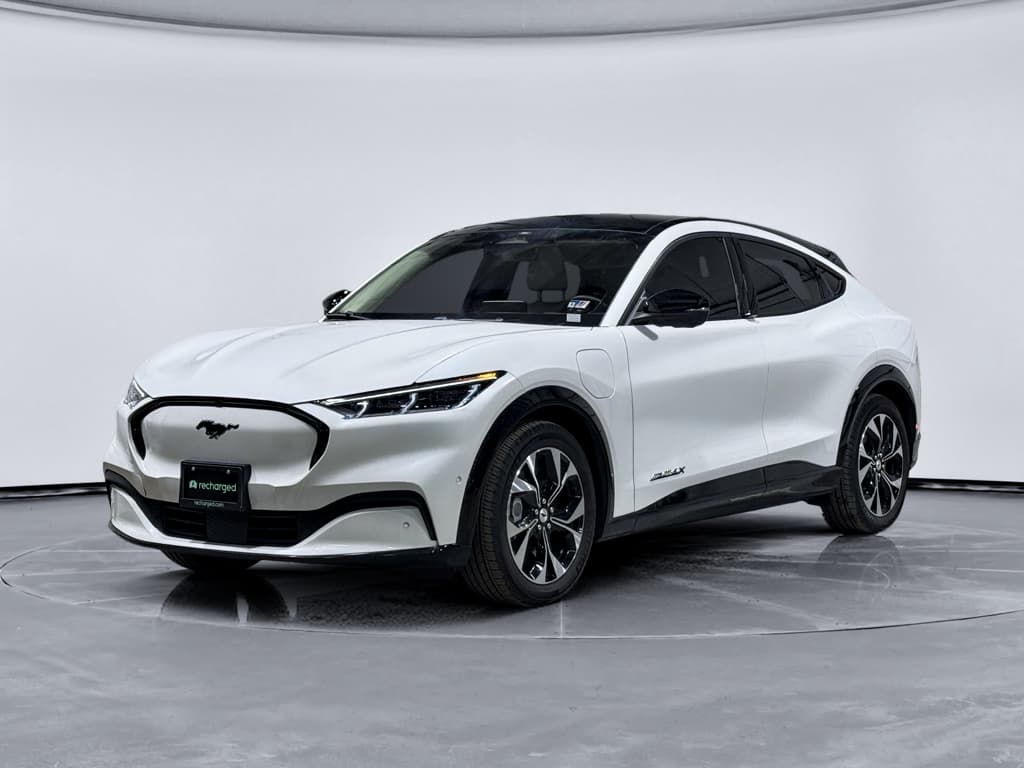
If you’re cross-shopping a Ford Mustang Mach-E against a similar gas-powered SUV, sticker price only tells part of the story. Over five years, fuel, maintenance, insurance, and depreciation can easily outweigh the difference between an EV and a traditional crossover. This guide walks through a clear Ford Mustang Mach-E vs gas car cost comparison so you can see how the numbers pencil out before you buy, especially if you’re considering a used Mach-E from a marketplace like Recharged.
What this article covers
Why compare the Mustang Mach-E to a gas SUV?
The Ford Mustang Mach-E doesn’t compete with a two-door pony car in most driveways. In practical terms, shoppers usually line it up against vehicles like the Ford Escape, Toyota RAV4, Honda CR‑V, or Hyundai Tucson, compact and midsize crossovers with similar space and family duty. When you line up these vehicles, the key question becomes: does the EV’s higher upfront price get paid back through lower running costs? That’s exactly what we’ll unpack here.
Mustang Mach-E vs gas SUV: quick 5-year snapshot (typical U.S. driver)
Key assumptions for this Mach-E vs gas cost comparison
Any cost comparison lives or dies on its assumptions. To keep things realistic, and easy to adjust for your own situation, we’ll use the following baseline numbers for a new Ford Mustang Mach-E versus a similar new gas SUV.
Baseline assumptions: Mach-E vs comparable gas SUV
Adjust these to match your own driving, prices, and location.
Ford Mustang Mach-E (new)
- Annual mileage: 13,500 miles (close to U.S. average)
- Energy efficiency: ~34 kWh per 100 miles (roughly 100 MPGe)
- Electricity price: $0.18/kWh (around recent U.S. residential average)
- Maintenance: About $530/year for a newer Mach-E, trending lower on average than gas SUVs as EV service networks mature.
- Charging mix: Mostly home charging, occasional DC fast charging on road trips.
Comparable gas SUV (new)
- Annual mileage: 13,500 miles
- Fuel economy: 28 mpg combined (typical for compact/midsize crossovers)
- Gas price: $3.10/gal, in line with recent national averages
- Maintenance: Oil changes, transmission service, spark plugs, exhaust, and more frequent brake work over time.
- Usage: Same mileage and driving pattern as the Mach-E for a clean comparison.
Customize this comparison for your commute
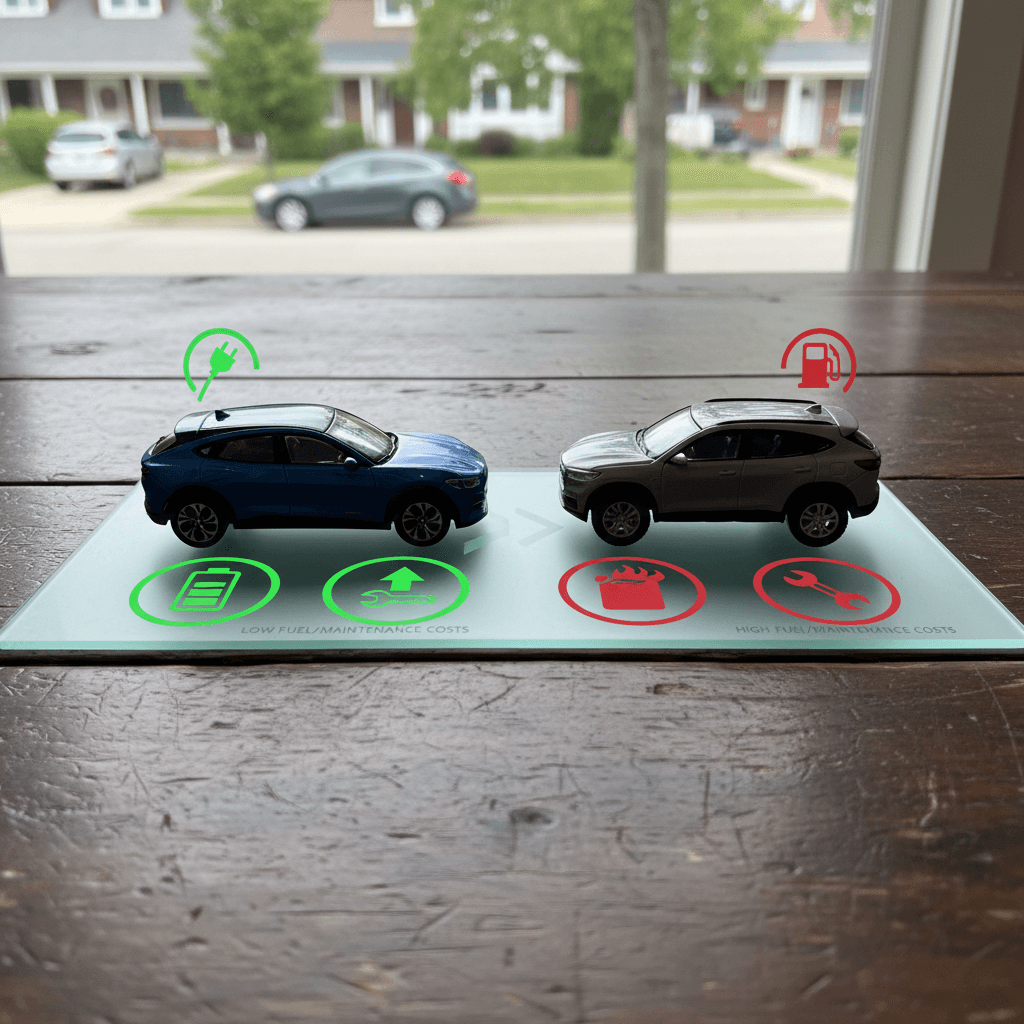
Fuel costs: Ford Mustang Mach-E vs gas car
Fuel is where EVs like the Mustang Mach-E typically win big. Let’s translate efficiency and energy prices into something tangible: cost per mile and 5-year spend.
Estimated 5-year fuel costs: Mach-E vs gas SUV
Assumes 13,500 miles per year, $3.10/gallon gas, $0.18/kWh electricity, and mostly home charging.
| Vehicle | Energy efficiency | Energy price | Cost per 100 miles | Annual fuel cost | 5-year fuel cost |
|---|---|---|---|---|---|
| Ford Mustang Mach-E | 34 kWh/100 mi | $0.18/kWh | $6.12 | ≈$826 | ≈$4,130 |
| Comparable gas SUV | 28 mpg | $3.10/gal | $11.07 | ≈$1,493 | ≈$7,465 |
You can tweak mileage or energy prices to match your own situation, but the pattern, lower cost per mile for the Mach-E, generally holds.
Fuel savings at a glance
3 ways to maximize Mach-E fuel savings
1. Charge mostly at home
Level 2 home charging almost always beats public DC fast charging on price. If you can plug in overnight, you’ll lock in the lowest per‑mile cost.
2. Use off-peak rates where available
Some utilities offer cheaper nighttime electricity. Scheduling your Mach-E to charge after 9 or 10 p.m. can trim another 10–30% off charging costs.
3. Watch your driving style
Smooth acceleration, moderate speeds, and using Eco modes where available can easily add 10–15% more range, lowering effective cost per mile.
Maintenance and repairs: fewer moving parts, fewer surprises
The Mach-E doesn’t need oil changes, fuel-system service, or transmission fluid swaps. Regenerative braking also stretches brake-pad life. That doesn’t mean maintenance is free, but it’s simpler and often cheaper over time than for a comparable gas SUV.
Ford Mustang Mach-E maintenance
- No engine oil or transmission service, the big one for long-term savings.
- Tire rotations, cabin air filters, brake fluid, and coolant checks on longer intervals.
- Fewer wear items under the hood means fewer surprise repairs as the vehicle ages.
- Average annual maintenance costs have been tracking in the low hundreds for newer Mach-E models, with most of that going to tires and routine inspections.
Gas SUV maintenance
- Oil changes every 5,000–7,500 miles, plus filters and periodic spark plugs.
- Transmission service, belts, and more complex exhaust and emissions systems.
- More heat and vibration under the hood, which can lead to gaskets, hoses, and sensors failing over time.
- Brake pads and rotors usually wear faster without regenerative braking.
Don’t forget tires and brakes
Insurance, taxes, and fees
Insurance for a Ford Mustang Mach-E can be similar to or slightly higher than a mainstream gas SUV, depending on your location and the specific vehicles you’re comparing. Insurers factor in vehicle price, repair costs, and crash data, so a high-trim Mach-E with expensive wheels and tech can cost more to insure than a base gas crossover.
- Insurance: For many households, EV vs gas differences are measured in the low hundreds of dollars per year once you match trim level and MSRP. Shopping quotes for both vehicles before you buy is one of the smartest steps you can take.
- Registration and local fees: A handful of states add an annual EV fee to replace lost gas-tax revenue. Others reduce registration fees or offer perks like HOV lane access.
- Tax credits: New and used EV credits at the federal and state level can materially change your net cost. A used Mach-E, for example, may qualify for a federal used EV credit if it meets income and price caps, something a comparable gas SUV doesn’t offer. Always check current rules before you sign.
Factor incentives into your real cost
Depreciation and resale value
Depreciation has been the wild card for EVs. Early on, some electric models lost value quickly as technology advanced and incentives shifted. The Mustang Mach-E has followed a more traditional curve: it takes its biggest hit in the first 2–3 years, then levels off in a way that’s increasingly similar to mainstream gas SUVs as used-EV demand grows.
How depreciation shapes cost of ownership
Why a used Mach-E often hits the value sweet spot.
New vehicle hit
Used EV opportunity
Gas SUV stability
5-year total cost of ownership: Mach-E vs gas car
Let’s pull everything together into a simple 5‑year comparison using our baseline assumptions. Think of this as a starting point rather than a promise, your numbers will vary by trim level, mileage, and local energy prices, but the relationships tend to hold.
Illustrative 5-year total cost of ownership
Approximate 5-year ownership costs for a new Ford Mustang Mach-E vs a new gas SUV at similar MSRP, driven 13,500 miles per year.
| Category | Ford Mustang Mach-E (new) | Comparable gas SUV (new) |
|---|---|---|
| Upfront price (after typical incentives) | $47,000 | $40,000 |
| 5-year depreciation | -$23,000 | -$18,000 |
| 5-year fuel cost | ≈$4,100 | ≈$7,500 |
| 5-year maintenance & repairs | ≈$2,800 | ≈$4,000 |
| 5-year insurance (typical) | ≈$8,000 | ≈$7,500 |
| Other fees & taxes (incl. EV fees where applicable) | ≈$2,000 | ≈$1,800 |
| Estimated 5-year total cost | ≈$40,900 | ≈$41,800 |
Purchase price and depreciation figures are rounded estimates based on mainstream trims; fuel and maintenance are derived from the assumptions outlined earlier.
What this table is really saying
Used Mach-E vs new: where the math gets better
For cost-conscious shoppers, this is where the Ford Mustang Mach-E really gets interesting. Because the largest chunk of depreciation happens early, a used Mach-E can deliver new‑car tech and range for a monthly outlay that looks a lot more like a mainstream gas crossover, while still reaping the fuel and maintenance savings.
Why a used Mustang Mach-E can undercut a new gas SUV
1. Depreciation already priced in
A 3–4‑year‑old Mach-E has typically taken most of its depreciation hit. You’re paying closer to the vehicle’s long-term value, not subsidizing its first owner’s new‑car moment.
2. Lower monthly payment options
Because the price is lower, loans and leases on used EVs can be more manageable, especially when paired with <strong>Recharged financing</strong> and pre-qualification tools that let you see where a Mach-E fits in your budget before you commit.
3. Battery and range transparency
With Recharged’s <strong>Recharged Score battery health diagnostics</strong>, you get hard data on real-world battery condition and range expectations, something you won’t see on a standard dealer window sticker.
4. Potential used EV tax credit
Subject to current rules, some used Mach‑E models may qualify for federal or state used EV credits. Gas SUVs do not. The right deal can knock thousands off your net cost on day one.
How Recharged derisks the used-EV equation
How electricity and gas prices change the math
Energy prices aren’t static. Gasoline and electricity both move, and regional spreads are real. Still, you can stress-test this comparison with a few quick scenarios.
What happens when gas or electricity prices move?
Gas gets cheaper
If gas fell closer to $2.50/gal and electricity stayed around $0.18/kWh, the Mach‑E would still enjoy a cost-per‑mile edge, but the annual fuel savings might shrink from ~$670 to perhaps ~$400–$450.
In that world, the Mach‑E’s advantage leans more on maintenance savings and potential tax credits than on fuel alone.
Gas gets more expensive
At $3.75/gal, with the same 28‑mpg SUV, a 13,500‑mile driver spends closer to $1,800–$1,900 per year on fuel.
The Mach-E’s yearly fuel bill doesn’t move nearly as much, so the annual savings can easily top $1,000, putting EV ownership firmly ahead on operating cost.
Electricity is unusually costly
In high-cost electricity states where residential rates push $0.28–$0.30/kWh, home charging gets pricier.
Even then, many Mach-E owners still end up roughly on par or slightly ahead, especially if they can access cheaper overnight rates or workplace charging. The equation simply gets tighter, so local rates matter more.
You drive more than average
Run 18,000–20,000 miles a year and fuel becomes the largest line item in either column.
The more you drive, the more every cent per mile matters, tilting the long-term math heavily in the Mach-E’s favor in most markets.
Beware public fast-charging sticker shock
Beyond cost: non-financial factors to weigh
Total cost of ownership matters, but it’s not the only variable that decides whether a Mach-E or a gas SUV fits your life. Convenience, driving experience, and infrastructure all play a role.
Mach-E vs gas SUV: factors you can’t put in a spreadsheet
Cost is just one part of the decision.
Home fueling convenience
Driving experience
Road-trip flexibility
How Recharged helps you run the numbers on a used Mach-E
If you’re leaning toward a Ford Mustang Mach-E but want clarity before committing, a data-backed look at costs can be the difference between confidence and second-guessing. That’s where Recharged is designed to help.
- Recharged Score Report: Every vehicle comes with a detailed report on battery health, range, and market value so you know exactly what you’re getting in a used Mach-E.
- Transparent pricing and TCO context: Listings highlight fair market pricing, and EV specialists can walk you through how fuel and maintenance savings factor into your monthly budget versus a gas SUV you’re considering.
- Financing and trade-in options: From pre-qualification to trade‑ins and instant offers, Recharged can help you move out of your gas vehicle and into a Mach-E without guesswork.
- Nationwide delivery and support: You can shop fully online or visit the Recharged Experience Center in Richmond, VA, then have your car delivered to your driveway with EV‑savvy support baked in.
Ford Mustang Mach-E vs gas car: FAQ
Frequently asked questions
Bottom line: Is a Mustang Mach-E cheaper than a gas car?
When you put real numbers to it, a Ford Mustang Mach-E doesn’t just compete with a comparable gas SUV on total cost of ownership, it often beats it, especially over a 5‑year window and especially in the used market. Lower fuel and maintenance bills help close the gap on higher upfront prices, and incentives or used-EV discounts can tilt the scales further.
If you’re in research mode, treat the tables and assumptions here as a starting point. Then plug in your mileage, your local energy prices, and the specific trims you’re eyeing. And if a used Mach-E is on your list, a Recharged Score Report, transparent pricing, and EV‑savvy support can give you the kind of clarity shoppers rarely get in a traditional showroom. That’s how you turn an abstract EV vs gas debate into a confident decision that fits your driveway, and your budget.