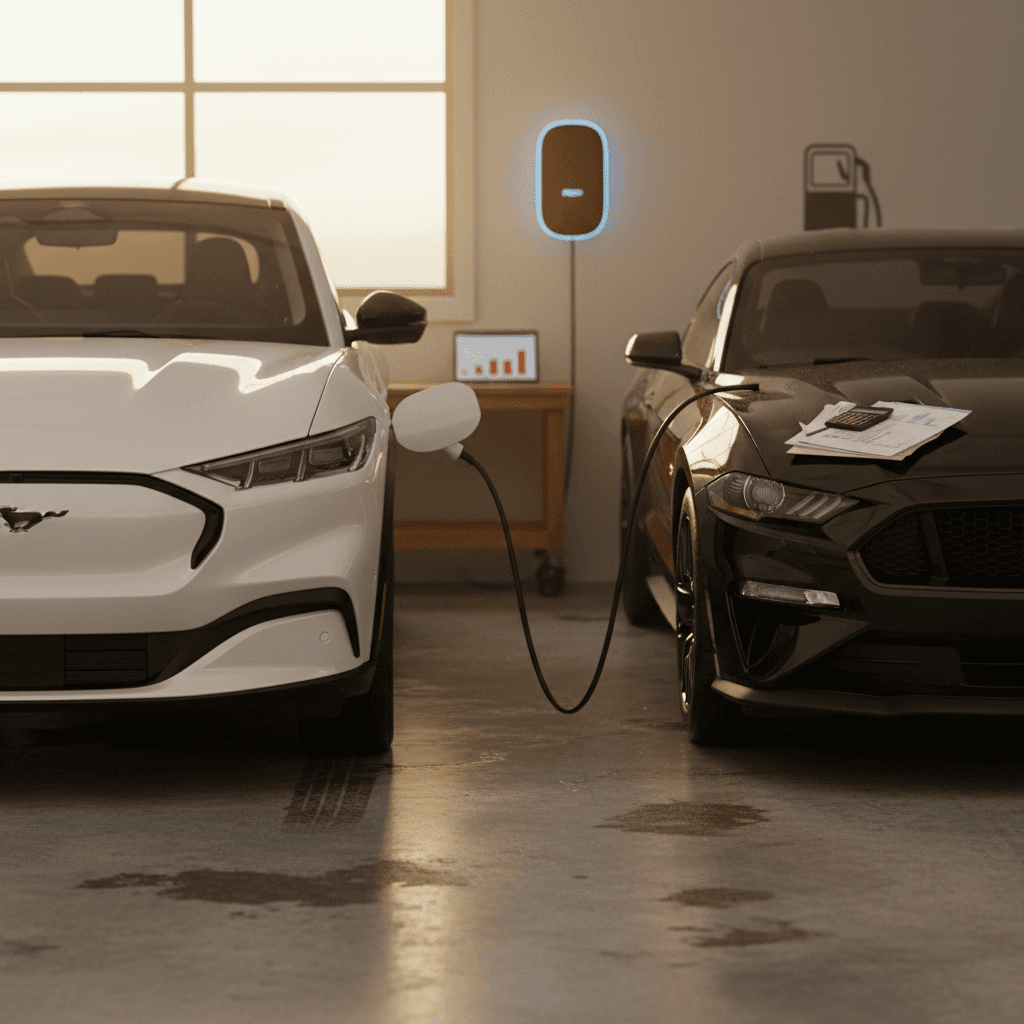
You don’t buy a Ford Mustang Mach-E just because it’s electric. You buy it because you want the performance and style of a sporty compact SUV, and you’re hoping the **total cost** won’t bite harder than a gas equivalent. In this guide, we’ll put real numbers to the Ford Mustang Mach-E total cost vs a comparable gas SUV, so you can see what you’ll actually spend over five years.
What this article covers
Why total cost matters more than sticker price
If you only look at MSRP, the Mustang Mach-E often starts higher than a mainstream gas SUV. That’s where many shoppers stop, and walk right back to the gas aisle. But the check you write every month isn’t just about what you financed. It’s fuel (or electricity), oil changes and repairs, registration, insurance, and what the thing is worth when you’re ready to sell or trade. Total cost of ownership (TCO) bundles all of that into one picture. When you do that math, the Mach-E usually pulls ahead, especially if you buy used, tap into **cheap home charging**, or drive more than the 12,000‑mile national average.
How we picked the “gas car equivalent” to the Mach-E
To make this fair, we need a gas SUV that matches the Mach-E on size, performance and brand. In Ford’s own stable, the closest match is a **Ford Escape compact SUV** with a turbocharged gas engine and all‑wheel drive, similar footprint, similar family-hauling mission, and similar real-world performance. For this comparison, we’ll use: - Ford Mustang Mach-E (mid‑trim, extended‑range battery, AWD) - Ford Escape 2.0L EcoBoost AWD (gas, automatic, similar equipment) You can mentally swap in another gas SUV you’re cross-shopping, RAV4, CR‑V, Equinox, and you’ll land in roughly the same cost neighborhood.
Trim choice matters
Quick answer: Is the Mustang Mach-E cheaper than gas?
5‑year cost snapshot: Mach-E vs comparable gas SUV*
How to read these numbers
Key assumptions behind the numbers
- Timeframe: 5 years of ownership
- Miles: 12,000 miles per year (60,000 miles total)
- Gas SUV efficiency: 26 mpg combined for a turbo AWD compact SUV
- Mach-E efficiency: about 3.0 miles/kWh in mixed driving (typical for mid‑trim AWD models)
- Electricity price: $0.17 per kWh U.S. residential average in 2025–2026
- Gas price: $3.75 per gallon long‑run average assumption
- Charging mix: 90% home Level 2, 10% public DC fast charging priced roughly 3x home rates
Adjust the math for your life
5‑year cost comparison: Mach-E vs gas SUV
Approximate 5‑year ownership cost: Ford Mustang Mach-E vs comparable gas SUV
Rounded, illustrative numbers for a mid‑trim Mach-E and a similar Ford Escape–class gas SUV over 60,000 miles.
| Category | Mach-E (EV) | Gas SUV (Escape‑class) | Notes |
|---|---|---|---|
| Purchase price (out the door) | $52,000 | $42,000 | Typical mid‑trim AWD with options, after fees and small discounts |
| 5‑year depreciation | -$25,000 | -$21,000 | EVs still drop faster in early years, but gap is shrinking |
| Electricity / fuel | $4,550 | $10,400 | Assumes 60,000 miles, home charging vs 26 mpg gas |
| Maintenance & repairs | $3,000 | $5,500 | Fewer wear items and no oil for Mach-E |
| Insurance (5 years) | $8,000 | $7,500 | EV slightly higher, depends heavily on your profile |
| Taxes, registration, fees | $3,000 | $2,800 | Some states add EV fees; others offer breaks |
| Estimated 5‑year total cash outlay | ≈$48,000 | ≈$52,000 | After resale value, fuel, maintenance, insurance and fees are accounted for |
*Assumes no federal EV tax credit. If you qualify, knock up to $7,500 off the Mach-E’s effective purchase cost for new vehicles.
Notice what’s happening: the Mach-E starts more expensive, but fuel and maintenance claw a lot of that back. Once you include resale value, the EV can end up a few thousand dollars cheaper than its gas twin over five years, without counting federal or state incentives.

Fuel vs electricity: What you’ll really spend
Gas SUV fuel cost
Assumptions:
- 26 mpg combined
- 60,000 miles in 5 years
- $3.75 per gallon average
Math:
- Gallons used = 60,000 ÷ 26 ≈ 2,308 gallons
- Fuel cost ≈ 2,308 × $3.75 ≈ $8,655
Add some idling, cold‑weather driving, and road trips, and $9k–$10k over five years is easy to hit.
Mustang Mach-E electricity cost
Assumptions:
- 3.0 miles/kWh in mixed use
- 60,000 miles in 5 years
- 90% home charging at $0.17/kWh
- 10% fast charging at roughly $0.45/kWh
Math:
- kWh used = 60,000 ÷ 3.0 ≈ 20,000 kWh
- 18,000 kWh at $0.17 ≈ $3,060
- 2,000 kWh at $0.45 ≈ $900
- Total ≈ $3,960 over five years
Even if your power is pricier, the EV typically cuts your “fuel” spend by **30–60%**.
Watch your fast-charging habit
Maintenance and repairs: Where EVs quietly win
How Mach-E maintenance compares to a gas SUV
Fewer moving parts, fewer fluids, fewer surprises.
No oil changes
Simpler drivetrain
Brake savings
You’ll still have tires, cabin filters, coolant service and the occasional suspension or alignment bill on either vehicle. But over five years, it’s realistic to see the Mach-E land around **$2,000–$3,000** in routine maintenance and minor repairs, vs **$4,000–$6,000** for a gas SUV if you actually follow the service schedule. Over a decade, that gap only grows wider, more so if you keep your vehicles past 100,000 miles, where gas engines and transmissions become expensive wildcards.
Battery fear, put in perspective
Insurance, taxes, and fees
Here’s where the story gets a little less glamorous for the EV. In many markets, insurers still charge a **slight premium** to cover an electric vehicle, particularly newer ones with pricey battery packs and advanced driver assistance systems. Call it a few hundred dollars per year compared with a similarly valued gas SUV. On the tax and registration side, several states now layer on **EV-specific registration fees** to make up for lost gas tax revenue, while others offer lower registration or property taxes for EVs. The result: over five years, insurance and fees together are usually **slightly higher for the Mach-E**, but not enough to erase the big wins on fuel and maintenance.
Shop your insurance early
Depreciation and resale value
Depreciation is where EV shoppers have felt some whiplash. As more new EV supply hit the market and federal incentives reshuffled, early Mustang Mach-E buyers watched used values soften faster than comparable gas SUVs. That volatility cuts both ways. If you’re buying **new**, you should assume the Mach-E will lose more dollars of value in the first 3–4 years than a similar Escape. If you’re buying **used**, that same early drop becomes your friend: you’re letting the first owner eat the steepest part of the curve while you enjoy low running costs. By year five, a mid‑trim Mach-E and a similar Escape often sit surprisingly close in percentage of value retained. The EV may have lost more dollars up front, but it also cost less to feed and maintain along the way.
Where used EVs shine
Ready to find your next EV?
Browse VehiclesNew vs used Mach-E: How the math changes
Illustrative 5‑year cost: new vs used Mach-E vs gas SUV
How starting with a used Mach-E instead of new can shift total cost of ownership vs a gas SUV.
| Scenario | Upfront price | 5‑year fuel / electricity | 5‑year maintenance | 5‑year total (after resale) |
|---|---|---|---|---|
| New Mach-E mid‑trim AWD | $52,000 | $3,960 | $2,500 | ≈$48,000 |
| 3‑year‑old used Mach-E, similar spec | $35,000 | $3,960 | $3,000 | ≈$39,000 |
| New gas SUV (Escape‑class AWD) | $42,000 | $8,655 | $5,000 | ≈$52,000 |
Prices and totals rounded for clarity; your actual numbers will depend on trim, mileage, region, and interest rate.
With a **new** Mach-E, you’re leaning on lower running costs, and potentially a tax credit, to offset a higher sticker. With a **used** Mach-E, the equation gets more dramatic: you’re starting closer to gas‑SUV pricing but keeping the fuel and maintenance advantage. That’s why so many budget‑minded buyers end up cross‑shopping a used EV against a brand‑new gas model.
How Recharged fits in
When a gas SUV can still make more sense
- You can’t install home charging. If you rely entirely on public DC fast charging, especially at high per‑kWh rates, your fuel savings shrink fast.
- Your electricity is extremely expensive. In a few regions, residential rates are high enough that the Mach-E’s advantage narrows or disappears unless gas prices spike.
- You drive very few miles. If you’re only putting 5,000–6,000 miles a year on the odometer, fuel savings may not be large enough to justify any upfront price premium.
- You tow or frequently drive in remote areas. The Mach-E isn’t a heavy hauler, and charging gaps on rural routes can make a gas SUV more practical today.
- You simply prefer the driving/ownership experience. There’s nothing wrong with liking the sound and feel of a gas engine or the refueling routine you know. Total cost is just one piece of the puzzle.
Road-trip reality check
Checklist: Deciding between a Mach-E and gas SUV
Quick decision checklist
1. Confirm your charging plan
Can you install or access reliable Level 2 home charging? If not, what will your real‑world fast‑charging mix and cost look like?
2. Pull your real mileage
Look at the last couple of years of odometer history or app data. If you’re well over 12,000 miles a year, fuel savings will be a major factor.
3. Price out insurance
Get quotes for a specific Mach-E VIN and a comparable gas SUV. Use the same coverage levels so you’re comparing apples to apples.
4. Decide new vs used
If you’re payment‑sensitive, compare a used Mach-E from a source that verifies battery health against a new gas SUV. The total cost difference may surprise you.
5. Check incentives and fees
Look up federal, state, and local EV incentives, plus any EV‑specific registration fees. These can move the needle by thousands over your ownership period.
6. Run your own TCO math
Use an EV total cost of ownership calculator or a simple spreadsheet. Plug in your local gas and electricity prices, your actual miles, and quotes you’ve collected.
7. Think about your exit plan
How long will you keep the vehicle? If you tend to trade every 3 years, depreciation matters more. If you keep cars 8–10 years, running costs dominate the story.
FAQ: Ford Mustang Mach-E total cost vs gas
Frequently asked questions
Bottom line: Should you go Mach-E or gas?
If you’re comparing a Ford Mustang Mach-E total cost vs a gas car equivalent, you’re already asking a smarter question than, “Which one has the lower payment?” For a typical American driver with access to home charging, the Mach-E usually wins on 5‑year total cost, and it does it while being quicker, quieter, and cleaner to live with day to day. A gas SUV still has its advantages: simpler road‑trip planning in some regions, familiar fueling, and sometimes a lower drive‑off price. But once you add up five years of gas, maintenance, and depreciation, that cheaper sticker can turn into the more expensive relationship. If you’re EV‑curious but cost‑cautious, a used Mustang Mach-E with verified battery health is one of the most interesting deals in the market right now. And if you’d like help running the numbers on a specific vehicle, EV versus gas, Recharged’s EV‑specialist team can walk you through the details so you’re confident not just in what you’re buying, but in what it will really cost to own.