If you own or are eyeing a used Ford Mustang Mach‑E in 2026, depreciation isn’t just an abstract number, it’s the single biggest cost of “fuel” you’ll never plug into a charger. The Ford Mustang Mach‑E depreciation rate in 2026 is steeper than most gas crossovers and many hybrids, but that doesn’t mean it’s a bad buy. It does mean you need to understand where the curve is steepest, how battery health changes the math, and how to position yourself on the right side of that curve.
Key takeaway for 2026 shoppers
Ford Mustang Mach‑E depreciation in 2026: the short version
Ford Mustang Mach‑E depreciation at a glance (2026)
Put simply, the Mach‑E is one of the faster‑depreciating EVs, but that’s also why a smart used‑buyer in 2026 can get a lot of car for the money. If you’re buying new, depreciation is a cost you must manage. If you’re buying used, someone else already paid most of that bill.
How fast does a Ford Mustang Mach‑E depreciate?
Exact percentages vary by trim, incentives, and local market conditions, but multiple 2024–2026 analyses of five‑year‑old EVs place the Ford Mustang Mach‑E near the top of the depreciation charts. Several datasets and summaries indicate roughly 60–65% value loss over five years for the Mach‑E, meaning a $55,000 MSRP example might trade in the low‑$20,000s after that time under typical mileage and condition.
- Most of the pain hits in years 1–3 as heavy discounts on new EVs and fast tech improvements reset used prices downward.
- Years 4–6 tend to be less dramatic; values track more closely with mileage, battery health, and overall EV demand.
- After 8 years, or once a Mach‑E is out of high‑voltage battery warranty, market behavior depends heavily on demonstrated battery health and consumer confidence.
Don’t over‑generalize the percentage
2026 value snapshot: Mach‑E by model year
To make this practical, let’s translate those percentages into the sort of ranges you’re likely to see in 2026 for U.S. market vehicles with average mileage and clean histories. These are directional guideposts, not appraisal numbers:
Illustrative 2026 Ford Mustang Mach‑E value ranges by model year
Approximate retail transaction ranges in 2026 for clean, average‑mileage U.S. Mach‑Es. Actual values will vary by trim, region, options, incentives at original sale, and battery health.
| Model year (in 2026) | Typical odometer | Illustrative retail range* | Approx. depreciation from original MSRP |
|---|---|---|---|
| 2021 (5 years old) | 55,000–75,000 mi | $15,000–$22,000 | ≈55–65% |
| 2022 (4 years old) | 45,000–65,000 mi | $18,000–$25,000 | ≈50–60% |
| 2023 (3 years old) | 30,000–50,000 mi | $23,000–$30,000 | ≈40–50% |
| 2024 (2 years old) | 15,000–35,000 mi | $28,000–$36,000 | ≈30–40% |
| 2025 (1 year old) | 8,000–20,000 mi | $35,000–$42,000 | ≈20–30% |
Use these numbers as context when you compare asking prices or trade‑in offers; always back them up with real‑time market data and a vehicle‑specific report.
About these numbers
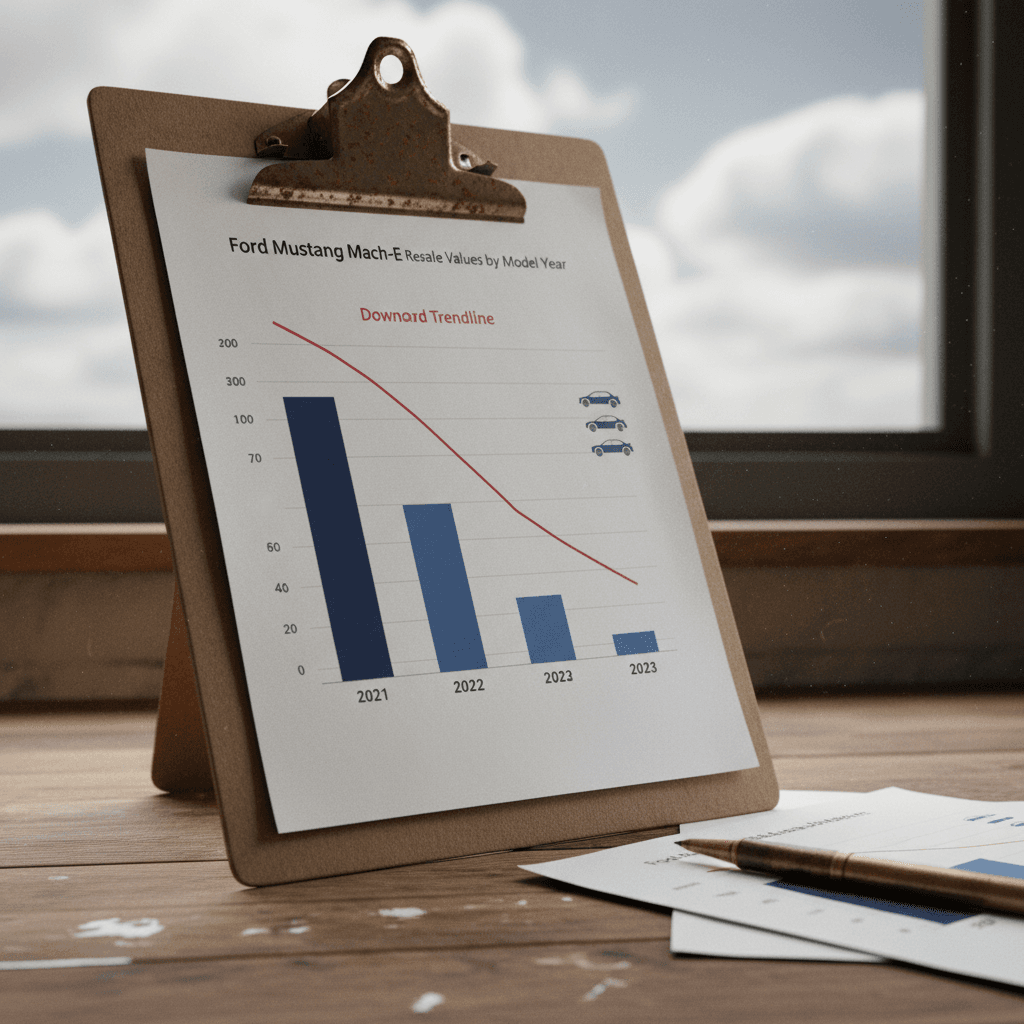
Five‑year Ford Mustang Mach‑E depreciation forecast
Forecasts are never perfect, but if current trends hold and EV demand in the U.S. grows steadily rather than explosively, here’s a reasonable 5‑year view for the Mach‑E purchased or evaluated in 2026:
What a 5‑year hold could look like in 2026
Three common starting points for Mach‑E buyers
Scenario 1: Buy new in 2026
Who it fits: You want the latest tech, full warranty, and plan to keep the car 5+ years.
- Expect 50–60% loss of MSRP over 5–6 years if current EV trends continue.
- Your depreciation cost will likely dwarf your electricity and maintenance bills combined.
- Upside: you control maintenance from day one and enjoy every software and hardware update of the newest model years.
Scenario 2: Buy 2–3 years old
Who it fits: Value‑focused buyers willing to skip the “new car” moment.
- The first owner already ate much of the 30–45% initial hit.
- Over your 5‑year hold, additional depreciation might be closer to 30–40% of the price you pay, not of original MSRP.
- That often translates to lower cost per mile than buying new.
Scenario 3: Trade a 2021–2022 in 2026
Who it fits: Early adopters wanting out before battery warranty ages out.
- Expect trade‑in offers that reflect 50–65% total loss from original MSRP, depending on mileage and battery health.
- Values will be more sensitive to Recharged‑style battery reports, service history, and accident records than just age.
The value “sweet spot”
Why the Mach‑E depreciates faster than some gas SUVs
If you’re coming from the gas world, a 60+% five‑year depreciation number can feel brutal. Several structural forces are at work here, most of them affecting the EV segment as a whole, with the Mach‑E caught in the crossfire:
- Rapid tech turnover: Range, charging speeds, and driver‑assist features are improving fast. A 2026 EV can make a 2021 model feel dated even if both are in great shape.
- Aggressive incentives on new EVs: Factory rebates, tax credits, and discounting on new inventory pull transaction prices down and reset used values.
- Segment competition: The Mach‑E competes with Tesla Model Y, Hyundai Ioniq 5, Kia EV6, and others. When one brand cuts prices, the others feel it in their used values.
- Consumer uncertainty about batteries: Many shoppers still overestimate EV battery replacement risk and cost, pushing resale values lower than real‑world data might justify.
- Brand and perception: Ford’s first mass‑market EV SUV launched into a space dominated by Tesla. Early recalls and software quirks didn’t help confidence, even as many owners report positive long‑term experiences.
Recalls and reliability perception matter
How battery health changes Mach‑E depreciation math
Unlike a gas SUV, a used EV’s value is tightly linked to verified battery state of health (SOH). In 2026, more buyers, lenders, and dealers are asking, “What’s the battery score?” before they talk numbers. Two Mach‑Es with the same model year and mileage can differ by thousands of dollars based purely on battery diagnostics and charging history.
Stronger battery health
- Pack shows minimal degradation for age and mileage.
- DC fast‑charging history is moderate, not extreme.
- No history of high‑voltage faults or temperature‑related derating.
- Backed by a transparent, third‑party report like the Recharged Score.
Result: Higher buyer confidence and stronger offers; depreciation more closely tracks typical market averages.
Questionable or unknown battery health
- No diagnostic report, or only a basic OBD snapshot.
- Hard, repeated DC fast‑charging use without documentation.
- Software derates, range complaints, or open battery‑related recalls.
- Seller can’t explain charging habits or service history.
Result: Wider spread between ask and bid, more lowball offers, and sharper effective depreciation.
How Recharged helps here
Ford Mustang Mach‑E vs Tesla Model Y depreciation
It’s impossible to talk about Mach‑E value without mentioning the Tesla Model Y. Both play in the same electric crossover space, and both have seen intense price volatility since 2022. Recent five‑year depreciation studies typically show the Mach‑E losing a larger percentage of original MSRP than the Model Y, which benefits from brand cachet, broader charging infrastructure, and historically strong demand.
Mach‑E vs. Model Y: 2026 depreciation themes
Why values don’t move in lockstep
Where the Mach‑E lags
- Weaker brand pull in the EV‑only shopper crowd.
- Early production and software issues that linger in buyer memory.
- Ford’s use of incentives on new inventory, which can undercut late‑model used prices.
- Slightly less efficient drivetrain in some trims, affecting perceived running costs.
Where the Mach‑E competes strongly
- More traditional interior and driving feel that many shoppers prefer.
- Strong safety credentials and family‑friendly packaging.
- Improving fast‑charging access via NACS adoption and charging partnerships.
- Heavier early depreciation, which can make used Mach‑Es look like bargains versus similar‑year Model Ys.
What this means in dollars
Owning vs. leasing a Mach‑E in 2026
Steep early depreciation raises a natural question: are you better off leasing a Mach‑E instead of owning it in 2026? The answer depends on whether you want payment certainty or asset control.
How to decide between owning and leasing a Mach‑E
1. Look at real‑world residuals
Lease residuals are set by banks, not market realities. In a fast‑changing segment like EVs, actual resale values can come in lower, or sometimes higher, than the residual baked into your contract.
2. Consider your tech tolerance
If you always want the latest range and driver‑assist features, leasing every 2–3 years keeps you ahead of the depreciation curve. If you plan to hold 7+ years, ownership usually pencils out better.
3. Factor in federal and state incentives
Some incentives flow to the lessor and are baked into the lease payment; others benefit you directly when you purchase. In 2026, structure matters as much as sticker price.
4. Think about mileage and usage
High‑mileage or ride‑share use will concentrate depreciation into fewer years. In those cases, owning a used Mach‑E that’s already taken the big hit can be more cost‑effective than leasing new.
5. Run a total‑cost‑of‑ownership comparison
Don’t just compare monthly payments. Add purchase price or cap cost, expected depreciation, finance charges, insurance, electricity, and maintenance. Used‑EV calculators and Recharged pricing tools can help.
7 ways to reduce depreciation on your Mach‑E
You can’t control the entire market, but you can absolutely influence where your Mach‑E lands within the value range for its model year. Here are concrete steps that tend to pay off when it’s time to sell or trade:
- Keep mileage in check. The market still pays a premium for low‑ and mid‑mileage EVs. If you have a second vehicle for long‑distance use, that can help preserve Mach‑E value.
- Charge wisely. Favor Level 2 charging at home or work, and save DC fast charging for trips. Document your habits; a healthy battery history supports higher offers.
- Stay on top of recalls and software updates. Completed repairs and current firmware reassure the next owner and their lender.
- Maintain detailed records. Keep receipts and digital logs for tires, brakes, cabin filters, and any warranty work. A well‑documented EV is easier to value and easier to sell.
- Protect the interior and exterior. Cosmetic damage doesn’t change battery health, but it absolutely changes bids. Simple things like paintless dent repair and professional detailing can lift value.
- Avoid heavy modifications. Non‑OEM wheels, suspension changes, or cosmetic wraps narrow your buyer pool and can hurt resale, especially with conservative lenders.
- Sell through EV‑savvy channels. Platforms that understand and explain battery reports (like Recharged) usually attract buyers willing to pay closer to true market value.
Time your exit
Using Recharged to buy or sell a Mach‑E
Because depreciation is such a big piece of the cost puzzle, you want every advantage you can get when you buy or sell. That’s where Recharged is designed to help Mach‑E shoppers and owners in 2026.
How Recharged fits into your Mach‑E depreciation strategy
Make the numbers work harder for you, not against you
Buying used Mach‑E
Shop used Ford Mustang Mach‑E inventory with:
- Recharged Score Reports that include battery health diagnostics and fair‑market pricing.
- Expert EV‑specialist support to help you compare trims and depreciation expectations.
- Financing options tailored to used EVs, not just gas cars.
Selling or trading your Mach‑E
Turn your Mach‑E into cash or your next EV via:
- Instant offer or consignment programs that expose your car to EV‑interested buyers nationwide.
- Valuations that account for verified battery health, not just age and mileage.
- Transparent fees and support throughout the sale process.
Making the transition easy
Recharged can coordinate:
- Nationwide delivery of your next EV.
- Trade‑in logistics so you’re not juggling multiple dealers.
- On‑site help at the Recharged Experience Center in Richmond, VA if you prefer to see and drive vehicles in person.
Ready to find your next EV?
Browse VehiclesFord Mustang Mach‑E depreciation FAQ (2026)
Common questions about Mach‑E depreciation in 2026
Bottom line: Is Mach‑E depreciation a deal‑breaker?
The Ford Mustang Mach‑E depreciation rate in 2026 is undeniably higher than many mainstream gas crossovers and hybrids, and it’s a touch steeper than some direct EV rivals. That’s the downside. The upside is that depreciation is a one‑time cost, and in 2026, much of that cost has already been paid by the first owner. If you focus on healthy 2–4‑year‑old examples with verified battery reports and realistic pricing, the Mach‑E can deliver a lot of electric performance and practicality for the money.
If you’re selling, treating your Mach‑E like an asset, documenting service, managing charging habits, and listing it on an EV‑savvy platform, can claw back thousands that casual sellers leave on the table. If you’re buying, leaning on transparent diagnostics and market‑driven pricing, like you’ll find with Recharged’s used EV marketplace and Recharged Score Reports, lets you turn someone else’s steep depreciation into your opportunity rather than your risk.