If you’re considering a Ford Mustang Mach-E, or already own one, your biggest practical question is simple: **how fast does it really charge** on a road trip? Automaker claims are one thing; real-world DC fast charging speed tests tell a more honest story. This guide breaks down Ford Mustang Mach-E charging speed test results, what they mean for 10–80% fast charges, and how to get the quickest possible stops.
Quick Mach-E fast-charging snapshot
Why Mach-E charging speed matters
The Ford Mustang Mach-E sits in a crowded field of electric crossovers, and its **charging performance** can make or break your ownership experience. You might commute just fine on Level 2 at home, but when you hit the highway, how long you sit at a DC fast charger, and how often, matters more than the headline range number on the window sticker.
- Fast charging speed determines **how quickly you can add 150–200 miles** on a long drive.
- Different Mach-E trims (standard vs extended range, RWD vs AWD) have **different charge times and curves**.
- Software updates in 2023–2024 improved **10–80% times by several minutes**, especially on newer models.
- If you’re buying a **used Mustang Mach-E**, understanding charge speed and battery health helps you separate a great deal from a problem child.
Rule of thumb for road trips
Mach-E batteries and peak charging speeds
Before you can interpret any charging speed test, you need to know which **battery and drivetrain** you’re working with. The Mach-E has used a couple of different usable battery sizes over the years, but they fall into two basic buckets: **standard range** and **extended range**.
Ford Mustang Mach-E battery options & DC fast charging specs
Key battery sizes, usable capacity, and peak DC fast charging power for common Mustang Mach-E configurations.
| Battery type | Approx. usable capacity | Typical trims | Peak DC fast charge power |
|---|---|---|---|
| Standard Range | ~70–73 kWh usable | Select, some Premium (RWD/eAWD) | Up to ~115 kW |
| Extended Range (early) | ~88 kWh usable | Premium, California Route 1, some GT | Up to 150 kW |
| Extended Range (later) | ~88–91 kWh usable | Premium ER, GT, Rally | Up to 150 kW |
Exact specs vary slightly by model year and trim, but these figures cover the most relevant ranges for real-world charging performance.
Don’t confuse kW with kWh
Ford Mustang Mach-E charging speed test results
Laboratory numbers are useful, but what owners care about is **10–80% time on a good DC fast charger**. Here’s how real-world and manufacturer-published figures line up for recent Mach-E models on a 150-kW (or faster) charger, assuming a warm battery and ideal conditions.
Headline Mach-E DC fast charging stats (recent model years)
Typical 10–80% DC fast charge times by Mach-E battery
Approximate Ford estimates and independent tests for 10–80% charging on a healthy battery and a 150-kW+ charger.
| Battery & model year | Approx. 10–80% time | Notes |
|---|---|---|
| 2021–2022 Standard Range | ~36–38 minutes | Early software; some owners report slightly slower curves in cold weather. |
| 2023 Standard Range (after update) | ~33 minutes | Ford reduced the estimate via charging-curve tweaks. |
| 2021–2022 Extended Range | ~42–45 minutes | Typical figure on 150-kW DC, especially on early builds. |
| 2024+ Extended Range | ~36–37 minutes | Ford’s own data implies ~36.2 minutes after thermal and software improvements. |
| Rally/GT extended-range performance | ~36–38 minutes | Same pack and peak power; hard driving before a session can warm the pack and stabilize high power early in the session. |
Older cars may be a few minutes slower; newer software updates have generally improved these times.
Those are **ideal-case numbers**. In real owner testing, you’ll usually see something within a couple of minutes of these figures if you: - Arrive at the charger between about **5–20% state of charge** - Plug into a **150-kW+ DC fast charger** with no power-sharing - Have a **warmed battery** (after at least 20–30 minutes of highway driving in moderate weather) - Avoid extremely cold or hot ambient temperatures
Real-world adjustment
How the Mach-E charging curve behaves
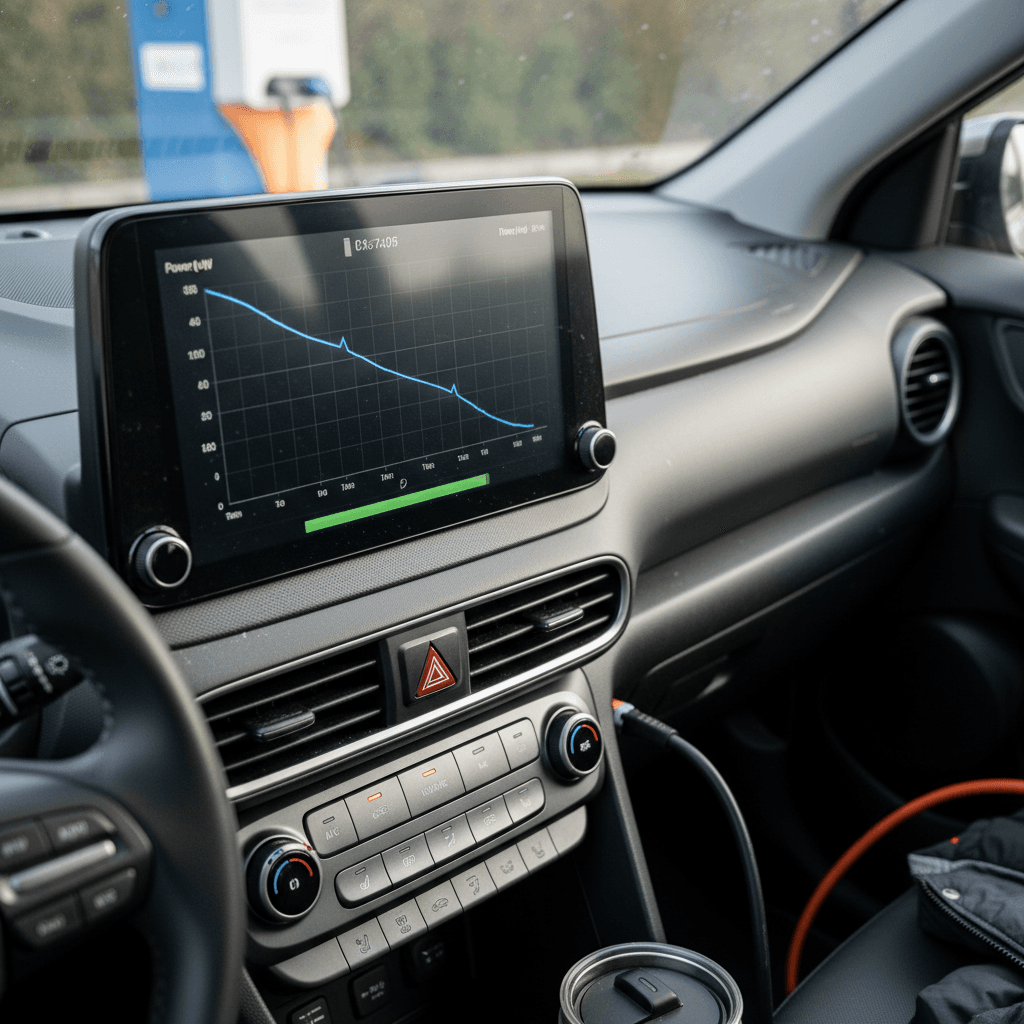
Charging speed tests aren’t just about the single biggest number. What matters is the **shape of the charging curve**, how long the Mach-E holds near its peak power before it tapers down. That’s where Ford’s more recent software updates have quietly helped.
1. Early Mach-E models
- Hit peak power (115–150 kW) around **10–20% SOC**.
- Begin ramping down noticeably by **40–50% SOC**.
- Spend a lot of time in the **70–90 kW** band, stretching 10–80% to the low 40-minute range on extended-range packs.
2. Updated 2023–2025 models
- Software and thermal tweaks keep the car **closer to peak longer**.
- Charge curve holds well over **100 kW deeper into the pack**.
- Result: extended-range 10–80% drops into the **mid-30-minute** range, standard-range into the low 30s.
Warm batteries charge faster
Home and Level 2 charging: how it compares
Day to day, you’ll live on **Level 2 AC charging**, not DC fast charging. Ford’s own guidance, and multiple dealer guides, quote about **7–11 hours** for a full 0–100% charge on a properly sized home charger, depending on which battery you have and whether you’re using Ford’s 48-amp Charge Station Pro or a lower-amp wallbox.
Mustang Mach-E home charging times (typical)
Approximate home charging times for 0–100% in common setups. Real times vary with amperage, wiring, and starting SOC.
| Charging method | Battery | Typical 0–100% time | Use case |
|---|---|---|---|
| 120V Level 1 (mobile cord) | Standard or extended | 50–95 hours | Emergency backup; impractical for daily full charges. |
| 240V Level 2 ~32A (mobile cord or basic wallbox) | Standard range | ~11–12 hours | Overnight at home or work. |
| 240V Level 2 ~32–40A | Extended range | ~13–14 hours | Overnight for longer commutes. |
| 240V Level 2 48A (Ford Charge Station Pro) | Extended range | ~10–11 hours | Fastest realistic home charging; good for heavy daily drivers. |
These figures are for a healthy pack and a properly wired circuit; older homes may require electrical upgrades.
Good news for most owners
Using Tesla Superchargers with the Mach-E
One of the biggest charging-story updates for Ford in 2024–2025 is **access to Tesla Superchargers**. Ford now supports a NACS (also called J3400) adapter for the Mustang Mach-E, and with recent software updates you can route to and activate Tesla chargers through Ford’s connected services.
Mach-E + Tesla Superchargers: what you need to know
You can now tap into the biggest fast-charging network in the U.S., with a few caveats.
1. You need the adapter
2. Power levels still apply
3. Activation is app-based
Stall and site limitations
Real-world miles of range added per minute
Charging speed tests often focus on kW, but what you really care about is **miles of range per minute of charging**. That depends on both **how fast you charge (kW)** and **how efficient your specific Mach-E trim is (mi/kWh).**
Approximate range added per minute for common Mach-E trims
These numbers assume a warm battery, a strong DC fast charger, and operation in the fat part of the charge curve (roughly 10–60% SOC).
| Trim & battery | Typical highway efficiency | Realistic power band | Approx. miles added per minute (10–60% SOC) |
|---|---|---|---|
| Standard-range RWD | ~3.0 mi/kWh | 80–110 kW | ~4–5 miles/min |
| Standard-range eAWD | ~2.7–2.9 mi/kWh | 80–110 kW | ~4 miles/min |
| Extended-range RWD | ~3.2 mi/kWh | 90–130 kW | ~5 miles/min |
| Extended-range GT / Rally eAWD | ~2.5–2.7 mi/kWh | 90–130 kW | ~4–5 miles/min |
Think of these as trip-planning rules of thumb, not guaranteed results in all conditions.
Trip-planning shortcut
Charging tips to speed up your stops
You can’t change physics, but you *can* change how you interact with your Mustang Mach-E’s charging system. Small tweaks in how you plan and drive can shave **5–15 minutes off** a long drive, and reduce how often you charge in the least efficient parts of the curve.
6 ways to get the fastest Mach-E fast charges
1. Arrive low, but not empty
Aim to reach fast chargers at **10–20% state of charge**. Below that you risk stress and slower power limits; above ~40% you’re already past the highest charging plateau.
2. Favor 150-kW (or better) chargers
The Mach-E’s extended-range pack can take **up to 150 kW**, so plugging into a 50–75 kW station will cap your speed long before the car does.
3. Avoid 80–100% fast charging
Past roughly **80% SOC**, your Mach-E will sharply taper power to protect the battery. You’ll spend a lot of time for very little extra range, better to leave and charge again later if needed.
4. Pre-warm the battery in winter
In cold weather, plan **20–30 minutes of highway driving** before the first DC fast charge. If your nav supports it, set the charger as a destination so the car can precondition the pack where available.
5. Park smart in extreme heat
If it’s blazing hot, don’t sit in direct sun before a big charge. A little shade and keeping the cabin temp reasonable helps the **battery cooling system** keep charge power high.
6. Check recent station check-ins
Use apps that show **recent user reports and check-ins**. An out-of-service or power-limited charger will ruin any carefully planned charging strategy.
Don’t fast charge like it’s a gas station
Buying a used Mach-E: checklist for charging performance
If you’re shopping the used market, you’ll find plenty of Mustang Mach-E crossovers at attractive prices. But not every used EV has the same **charging behavior or battery health**. This is where working with a specialist like Recharged, and having transparent diagnostics, really matters.
Key charging questions to ask about a used Mach-E
A few smart questions now can save you from slow, frustrating road trips later.
Battery health & history
Software & recall status
Fast-charging behavior
Warranty coverage
How Recharged can help
Ready to find your next EV?
Browse VehiclesFord Mustang Mach-E charging FAQ
Common questions about Mach-E charging speed
Bottom line: how fast does the Mach-E really charge?
Put simply, the Ford Mustang Mach-E is a **solid, but not class-leading, fast charger** that has improved meaningfully since its launch. With a modern software build, a healthy battery, and a strong DC fast charger, you can expect a **10–80% stop in the mid‑30‑minute range**, adding roughly 150–200 miles of real-world highway range. That’s entirely workable for cross-country trips if you plan stops around 10–80% windows instead of chasing 100%.
If you’re in the market for a **used Mustang Mach-E**, pay as much attention to **charging behavior and battery health** as you do to paint color and options. Working with an EV‑focused retailer like Recharged, with transparent battery diagnostics, fair market pricing, expert support, and nationwide delivery, makes it much easier to end up with a Mach-E that charges quickly, drives confidently, and fits your daily life.