If you’re considering Ford’s all‑electric pickup, the big question isn’t just sticker price, it’s **how much it costs to own a Ford F-150 Lightning per year**. Between electricity, insurance, maintenance, and depreciation, the yearly bill can look very different from a gas F-150, and it changes a lot if you buy new versus used.
Short version
Overview: What this guide covers
- A clear, number‑driven answer to what it costs per year to own a Ford F-150 Lightning
- Breakdowns for **charging, insurance, maintenance, depreciation, taxes and fees**
- Example scenarios at 10,000, 12,000 and 15,000 miles per year
- How buying **used** can cut your annual cost dramatically
- Where a marketplace like Recharged fits into the picture if you’re looking at a used Lightning
Important caveat
Quick answer: typical annual cost to own an F-150 Lightning
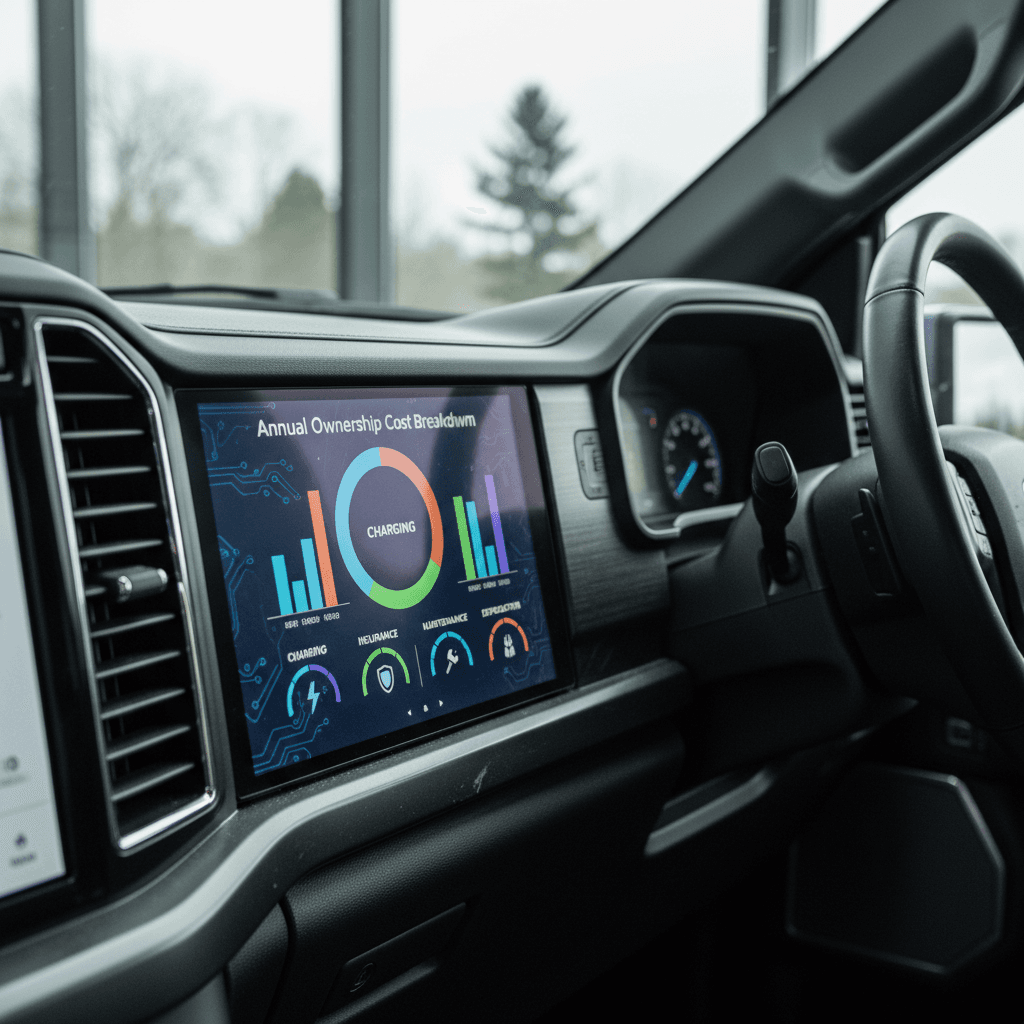
Ford F-150 Lightning: typical yearly costs (new, U.S. average)
Add in registration, taxes and the time value of money on a loan, and **total annual ownership for a new Ford F-150 Lightning commonly lands around $10,000–$13,000 per year** for a typical U.S. driver. If that sounds high, remember that a comparably‑equipped gas F-150 can be in the same ballpark once you add fuel and maintenance, especially if you drive a lot.
Buying used changes the math
Key assumptions: mileage, electricity price and trim
To keep this guide realistic, and comparable to other ownership cost tools, we’ll base calculations on these assumptions:
Core assumptions for F-150 Lightning annual cost estimates
You can adjust these to match your own situation, but this is the baseline used in all examples below.
| Factor | Baseline assumption | Notes |
|---|---|---|
| Annual mileage | 12,000 miles | Close to U.S. light‑duty average |
| Truck version | Extended‑range AWD | Most popular configuration for range and towing |
| Efficiency | 49 kWh / 100 miles | EPA figure for 4WD Lightning (about 2.0 mi/kWh) |
| Home electricity price | $0.17 per kWh | Approximate recent U.S. residential average |
| Home charging share | 90% home / 10% DC fast | Occasional road trips or convenience fast charging |
| Ownership horizon | 5 years | Matches most cost‑to‑own calculators |
Baseline assumptions reflect typical U.S. ownership in 2024–2026.
Adjusting for your situation
Yearly charging cost for a Ford F-150 Lightning
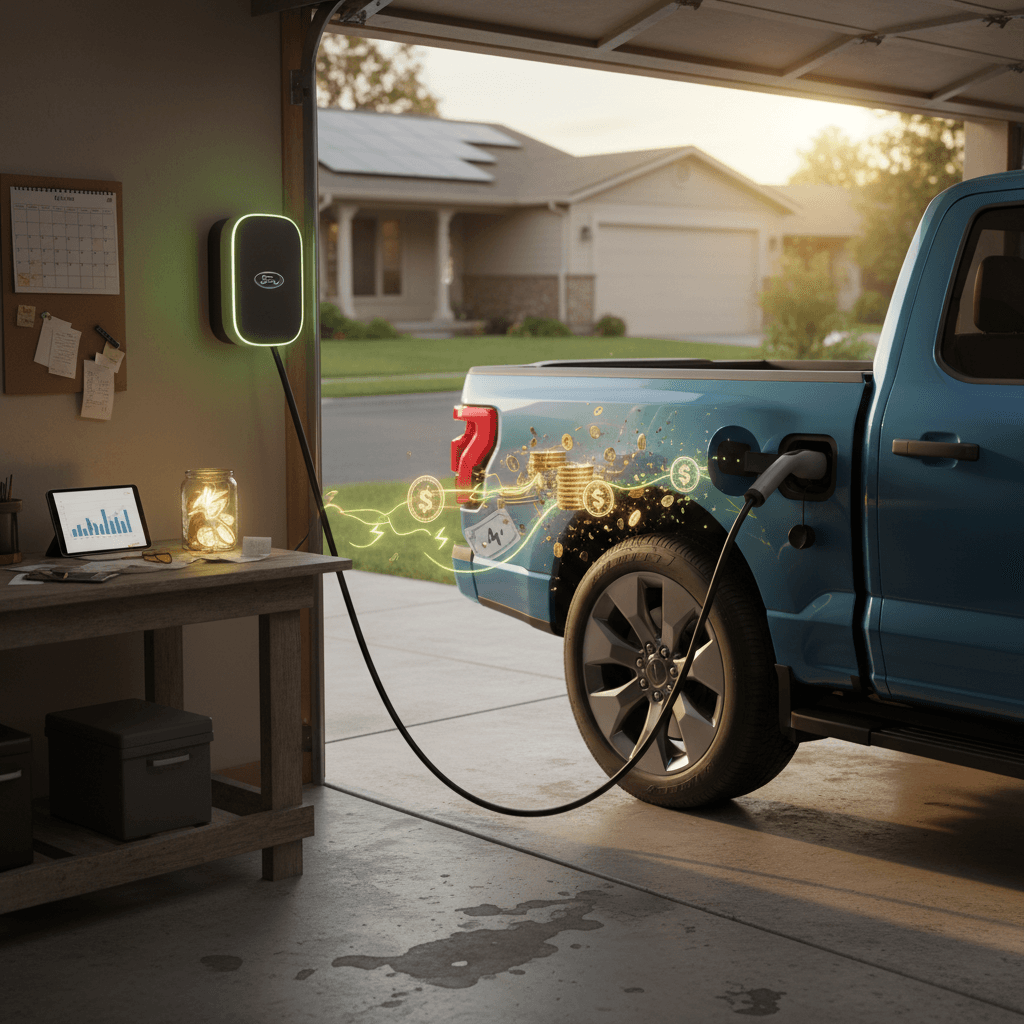
The good news: for a full‑size, 6,000‑plus‑pound pickup, the F-150 Lightning is remarkably cheap to “fuel” if you mostly charge at home. Let’s walk through the math.
- At the EPA combined rating of about 49 kWh per 100 miles, 12,000 miles per year uses roughly 5,880 kWh of electricity.
- At an average residential rate of $0.17 per kWh, that’s about $999 per year.
- Real‑world efficiency varies. Many owners report closer to 2.1–2.4 mi/kWh in mixed driving, which works out to about 50–48 kWh per 100 miles, roughly in line with the EPA number over a full year.
Mostly home charging
- 12,000 miles/year
- 49 kWh/100 mi → 5,880 kWh/year
- 90% at home @ $0.17/kWh → $903
- 10% DC fast @ $0.40/kWh → $235
Estimated annual charging cost: ≈ $1,140
Mixed or high‑speed driving
- 15,000 miles/year
- Real‑world 55–60 kWh/100 mi → ~8,500 kWh
- Blend of home and public charging
Estimated annual charging cost: $1,400–$1,700
Compared with a gas F-150
Insurance costs: why the Lightning runs higher than average
Insurance is where many new F-150 Lightning owners get sticker shock. It’s a heavy, powerful, high‑MSRP truck with expensive aluminum bodywork and a large battery pack, so insurers price in higher repair costs.
Why insuring a Ford F-150 Lightning often costs more
The truck itself is only half the story, your profile matters just as much.
High vehicle value
Repair complexity
Driver profile
Looking across major cost‑to‑own calculators and recent quotes shared by owners, **$1,800–$2,400 per year** is a realistic insurance range in many U.S. states for a new Lightning, assuming good credit and a clean record. Some owners in high‑cost markets report numbers above $3,000; others in rural, low‑rate states land closer to $1,500.
How to tame Lightning insurance costs
Maintenance and repairs: what you actually spend each year
Mechanically, the Lightning follows the familiar F‑150 formula, independent front suspension, solid rear axle, body‑on‑frame, but replaces the engine, transmission and fuel system with motors, power electronics and a big battery. That means **far fewer routine service items** than a gas truck.
- No oil changes, spark plugs or exhaust; fewer moving parts overall
- Brake pads often last longer thanks to **regenerative braking**
- Ford’s maintenance schedule calls mainly for inspections, tire rotations, cabin air filters, and occasional coolant/brake fluid service.
- The big unknown is **out‑of‑warranty repairs** (battery, power electronics, advanced driver‑assist sensors), which are still rare but potentially expensive.
Typical Lightning maintenance schedule highlights
Pulling together OEM guidance and real‑world data, a reasonable estimate for **routine maintenance and minor repairs** looks like:
Estimated annual maintenance & repair cost – F-150 Lightning
Average over a 5‑year period; does not include major accident repairs or aftermarket accessories.
| Item | Low‑mileage (10k/yr) | Average (12k/yr) | High‑mileage (15k/yr) |
|---|---|---|---|
| Tire rotations & balancing | $60 | $80 | $120 |
| Tires (amortized) | $250 | $300 | $400 |
| Cabin air filter & fluids | $80 | $100 | $120 |
| Misc. repairs & alignments | $60 | $80 | $120 |
| Total est. per year | $450 | $560 | $760 |
Expect years two and three to be cheaper, with tires and brakes driving occasional spikes.
Watch your tires
Depreciation, taxes and registration fees
Depreciation, how much value your truck loses each year, is usually the **single biggest cost of owning a new F-150 Lightning**. Like most high‑priced EVs, it drops fastest in the first 3–4 years, then levels off.
How a new Lightning’s value typically falls
Illustrative example for a $75,000 extended‑range truck bought new and driven ~12,000 miles/year.
Year 1
Years 2–3
Years 4–5
If you average it out, many new Lightning buyers are effectively burning **~$7,000–$9,000 per year in depreciation** over the first five years. That number falls sharply if you buy the truck at three years old rather than brand‑new.
Taxes and registration
Example scenarios: low‑ vs. high‑mileage owners
Let’s pull everything together into rough, apples‑to‑apples annual cost examples. These assume a new, extended‑range F-150 Lightning, average U.S. electricity prices, and largely home charging.
Estimated yearly ownership cost – new F-150 Lightning (U.S. averages)
Rounded numbers; your situation will vary. Loan interest is not included to keep comparisons simple.
| Category | Low‑mileage commuter<br>(10,000 mi/yr) | Typical driver<br>(12,000 mi/yr) | High‑mileage user<br>(15,000 mi/yr) |
|---|---|---|---|
| Charging (mostly home) | $750 | $1,000–$1,150 | $1,400–$1,700 |
| Insurance | $1,700–$2,200 | $1,800–$2,400 | $2,000–$2,700 |
| Maintenance & repairs | $450 | $560 | $760 |
| Depreciation (avg over 5 yrs) | $6,000–$8,000 | $7,000–$9,000 | $8,000–$10,000 |
| Taxes & registration | $400–$900 | $500–$1,000 | $600–$1,100 |
| Estimated total per year | ≈ $9,300–$12,300 | ≈ $10,800–$14,900 | ≈ $12,800–$16,200 |
Charging is the most flexible line item, driving less and charging smartly can move it a lot.
Versus a comparable gas F-150
How buying used (or certified) changes your yearly cost
The fastest way to cut your **per‑year cost of owning an F-150 Lightning** is to skip that brutal first‑owner depreciation. The used market is already full of 2‑ to 3‑year‑old Lightnings with relatively low miles.
Example: buying new
- Purchase price: $75,000
- 5‑year value: falls to ~$40,000
- Total depreciation: ~$35,000
- Average annual depreciation: $7,000
Example: buying 3 years used
- Purchase price at year 3: $48,000
- 5‑year value (own from year 3–8): maybe ~$30,000
- Total depreciation during your ownership: ~$18,000
- Average annual depreciation: $3,600
In this simplified example, choosing a 3‑year‑old truck instead of a new one cuts **annual depreciation roughly in half**, saving you about **$3,000–$3,500 per year** without materially changing your charging or maintenance story.
Battery health is the key variable on used EVs
How Recharged helps lower your Lightning ownership costs
If you’re leaning toward a used F-150 Lightning, the challenge is separating good deals from future headaches. That’s precisely what **Recharged** is built to solve for used EVs.
Ways Recharged can improve your yearly Lightning cost
It’s not just about price, it’s about risk, battery health and financing.
Recharged Score battery report
Fair market pricing & financing
Trade‑in, delivery & support
Ready to find your next EV?
Browse VehiclesRun the numbers before you buy
FAQ: Ford F-150 Lightning annual ownership costs
Frequently asked questions about F-150 Lightning yearly costs
Bottom line: is a Lightning cheaper to own than a gas F-150?
If you’re only looking at the energy bill, the answer is straightforward: **yes, a Ford F-150 Lightning is usually much cheaper to “fuel” than a comparable gas F‑150**, especially if you rack up miles and mostly charge at home. Where the analysis gets more nuanced is **insurance and depreciation**, which can be higher on a new, high‑MSRP EV truck.
Viewed as a whole, a typical owner can expect to spend **around $10,000–$13,000 per year** to own and operate a new F-150 Lightning, not counting any tax credits. Choose your mileage, local electricity rate, and insurance market wisely and that number can shift thousands of dollars either direction.
If you want the Lightning experience with a lower yearly burn rate, the most powerful lever is to **buy used with verified battery health** rather than new. That’s where a specialist marketplace like Recharged earns its keep, by surfacing clean, late‑model Lightnings with transparent Recharged Scores, fair pricing, and EV‑savvy financing so your annual ownership costs line up with your expectations instead of surprising you later.