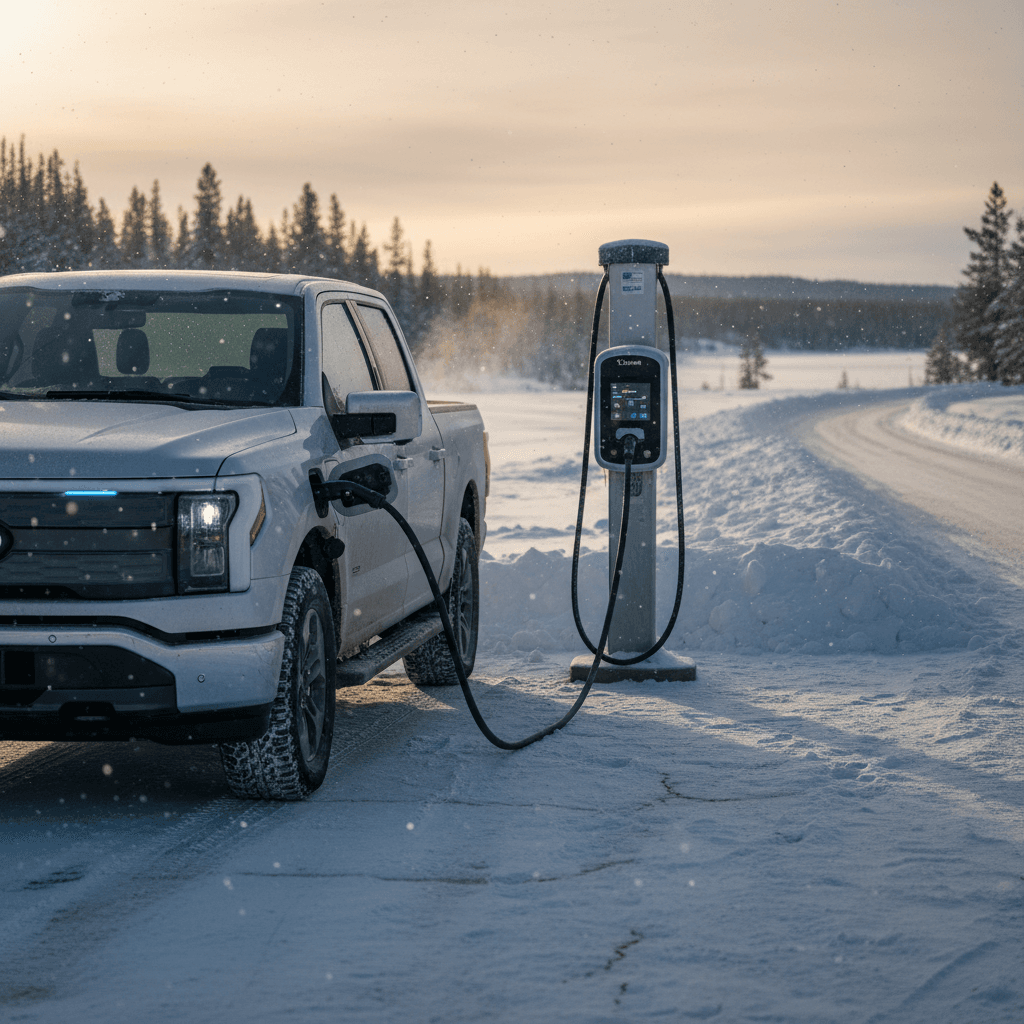
If you own a Ford F-150 Lightning, you already know it can sprint like a sports car and haul like a work truck. But when winter shows up, so does the hard reality of physics: cold weather can slice your Lightning’s range far more brutally than it will a small crossover. Understanding how much range you’ll actually get, and how to protect it, is the key to enjoying this truck year-round instead of white‑knuckling every cold‑weather drive.
Quick takeaway
Why cold weather hits EV trucks so hard
Cold weather hurts every EV, but big, square trucks like the F-150 Lightning are playing this game on “hard mode.” You’re pushing a barn door through the air, on big all‑season or all‑terrain tires, with a battery that would rather be on a beach.
- Battery chemistry slows down in the cold. Lithium‑ion cells can’t move ions as efficiently at low temperatures, so usable energy and power both drop until the pack warms up.
- Cabin heat is energy‑hungry. There’s no engine throwing off free heat, so your Lightning’s electric heater and heated seats steal kilowatts directly from the battery.
- Aero drag and rolling resistance are higher. Cold, dense air and stiffer tires make it harder to shove a full‑size pickup through the wind.
- Short trips are especially punishing. Warming a cold battery and cabin for a 5‑mile drive is like heating your whole house to boil one cup of water.
Cold starts are the killer
EPA range vs real-world F-150 Lightning in winter
First, let’s anchor expectations. Depending on year and trim, Ford quotes roughly 240 miles of EPA range for standard‑range (SR) trucks and up to about 320 miles for extended‑range (ER) versions on the combined driving cycle. That’s in lab conditions, on all‑season tires, at moderate speeds, in mild weather.
F-150 Lightning range: lab vs reality
In independent testing and owner reports, extended‑range Lightnings often return around 210–250 miles on the highway in mild temps at 70–75 mph, already well shy of the window sticker. Add winter conditions, and the gap grows. Many owners describe a fully charged extended‑range truck in sustained cold (say 10–25°F) behaving more like a 150–200‑mile truck if you’re using heat and driving at normal highway speeds.
EPA ratings aren’t lying, they’re just optimistic
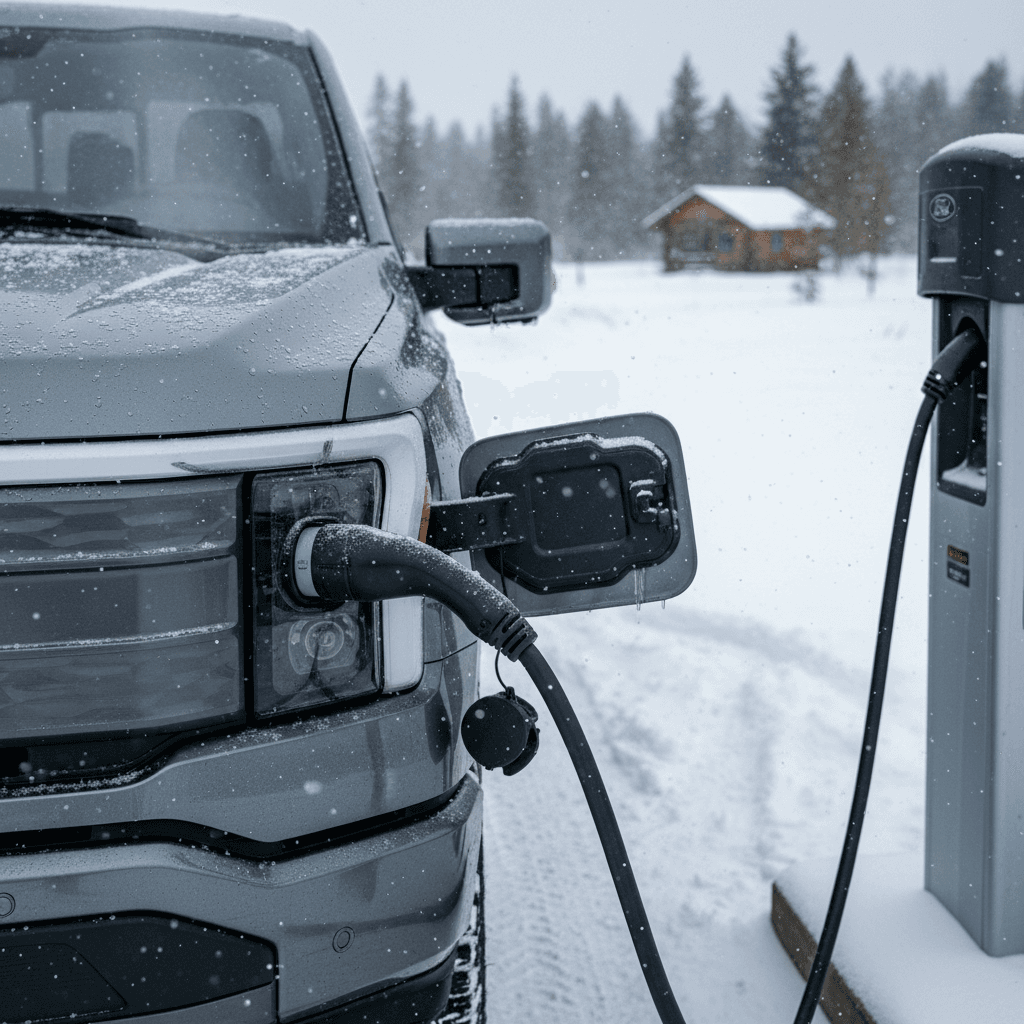
How much range you’ll lose at different temperatures
No two trucks, tires, or routes are identical, but the pattern is remarkably consistent: the colder it gets, the more energy disappears into battery warming and cabin heat. Here’s a ballpark guide for a healthy extended‑range Lightning starting from a 100% charge, driven sensibly.
Typical F-150 Lightning winter range vs temperature (Extended-Range)
Illustrative ranges assume normal driving, some cabin heat, and no trailer. Individual results vary with speed, tires, payload, and elevation.
| Outside temp | Typical range hit vs EPA | Approx. usable range (ER) | What it feels like |
|---|---|---|---|
| 50°F (cool, not cold) | –10–15% | 270–285 mi | Almost like spring; mild efficiency penalty |
| 30°F (light winter) | –20–30% | 225–255 mi | Range noticeably down, especially on short trips |
| 20°F (solid winter) | –30–40% | 190–225 mi | You’ll plan charging more carefully on long drives |
| 0°F (deep cold) | –40–50% | 155–190 mi | Heater + battery warming dominate; short trips are brutal |
| -10°F and below | –45–55% | 140–175 mi | Truck can still be usable, but you must plan like a pilot |
Use this as a planning tool, not a promise. In extreme cold, always build in extra buffer.
Don’t plan a route to the last mile
Standard-range (SR) expectations
If your Lightning has the smaller standard‑range battery, scale everything down proportionally:
- EPA rating ~240 miles becomes 150–180 miles on a cold highway day.
- At 0°F, owners report seeing 100–140 miles of realistic range.
- Great for city use and short commutes, but winter road trips take serious planning.
Extended-range (ER) expectations
The ER pack gives you more cushion, but not immunity:
- EPA rating ~320 miles behaves more like 210–250 miles in mild temps on the highway.
- In sustained deep cold, plan around 150–190 miles between charges.
- The extra capacity mainly buys you flexibility and less stress, not magic physics.
City vs highway vs towing in the cold
Not all winter miles are created equal. The same temperature can feel very different depending on how you’re using your Lightning.
How your winter use case changes Lightning range
Same truck, same temperature, very different outcomes.
City / suburban driving
Once the truck and battery are warmed up, stop‑and‑go can actually be kind to range thanks to regen braking and lower aero drag. The catch is lots of cold starts and short hops, where you burn energy just heating the cabin.
Highway cruising
At 70–80 mph in cold, dense air, the Lightning’s bluff nose and big tires are a tax bill you pay every minute. Expect the biggest percentage range hit here, especially into a headwind with the heat on.
Towing & hauling
Cold plus trailer is the final boss. A big trailer can already cut your range in half in good weather. Add freezing temps and you can be staring at 60%+ total reduction vs EPA. This is where planning and public DC fast charging are non‑negotiable.
Trailer mode matters
Winter range tips from Ford and real owners
The good news: you’re not helpless. Ford has baked in tools specifically to protect winter range, and owners have learned a few hard lessons so you don’t have to.
Seven ways to protect your Lightning’s range in cold weather
1. Precondition while plugged in
Use scheduled departure or remote start so the truck warms the battery and cabin <strong>before</strong> you leave, while it’s still on shore power. That way, more of the battery is reserved for driving, not heating.
2. Use seat and steering wheel heaters first
Resist the urge to blast cabin heat to 80°F. Heated seats and steering wheel use far less energy and can keep you comfortable even with the cabin a bit cooler.
3. Dial back highway speed
Above about 65 mph, cold‑weather aero drag ramps up quickly on a full‑size truck. Dropping from 75 to 65 mph can claw back a surprising chunk of range, especially with a headwind.
4. Keep the truck plugged in when parked
If you can, leave the Lightning plugged in overnight or at work. The truck can maintain battery temperature with less impact on your usable state of charge, instead of letting the pack freeze and reheating from scratch.
5. Avoid tiny errands on a stone‑cold truck
Combine trips when it’s truly frigid. Driving 3 miles, parking outside for an hour, then repeating is like reheating the entire battery over and over for almost no mileage.
6. Use Eco or a gentle driving style
Smooth acceleration and looking ahead so you can coast reduce peak power demand. In the cold, that means less waste heat and slower battery warm‑up, which can actually <strong>extend</strong> usable range on longer drives.
7. Check your tires and pressure
Cold air drops tire pressure. Under‑inflated winter or all‑terrain tires are like dragging an anchor. Check pressures regularly and stay within the door‑jamb spec, especially in long cold snaps.
Use Ford’s built-in winter guidance
Battery health vs winter range loss
There are two different stories that get tangled together in winter: temporary cold‑weather range loss and permanent battery degradation. They feel similar from behind the wheel (“my range is down”), but they behave very differently.
What’s just the weather
- Range drops sharply when temps fall, then rebounds in spring.
- Displayed miles can swing wildly day‑to‑day based on recent driving and climate control use.
- This is normal, even for a brand‑new truck.
What might be battery wear
- Range is consistently low in all seasons, even in mild weather.
- DC fast charging feels noticeably slower than when the truck was new.
- Two similar Lightnings (same wheels, tires, trim) show very different summer range on the same route.
How Recharged separates the two
Ready to find your next EV?
Browse VehiclesPlanning trips in cold weather with an F-150 Lightning
If you treat winter trips like summer road trips, you’ll be disappointed. If you treat them like flying a small airplane, deliberate, with built‑in margins, they can be completely manageable.
- Start with a realistic baseline. For a healthy extended‑range Lightning in true winter, plan your legs around 150–200 miles, not the headline 320 miles.
- Use apps that understand EVs. Tools like A Better Routeplanner (ABRP) or PlugShare, combined with Ford’s native navigation, can model temperature, elevation, and speed to avoid sketchy gaps between chargers.
- Target chargers you can skip. Pick DC fast chargers such that you could skip one and still limp to the next if something goes wrong.
- Aim to arrive with 10–20%. Rolling into every charger at 1–2% may give you a good story, but it’s miserable in the moment, especially in a blizzard.
- Warm the pack before fast charging. If possible, navigate to the charger in the truck’s nav so it will precondition the battery. A warm pack charges faster and wastes less heat.
- Book lodging with Level 2 charging. A simple overnight 7–11 kW plug can turn a tense winter road trip into a non‑event.
Think of chargers like motels, not unicorns
Used F-150 Lightning: what to ask about winter range
If you’re shopping for a used Lightning, especially in northern states, winter performance is not a theoretical concern. It’s the difference between loving the truck and quietly selling it next March.
Key winter questions to ask about a used Lightning
These reveal more than generic “What’s the range like?” small talk.
How was it used in winter?
Ask the seller how they typically drove in cold weather:
- Daily commute length?
- City vs highway split?
- Any regular towing in winter?
Long, cold highway commutes with fast charging every day are harder on a pack than short, mild errands.
What’s the actual battery health?
Don’t rely on the dashboard. A proper diagnostic (like the Recharged Score) looks at usable capacity, cell balance, and DC fast charging history so you know how close the truck still is to its original pack.
Where did it live?
A truck that spent three winters in Minnesota parked outside lives a different life than one garaged in North Carolina. Neither is bad, but they inform your expectations for winter range.
Any software or recall updates?
Ford has iterated range prediction, charging behavior, and thermal management via software. Verify that major updates and any relevant recalls have been applied; they can make winter behavior more predictable and sometimes more efficient.
How Recharged helps here
FAQ: Ford F-150 Lightning range in cold weather
Common questions about Lightning winter range
Cold weather doesn’t turn the Ford F-150 Lightning into a bad truck. It just turns it into an honest one. The billboard numbers vanish, and what’s left is a comfortable, brutally capable machine that demands you learn a little about energy management. If you understand how temperature, speed, and towing gang up on your range, and you build smart habits around preconditioning, charging, and trip planning, the Lightning can be a rock‑solid winter companion. And if you’re considering a used one, especially in a cold‑weather state, tools like the Recharged Score Report give you the missing piece: whether that truck’s battery is still healthy enough to handle the winters you actually live with.