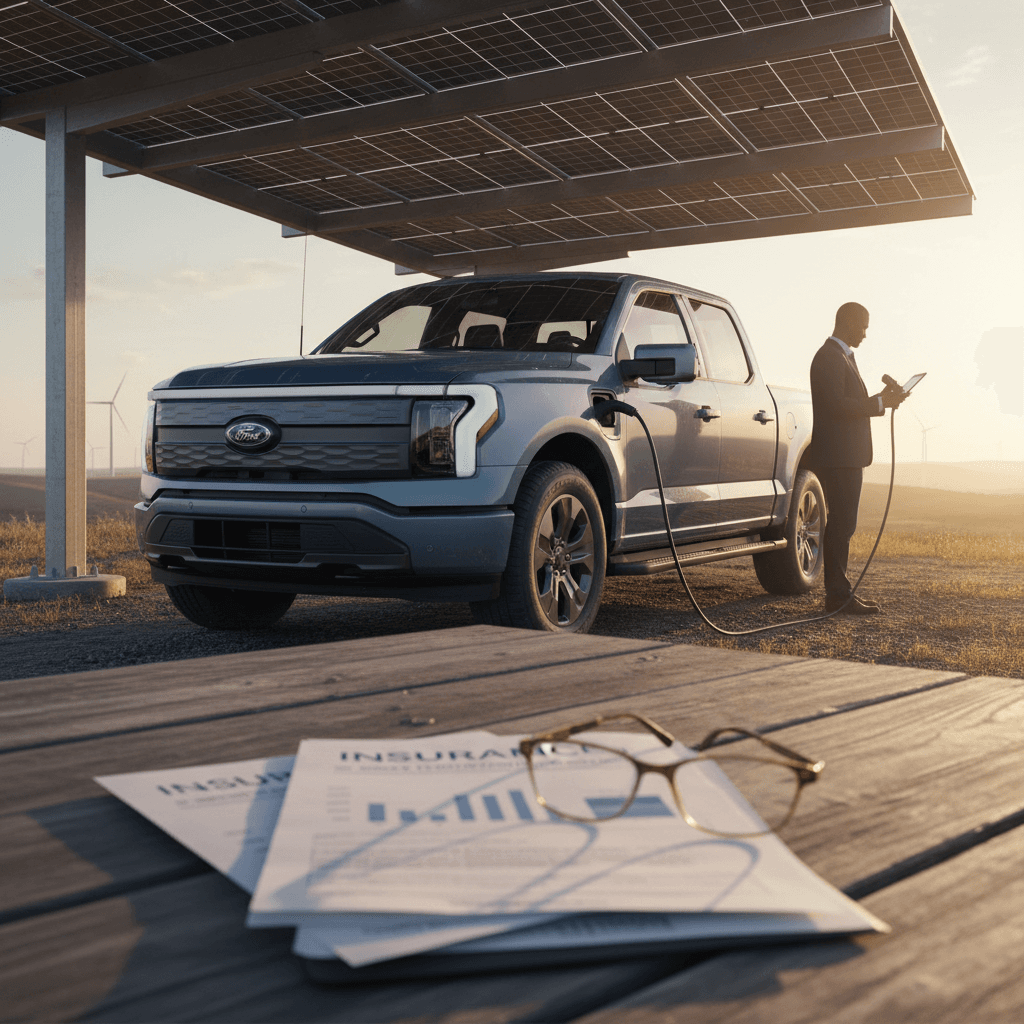
If you’ve started shopping quotes for your electric pickup, you may have discovered that getting the cheapest insurance for a Ford F-150 Lightning isn’t as simple as copying whatever you paid on a gas F-150. Insurers are still learning this truck, repair costs are high, and EV premiums overall have risen since 2022. The good news: there are clear levers you can pull to push your rate down, especially if you’re flexible on trim, coverage, and how you buy your Lightning.
Quick snapshot
Why Ford F-150 Lightning insurance can feel expensive
Compared with a gas F-150, the Lightning brings a few traits insurers don’t love: a heavy battery pack, expensive aluminum body work, and complex electronics. When these trucks are involved in a serious crash, the repair bill can add up fast, and in some cases, they’re written off entirely. That shows up in the loss data insurers use to price policies, which is part of why Lightning premiums trend above a comparable gas F-150.
What worries insurers about EV trucks
- Battery packs: High-voltage battery damage can turn a repairable crash into a total loss.
- Weight: The Lightning can weigh 1,000+ lbs more than some gas F-150s, which can mean more damage in multi-vehicle collisions.
- Specialized repairs: Fewer body shops are certified to work on EVs, which can increase labor costs and cycle times.
What works in your favor
- Safety tech: Lightning trims pack advanced driver-assistance systems that help avoid or soften crashes.
- Owner profile: Many EV buyers skew older with stable driving records, which pulls premiums down.
- Growing data: The truck launched for 2022; every year of claims data helps responsible drivers get fairer rates.
Recall headlines vs real pricing
How much does Ford F-150 Lightning insurance cost in 2026?
Typical Ford F-150 Lightning insurance costs in 2026 (US)
Those ranges hide a lot of variation. A clean-driving 45‑year‑old in Ohio insuring an XLT at 7,500 miles per year will look very different from a 25‑year‑old in Florida daily‑driving a Platinum. But if your full‑coverage Lightning quote is far north of $3,500 per year, it’s worth assuming something about your risk profile or coverage selections is out of sync, and that you can probably do better with some targeted moves.
9 factors that drive your F-150 Lightning premium
What insurers actually price into your Lightning policy
Understanding these levers helps you find the cheapest realistic rate.
1. Driver profile
2. Garage ZIP code
3. Trim and battery pack
4. Annual mileage & usage
5. Coverage limits & deductibles
6. Parking situation
7. Prior insurance history
8. Household & multi‑car
9. Telematics & data sharing
Why some Lightning quotes look broken
11 ways to get the cheapest Ford Lightning insurance
You can’t control your age or regional medical costs, but you have more power than you think over your premium. The cheapest realistic insurance for a Ford F-150 Lightning usually comes from stacking several smaller savings tactics rather than hunting for a single magic discount.
Practical moves that actually lower Lightning premiums
1. Dial in realistic annual mileage
When you quote, be honest but not lazy. If you truly drive 7,500–10,000 miles a year, don’t accept a default of 15,000. Lower exposure generally means a lower price, especially on an expensive EV truck.
2. Choose smart but not bare‑bones coverage
Dropping to state‑minimum liability on a $60,000+ Lightning is risky. Instead, consider higher deductibles ($500–$1,000) on comprehensive and collision while keeping robust liability limits like 100/300/100 or higher.
3. Compare at least 5–7 carriers
Different insurers read Lightning risk differently. Pull quotes from both national brands and strong regional carriers, and make sure each quote uses the same limits and deductibles so you’re comparing apples to apples.
4. Use telematics if you’re a careful driver
Usage‑based programs can shave 10–30% off for smooth, daytime‑heavy driving with little hard braking. EV owners often already drive more predictably, so these programs tend to work in your favor.
5. Bundle home or renters insurance
If you own a home, or even just rent an apartment, bundling that policy with your auto is one of the most reliable ways to trim 5–20% off your Lightning premium.
6. Ask specifically about EV or green‑vehicle discounts
Some insurers quietly offer small breaks for electric vehicles or for installing a home Level 2 charger. These won’t halve your bill, but they can tip one quote over another when everything else is close.
7. Clean up tickets before you switch
If a minor ticket is close to falling off your record, it can be worth waiting for your renewal or timing a switch so you quote after the violation ages out of your insurer’s rating window.
8. Add an experienced driver when appropriate
In some households, listing an older, ticket‑free driver as the primary operator and a younger driver as occasional use can help. Be honest, misrepresenting who drives the truck daily can cause headaches at claim time.
9. Skip unnecessary add‑ons
Roadside assistance, rental reimbursement, GAP, and custom‑equipment coverage all have a role, but they also add cost. Decide what you truly need for an EV truck you plan to keep, and strip out the rest.
10. Pay in full or set up automatic payments
Many carriers charge installment fees on monthly bills. Paying the six‑month term in full, or at least using autopay, can quietly save you another few percent a year.
11. Re‑shop your policy every 12–18 months
EV pricing is a moving target. As insurers gather more Lightning data, some quietly adjust their rates. Revisiting the market annually keeps you from overpaying simply out of habit.

Can a used F-150 Lightning be cheaper to insure?
Often, yes. Insurance companies care a lot about what it would cost them to replace or repair your truck. As transaction prices drop on the used market and more examples are sold at lower MSRPs than early adopters paid, comprehensive and collision premiums can ease slightly, especially if you’re buying a well‑equipped but not top‑of‑the‑line trim.
Why used can cost less to insure
- Lower ACV: The insurer’s payout cap is based on actual cash value; a $45,000 used Lightning costs less to cover than an $80,000 new Platinum.
- More repair history: By 2026, there’s more data on which trims generate frequent or severe claims.
- Cheaper financing: If you owe less than the truck’s value, you may not need GAP coverage, which trims your bill.
Where a used truck may still be pricey
- High‑end trims: A used Platinum or Lariat with every option can still sit at the top of the insurance price ladder.
- Prior incidents: If the VIN has prior claims (even if repaired), it might influence some carriers’ appetite.
- Older safety tech: Future Lightning revisions may add new safety hardware that earns better loss performance than early builds.
Where Recharged fits in
Ready to find your next EV?
Browse VehiclesBecause Recharged focuses on used EVs specifically, you can also compare multiple Lightning trims side by side and see how their purchase price and equipment might influence your long‑term ownership costs, including insurance. That context makes it easier to pick the sweet spot between capability and what you’ll pay to insure it over the next five years.
Picking the right coverage for an electric truck
Chasing the absolute cheapest insurance can backfire if you strip away coverage you’ll absolutely want when something goes wrong. With an EV truck like the F-150 Lightning, your focus should be on value per dollar of protection, not just getting the lowest number on the screen.
Common coverage choices for Ford F-150 Lightning owners
How different coverage approaches affect cost and risk.
| Profile | Liability limits | Comp & collision deductibles | Pros | Cons |
|---|---|---|---|---|
| Budget-focused | State minimums | $1,000–$2,000 | Lowest upfront premium; may work for older, low-value vehicles you could afford to replace. | Too little protection for a modern EV truck; high out-of-pocket risk after any loss. |
| Balanced (typical EV owner) | 100/300/100 or higher | $500–$1,000 | Good financial protection with manageable deductibles; often the best value for newer Lightnings. | Costs more than bare minimum, but usually far less than a serious claim. |
| Premium protection | 250/500/250+ umbrella | $250–$500 | Maximizes asset protection and reduces deductible shock after a big repair. | Highest premium; can be overkill if you don’t have much to protect yet. |
These are examples, not recommendations, talk with an agent or advisor about your specific needs.
Don’t skimp on uninsured/underinsured coverage
Checklist: shopping quotes for the lowest Lightning rate
Before you request quotes
Confirm your garaging address and parking details
Make sure carriers are rating the truck where it truly spends the night, and whether it’s in a garage or outside. A simple error here can cost you hundreds of dollars a year.
Decide on target liability and deductible levels
Write down your preferred limits and deductibles first (for example, 100/300/100 liability, $500 comprehensive, $1,000 collision). Use the same settings with every company so you can compare pricing fairly.
Gather your VIN and current declarations page
Having the truck’s VIN and your existing policy details in front of you reduces data-entry mistakes and helps an agent quickly mirror or improve your current coverage.
Ask each carrier about EV-specific or telematics discounts
During quotes, specifically ask: “Do you offer any electric‑vehicle, advanced‑safety, or telematics discounts for this truck?” Not every rep will volunteer these without being prompted.
Request both 6‑month and 12‑month terms
Some carriers offer modest savings for locking in a 12‑month rate. That can be especially helpful if you’re concerned about broader EV insurance volatility.
Document quotes in a simple comparison sheet
Create a quick spreadsheet with carrier, term, total premium, deductibles, and special conditions. The cheapest option should also be the one that feels sustainable and understandable.
Ford F-150 Lightning insurance FAQ
Frequently asked questions about F-150 Lightning insurance
Bottom line: keeping Lightning insurance in check
Ford F-150 Lightning insurance isn’t automatically budget‑breaking, but it is different. You’re insuring a heavy, tech‑dense electric truck with high repair costs and a relatively short claims history. That reality shows up in the premium, but it doesn’t have to control your entire ownership story.
If you understand the levers insurers pull, compare quotes from several carriers, choose smart coverage instead of bare‑bones limits, and revisit your policy every year or two, you can usually land on the cheapest realistic insurance for your Lightning without taking on unnecessary risk. And if you’re still in the shopping phase, pairing those steps with a well‑priced used Lightning, backed by a transparent Recharged Score battery health report, can make your long‑term cost of ownership a lot more comfortable.