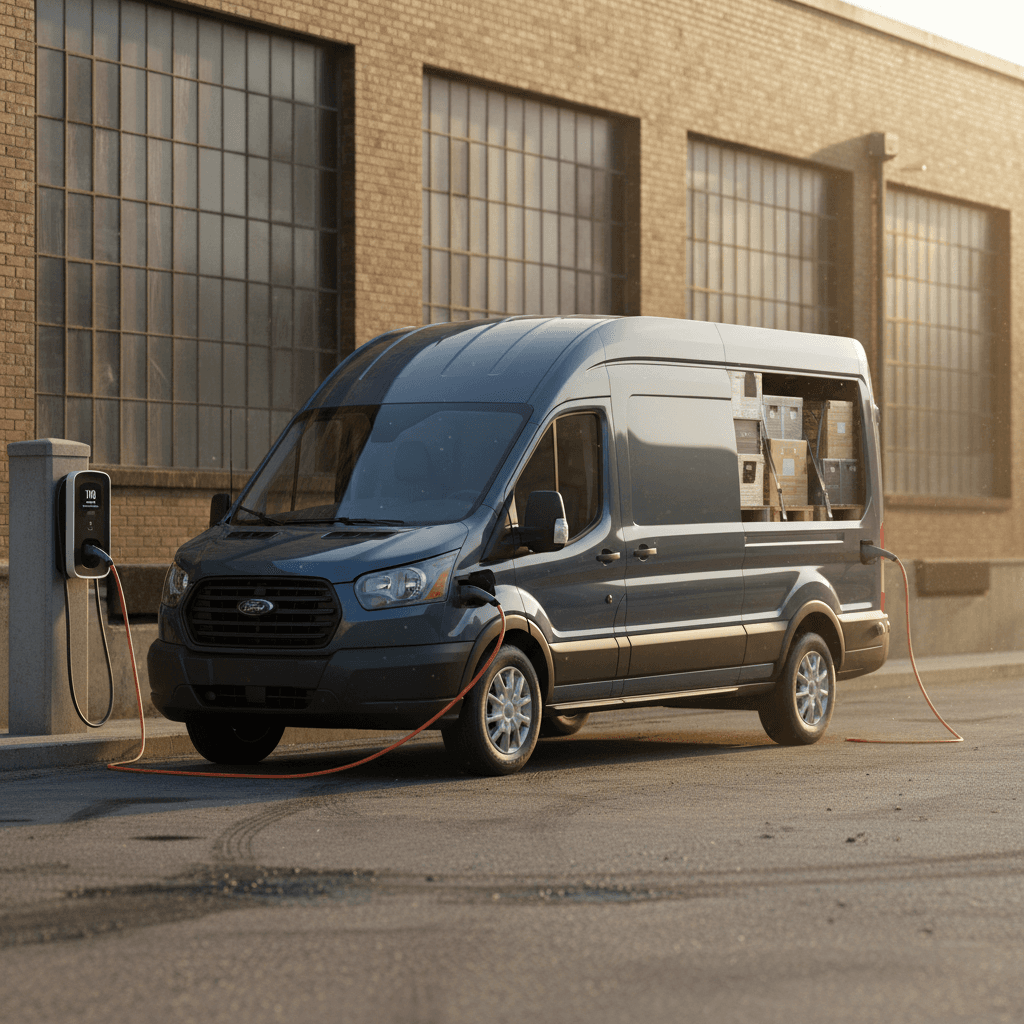
If you’re considering a Ford E‑Transit for deliveries, trades, or mobile services, the first thing you want to know isn’t the brochure number, it’s the real‑world Ford E‑Transit range when the van is loaded. Can it actually cover your route with tools, parts, and a ladder rack on the roof, or will you be babysitting a charger all day?
Key takeaway up front
Why Ford E‑Transit range matters most when you’re loaded
A cargo van lives or dies on its ability to do a full day’s work without interruption. For an electric van, that means having enough usable range to leave your depot, run every stop with tools and inventory on board, and get back to base with a comfortable buffer. With the Ford E‑Transit, understanding the difference between advertised and real‑world, fully loaded range is the difference between a van that quietly saves you fuel money and one that blows up your schedule.
Ford E‑Transit range at a glance
Ford E‑Transit official range vs real‑world results
Ford quotes up to 159 miles of estimated range for newer enhanced‑range E‑Transit cargo vans with the 89 kWh battery, typically on a low‑roof configuration. Earlier standard‑range vans with a ~68 kWh pack were rated closer to 108–126 miles depending on roof height and wheelbase. Those numbers are generated on a controlled test cycle that mixes city and highway driving at an adjusted loaded vehicle weight, helpful for comparison, but not a guarantee for your route.
In the field, drivers and fleet managers often see something like this:
- Lightly loaded, low‑roof, mostly city driving: 120–140 miles on a mild day if you use Eco mode and drive smoothly.
- Medium‑roof, mixed city and freeway at 65–70 mph, tools and parts on board: 90–120 miles.
- High‑roof, long‑wheelbase, highway‑heavy work, roof rack, and a full complement of tools: 70–100 miles, sometimes less in winter cold.
Why your results may vary
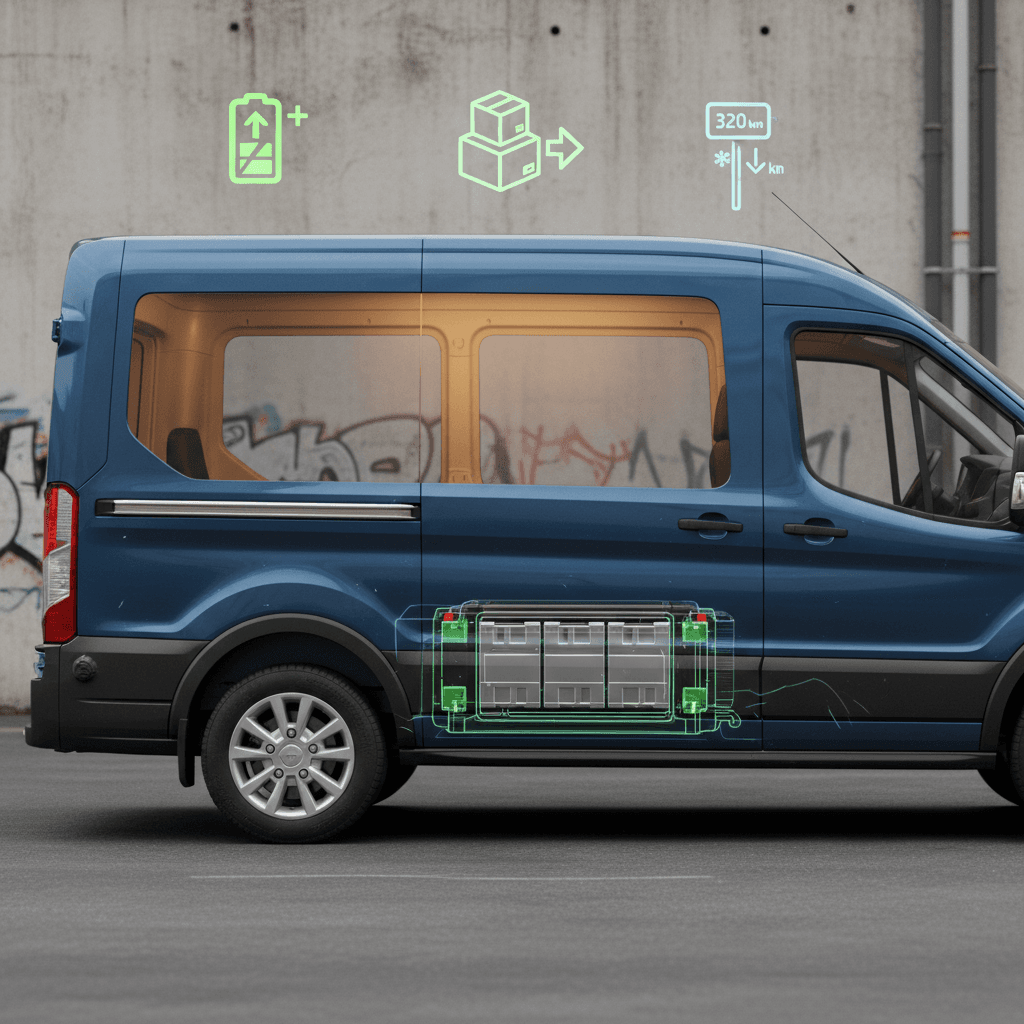
How payload and weight actually affect E‑Transit range
Range anxiety with electric vans usually comes down to one question: “What happens when I load it up?” The Ford E‑Transit can carry over 3,000 pounds of payload in some cargo configurations, but you don’t need to max it out before range starts to change.
Payload vs range: what really happens
Think in terms of patterns, not exact numbers
Light loads (0–1,000 lbs)
With just shelving, tools, and light inventory, many operators see efficiency around 2.4–2.8 mi/kWh in mild weather at city speeds. On an 89 kWh pack, that’s roughly 120–150 miles if you’re not hammering the freeway.
Moderate loads (1,000–2,000 lbs)
Add heavier inventory, equipment, or multiple crew members and you may drop closer to 2.0–2.3 mi/kWh. In practice, that usually means 100–130 miles if your route is mostly urban with reasonable speeds.
Near max payload (2,000–3,000+ lbs)
Close to GVWR, each stop takes more energy to get that weight moving, especially on hills. Efficiency can fall into the 1.5–2.0 mi/kWh range, giving you more like 70–110 miles depending on roof height, speed, and weather.
Stop‑and‑go vs. steady cruising
At lower speeds, extra weight hurts less because you’re not fighting as much wind. On the highway, drag matters more than cargo. That’s why a high‑roof with a ladder rack at 70 mph can burn range faster than a low‑roof loaded to the gills at 35 mph.
Payload rule of thumb
6 other factors that quietly kill range
Payload is only part of the story. Many business owners underestimate how much aerodynamics, temperature, and driving style erode real‑world Ford E‑Transit range when loaded.
The hidden range killers on work vans
1. Highway speed over 65 mph
Above about 60–65 mph, aerodynamic drag ramps up quickly, especially on a high‑roof van. Jumping from 60 to 75 mph can easily cost you <strong>20–30% of your range</strong>, even with the same payload.
2. Roof racks and ladders
A bare E‑Transit already has the aerodynamic profile of a small billboard. Add open ladder racks, conduit carriers, or a roof box and you increase drag noticeably, especially in crosswinds.
3. Cold weather and cabin heat
In winter, the battery is less efficient and the electric heater can draw several kW on its own. Uninsulated cargo areas lose heat quickly, so drivers often crank the heat higher than in a passenger EV, <strong>cutting effective range by 20–40%</strong> in harsh cold.
4. Aggressive acceleration
Electric torque makes an empty or lightly loaded E‑Transit feel surprisingly quick. But repeated hard launches with a heavy load waste energy you’ll miss at the end of the route. Smooth launches and using Eco mode make a real difference.
5. Hills and elevation changes
Climbing hills with a fully loaded van is energy‑intensive. Regenerative braking recovers some energy on the way back down, but not all of it. If your route includes long grades, build in a healthy buffer.
6. Auxiliary loads and upfits
Inverters, Pro Power Onboard tools, refrigeration, liftgates, and interior lighting all draw from the same battery. Continuous loads, like a refrigerated box, can eat into range steadily across the day.
Don’t ignore winter
Real‑world Ford E‑Transit range scenarios (loaded)
Because routes vary wildly, it’s impossible to give a single “correct” number for Ford E‑Transit range loaded. But you can get oriented with a few realistic use‑case scenarios and see where your operation fits.
Sample loaded E‑Transit use cases
These are illustrative ranges, not guarantees, but they reflect how many operators actually use the vans.
| Use case | Van configuration | Typical load & conditions | Estimated usable range |
|---|---|---|---|
| Urban electrician | Medium‑roof, regular wheelbase | ~1,200 lbs of tools & inventory, 20–30 city stops, speeds under 45 mph, mild weather | ~110–140 miles |
| HVAC contractor | High‑roof, long wheelbase | ~2,000 lbs equipment & parts, mix of city and suburban highway at 55–65 mph | ~90–120 miles |
| Parcel delivery | Low‑roof, long wheelbase | Near max payload departing depot, constant stop‑and‑go in dense urban area, curb‑idling with climate control | ~80–120 miles depending on temperature |
| Mobile upfitted workshop | High‑roof, long wheelbase (earlier 68 kWh pack) | Heavy custom interior, lots of tools, mixed driving including 65–70 mph | Often ~70–100 miles, less in winter |
| Rural service route | High‑roof, long wheelbase | Moderate load, 65–75 mph highway, longer distances between stops, some hills | Can drop into ~70–90 miles, winter may require mid‑day charging or a different solution |
Assumes 89 kWh enhanced‑range pack unless noted. Build in your own safety margins.
Where the E‑Transit shines
Can the E‑Transit work for your routes? A simple framework
Rather than fixating on a single range number, it’s more useful to ask whether a Ford E‑Transit can handle your specific duty cycle. Here’s a simple three‑step framework fleets and small businesses can use.
1. Map your real daily distance
Add up a typical day’s miles from leaving the yard to returning, including detours and unplanned stops. Then add at least a 20–30% buffer for traffic, weather, and the odd emergency call.
2. Classify your route type
- Urban/stop‑and‑go, under 50 mph – best for E‑Transit.
- Mixed city/suburban, some freeway – workable with margin.
- Highway‑heavy, 65–75 mph – harshest on range.
3. Match to a realistic range band
If your worst‑case day plus buffer fits comfortably under 80–100 miles, an E‑Transit is a strong candidate. If you regularly need 130–150+ miles with no chance to charge mid‑day, you may want to wait for longer‑range vans or consider a different solution.
How Recharged can help you model this
Driving and charging tips to stretch E‑Transit range
If your routes are close to the edge, small changes in how you drive and charge a Ford E‑Transit can yield surprisingly large range gains, especially when the van is loaded.
Practical ways to get more miles from every kWh
Most cost nothing but a bit of planning and coaching
Use Eco mode by default
Eco mode softens throttle response and reduces climate output. That alone can claw back a noticeable chunk of range in stop‑and‑go work without slowing your techs down.
Cap highway speeds
Coaching drivers to cruise at 60–65 mph instead of 70–75 can add double‑digit miles of range, especially in high‑roof vans with upfits.
Pre‑condition while plugged in
Heat or cool the cabin while the van is still on the charger each morning. That way, you use grid power instead of battery energy to get to temperature.
Cluster stops intelligently
Route‑planning software (or just common sense) that minimizes backtracking and long dead‑heading legs pays big dividends. Electric vans reward efficient routing.
Be smart about roof gear
If you must run ladder racks or carriers, choose more aerodynamic designs, keep them as low as possible, and remove unused accessories that act like sails.
Schedule opportunity charging
On routes near the limit, plan a short Level 3 DC fast‑charge stop at lunchtime or between service zones. Even 20–30 minutes can add enough buffer to finish the day comfortably.
Driver training pays off
Buying a used Ford E‑Transit: range questions to ask
As more E‑Transits come off lease and into the used market, you’ll see attractive prices, but you still need to know whether the real‑world loaded range works for your business today, not just when the van was new.
Used E‑Transit range checklist
1. Confirm battery size and model year
Newer enhanced‑range vans with the 89 kWh pack offer meaningfully more range than earlier 68 kWh versions. Verify roof height, wheelbase, and battery spec, these matter as much as mileage.
2. Review battery health data
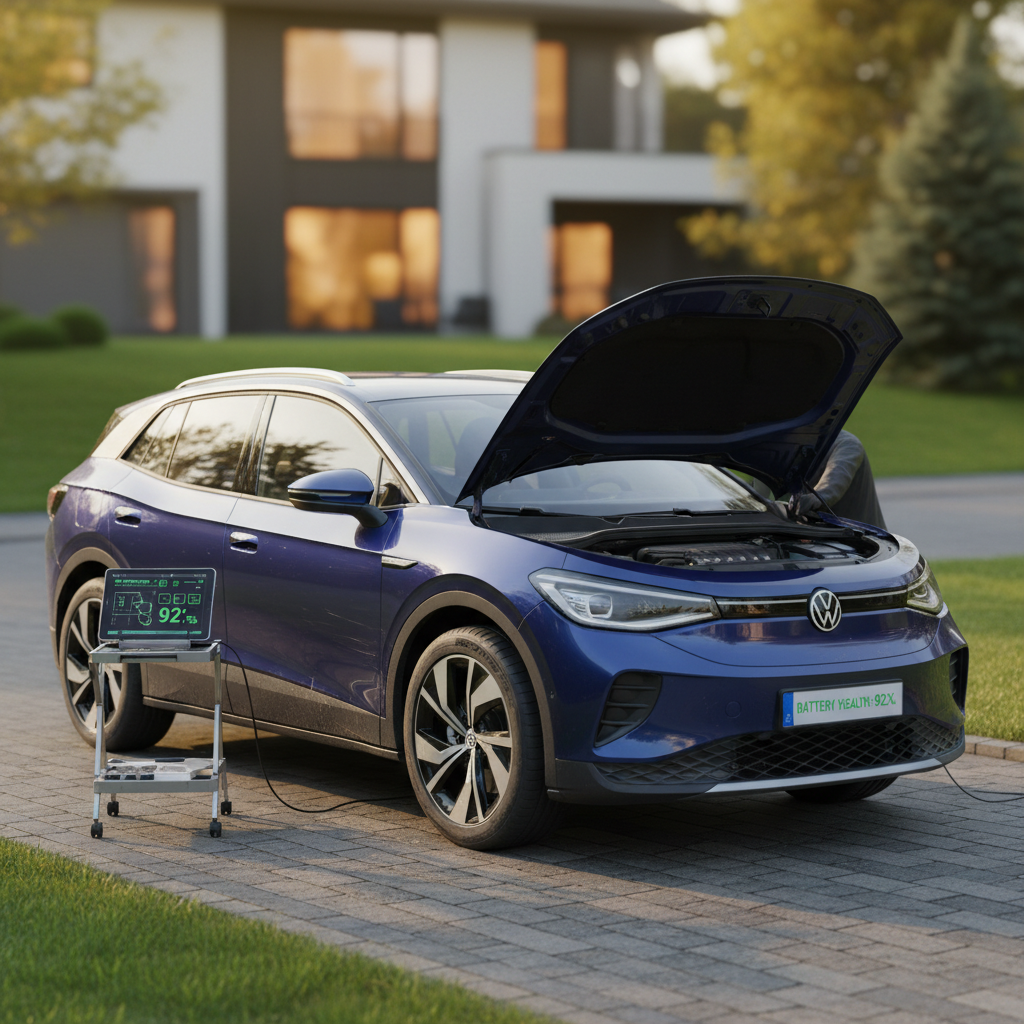
Ask for a <strong>third‑party battery health report</strong> or, when buying through <a href="/">Recharged</a>, review the Recharged Score to see remaining usable capacity and charging behavior over time.
3. Ask about prior duty cycle
A van that lived its life on short urban routes may have very different wear patterns than one that ran high‑speed highway legs at max payload. Use that history to judge whether its current range suits your work.
4. Inspect upfits and electrical loads
Refrigeration units, heavy inverters, liftgates, and interior lighting all pull from the same battery you need for range. Understand what’s installed and how it was used.
5. Test a realistic route
If possible, load the van as you would for a workday and run a shortened version of your route. Pay attention to projected range, efficiency (mi/kWh), and how much buffer you have at the end.
6. Plan depot charging in detail
Before you sign, make sure you have <strong>reliable overnight Level 2 charging</strong> at the depot or shop. A 40‑amp Level 2 can comfortably recharge an E‑Transit between shifts.
Why shop used electric vans with Recharged
Ready to find your next EV?
Browse VehiclesFord E‑Transit range loaded: FAQ
Frequently asked questions about Ford E‑Transit real‑world range
Bottom line: Who the Ford E‑Transit is really for
The Ford E‑Transit isn’t a one‑size‑fits‑all solution, and that’s especially true when you look closely at its real‑world range while loaded. If your business runs predictable, sub‑120‑mile routes, mostly in town, with depot charging and drivers who can respect Eco mode and reasonable speeds, the E‑Transit can quietly cut your fuel and maintenance bills without disrupting operations.
On the other hand, if your crews regularly pound out long, high‑speed highway legs with max payload, roof racks, and harsh winters in the mix, you’re operating at the edge of what the current E‑Transit battery can comfortably support. In that case, you either design shorter routes with opportunity charging baked in, or you wait for the next wave of longer‑range vans.
Either way, the key is to match the van to the job, not the other way around. When you’re ready to explore used E‑Transits, and want hard data instead of guesswork, a Recharged Score Report, flexible EV‑friendly financing, and expert support from Recharged can help you decide if an electric Transit is the right tool for your routes today.