If you’re looking into a Fisker Ocean today, you’re probably seeing two things at once: fire‑sale prices and a 10‑year/100,000‑mile battery warranty that sounds almost too good to be true. This guide breaks down the Fisker Ocean battery warranty details in plain English, then looks at the uncomfortable question: how much does that warranty really matter now that Fisker has gone bankrupt?
Quick takeaway
Fisker Ocean battery warranty at a glance
Key Fisker Ocean warranty numbers (original)
From launch, Fisker positioned the Ocean’s battery coverage as a headline feature. The high‑voltage traction battery and powertrain were advertised with a 10‑year/100,000‑mile warranty, beating many rivals on both time and capacity guarantee. Basic coverage (the bumper‑to‑bumper part that covers most other components) was 6 years/60,000 miles, with 12 years of unlimited‑mileage corrosion protection and 6 years/60,000 miles of roadside assistance.
Original Fisker Ocean warranty coverage (North America & UK baseline)
These were the headline warranty figures advertised for the Ocean when Fisker was still operating. Exact terms could vary slightly by market, but the structure was broadly the same.
| Component | Duration (years) | Mileage limit | Notes |
|---|---|---|---|
| High‑voltage battery | 10 | 100,000 | Capacity warranty to ~75% of original usable capacity |
| Electric powertrain (drive units, inverter, etc.) | 10 | 100,000 | Often bundled with battery as “drivetrain” coverage |
| Basic / bumper‑to‑bumper | 6 | 60,000 | Electronics, interior, most non‑wear components |
| Corrosion perforation | 12 | Unlimited | Rust‑through only, not cosmetic |
| Roadside assistance | 6 | 60,000 | Tied to Fisker’s service partners; now largely defunct |
Remember: with Fisker now in bankruptcy, these terms describe what was promised then, not what’s easily enforceable today.
Original Fisker Ocean battery warranty terms and capacity guarantee
Let’s start with what the Fisker Ocean battery warranty actually promised. The high‑voltage pack, supplied by CATL and built around LFP and NMC chemistries depending on trim, was marketed with a simple, attractive headline: 10 years or 100,000 miles of coverage, whichever came first, and support if capacity dropped below roughly 75% of what it was when new.
- Term: 10 years / 100,000 miles from the vehicle’s in‑service date (the day it was first sold or leased).
- Circuitry covered: The high‑voltage battery pack enclosure, cells, internal wiring, and the battery management system, plus associated high‑voltage components typically grouped under “electric powertrain.”
- Capacity floor: If the pack degraded below about 75% of its original usable capacity during the warranty period, Fisker said it would repair or replace it.
- Normal vs. abnormal degradation: Gradual capacity loss over time was expected; the line for a valid claim was “more than normal,” often demonstrated by diagnostics showing unusual drops versus age and mileage.
Capacity guarantee in context
In practical terms, a Long Range Ocean that started with, say, ~100 kWh gross capacity would trigger serious warranty questions if its usable capacity slid into the low‑70‑kWh range well before 10 years or 100,000 miles. That’s where the promise was supposed to catch early pack failures, bad modules, or BMS issues, before you ended up with a luxury EV that could barely clear a commuter’s daily mileage.
How the Fisker Ocean battery warranty was supposed to work
1. Detecting a problem
In a normal world, here’s how you’d use the warranty:
- You notice a steep drop in range or the car refuses to DC fast‑charge properly.
- You schedule service at an authorized Fisker service partner or via the app.
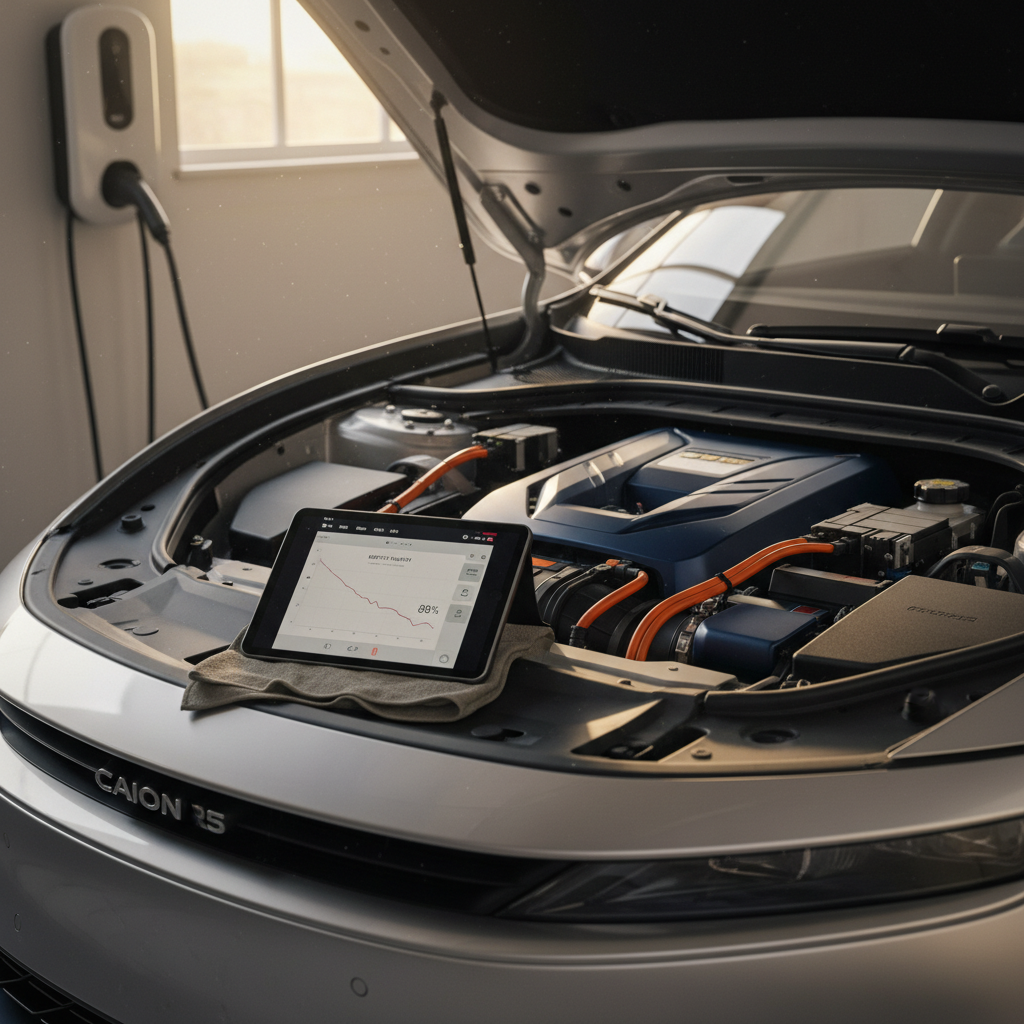
- The technician runs high‑voltage diagnostics to measure state of health (SoH), check cell balance, and scan for battery‑related error codes.
2. Making a warranty claim
If the data showed abnormal degradation or a defect, the next steps would be:
- Fisker approves a repair order under the battery warranty.
- The shop replaces modules or, in extreme cases, the entire pack.
- You pay nothing for covered work beyond incidental costs (like a rental car if not included).
This was the theory. It depended on Fisker having money, staff, and parts, three things that are in very short supply now.
The missing piece now
Bankruptcy reality: what the warranty means in 2026
Fisker filed for Chapter 11 bankruptcy in June 2024 and has since been moving toward liquidation, selling off remaining Oceans to a leasing company and winding down operations. For owners, it’s like finding out your safety net is made of vapor. The warranty book may still be in your glovebox, but the company that wrote it is effectively gone.
Fisker’s paper warranty vs. today’s reality
What the brochure promised, and what you can reasonably expect now.
What the booklet says
- 10‑year/100,000‑mile battery coverage
- Repair or replace defective packs
- Capacity support down to ~75%
What the law says
In theory, bankruptcy courts decide who gets paid. Secured creditors are first in line; consumer warranty claims are far behind. Unless a buyer acquires the brand and explicitly assumes warranties, coverage becomes very hard to enforce.
What owners experience
Post‑bankruptcy, owners report unanswered calls, shuttered support lines, and difficulty finding anyone authorized, or funded, to perform warranty work. In the UK, for example, the Ocean is already treated as effectively out of warranty.
Hard truth for current and future owners
The only meaningful protections left are general consumer laws in your state or country (for example, lemon laws or statutory rights) and any third‑party service contract you might buy. Neither of those is the same thing as a genuine, manufacturer‑backed high‑voltage battery warranty.
Warranty vs reality: battery health, chemistry, and degradation
Here’s the irony: the Fisker Ocean’s underlying battery technology is not the problem. CATL supplies both LFP (lithium iron phosphate) and NMC (nickel manganese cobalt) packs for the Ocean. These are mature chemistries used across the EV industry. If you treat them well, reasonable charge levels, limited DC fast‑charging, no chronic overheating, they can age gracefully whether or not the warranty paperwork is framed on your wall.
- LFP packs (generally used on lower‑range trims) prefer frequent charging to 100% and are very cycle‑tolerant, which is good news for commuters who plug in often.
- NMC packs (often used on Long Range and Performance trims) reward you for keeping daily charge limits around 70–80% and only topping to 100% before trips.
- In both chemistries, fast charging is a stress multiplier. A road‑trip here and there is fine; using DC fast charging as your primary habit accelerates wear.
- Thermal management matters. If a previous owner parked the Ocean in the sun at 100% charge for days at a time, no 10‑year warranty in the world can rewind that damage.
The good news for smart buyers
Buying a used Fisker Ocean? Battery-focused checklist
If you’re shopping used, the right way to think about the Fisker Ocean battery warranty is simple: treat it as background color, not protection. What matters is the pack in this particular car, on this particular day. Here’s how to evaluate it like a pro.
Essential battery checks before you buy a used Fisker Ocean
1. Get a true high-voltage battery health report
Ask for independent battery diagnostics, not just a dash readout. At Recharged, every EV gets a Recharged Score Report that measures battery state of health, projected range, and thermal behavior under load, so you’re not guessing.
2. Verify build date and in-service date
Find the build sticker and the original sale date. Even if you treat the 10‑year clock as notional, it’s useful for understanding how long the pack has been in real‑world use and under what climate conditions.
3. Inspect charging history and habits
Ask the seller how the car was typically charged. Lots of DC fast‑charging, frequent 100% charges, or chronic storage at full can all accelerate degradation. A car mostly charged at home on Level 2 is usually a better bet.
4. Look for software and recall history
Because Fisker’s update pipeline was chaotic even before bankruptcy, you want documentation of software versions, recalls, and any previous high‑voltage work. Gaps here aren’t a deal‑breaker, but they should influence price and your risk tolerance.
5. Do a long mixed-drive test
Go beyond a quick spin. Take at least a 30–40 minute test drive with mixed city and highway speeds. Watch how quickly the state‑of‑charge percentage drops versus miles driven and whether any HV‑system warnings appear.
6. Price in a worst-case battery scenario
With no active factory support, imagine the cost and hassle if the pack needed major work in a few years. If the price doesn’t leave room for that risk, or if the seller is leaning hard on the original warranty language, walk away or negotiate accordingly.
How Recharged can de-risk a used Ocean
Fisker Ocean battery warranty FAQ
Frequently asked questions about the Fisker Ocean battery warranty
So…should you still buy a used Fisker Ocean?
The Fisker Ocean battery warranty details read great in a press release: 10 years, 100,000 miles, and a solid capacity guarantee that out‑spec’d some rivals. In 2026, though, the fine print meets the bankruptcy docket. The promise is still there in legal theory, but the company behind it has effectively left the building.
If you’re drawn to a used Ocean, treat it like what it really is: an interesting EV with a complicated backstory. Pay for the actual battery in the car, not for a ghost warranty. Look for independently verified battery health, proof of sane charging habits, and pricing that bakes in the risk of owning an orphaned brand.
Platforms built specifically for EVs, like Recharged, exist to take some of that uncertainty off your shoulders. With battery diagnostics, fair‑market pricing, and EV‑savvy support, you can decide whether the Ocean’s combination of range, design, and discount is worth living without a living factory warranty. If the answer is yes, go in with your eyes open and the best data you can get; if not, there’s a whole wave of other used EVs whose battery warranties are backed by companies still very much alive.