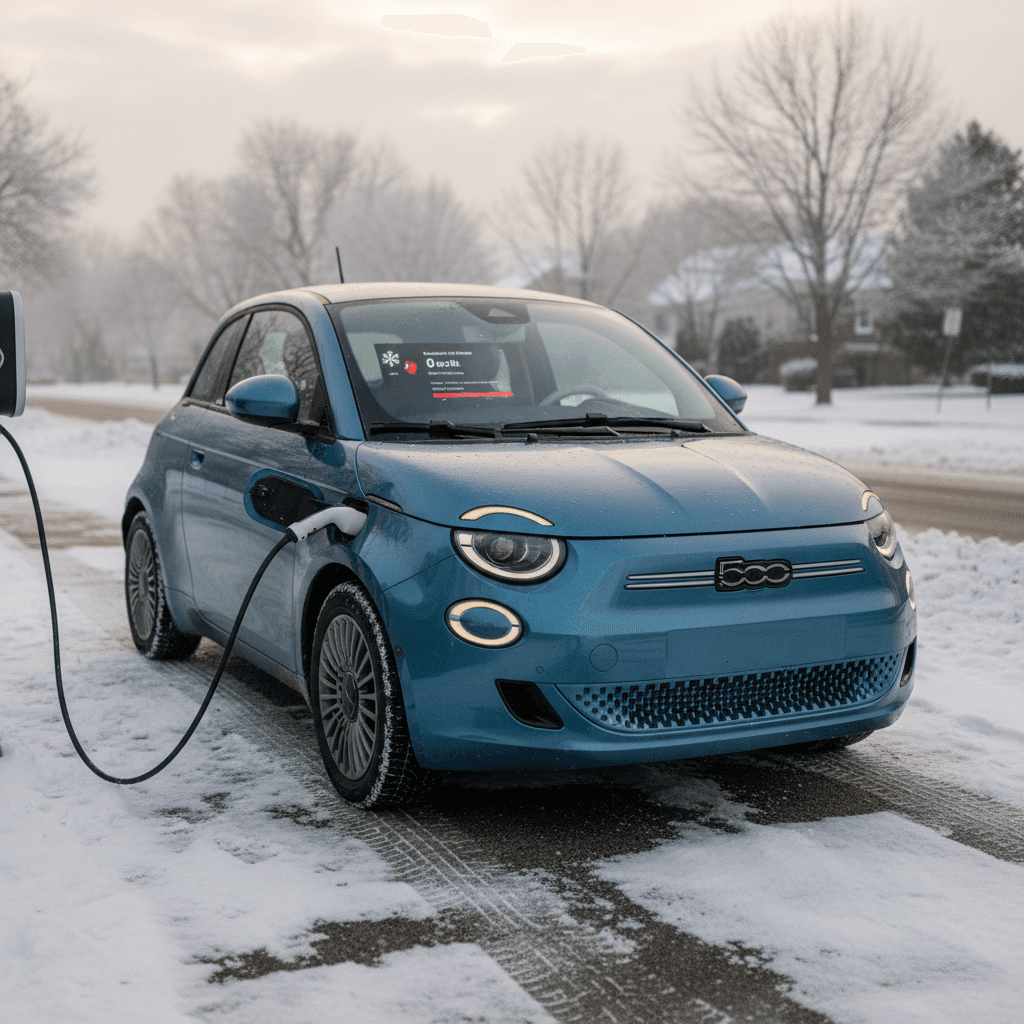
If you live somewhere with real winters and you’re eyeing a Fiat 500e, there’s one blunt question you’re probably trying to answer: what winter range loss percentage should I actually expect? Not the brochure number, not the hero YouTube run, your life, on a Tuesday, in January.
Key takeaway up front
Fiat 500e winter range loss: the short version
Typical Fiat 500e winter range loss
Those percentages put the Fiat 500e a bit on the vulnerable side compared with bigger‑battery EVs. Industry and independent testing show that the average EV keeps roughly 75–80% of its rated range in cold conditions, a 20–25% hit. The 500e, with its short wheelbase and small pack, tends to lose a little more in real life, especially on short trips and highway runs.
Before we split the story between the original U.S.‑only 500e (2013–2019) and the new 2024+ global model, it helps to understand why any EV, and especially a tiny one, takes a beating in winter.
How cold weather hits EV range (and why the 500e feels it more)
Four reasons your Fiat 500e loses range in winter
The physics are the same for every EV, but small batteries pay a higher price.
1. Cold batteries are less efficient
2. Cabin heat is a huge energy hog
3. Short trips are the worst case
4. Aerodynamics & rolling resistance
Don’t blame it all on degradation
1st‑gen Fiat 500e winter range loss (2013–2019 U.S. car)
The first‑generation Fiat 500e sold in the U.S. used a ~24 kWh pack and carried an EPA rating around 84 miles when new. In mild weather with conservative driving, many owners report 80–90 miles on a full charge. In winter, that picture changes fast.
- Owner reports commonly show summer mixed driving: 80–100 miles per charge.
- In mild winter (30–40°F), many see 60–70 miles, roughly a 25–35% loss.
- In harsher cold (teens and below, full heat): reports of 50 miles or less, which is effectively a 40%+ reduction from the “good day” range.
“For short winter trips in the 500e, I’ll run it with the heat off and just wear a coat… The range with cabin heating is maybe 15–30% down depending on the temperature.”
That anecdotal picture lines up eerily well with lab testing from groups like AAA and Recurrent on other EVs: figure 30–40% loss at 20°F with the heat on, less if you precondition and keep speeds down, more if you hammer the highway.
Range loss vs. permanent battery loss
2024+ Fiat 500e winter range loss in the real world
The new‑generation 2024 Fiat 500e that finally returned to the U.S. uses a much larger ~42 kWh battery and carries an EPA combined range of about 149 miles. In independent U.S. highway testing at 75 mph, the car has delivered roughly 120 miles in mild conditions, about 80% of the EPA figure, which is normal for small city EVs at freeway speeds.
In European cold‑weather testing and early owner reports, the 2024 500e tends to lose around 25–35% of its range in typical sub‑freezing use, with deep‑winter scenarios edging toward 40%. One long‑term winter evaluation pegged the car’s effective winter range at about 105 miles versus a 149‑mile rating, roughly a 30% drop, with full heat and mixed driving.
Good news for new‑gen owners
Fiat 500e winter range loss percentage table
Approximate Fiat 500e winter range loss by scenario
These are realistic planning numbers, not guarantees. Think of them as the ranges your range falls into.
| Model / scenario | Weather & use case | Estimated loss vs. mild weather | Realistic usable range* |
|---|---|---|---|
| 1st‑gen 500e (24 kWh), gentle winter city driving | 30–40°F, mostly 30–45 mph, moderate heat, preconditioned | ~20–25% | 60–70 miles (vs. 80–90 mi in mild weather) |
| 1st‑gen 500e, harsh winter commute | 10–20°F, 65–70 mph, full heat, mixed city/highway | ~35–45% | 45–55 miles |
| 2024+ 500e (42 kWh), typical winter mixed driving | 25–35°F, mixed city/highway, cabin heat, preconditioned | ~25–35% | 95–115 miles (vs. ~140–150 mi mild) |
| 2024+ 500e, worst‑case cold snap | 0–15°F, highway‑heavy at 70 mph, full heat | ~35–40% | 80–95 miles |
Real‑world planning numbers for both generations of Fiat 500e in cold weather.
What this table is, and isn’t
7 ways to protect your Fiat 500e range in winter
Cold‑weather habits that make a big difference
1. Always start warm and plugged in
Use the Fiat app or the in‑car timer to <strong>preheat the cabin and battery while plugged in</strong>. You’ll use wall power instead of draining the pack, and the car will start the trip in its happy temperature zone.
2. Use seat and wheel heaters first
If your 500e has heated seats or steering wheel, lean on those instead of cranking the cabin temp to 76°F. They use far less energy and keep you comfortable even if you set the climate control in the low 60s.
3. Pick a speed and stick to it
High speed plus cold air is a one‑two punch. Dropping from 75 to 65 mph can save a <strong>surprising amount of winter range</strong>, especially in a small, upright car like the 500e.
4. Avoid lots of tiny trips
Batch errands so the car stays warm. Five separate 3‑mile drives are far worse for range than <strong>one 15‑mile loop</strong>, because you’re not reheating the pack and cabin from stone cold each time.
5. Mind your tires and pressure
Winter tires are worth it for grip, but they do add rolling resistance. Keep them properly inflated, cold air can drop pressures 3–5 psi, and avoid oversized, heavy wheels that cost you range for looks.
6. Park smart
Whenever you can, park in a garage or at least out of the wind. Even a basic carport or south‑facing spot where the sun hits the car can shave a few percent off your winter hit.
7. Use realistic charge targets
In deep winter, it’s smart to treat 20–80% as your normal operating band, but <strong>plan your day like 10–90% is your real safety window</strong>. Leave a cushion, especially on unfamiliar routes.
Pro tip for apartment dwellers
Is the Fiat 500e a good EV for cold climates?
Where the 500e works beautifully in winter
- Short, predictable commutes: 15–40 miles per day with easy charging at home or work is right in this car’s wheelhouse, even at 20°F.
- City and inner‑suburb life: Stop‑and‑go traffic actually helps; you’re not fighting highway aero drag all day.
- Garaged or covered parking: Starting from a relatively warm garage can narrow your winter hit by a noticeable margin.
- Multi‑car households: Use the 500e as the winter city runabout; keep long‑range road‑trip duty for something else.
Where winter exposes the limits
- Single‑car households in rural areas: Daily 70–90 mile roundtrips at 70 mph in January will feel tight, even in the 2024 car.
- No reliable home charging: Depending on public charging in sub‑freezing weather adds complexity and time.
- Steep hills + snow: Climbing long grades in the cold can torch range fast. You need margin on top of margin.
- Old 1st‑gen 500e with a tired pack: If the battery has already lost 25–30% capacity, winter can turn it into a 40‑mile car.
If you need more winter headroom
Buying a used Fiat 500e for winter driving
If you’re shopping the used market, winter is both the best and worst time to test‑drive a Fiat 500e. Best, because you’ll see its bad‑day behavior. Worst, because it’s easy to misinterpret winter consumption as terminal battery wear.
Used Fiat 500e winter buying checklist
1. Separate winter loss from degradation
On a test drive, note the temperature, trip length, speed, and heater use. A car that seems to “only do 60 miles” at 28°F with full heat might deliver 80–90 miles on a mild day if the pack is still healthy.
2. Get objective battery health data
A <strong>professional battery health report</strong> is worth its weight in lithium. Every EV listed on Recharged includes a Recharged Score with verified battery health, so you can see how much capacity the pack has actually lost before you commit.
3. Look for cold‑weather features
Check for heated seats, heated steering wheel, a heat pump (on newer 500e trims), and remote preconditioning. These options don’t just add comfort, they reshape the winter range equation in your favor.
4. Evaluate your daily route honestly
Map your longest regular winter days, school run, commute, errands, kid activities, and add 25–40% as a winter penalty. If a healthy 500e still covers that with buffer, you’re in the clear.
5. Test‑charge in the cold
If possible, plug into a Level 2 charger after a long winter test drive. A pack that charges at a normal rate and doesn’t trigger warnings is a good sign the thermal system and battery are behaving.
6. Factor in resale and flexibility
The 500e’s niche mission means it’s wise to <strong>buy at a sensible price and with transparent battery health</strong>. That way, if your needs grow beyond its winter range, you’re not trapped in the wrong car.
How Recharged de‑risks winter EV buying
Ready to find your next EV?
Browse VehiclesFAQ: Fiat 500e winter range loss questions, answered
Common Fiat 500e winter range questions
Bottom line: what to expect from a Fiat 500e in winter
The Fiat 500e doesn’t break the laws of EV physics just because it’s charming. In fact, its tiny pack makes the laws of winter range loss feel even harsher. Whether you’re in the older U.S.‑only car or the new 2024+ model, the pattern is the same: plan on roughly 25–40% range loss in real‑world cold weather with the heat on, and treat best‑case days as a pleasant surprise, not the baseline.
If your life is built around short, knowable trips with easy charging, the 500e remains one of the most delightful winter city cars you can own, instant heat, quiet, and zero tailpipe emissions in the worst traffic your town can throw at you. If your winter reality is long, fast, and rural, it’s better to know that now and shop accordingly.
Either way, the smart move is to separate weather effects from battery health before you buy. That’s exactly what the Recharged Score does for used EVs, including the Fiat 500e, so you can choose a car, and a winter range margin, that fits your actual life, not just the label on the window.