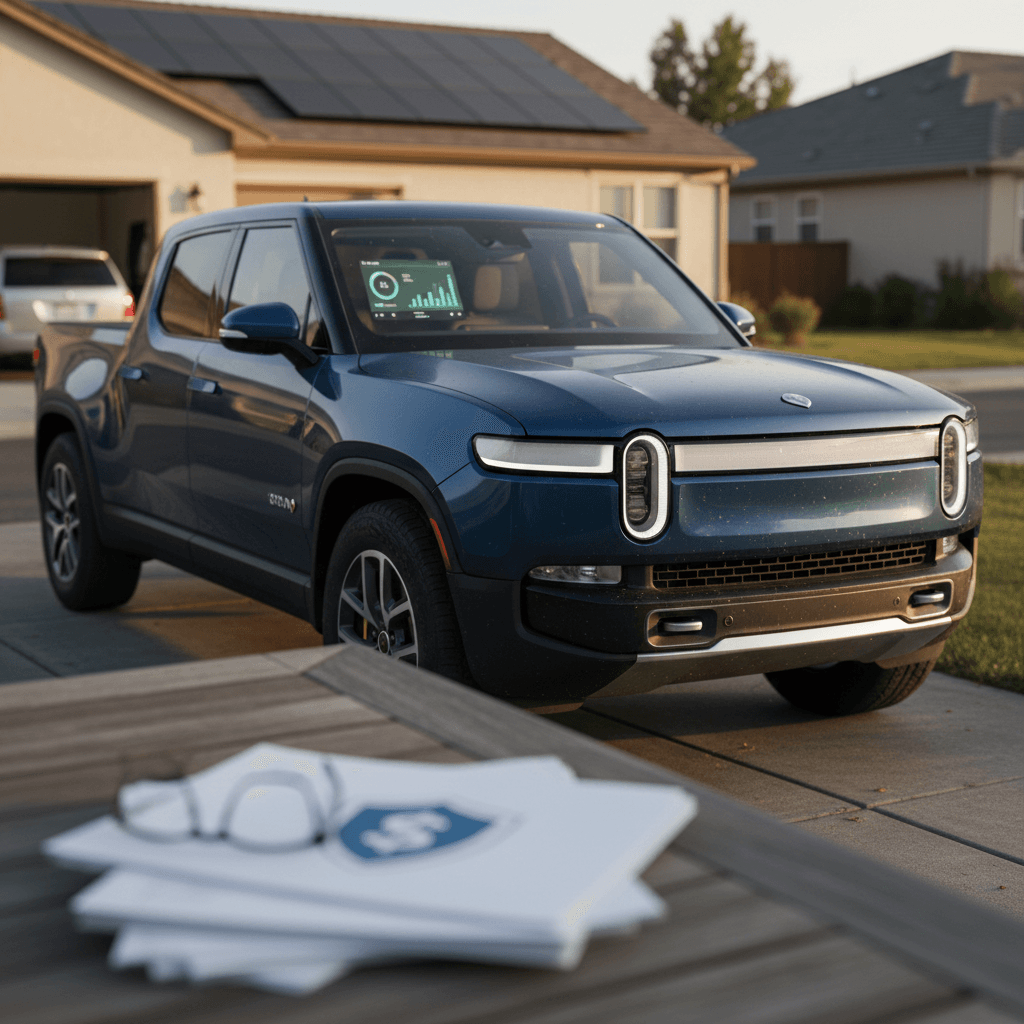
You don’t buy a Rivian R1S because you’re sensible. You buy it because it’s a three-row electric Swiss Army knife: quick, luxurious, off-road capable and cleaner than the gas-guzzling SUVs it embarrasses at stoplights. But there’s one very un-romantic part of the story, Rivian R1S insurance cost. And if you’re not careful, that number can sting harder than a 0–60 launch.
In a hurry? Here’s the short answer
Rivian R1S insurance cost overview
Rivian R1S insurance in context
Why the gap? The R1S is a large, heavy, expensive electric SUV loaded with sensors, cameras, and aluminum and composite bodywork. Great for safety and performance, less great when it’s time to write a repair estimate. To an underwriter, that looks like higher potential claim payouts, so premiums climb.
How much does it cost to insure a Rivian R1S?
Let’s talk numbers. No two drivers get the same quote, but there are some solid benchmarks you can use when budgeting for a Rivian R1S in 2025.
Typical Rivian R1S insurance cost vs benchmarks (2025)
High-level comparison of Rivian R1S insurance with national averages and other vehicles.
| Vehicle / benchmark | Typical annual full-coverage premium (2025) | How it compares | ||||||||||||
|---|---|---|---|---|---|---|---|---|---|---|---|---|---|---|
| National average (all vehicles) | $2,671 | Baseline for a typical driver in 2025 full coverage. | Mainstream compact SUV (e.g., Honda CR‑V) | $2,200–$2,400 | Usually cheaper thanks to lower repair costs and lower vehicle price. | Luxury gasoline SUV | $2,500–$3,200 | Similar band; big, pricey vehicles cost more to insure. | Rivian R1S (new) | $2,500–$3,500+ | Higher than average due to vehicle price and EV repair complexity. | Rivian R1S (used, 2–3 years old) | $2,200–$3,000 | Often slightly lower than new, depending on value and coverage. |
These ranges assume a clean-driving adult with good credit and full-coverage limits around 100/300/100, plus comprehensive and collision.
Third‑party cost-to-own tools also offer clues. Some estimate five‑year insurance totals in the low– to mid‑$6,000s for an R1S under conservative assumptions, while others appear far higher because they bake in steeper regional and driver‑risk assumptions. The point isn’t the exact dollar; it’s that your individual quote can sit nearly anywhere between “expensive” and “eye-watering” based on your situation.
Don’t anchor on one online estimate
Why Rivian R1S insurance is higher than average
Why insurers price the R1S like a luxury flagship
It’s not just that it’s electric, it’s that it’s expensive, heavy, and packed with tech.
Vehicle price & trim
Weight & performance
Complex EV hardware
On top of that, mainstream carriers don’t yet have decades of claims data on Rivian products the way they do on a CR‑V or RAV4. When actuaries squint at a new, expensive technology platform, they tend to price in uncertainty. That shows up as higher baseline premiums for early adopters.
Is it all bad news? Not quite.
8 factors that drive your R1S insurance premium
You can’t change the fact that the R1S is an expensive EV, but you can absolutely influence how insurers see you. Here are the levers that matter most.
Quick win: quote before you commit
How to save on Rivian R1S insurance
You can’t turn a Rivian R1S into a budget Corolla in the eyes of your insurer, but you can shave real money off the annual bill. Think in terms of stacking small percentage gains, 5% here, 10% there, until the premium looks much friendlier.
Practical ways to cut your R1S premium
Start with the easy wins, then decide how far you’re willing to go on coverage trade‑offs.
Shop around, seriously
Right-size your coverage
- Liability of 100/300/100 or higher for asset protection.
- Raising deductibles from $500 to $1,000 if you have an emergency fund.
- Dropping rental or roadside if your Rivian coverage already provides it.
Leverage telematics & safe-driver programs
Bundle & household discounts
Defensive driving courses
Let time work for you
Where a used R1S helps
Safety ratings, recalls and how they affect insurance
Insurers care about how well a vehicle protects people and avoids crashes in the first place. On that front, the R1S brings some reassuring credentials to the table.
- The Rivian R1S has earned a Top Safety Pick+ rating from the Insurance Institute for Highway Safety (IIHS) for recent model years, indicating strong crash performance and effective crash-avoidance tech.
- Its standard forward‑collision warning, automatic emergency braking, and pedestrian detection systems have tested at advanced to superior performance levels in multiple scenarios.
- Rivian has already handled software‑driven safety recalls via over‑the‑air updates, including driver-assistance tweaks, helpful for insurers because fixes roll out quickly without waiting for dealer visits.
Safety tech ≠ permission to relax
The upshot for your premium: good crashworthiness and active safety generally help, especially when paired with an adult driver who isn’t constantly feeding the claims department. But any big, fast, expensive vehicle starts from a higher baseline, and safety tech alone won’t turn a Rivian into a bargain to insure.
Insurance cost: new vs used Rivian R1S
New R1S: maximum sticker, maximum exposure
A brand‑new R1S with a high MSRP means your insurer is staring at the worst‑case scenario: replacing or repairing an extremely expensive vehicle at today’s labor and parts rates. That’s why first‑year insurance projections in some cost‑to‑own tools look steep, they’re assuming peak replacement cost and limited data.
If you’re financing heavily or leasing, your lender will also insist on full coverage with low deductibles, and may strongly recommend gap coverage. All of that pads your monthly outlay.
Used R1S: still premium, but more rational
On a 2‑ or 3‑year‑old R1S, depreciation has already done some of the ugly work. The insurer now prices comprehensive and collision against a lower actual cash value, which usually means somewhat lower premiums.
Where used buyers really win is on the package deal: lower payment, slightly lower insurance, and similar capability. Shopping a well‑vetted used EV can narrow the ownership‑cost gap more than any single insurance trick.
Pro move: quote specific VINs
Budgeting insurance into your R1S total cost of ownership
With EVs, it’s easy to obsess over range and charging and forget that insurance is one of the largest recurring line items after your payment. For a Rivian R1S, pretending it’s an afterthought is how budgets blow up.
Sample annual R1S ownership budget (illustrative only)
A rough framework for thinking about your Rivian R1S costs over a year.
| Cost category | Estimated annual cost | Notes | ||||||||||||
|---|---|---|---|---|---|---|---|---|---|---|---|---|---|---|
| Loan or lease payment | $9,000–$12,000 | $750–$1,000/month depending on price, term, and down payment. | Insurance (full coverage) | $2,200–$3,000 | Varies widely; obtain quotes with your real details. | Charging/electricity | $600–$900 | Depends on local kWh rates and home vs public charging mix. | Maintenance & tires | $400–$800 | EVs skip oil changes but heavy SUVs can eat tires. | Registration & taxes | $300–$800 | Some states add EV surcharges or higher fees. |
Assumes a financed used R1S driven 12,000–15,000 miles per year in an average‑cost state.
Looking at the full year instead of just a monthly payment also makes it easier to compare a Rivian R1S with alternatives. A cheaper-to-insure small SUV might save you $800–$1,200 a year on premiums, but if you’re buying used and financing smartly, a pre‑owned R1S can claw a lot of that back in other areas.
Where Recharged fits in
Rivian R1S insurance cost: FAQs
Frequently asked questions about Rivian R1S insurance
Key takeaways before you buy
The Rivian R1S is one of the most compelling electric SUVs on sale: fast, capable, safe, and deeply desirable. It’s also, unapologetically, not cheap to insure. Most owners should brace for premiums that sit comfortably above the U.S. average, especially in high‑cost states or with less‑than‑perfect driving records.
The good news is that you have more control than it first appears. Choosing the right trim and model year, shopping quotes aggressively, tweaking deductibles, and opting for a well‑priced used R1S can all bend the cost curve in your favor. And when you shop through Recharged, you’re not guessing in the dark, we pair each used EV with a Recharged Score Report and EV‑savvy specialists who can talk through total cost of ownership, including insurance, before you ever click “buy.”