If you’re looking at a Fiat 500e, you’re probably trying to answer one simple question: how much does it cost per mile to drive? The 500e is one of the most efficient EVs you can buy in the U.S., but your real cost per mile depends on electricity prices, how and where you charge, and what you pay for insurance and maintenance.
Short answer
Fiat 500e cost per mile: quick overview
Fiat 500e cost-per-mile snapshots (typical U.S. scenarios)
Those numbers are averages, not promises. To make them useful, you need to understand how the Fiat 500e uses energy and what you pay for each kilowatt-hour (kWh). Then you can layer in maintenance and ownership costs and see how a 500e really stacks up against a gas car in your driveway.
How efficient is the Fiat 500e?
The current U.S.-spec Fiat 500e uses a 42 kWh battery and is rated at roughly 29 kWh per 100 miles of driving on the EPA cycle. That’s another way of saying it averages about 3.4 miles per kWh in mixed driving. In real-world testing and owner reports, the 500e often lands between about 3.0–4.2 mi/kWh depending on speed, temperature, and driving style.
- EPA combined energy use: about 29 kWh / 100 miles (≈3.4 mi/kWh)
- City driving: often closer to 3.8–4.2 mi/kWh if you’re gentle on the pedal
- Highway at 70–75 mph: more like 2.7–3.1 mi/kWh
- Battery size: 42 kWh gross, with a bit less usable for driving
Convert efficiency to cost
Electricity cost per mile: real U.S. examples
Electricity is where the Fiat 500e shines. But U.S. electricity prices vary a lot by state. In 2024–2025, the national residential average has hovered around the mid-to-high teens in cents per kWh, with many drivers on time-of-use or EV-friendly plans paying less overnight and more in the late afternoon.
Home charging cost per mile for a Fiat 500e
Approximate electricity cost per mile using typical residential rates and realistic efficiency values.
| Scenario | Electricity price (¢/kWh) | Efficiency (mi/kWh) | Cost per mile (¢) | Cost per 1,000 miles |
|---|---|---|---|---|
| Low-cost power (some Midwest/South) | 12 | 3.5 | ≈3.4¢ | ≈$34 |
| Near U.S. 2024–2025 average | 17 | 3.4 | ≈5.0¢ | ≈$50 |
| Higher-cost coastal metro | 24 | 3.2 | ≈7.5¢ | ≈$75 |
| Efficient city driving on cheap off-peak EV rate | 10 | 4.0 | ≈2.5¢ | ≈$25 |
Your actual cost depends on your local rate plan and driving style, but these examples show the ballpark.
How this compares to gas
Cost per mile: home charging vs public fast charging
If you can plug in at home, your Fiat 500e will be one of the cheapest cars you’ve ever owned on an energy-per-mile basis. Rely mostly on DC fast charging, though, and your cost per mile can double or even triple.
Home charging (Level 2 or even Level 1)
- Typical cost in many areas: $0.12–$0.22 per kWh
- At 3.3–3.7 mi/kWh, that’s about 4–6¢ per mile
- Great for overnight charging and predictable costs
- Best way to unlock the 500e’s efficiency advantage
Public DC fast charging
- Common pricing: $0.40–$0.60 per kWh or more
- At 3.0 mi/kWh, that’s roughly 13–20¢ per mile
- Similar to or slightly higher than many gas cars on fuel-only cost
- Fantastic for road trips, but expensive for everyday use
Don’t budget around fast charging
Maintenance and repairs per mile
The Fiat 500e has no oil to change, no traditional automatic transmission, and far fewer wear items than a comparable gas car. That said, it’s still a European city car with tires, brakes, suspension, and a cooling system that all need periodic attention, especially if you’re buying used.
Common Fiat 500e maintenance items and cost impact
These are rough U.S. estimates for planning, not quotes from a specific shop.
Tires
Expect 25,000–40,000 miles out of a set, depending on driving style and roads.
Ballpark: $500–$800 a set installed → roughly 1.5–3¢ per mile over their life.
Brake service
Regenerative braking means pads can last a long time, especially around town.
Ballpark: $400–$700 front brakes every 60,000+ miles → often well under 1¢ per mile.
Other wear items
Cabin filters, coolant service, and the occasional suspension component or 12V battery.
Ballpark: Averaging everything out, many owners land near 2–4¢ per mile over several years.
If you spread those costs over, say, 60,000–90,000 miles of use, a reasonable planning figure for maintenance and minor repairs on a Fiat 500e is in the 3–7¢ per mile range for a well-kept car. A neglected or high-mileage example can be higher, which is where tools like a Recharged Score battery and condition report matter when you’re shopping used.
Insurance, registration, and other ownership costs
Electricity and maintenance don’t tell the whole story. To understand what it truly costs per mile to drive a Fiat 500e, you have to spread fixed annual costs over the number of miles you actually drive.
- Insurance: Depending on age, location, and driving record, a Fiat 500e often runs similar to or slightly lower than a comparable gas hatchback. Many U.S. owners see $1,000–$1,800 per year, but high-cost metro areas can be more.
- Registration, fees, and taxes: In many states, you’ll pay roughly $150–$400 per year. A few states add EV-specific fees that can add $100–$250 annually.
- Parking and tolls: These are highly location-specific but can meaningfully change your cost per mile in dense urban areas.
Turning annual costs into cost per mile
How yearly insurance and registration look when you divide by miles driven.
| Annual miles driven | Insurance + reg. per year (example) | Cost per mile from those items alone |
|---|---|---|
| 6,000 miles (urban, low mileage) | $1,600 insurance + $250 reg. = $1,850 | ≈31¢ per mile |
| 10,000 miles | $1,600 insurance + $250 reg. = $1,850 | ≈18.5¢ per mile |
| 15,000 miles | $1,600 insurance + $250 reg. = $1,850 | ≈12.3¢ per mile |
More miles per year spread your fixed costs thinner, cutting your all-in cost per mile.
Drive more, lower your cost per mile
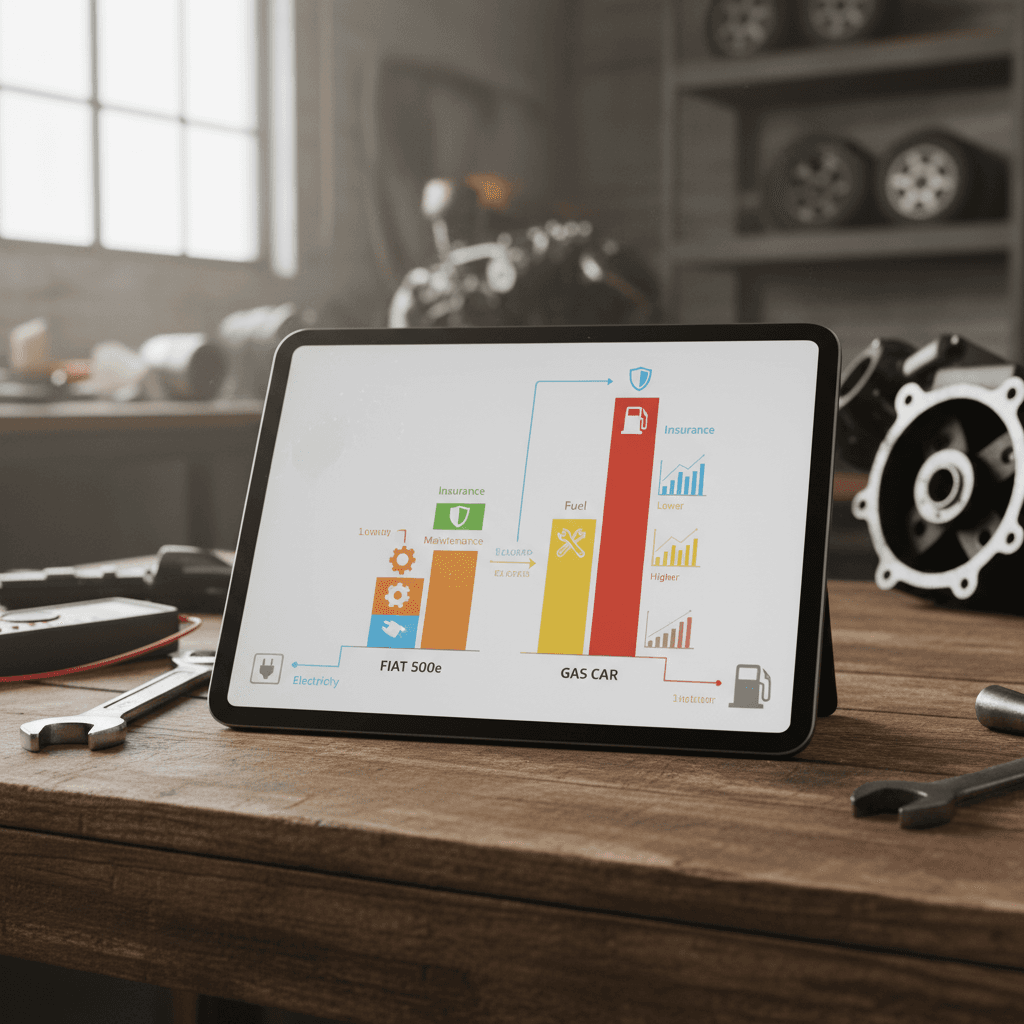
Fiat 500e vs gas car: cost per mile comparison
Let’s stand the Fiat 500e next to a typical small gas hatchback and look at what you’d spend just to power the car down the road, before insurance and other charges.
Fiat 500e vs small gas hatchback: fuel/energy cost per mile
Assumes $3.50/gal gasoline and typical U.S. home electricity pricing.
| Vehicle | Assumed efficiency | Energy price | Energy cost per mile |
|---|---|---|---|
| Fiat 500e – home charging | 3.4 mi/kWh | $0.17/kWh | ≈5.0¢ |
| Fiat 500e – cheap off-peak | 4.0 mi/kWh | $0.12/kWh | ≈3.0¢ |
| Fiat 500e – frequent fast charging | 3.0 mi/kWh | $0.50/kWh | ≈16.7¢ |
| Gas hatchback (e.g., 35 mpg) | 35 mpg | $3.50/gal | 10.0¢ |
| Efficient hybrid (e.g., 50 mpg) | 50 mpg | $3.50/gal | 7.0¢ |
Even when electricity prices rise, a very efficient EV like the 500e usually keeps a clear edge on energy cost per mile.
Where the 500e wins
What changes your real-world cost per mile
Five big levers that change your 500e’s cost per mile
Understanding these makes your budget more predictable.
1. Home vs public charging
The more kWh you buy at home, the lower your average cost per mile. If you live on public DC fast charging, plan on energy costs similar to a gas car’s fuel bill.
2. Time-of-use rates
In many states, charging overnight can be far cheaper than late afternoon. Shifting charging to off-peak hours can shave 1–3¢ per mile off your electricity cost.
3. Weather and climate
Cold weather reduces efficiency and increases HVAC use. In a short-range car like the 500e, winter city driving can add a couple of cents per mile to energy costs.
4. Speed and driving style
Running 80 mph or accelerating aggressively eats into your mi/kWh. Smooth driving at city speeds lets the 500e’s strong efficiency really show.
5. Your state’s electricity prices
States with inexpensive generation can put you near 3–4¢ per mile. High-cost coastal states might see 7–8¢ per mile even with the same car and driving.
6. Annual mileage
The more you drive, the more you spread out fixed costs like insurance and registration, pulling your all-in cost per mile down.
Cost per mile on a used Fiat 500e
On a used Fiat 500e, you’re layering purchase price and depreciation on top of the running-cost picture we’ve just sketched. The good news is that small city EVs typically depreciate faster than big crossovers when new, which can make used 500e ownership surprisingly affordable per mile, if you buy carefully.
Checklist: getting a low-cost-per-mile used Fiat 500e
1. Focus on battery health, not just mileage
The traction battery is the heart of your 500e. A pack in strong health preserves range and efficiency. A <strong>Recharged Score battery health report</strong> can give you hard data instead of guesswork.
2. Look for clean service history
Documented tire, brake, and basic maintenance history lowers your risk of front-loaded repair costs that would spike your cost per mile in the first year.
3. Avoid cars with unknown charging issues
Intermittent DC fast-charging problems, on-board charger faults, or repeated charging errors can turn into expensive repairs. Walk away or price them in very aggressively.
4. Check tires and brakes before you buy
If the car needs rubber and pads immediately, factor $800–$1,200 into your math. On a low-priced used 500e, that can move your first-year cost-per-mile more than you expect.
5. Consider how long you’ll keep it
If you’ll own the car three to five years and drive 10,000–15,000 miles per year, your purchase price gets divided over a lot of miles, keeping depreciation per mile low.
How Recharged can help
FAQ: Fiat 500e cost per mile to drive
Common questions about Fiat 500e running costs
Bottom line: is the Fiat 500e cheap to run?
If you can charge at home, the Fiat 500e is one of the lowest-cost-per-mile cars you can drive. Energy often runs in the 3–6¢-per-mile range, maintenance is modest, and the car’s city-friendly efficiency means you’re not paying to move around unnecessary mass. The real swing factors are your local electricity prices, insurance rates, and how many miles you drive per year.
For shoppers comparing a used Fiat 500e to a similar gas hatchback, the 500e’s low running costs can more than offset its shorter range, especially in urban use. If you’re considering one, take the time to run the numbers with your local kWh rate, and when you’re ready to shop, look for a verified battery-health report. Platforms like Recharged can help you see battery condition, fair pricing, financing options, and delivery all in one place so you understand your true cost per mile before you buy.