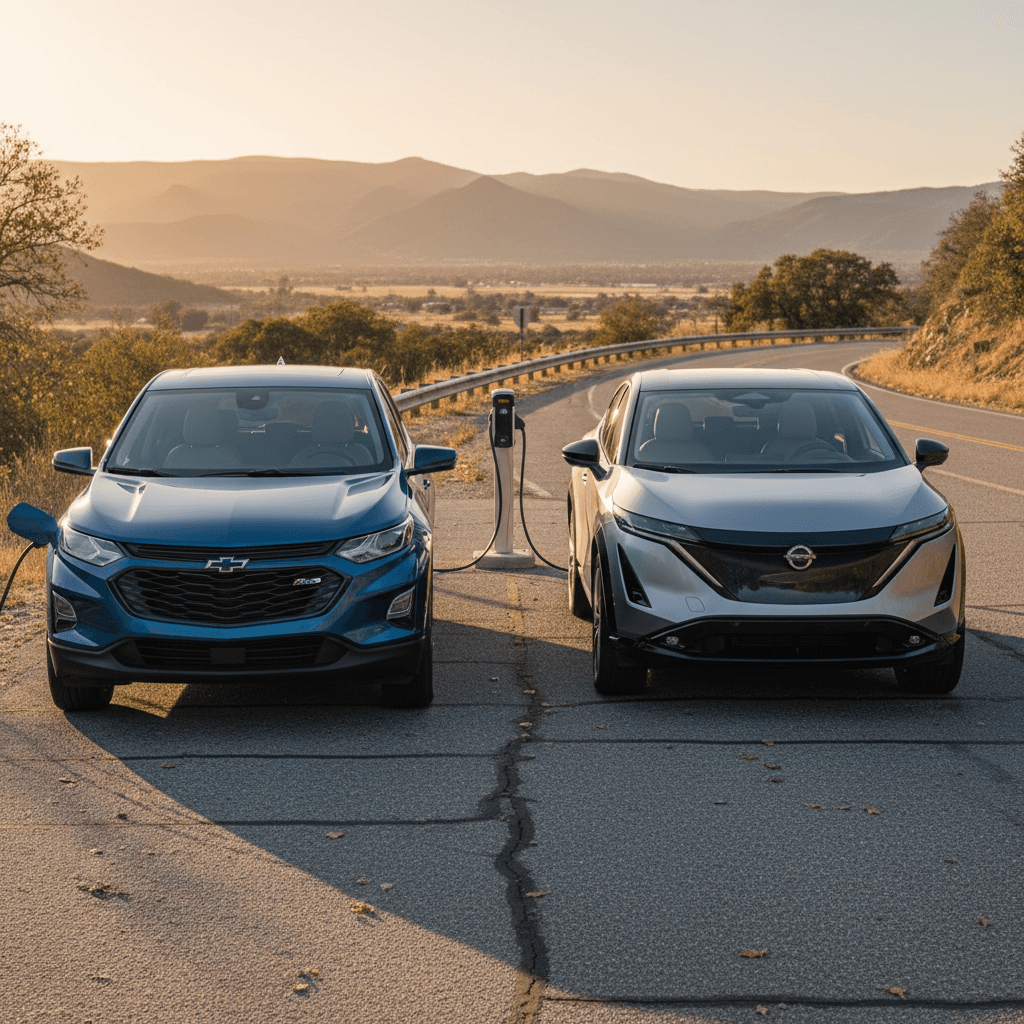
If you’re shopping for an electric SUV, the **Chevy Equinox EV vs Nissan Ariya** matchup is hard to ignore. They’re similar in size and mission, comfortable, family-friendly crossovers, but they approach range, charging, and pricing very differently, and their futures in the U.S. market are heading in opposite directions.
Why this comparison matters in 2026
Chevy Equinox EV vs Nissan Ariya: Quick Overview
Headline differences at a glance
Both are compact electric SUVs, but they prioritize different strengths.
Chevy Equinox EV (2025–2026)
- Class: Compact electric SUV
- Battery: ~85 kWh Ultium pack
- Range: Up to about 319 miles FWD, low-300s with eAWD
- Charging: DC fast up to ~150 kW, strong Level 2 capability
- Charging standard: Uses GM’s charging ecosystem with NACS adapter access to Tesla Superchargers
- Market role: High-volume, value-focused EV, still in active production
Nissan Ariya (2023–2025 U.S.)
- Class: Compact/midsize electric SUV
- Battery: 63 kWh or 87 kWh usable
- Range: Roughly 216–304 miles depending on trim and drivetrain
- Charging: DC fast up to about 130 kW, slower than newer rivals
- Charging standard: CCS fast charging, J1772 for AC
- Market role: Comfort-oriented EV that’s being phased out in the U.S. after the 2025 model year
Think new vs. used from the start
Pricing, Incentives and Market Position
On paper, the Chevy Equinox EV was positioned to start in the low- to mid-$30,000s before destination, with well-equipped trims climbing into the $40,000s and beyond as you add all-wheel drive and options. In practice, real-world transaction prices can look more like the high $30,000s to low $50,000s for fully loaded models, which still undercuts many premium electric SUVs.
The Nissan Ariya launched higher: base MSRPs landed around the low $40,000s for smaller-battery trims, pushing into the mid- and even high-$50,000s for extended-range, e-4ORCE all-wheel-drive versions with upscale interiors. That made the Ariya feel more like a quasi-premium offering in a mainstream badge, and it struggled to justify that pricing against aggressive competition.
Equinox EV: Value-focused and incentive-friendly
- Sticker price: Generally below many comparably sized EVs, with strong feature content.
- Tax credits: U.S. federal incentives may apply depending on where the vehicle is built, your income, and evolving rules, check current eligibility before you buy.
- Market positioning: Designed as a high-volume, affordable EV alongside the revived Bolt, so Chevy and dealers have an incentive to keep it competitive.
Ariya: Moving quickly toward the used market
- Sticker price: New inventory on lots still reflects original pricing in the $40,000s–$50,000s, but dealers are increasingly motivated to move remaining stock.
- Depreciation: The Ariya’s shorter U.S. run and higher new price point mean used examples can see meaningful discounts, especially as 2023–2024 models come off leases.
- Future new supply: Nissan has paused U.S. imports for the 2026 model year and beyond, which effectively turns this into a finite-supply vehicle here.
Watch dealer fees and EV discounts
Range, Battery Size and Efficiency
Approximate range and battery specs
Representative numbers for popular trims; always verify exact figures for the specific model year and configuration you’re considering.
| Model / Drivetrain | Battery (usable) | EPA-est. Range | Typical Use Case |
|---|---|---|---|
| Equinox EV FWD | ~85 kWh | Up to ~319 miles | Max range commuter and family road-tripper |
| Equinox EV eAWD | ~85 kWh | High-200s to low-300s miles | All-weather daily driver |
| Ariya FWD 63 kWh | ~63 kWh | ~216 miles | Suburban commuting, shorter trips |
| Ariya FWD 87 kWh | ~87 kWh | Up to ~304 miles | High-range, comfort-first cruiser |
| Ariya e-4ORCE 87 kWh | ~87 kWh | ~257–272 miles | Performance and traction over absolute range |
Real-world range will vary based on temperature, speed, load, and driving style.
If you want to maximize how far you can go between charges, the Equinox EV generally holds the edge. Chevy’s Ultium-based compact SUV squeezes impressive efficiency from its 85 kWh pack, landing in the low-300-mile ballpark for front‑drive trims and only slightly less for all‑wheel drive. That’s strong even against newer rivals.
The Ariya’s larger 87 kWh battery can match some Equinox EV trims on paper, with extended‑range FWD models advertised around 300+ miles. But most real-world Ariya configurations, especially the e‑4ORCE all‑wheel‑drive models, land in the mid‑200s. For many drivers, that’s still plenty. The real question is how the range pairs with charging speed and your daily routine.
Efficiency and climate considerations
Charging Speed and Road-Trip Usability
Range numbers are only half the story. How quickly you can add miles back into the pack, and where you can plug in, often matters more in day‑to‑day ownership.
Charging highlights
Equinox EV: Better aligned with the latest networks
- DC fast charging: Around 150 kW peak, which isn’t segment‑topping but is competitive. Chevy quotes roughly 70–80 miles of range added in about 10 minutes under ideal conditions.
- Home charging: Robust onboard AC charging (up to roughly 11.5–19.2 kW depending on trim and setup) means a properly sized Level 2 unit can refill the pack overnight with room to spare.
- Tesla Supercharger access: With a NACS adapter and the myChevrolet app, Equinox EV owners can tap into a growing pool of Tesla Superchargers, dramatically expanding road‑trip coverage.
Ariya: Capable enough, but starting to feel dated
- DC fast charging: Peak rates around 130 kW mean 10–80% sessions on the extended‑range battery commonly fall in the 30–40 minute band.
- Home charging: Level 2 at 240V can handle a full charge overnight, but its charging hardware isn’t as future‑leaning as the newest rivals.
- Network access: Uses CCS fast charging, so it works on major third‑party networks. As more U.S. stations convert to NACS, CCS‑only vehicles may increasingly rely on adapters and legacy hardware.
Plan your charging around your life
Space, Comfort and Interior Tech
Both SUVs are aimed squarely at families and commuters who want real back-seat room and usable cargo space. On paper and in person, they deliver, but with different personalities.
Interior character: Practical vs. lounge-like
You’ll feel the difference as soon as you sit down.
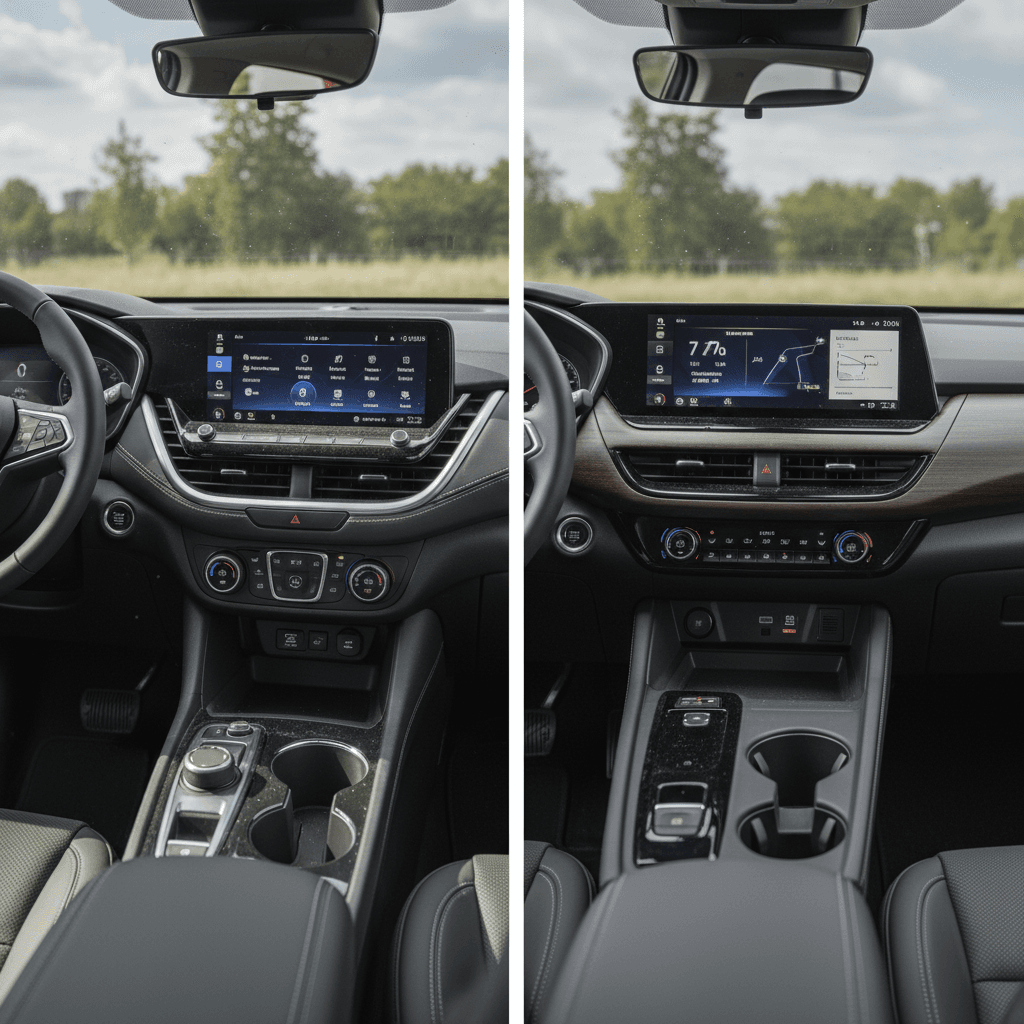
Equinox EV: Practical, tech-forward mainstream feel
- Clean, straightforward dashboard anchored by a large central display and digital cluster.
- Good sightlines, generous rear-seat room, and a cargo area on par with other compact SUVs.
- Interior materials are more mainstream than luxury, but higher trims add nicer finishes and options like a panoramic roof.
- Google built-in and GM’s latest software stack keep things current on navigation and connected services.
Ariya: Quiet, almost luxury-lite cabin
- Minimalist, lounge-inspired design with a flat floor and warm lighting.
- Available Nappa leather, soft-touch materials, and thoughtful details make it feel more upscale than many mainstream rivals.
- Comfortable seating and a calm ride tuned more for serenity than sport.
- Dual 12.3‑inch screens and Nissan’s driver-assistance tech (ProPILOT Assist, optional ProPILOT 2.0) boost the tech impression.
Family-friendly either way
Driving Dynamics and Performance
Neither the Equinox EV nor the Ariya chases track times. They’re tuned for comfort, confidence, and effortless torque rather than outright performance. Still, there are substantial differences once you start talking about motors and drivetrains.
- Equinox EV offers single‑motor FWD and dual‑motor eAWD setups with power comfortably above many gasoline compact SUVs, especially in all‑wheel‑drive form.
- Ariya spans from modest FWD variants focused on efficiency to powerful e‑4ORCE dual‑motor trims that deliver brisk acceleration and surefooted traction.
- Both SUVs include some form of strong regenerative braking or one‑pedal driving mode, helping you extend range in city driving and cut down on brake wear.
Ride and handling flavor
Ownership Costs and Long-Term Outlook
This is where the comparison gets less about spec sheets and more about strategy. General Motors is betting heavily on the Equinox EV, and the revived Bolt, to carry a big share of its EV volume in the U.S. over the next few years. That usually means ongoing software updates, parts availability, and a maturing service network.
Nissan, on the other hand, has decided to pause Ariya imports for the U.S. market starting with the 2026 model year. The company has pledged to support existing owners with service, parts, and warranties, but it’s clearly pivoting toward a more affordable EV lineup instead of doubling down on this particular SUV.
Key ownership questions to ask yourself
1. How long do you plan to keep the SUV?
If you’re a long‑term keeper, the Equinox EV’s status as a current, core model in Chevy’s EV lineup may give you more peace of mind on software support and parts over a 7–10‑year horizon.
2. Are you comfortable owning a discontinued model?
The Ariya will still be serviceable, but if you’re sensitive to resale value or want the reassurance of a long production run, its shortened U.S. lifecycle is worth factoring in.
3. How important is fast-charging access?
With multiple brands moving to the NACS standard and Tesla’s network opening up, a vehicle like the Equinox EV that can plug into that ecosystem may age better for road‑trip flexibility.
4. What does your local dealer support look like?
Check which brands have strong EV‑trained service departments near you. For used buyers, this can matter more than a few kilowatts of charging speed.
Don’t ignore battery health on used EVs
Which SUV Makes More Sense in the Used EV Market?
From a used‑EV perspective, the Nissan Ariya is likely to offer steeper initial discounts. Higher MSRPs and its shorter U.S. run usually translate into faster depreciation, especially as remaining new inventory is cleared out and more three‑year‑old lease returns show up at auction and on dealer lots.
The Equinox EV, by contrast, is still early in its lifecycle. Used inventory will grow through 2026 and beyond, but pricing may stay firmer because Chevy needs this vehicle, and the returning Bolt, to anchor its affordable EV strategy. That can make a used Equinox EV feel more expensive up front, even if it delivers better range, newer electronics, and a longer runway for software updates.
When a used Ariya makes sense
- You find a well‑optioned, extended‑range FWD or e‑4ORCE trim at a significant discount versus comparable new EVs.
- You love the comfortable, upscale interior and don’t mind slower DC fast‑charging.
- You expect to keep the vehicle for several years and are comfortable owning a discontinued model as long as service support is there.
When a used (or nearly new) Equinox EV wins
- You prioritize maximum range for the money and better access to a growing network of DC fast chargers, including Tesla Superchargers with the right adapter.
- You want a vehicle that aligns with where GM, and the broader North American market, is heading on EV platforms and charging standards.
- You care about long‑term software support, over‑the‑air updates, and an ecosystem that’s still expanding rather than winding down.
How Recharged fits into the picture
Ready to find your next EV?
Browse VehiclesHow to Choose: Equinox EV vs Nissan Ariya
Step-by-step way to choose your SUV
1. Start with your daily range needs
Write down your real daily mileage and your longest regular trip. If those numbers are modest and you have home charging, both SUVs will work. If you regularly push into long‑distance territory, the Equinox EV’s range and charging access get more compelling.
2. Decide how much you care about cabin feel
If you want a near‑luxury interior, the right Ariya trim can feel more special. If you prefer a straightforward, modern mainstream cabin with familiar controls and GM’s latest software, the Equinox EV will feel right at home.
3. Weigh long-term support vs short-term deal value
A deeply discounted Ariya might make financial sense if you don’t mind its shortened U.S. lifecycle. If you’re thinking a decade out, or you want your next EV aligned with current standards, lean toward the Equinox EV.
4. Price out total cost, not just monthly payment
Include home‑charging installation, insurance, likely depreciation, and any available rebates or credits. A slightly higher monthly payment for the SUV that better matches your driving and charging patterns often pays off in fewer headaches later.
5. Get objective battery and condition data
Before committing to any used EV, insist on a battery‑health report and a transparent inspection. On Recharged, that’s baked into the experience via the Recharged Score; elsewhere, you may need to arrange an independent inspection or negotiate with the seller.
In the end, the **Chevy Equinox EV vs Nissan Ariya** decision comes down to how you balance short‑term value against long‑term fit. The Ariya can be a smart, comfort‑oriented buy if you land the right used example at the right price and accept its slower charging and discontinued status. The Equinox EV, meanwhile, aligns more cleanly with where the U.S. EV market is heading on range, charging standards, and automaker commitment, especially if you want a vehicle to grow with you over the next decade. Either way, focus less on the brochure numbers and more on how each SUV fits your routes, budget, and charging reality, and make sure you have clear, verified data on the battery before you sign anything.