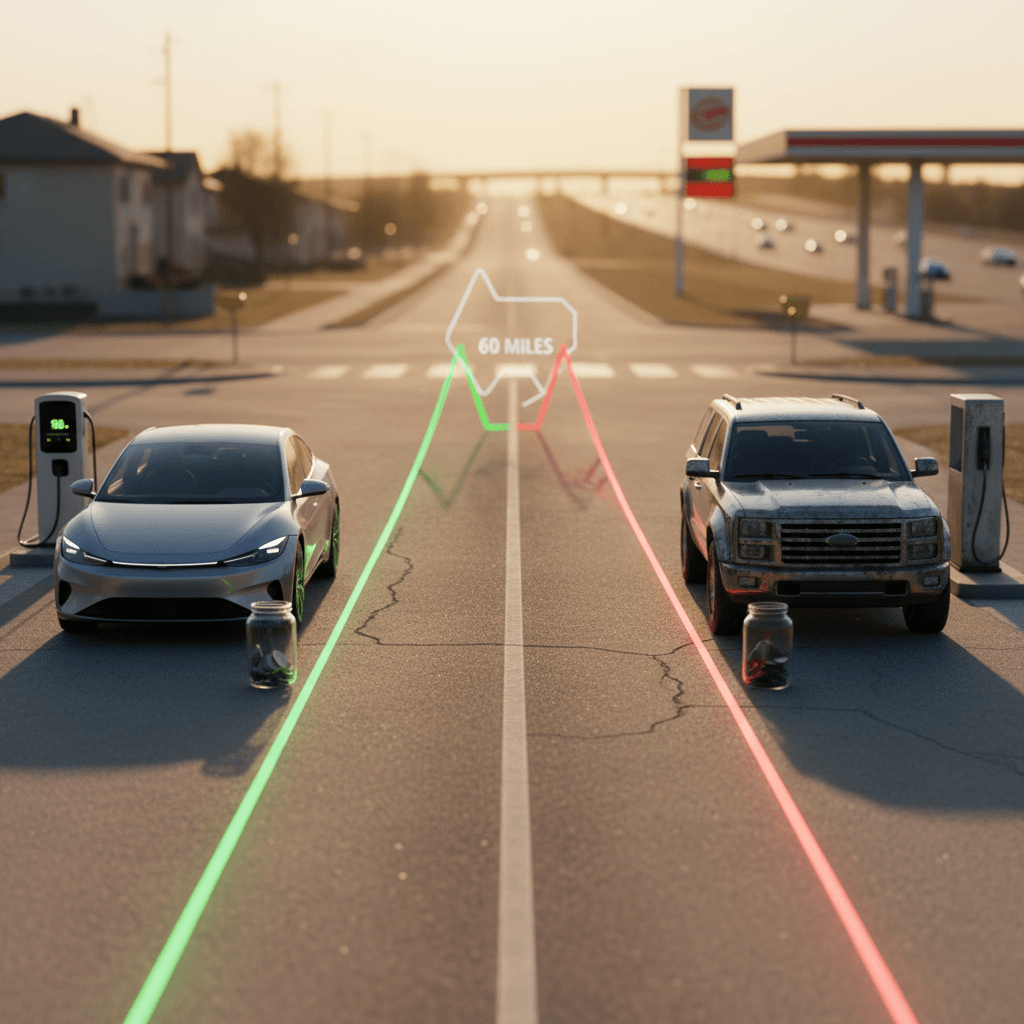
If you drive a lot, the **EV vs gas cost for a 60 mile commute** isn’t an abstract question, it’s your monthly budget. A 60‑mile round trip is 15,000+ miles a year just going to work, which is exactly the kind of use‑case where an electric vehicle’s lower running costs can quietly save you thousands.
Quick answer
How much does a 60‑mile commute cost in an EV vs gas?
Typical daily and annual commute costs (60 miles)
Those ranges are broad on purpose, your exact numbers depend on your **electricity price, gas price, and vehicle efficiency**. Let’s pin those down with clear assumptions and then walk through the math step by step so you can sanity‑check the numbers for your own situation.
Key assumptions for a fair EV vs gas comparison
To compare the **EV vs gas cost for a 60 mile commute** in a way that’s actually useful, we’ll start with realistic U.S. averages for 2026 and then show you how to tweak them.
Baseline assumptions for a 60‑mile commute cost comparison
These are reasonable 2026 U.S. averages. You can plug in your own numbers later using the same formulas.
| Factor | EV baseline | Gas car baseline |
|---|---|---|
| Energy price | $0.15 per kWh (home charging) | $3.75 per gallon of regular |
| Efficiency | 3.5 mi/kWh (typical modern EV) | 30 mpg (typical compact/midsize gas car) |
| Commute distance | 60 miles per workday | 60 miles per workday |
| Work days | 5 days per week | 5 days per week |
| Weeks per year | 50 (allowing for holidays/vacation) | 50 (allowing for holidays/vacation) |
Use this as a starting point, not a fixed rule, local energy prices matter.
Rule of thumb: cost per mile
Step‑by‑step cost breakdown: EV vs gas
1. Electric vehicle: daily energy use and cost
With an efficiency of 3.5 miles per kWh:
- Daily energy needed = 60 miles ÷ 3.5 mi/kWh ≈ 17.1 kWh
- Daily cost = 17.1 kWh × $0.15/kWh ≈ $2.57 per day
On an annual basis (5 days/week, 50 weeks/year ≈ 250 workdays):
- Annual commute energy = 17.1 kWh × 250 ≈ 4,275 kWh per year
- Annual energy cost = 4,275 × $0.15 ≈ $640 per year
2. Gasoline car: daily fuel use and cost
With an efficiency of 30 miles per gallon and gas at $3.75/gal:
- Daily gallons = 60 miles ÷ 30 mpg = 2.0 gallons
- Daily cost = 2.0 × $3.75 = $7.50 per day
On an annual basis (250 workdays):
- Annual commute fuel = 2.0 × 250 = 500 gallons per year
- Annual fuel cost = 500 × $3.75 = $1,875 per year
Energy savings from going electric
Cost per mile: EV vs gas with common scenarios
Use these examples to find the scenario that looks most like your reality.
Efficient EV, average power rates
Assumptions
- 4.0 mi/kWh (very efficient EV)
- $0.15/kWh
Cost per mile
60 ÷ 4.0 = 15 kWh × $0.15 = $2.25/day → 3.8¢/mile.
Typical EV, higher power rates
Assumptions
- 3.2 mi/kWh
- $0.22/kWh (expensive region)
Cost per mile
60 ÷ 3.2 ≈ 18.8 kWh × $0.22 ≈ $4.14/day → about 6.9¢/mile.
Typical gas car, mid‑range fuel price
Assumptions
- 30 mpg
- $3.75/gal
Cost per mile
2 gal/day × $3.75 = $7.50/day → 12.5¢/mile.
What about public fast charging?
Annual and 5‑year savings for a 60‑mile commute
Once you convert the **EV vs gas cost for a 60 mile commute** into yearly numbers, the gap becomes harder to ignore, especially over a typical ownership period of 5–8 years.
Energy cost comparison: 60‑mile commute, 250 workdays/year
Baseline assumptions: EV at 3.5 mi/kWh and $0.15/kWh; gas car at 30 mpg and $3.75/gal.
| Metric | Electric vehicle | Gasoline car |
|---|---|---|
| Daily commute cost | $2.57 | $7.50 |
| Annual commute cost | ≈ $640 | ≈ $1,875 |
| 5‑year commute cost | ≈ $3,200 | ≈ $9,375 |
| 5‑year savings | , | ≈ $6,175 in fuel alone |
Even modest differences in efficiency or price move these numbers, but the EV advantage generally remains large.
Commuting is only part of the story
Beyond fuel: maintenance and running costs
Fuel or electricity is just one part of the **EV vs gas cost for a 60 mile commute**. When you’re piling 15,000+ miles per year onto a car, **maintenance** becomes a major line item.
Typical maintenance differences at 15,000+ miles per year
Exact numbers vary by model, but the pattern is consistent: less complexity usually means lower maintenance.
Gasoline car
- Oil changes 3–4 times per year for a high‑mileage commuter.
- Transmission service over time.
- Exhaust, spark plugs, belts and more over the life of the car.
- Brake jobs more often; less regenerative braking.
At 15,000+ miles/year, it’s common to spend $800–$1,200 per year on maintenance and wear items, not counting unexpected repairs.
Electric vehicle
- No engine oil, spark plugs, or multi‑gear transmission.
- Regenerative braking reduces brake wear.
- Fewer moving parts overall mean fewer routine services.
Many high‑mileage EV owners report annual maintenance closer to $300–$600 per year, mostly tires and inspections.
Combined savings add up fast
What if your electricity or gas prices are different?
Nobody pays exactly the national average. The good news is that you don’t need a fancy calculator to adapt the **EV vs gas cost for a 60 mile commute** to your own situation.
DIY calculation: customize the numbers to your life
1. Find your electricity rate
Look at your power bill for your all‑in rate in $/kWh (not just the energy line item). Use that number instead of $0.15 in the calculations above.
2. Use your car’s real efficiency
For an EV, start with the EPA rating in mi/kWh or kWh/100 miles, then adjust down a bit if you do a lot of highway driving or cold‑weather commuting. For gas, use your actual mpg from the trip computer or fuel‑tracking app.
3. Plug in your commute miles
If your commute isn’t exactly 60 miles, replace 60 in the formulas with your real round‑trip distance. The structure of the math stays the same.
4. Adjust for public charging
If you expect to rely heavily on public Level 3 fast charging, swap your home rate (e.g., $0.15/kWh) for the fast‑charging rate you typically see (often $0.30–$0.50/kWh) and recalc your EV cost per mile.
5. Don’t forget off‑peak programs
Many utilities offer cheaper overnight EV rates. If you can schedule charging at night, you might drop your effective rate to $0.10–$0.12/kWh, improving the EV’s advantage even further.
Time‑of‑use rates can cut both ways
How a used EV can pay for itself on a long commute
So far we’ve focused on running costs, but a 60‑mile commute also amplifies the **total cost of ownership** story. Every dollar you save on energy and maintenance helps offset the purchase price of the vehicle itself, which is exactly where a **well‑chosen used EV** can shine.
Example: comparing total annual costs
Let’s say you’re choosing between:
- A used EV you’re eyeing on Recharged.
- Your existing 30‑mpg gas commuter.
Using our baseline assumptions for a 60‑mile commute:
- Gas car: ≈ $1,875/year in fuel + ~$1,000 in maintenance = ≈ $2,875/year.
- EV: ≈ $640/year in electricity + ~$450 in maintenance = ≈ $1,090/year.
Annual operating savings: roughly $1,800.
What that means over a 5‑year horizon
If you keep the car for 5 years, that $1,800/year is roughly $9,000 in lower operating costs just from your commute.
That kind of savings can:
- Cover a large chunk of the purchase price of a used EV.
- Help you justify upgrading to a newer, safer, better‑equipped car.
- Offset concerns about battery degradation, especially if you buy with verified battery health data.
Every EV listed through Recharged comes with a Recharged Score battery health report, so you’re not guessing about the pack’s condition when you’re about to depend on it for 15,000+ miles per year.

Why battery health matters more for commuters
Checklist: Is an EV a good fit for your 60‑mile commute?
High‑mileage commuter EV readiness checklist
You can charge at home or reliably at work
For a 60‑mile commute, **overnight Level 2 home charging** (or consistent workplace charging) is almost a must‑have. Relying only on public fast charging erodes your cost advantage and adds time to your day.
You’re comfortable with 200+ miles of real‑world range
Even with some winter range loss, a car with an honest 200+ mile highway range gives plenty of buffer for a 60‑mile round trip plus errands, without daily range anxiety.
Your electricity rate isn’t extreme
If you routinely pay over $0.30/kWh for home charging with no off‑peak options, run the numbers carefully. You still may come out ahead, but the margin shrinks compared with average‑rate drivers.
You drive mostly predictable routes
EVs are perfect for repeatable commutes where you know your energy use. If your job involves a lot of unpredictable, very long drives, you’ll want to think harder about fast‑charging coverage.
You’re willing to plan for public charging on edge days
Snowstorms, detours, or last‑minute trips can add miles. Being prepared to use public charging occasionally, apps installed, accounts set up, keeps those days stress‑free.
You value low hassle as much as low cost
Skipping gas stations, oil changes, and frequent brake jobs is a real quality‑of‑life upgrade when you’re already spending a lot of time behind the wheel.
FAQs: EV vs gas cost for a 60‑mile commute
Frequently asked questions
Bottom line: EV vs gas for commuters
For a 60‑mile daily commute, an EV’s strengths line up almost perfectly with your needs. You’re driving enough miles that **every cent of per‑mile savings matters**, but your routes are predictable enough that range and charging are manageable problems rather than deal‑breakers. In most real‑world scenarios, you’ll spend **roughly half, or even a third, as much per mile on energy**, and you’ll visit service bays less often.
The catch is that not every EV is the right EV. Battery health, usable range, and your charging setup at home or work determine whether you unlock the full economic advantage. That’s why, if you’re looking at a used EV specifically to tackle a long commute, it pays to buy where **battery condition, pricing, and support are transparent**. At Recharged, every EV comes with a Recharged Score battery health report and expert guidance, so you can match the right car to your commute, and let your everyday drive quietly pay for your upgrade over time.