If you drive around 20 miles a day, you’re probably wondering whether an electric vehicle actually saves you money over a gas car, or if the hype only applies to long‑distance drivers. Understanding the EV vs gas cost for a 20 mile commute comes down to a handful of simple numbers: your car’s efficiency, your gas price or electricity rate, and how many days a year you commute.
Assumptions in this guide
How much does a 20‑mile commute really cost?
Quick cost picture for a 20‑mile commute
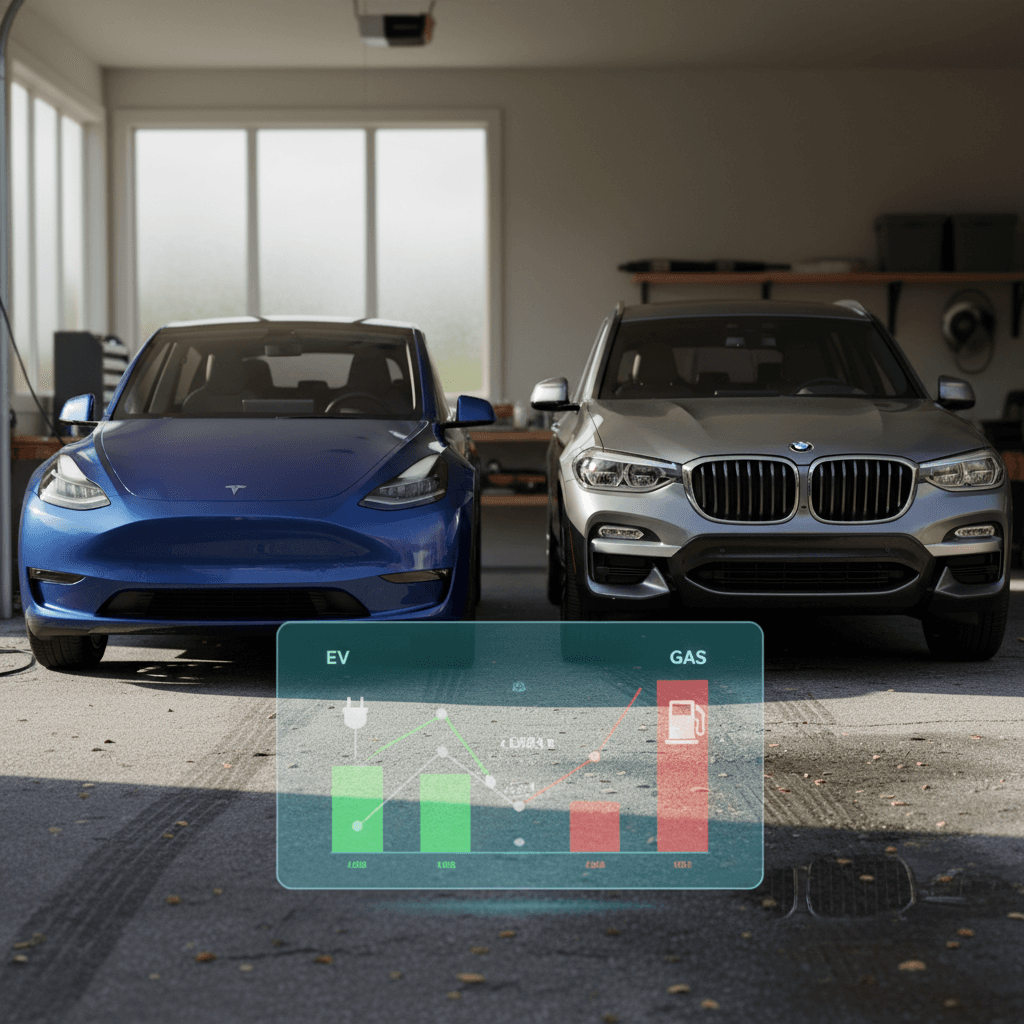
On typical U.S. prices, a 20‑mile round‑trip commute costs roughly $0.90–$1.10 per day in an EV charged at home, versus $2.30–$3.00 per day in a gas car. Over a working year, that’s in the ballpark of $225–$275 in electricity vs. $575–$750 in gasoline, before you even factor in maintenance.
Key takeaways: EV vs gas for short commutes
- For a 20‑mile daily commute, an EV’s fuel (energy) cost is usually 50–70% lower than a similar gas car when you mostly charge at home.
- Maintenance tilts the scales further: EVs typically spend hundreds less per year on routine service over the life of the car.
- If you rely heavily on expensive DC fast charging instead of home charging, your EV fuel cost advantage can shrink, or even disappear.
- Buying a used EV with a healthy battery can deliver new‑car technology and low commuting costs for a much smaller monthly payment.
- For many commuters, the money you save on fuel and maintenance can meaningfully offset (or outweigh) a higher EV purchase price or payment.
Step 1: Estimate your daily and annual commute
Before comparing EV vs gas, lock down the distance you actually drive. A lot of people under‑ or over‑estimate their daily miles, and that skews the math.
Commute basics: get your starting numbers
1. Confirm your one‑way distance
Use a maps app or your car’s trip meter to confirm how many miles you drive one way. In this guide, we’ll assume 10 miles each way, for a 20‑mile round trip.
2. Choose realistic commute days per year
Most full‑time workers commute about 5 days a week and take vacations and holidays. A simple estimate is 5 days × 50 working weeks = 250 commute days per year.
3. Calculate your annual commute miles
Multiply your daily round‑trip distance by your commute days. For a 20‑mile daily commute × 250 days, that’s <strong>5,000 miles per year</strong> just on commuting.
4. Add in other driving (optional)
If most of your driving is commuting, 5,000 miles may be close to your total. If you add weekend trips or longer drives, adjust the total accordingly, but keep the 5,000‑mile commute bucket separate, that’s the part you repeat daily.
Step 2: EV vs gas fuel cost per mile
Now let’s compare the energy cost per mile for an EV and a gas car over that 20‑mile commute. We’ll use realistic average efficiency numbers you can adjust for your situation.
Typical EV commute cost
Modern EVs commonly use around 0.25–0.30 kWh per mile in mixed driving. We’ll use 0.28 kWh/mi as a reasonable commuter average.
- Energy per mile: 0.28 kWh
- Daily miles: 20
- Daily energy: 0.28 × 20 = 5.6 kWh
- Home rate example: $0.16 per kWh
Daily energy cost: 5.6 kWh × $0.16 ≈ $0.90 per day.
Annual energy cost (250 days): about $225 to commute 5,000 miles.
Typical gas commute cost
Many compact and midsize gas cars get about 28–32 mpg in real‑world commuting. We’ll use 30 mpg for easy math.
- Fuel economy: 30 miles per gallon
- Daily miles: 20
- Daily fuel: 20 ÷ 30 ≈ 0.67 gallons
- Gas price example: $3.50 per gallon
Daily fuel cost: 0.67 × $3.50 ≈ $2.35 per day.
Annual fuel cost (250 days): about $590 to commute 5,000 miles.
Result: EV wins on fuel cost
EV vs gas fuel cost for a 20‑mile commute (example)
Illustrative comparison using typical 2026 U.S. gas and electricity prices and average vehicle efficiencies.
| Vehicle type | Efficiency assumption | Energy price | Daily commute cost (20 mi) | Annual commute cost (5,000 mi) |
|---|---|---|---|---|
| Electric vehicle | 0.28 kWh per mile | $0.16 per kWh | ≈$0.90 | ≈$225 |
| Efficient gas car | 35 mpg | $3.50 per gallon | ≈$2.00 | ≈$500 |
| Average gas car | 30 mpg | $3.50 per gallon | ≈$2.35 | ≈$590 |
| Thirsty SUV | 22 mpg | $3.50 per gallon | ≈$3.18 | ≈$795 |
You can plug your own mpg, efficiency, and local prices into this same framework to get personalized numbers.
Quick way to personalize these numbers
Step 3: Maintenance costs on a 20‑mile commute
Fuel is only part of the story. Over time, what you spend on maintenance and repairs can rival or even exceed your fuel bill, especially if you keep cars for a long time. Here, EVs have a built‑in advantage for commuters.
Why EVs tend to cost less to maintain
Fewer moving parts, fewer wear items, and less routine service.
No oil changes
Simpler drivetrains
Less brake wear
Maintenance on a gas commuter
For a mainstream gas sedan or crossover, it’s reasonable to budget roughly $600–$800 per year for routine maintenance and the occasional minor repair once the car is out of warranty. Some years will be cheaper, some more expensive, but over many years that average is realistic.
Maintenance on an EV commuter
For an EV driven 5,000 commute miles per year plus some personal driving, many owners see average routine maintenance costs more in the $300–$500 per year range, mostly tires, cabin filters, brake fluid, and the odd alignment. Again, it varies by model and driving style, but the trend is clear.
Putting fuel and maintenance together
Scenario comparisons: Budget vs average vs premium
Not all commuters and not all cars are the same. Here are three quick scenarios that show how the EV vs gas cost for a 20‑mile commute can change depending on your vehicle and where you charge.
Three real‑world commute cost scenarios (5,000 miles/year)
Illustrative examples only. Your own numbers will depend on your car’s efficiency and local energy prices.
| Scenario | Vehicle & fueling | Energy cost/year | Maintenance trend | Total running cost feel |
|---|---|---|---|---|
| Budget commuter | Used EV, home Level 2 charging at $0.14/kWh | ≈$195 | Lower than average | Very cheap to run day‑to‑day |
| Average driver | 30‑mpg gas compact, $3.50/gal gas | ≈$590 | Typical gas‑car costs | Noticeably higher monthly outlay |
| Premium SUV | 22‑mpg gas SUV, $3.70/gal gas | ≈$840 | Higher tire & brake costs | Most expensive to keep fueled and maintained |
Even with higher electricity rates, many commuters still see meaningful savings with an EV, especially versus larger, lower‑mpg vehicles.
Where EVs shine the brightest
When does an EV not save you money?
EVs aren’t automatically cheaper for everyone. There are a few common situations where the cost advantage narrows, or even disappears.
Common cases where EV savings shrink
1. Expensive public fast charging
If you can’t charge at home and rely heavily on DC fast chargers, you might be paying $0.40–$0.60 per kWh or more. At those rates, your EV’s fuel cost per mile can approach gas‑car territory, especially versus a very efficient hybrid.
2. Extremely cheap gas
If you live in an area with unusually low gas prices and high electricity rates, the fuel savings gap narrows. An efficient hybrid sedan getting 45–50 mpg can be tough to beat on pure energy cost.
3. Very low annual mileage
If you only drive a couple of thousand miles per year total, the dollar savings from fuel may be modest. In that case, it’s even more important to look at the full ownership picture, purchase price, insurance, and resale value, rather than fuel alone.
4. Buying the wrong EV for your needs
If you choose an EV with far more range and performance than you’ll ever use, you may pay more up front than necessary. For a 20‑mile commute, mid‑range used EVs are often the sweet spot for value.
Watch your charging mix
Non‑math benefits of commuting in an EV
Dollar savings matter, but they’re not the only reason many commuters prefer an EV once they’ve lived with one for a while. For a short daily drive, quality of life counts just as much as cents per mile.
Everyday upsides of an EV commute
Perks you notice on Monday morning, not just at tax time.
Quieter, smoother drive
Home fueling convenience
Lower tailpipe emissions
"For most everyday commuters, the biggest surprise isn’t the fuel savings, it’s how quickly they stop thinking about range at all once they get used to plugging in at home."
How a used EV changes the math
So far, we’ve focused on running costs. But total cost of ownership also includes your monthly payment or opportunity cost of tying up cash in a vehicle. This is where a well‑chosen used EV can be especially compelling for a 20‑mile commute.
Lower purchase price, similar savings
Because EV technology has advanced quickly, many 3–6‑year‑old EVs now sell for a fraction of their original sticker price, yet they still offer more than enough range for a 20‑mile commute. That means you can pair lower monthly payments with the same fuel and maintenance savings we’ve already discussed.
Battery health matters
The key variable with a used EV is the condition of its battery pack. For a short commute, you don’t need maximum range, but you do want reliable, predictable performance. Tools like a battery health report or a Recharged Score on a used EV can give you confidence that the pack still has plenty of usable life, and that your low running costs will last.
How Recharged fits in
Checklist: Figure out your own commute costs
You don’t need a spreadsheet to compare EV vs gas cost for a 20‑mile commute. Walk through this short checklist with your own numbers and you’ll have a clear answer.
DIY EV vs gas commute cost calculator
1. Confirm your round‑trip distance
Use your mapping app to confirm your real‑world daily commute mileage. Write down the total round‑trip distance.
2. Note your commute days per year
Multiply your weekly commute days by 50 to approximate your annual commute days. That gives you a simple yearly mileage estimate.
3. Capture your current car’s real mpg
Reset your trip computer for a week and drive normally. Divide miles driven by gallons used to get a realistic commute mpg number.
4. Find your EV efficiency or EPA rating
For an EV, look at the trip computer for average mi/kWh, or start with the EPA rating and adjust if you drive faster or in very cold weather.
5. Plug in local fuel and electricity prices
Check current gas prices at your usual station and your residential electric rate on your utility bill. Use those in the simple cost‑per‑mile formulas from earlier.
6. Compare annual fuel + maintenance
Estimate your annual fuel cost for both vehicles, then add a reasonable maintenance estimate. If you’re comparing a specific EV purchase, look at the monthly payment impact as well.
FAQ: EV vs gas cost for a 20‑mile commute
Frequently asked questions
Bottom line: Is an EV worth it for a 20‑mile commute?
For many Americans with a 20‑mile daily commute, an EV isn’t just an environmental statement, it’s a practical way to cut everyday driving costs while making your commute quieter and more convenient. When you charge mostly at home and choose a model with the right range and a healthy battery, the combination of lower fuel and maintenance costs can save you hundreds of dollars per year compared with a similar gas car.
If you’re considering a used EV specifically for commuting, it’s worth running the numbers on your own situation and then looking for a car with verified battery health and fair pricing. That’s exactly what Recharged was built for: transparent battery diagnostics, expert EV guidance, and a streamlined buying experience that helps you match the right used EV to your real‑world daily drive.