If you’ve tried to check your EV trade in value in New York lately, you’ve probably seen numbers that swing wildly from offer to offer. Between fast-changing used EV prices, New York’s sales tax rules, and new federal incentives, it’s hard to tell what your electric car is really worth, or how to structure a deal so you come out ahead.
Big picture: used EV values in 2025
Why EV trade-in value in New York feels so weird right now
If you live in New York, especially in or around NYC, you’re at the intersection of several forces that make EV trade-in value feel unpredictable:
- Fast technology cycles: Range, charging speed, and software features have improved quickly. A three-year-old EV can feel older than a three-year-old gas car, which pushes trade-in values down for some models.
- Federal and state incentives: New EVs in New York may qualify for up to $7,500 in federal credits plus a state Drive Clean Rebate of up to $2,000 on eligible new models. That effectively lowers new prices and puts pressure on used values.
- Patchy charging infrastructure: In NYC and some dense suburbs, limited parking and home charging access mean buyers focus heavily on range, charging speed, and battery condition, rewarding some models and punishing others.
- Inventory swings: Oversupply of certain off-lease or fleet EVs has pushed auction prices down on specific models, and New York dealers tend to follow those wholesale numbers closely.
- Consumer learning curve: As shoppers get more educated about battery health and incentives, they’re more selective, which can widen the gap between "book" trade-in values and market reality.
EV value trends that matter for New York owners
Don’t panic about headline depreciation stats
How dealers and buyers actually calculate EV trade-in value
Whether you’re trading in at a New York franchise dealer or working with an EV‑focused marketplace, most valuations start from the same foundation, then adjust for EV‑specific factors.
Core ingredients in an EV trade-in valuation
These are the levers you can influence, at least partially
Vehicle & trim details
- Make, model, trim, and options
- Model year and original MSRP
- Drive unit (single vs dual motor)
- Fast‑charging capability and port type
Mileage & usage
- Total odometer miles
- Urban stop‑and‑go vs highway mix
- Service and accident history
- Fleet or rideshare usage
Battery & charging health
- Measured battery capacity vs new
- DC fast‑charging history
- Thermal management design
- Any battery‑related recalls or repairs
Condition & cosmetics
- Interior wear (seats, screens)
- Wheel and tire condition
- Dents, dings, paintwork
- Rust risk in upstate/salt areas
Market & auction data
- Recent wholesale auction prices
- Time‑to‑sell for similar EVs
- Regional demand in NY metro vs upstate
- Incentive changes affecting new prices
Dealer risk & margin
- Reconditioning costs
- Warranty exposure
- Price volatility for that model
- How long they expect it to sit on lot
The key EV‑specific twist is how much weight gets put on verified battery health. For many New York buyers, especially without home charging, usable range is the make‑or‑break factor. A trade‑in with 8–10% degradation and good charging behavior will be worth noticeably more than a similar car that’s been DC‑fast‑charged daily and has lost 20%+ capacity.
Treat battery health like a home inspection
How New York sales tax rules make trade-ins more valuable
New York’s sales tax treatment is one of the most overlooked parts of EV trade in value in New York. In many cases, trading in instead of selling privately can save you hundreds or even thousands of dollars in tax, especially in higher‑tax jurisdictions like NYC.
How New York handles trade-ins for sales tax
These are simplified examples, not tax advice, but they show why your trade-in is worth more than just the check you receive.
| Scenario | Location & Rate (example) | New EV Price | EV Trade-In Value | Taxable Amount | Approx. Sales Tax Due |
|---|---|---|---|---|---|
| No trade-in | NYC (8.875%) | $40,000 | $0 | $40,000 | $3,550 |
| $10k EV trade-in | NYC (8.875%) | $40,000 | $10,000 | $30,000 | $2,662 |
| $15k EV trade-in | Albany (8%) | $40,000 | $15,000 | $25,000 | $2,000 |
| Sell EV private, no trade-in | NYC (8.875%) | $40,000 | $15,000 (separate) | $40,000 | $3,550 |
New York generally lets you subtract the trade-in allowance from the taxable price of your next vehicle, as long as it’s part of the same transaction and the dealer is reselling your trade.
Notice what’s happening: in New York, your trade‑in usually reduces the portion of the new vehicle’s price that sales tax applies to. That means a $10,000 trade‑in in NYC can save you roughly $888 in tax by itself. A private sale might bring in more cash on paper, but once you factor in lost tax savings, the net difference often shrinks, or disappears, especially for EVs with soft resale values.
Important caveats
Extra factors that shape EV trade-in value in New York
Beyond the standard valuation inputs and New York’s tax rules, there are a few EV‑specific wrinkles that affect what you’re offered for a trade in the Empire State.
1. Federal used EV tax credits
As of 2024, qualifying used EVs can be eligible for a federal tax credit of up to $4,000 or 30% of the sale price (whichever is lower), with income and price caps and a requirement to buy from a licensed dealer. In 2024 and 2025, buyers can choose to have that credit applied at the point of sale at participating dealers.
If your EV meets those criteria, a retail buyer in New York may see your car as effectively $4,000 cheaper than the sticker price, so a dealer who can place your trade with an eligible buyer has more room to pay up for it.
2. New York’s Drive Clean Rebate and new EV pricing
New York’s Drive Clean Rebate program offers up to $2,000 off new EVs that meet certain range and MSRP requirements. Combined with federal credits, that makes some new models far cheaper net than you’d guess from the window sticker.
For trade‑in value, that matters because a discounted new EV anchors buyer expectations. A shopper who can walk out the door with a brand‑new, incentivized EV for low‑$30Ks won’t pay mid‑$30Ks for a similar used one, so your trade‑in has to be priced with those incentives in mind.
New York–specific realities that move EV trade-in value
Some are in your control, others just define the playing field
NYC housing & charging
In the five boroughs, limited home charging and garage space make range and DC fast‑charging capability more valuable, and make large, hard‑to‑park EVs tougher to move.
Upstate winters & salt
In Buffalo, Rochester, Syracuse and similar markets, winter performance and underbody corrosion risk matter. EVs with good cold‑weather range and clean underbodies can command stronger offers.
Commute & VMT patterns
Suburban Westchester or Long Island commuters may put more miles on an EV than a downtown Brooklyn owner. Higher mileage compresses values faster but is less scary if paired with healthy battery metrics.
Why the same EV can price differently upstate vs. downstate
Steps to maximize your EV trade-in value in New York
You can’t control macro‑level depreciation, but you have a lot of influence over how your specific EV is valued. Here’s a New York–focused playbook to improve your trade‑in number and your total deal economics.
New York EV trade-in optimization checklist
1. Get a real battery health report
Before you ask for offers, obtain a <strong>verified battery health diagnostic</strong> that quantifies remaining capacity and charging behavior. Some franchised dealers and EV specialists (including Recharged via the Recharged Score) can provide this. A clean report can easily be worth more than the cost of getting it.
2. Gather New York–specific paperwork
Have your title, registration, service records, recall documentation, and any charging equipment receipts ready. New York buyers and dealers care about proof of software updates, recall completion, and ownership history, especially for early‑build EVs.
3. Clean, photograph, and fix the cheap stuff
Detail the interior, address inexpensive cosmetic issues (headlight restoration, basic paint correction, curb rash touch‑ups), and take clear photos in good light. This matters even for trade‑ins because it affects how the buyer imagines marketing your EV to the next owner.
4. Get multiple offers, including from EV specialists
Don’t rely on a single New York franchise dealer quote. Collect at least three data points: a local dealer trade‑in, a cash offer from a large online buyer, and pricing from an EV‑focused marketplace like Recharged. This triangulation often reveals hundreds or thousands of dollars of spread.
5. Model the tax impact of trading in vs. selling private
Run the numbers for your jurisdiction (NYC vs. elsewhere). Compare: (a) trade‑in offer + sales tax savings on the new vehicle, vs. (b) higher private‑sale price but full tax on the new EV. Many New Yorkers discover the “stronger” private‑sale price doesn’t translate into a meaningfully better net outcome.
6. Time your move around incentives and model cycles
If a newer version of your EV is about to launch with much longer range or a new battery chemistry, expect your trade‑in price to soften. Similarly, big incentive changes (federal or New York State) can shift the ground quickly. When possible, trade before major negative changes hit.
Where Recharged fits into this
Ready to find your next EV?
Browse Vehicles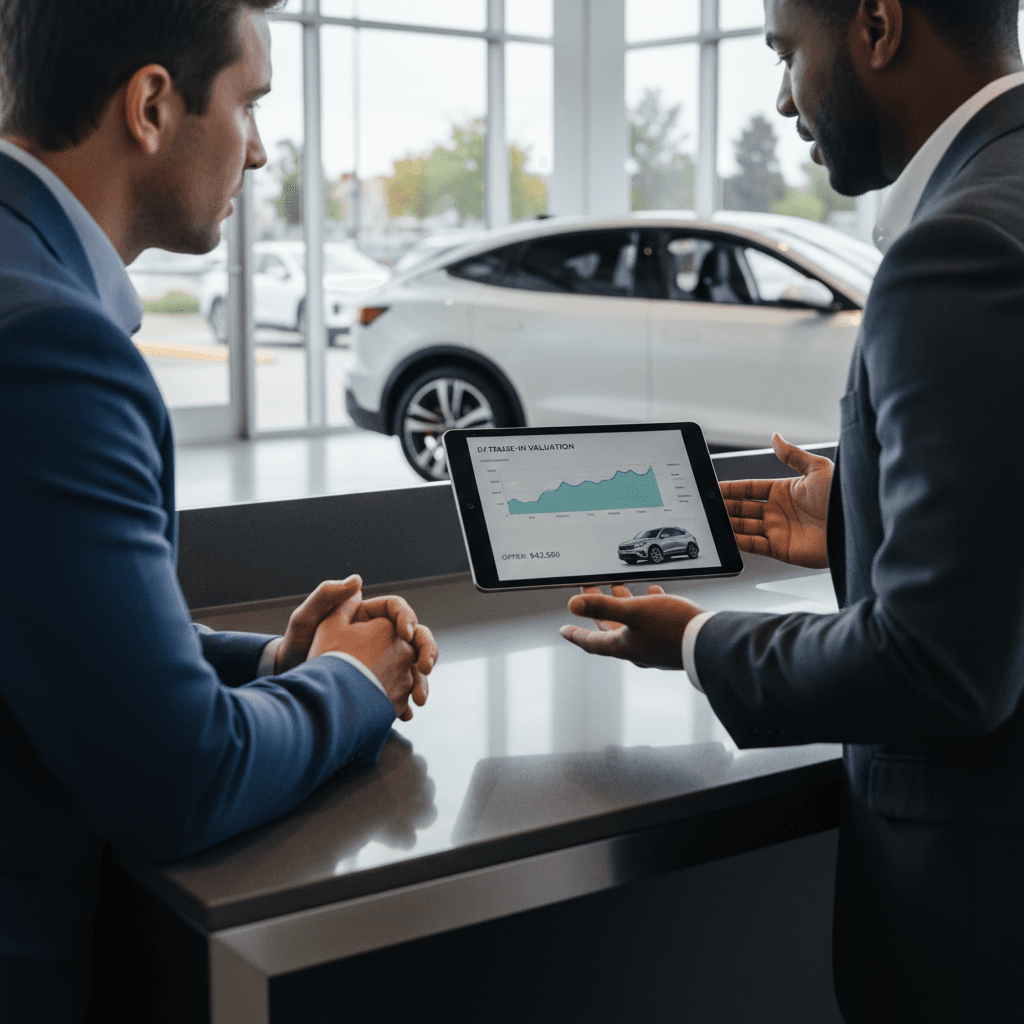
Should you trade in, sell private, or use an EV marketplace?
New York drivers effectively have three main paths for getting out of an EV: a traditional dealer trade-in, a private sale, or working with a digital EV marketplace or consignment partner. Each has different math and friction.
Compare your options for selling an EV in New York
Use this table as a starting point, real numbers will depend on your model, condition, and local demand.
| Option | Typical Gross Price | Sales Tax Benefit on New Car | Time & Effort | Risk / Hassle Level |
|---|---|---|---|---|
| Traditional dealer trade-in | Lower | Yes – trade-in reduces taxable amount | Fast, 1–2 visits | Low; but pricing opaque |
| Private sale (NYC or upstate) | Highest on paper | No – you pay tax on full new price | High; ads, test drives, DMV work | Higher fraud, payment, and time risk |
| EV-focused marketplace / consignment | Often between trade & private | Varies – sometimes combined with purchase | Moderate; more digital, less legwork | Lower; EV specialists screen buyers |
Net outcome isn’t just about the headline offer; it’s about tax, time, and risk.
In New York, look at the whole stack, not just the offer
How Recharged approaches EV trade-in value
Recharged was built specifically around used EVs, including the ones New York shoppers are most interested in. That changes how trade‑in value is calculated and how much transparency you get compared with a typical dealership desk appraisal.
What’s different about an EV-focused valuation
Especially relevant if you’re trading in a used EV in New York
Recharged Score battery health report
Every vehicle that goes through Recharged gets a Recharged Score, which includes a verified battery health assessment and charging behavior profile. When Recharged makes an offer or lists a car, it isn’t guessing about the pack, it’s working off measured data.
Market-based pricing, not just book values
Instead of leaning only on generic book values, Recharged looks at real transaction data for similar EVs, factoring in New York–specific demand. That helps align offers more closely with what informed buyers are actually willing to pay.
Flexible selling paths
Depending on your priorities, Recharged can provide instant offers, trade‑in support when you’re buying another EV, or consignment where we help you capture more upside while handling marketing, buyer screening, and paperwork.
EV‑specialist support
Because Recharged staff work with EVs all day, they understand software updates, charging quirks, and common NY‑specific concerns (like apartment charging). That expertise tends to narrow the spread between what a knowledgeable buyer would pay and your trade‑in offer.
For New York owners in particular, this specialization can mean two concrete benefits: a more realistic number for your trade‑in, and a smoother path to your next EV, whether that’s financed, traded in, or consigned through a fully digital process with optional delivery and an in‑person Experience Center in Richmond, VA for those who want to fly in and drive home.
Common questions about EV trade-in value in New York
Frequently asked questions about EV trade-ins in New York
Key takeaways for New York EV owners
If the last two years have taught us anything, it’s that EV trade in value in New York is shaped by more than a single “book” number. Battery health, incentives, local demand, and New York’s tax rules all interact to determine what your car is really worth and how much it will cost you to move into your next EV.
- Don’t fixate on national depreciation headlines, focus on how your specific model, battery, and condition perform in New York’s market.
- Remember that trade‑ins in New York come with a built‑in sales tax advantage that private sales don’t offer.
- Investing in a verified battery health report and light reconditioning can pay back more than it costs when you go to trade.
- Compare at least three exit paths: dealer trade‑in, private sale, and an EV‑specialist marketplace like Recharged, and evaluate them on total deal economics, not just the sticker numbers.
- Use tools and partners that understand EVs, incentives, and New York’s regulatory environment so you’re not leaving money on the table.
If you’re considering trading in or selling your EV in New York, taking a bit of time to understand these dynamics, and working with a buyer that can provide transparent battery health data and fair‑market pricing, can easily be worth thousands of dollars. That’s exactly the gap Recharged is designed to close.