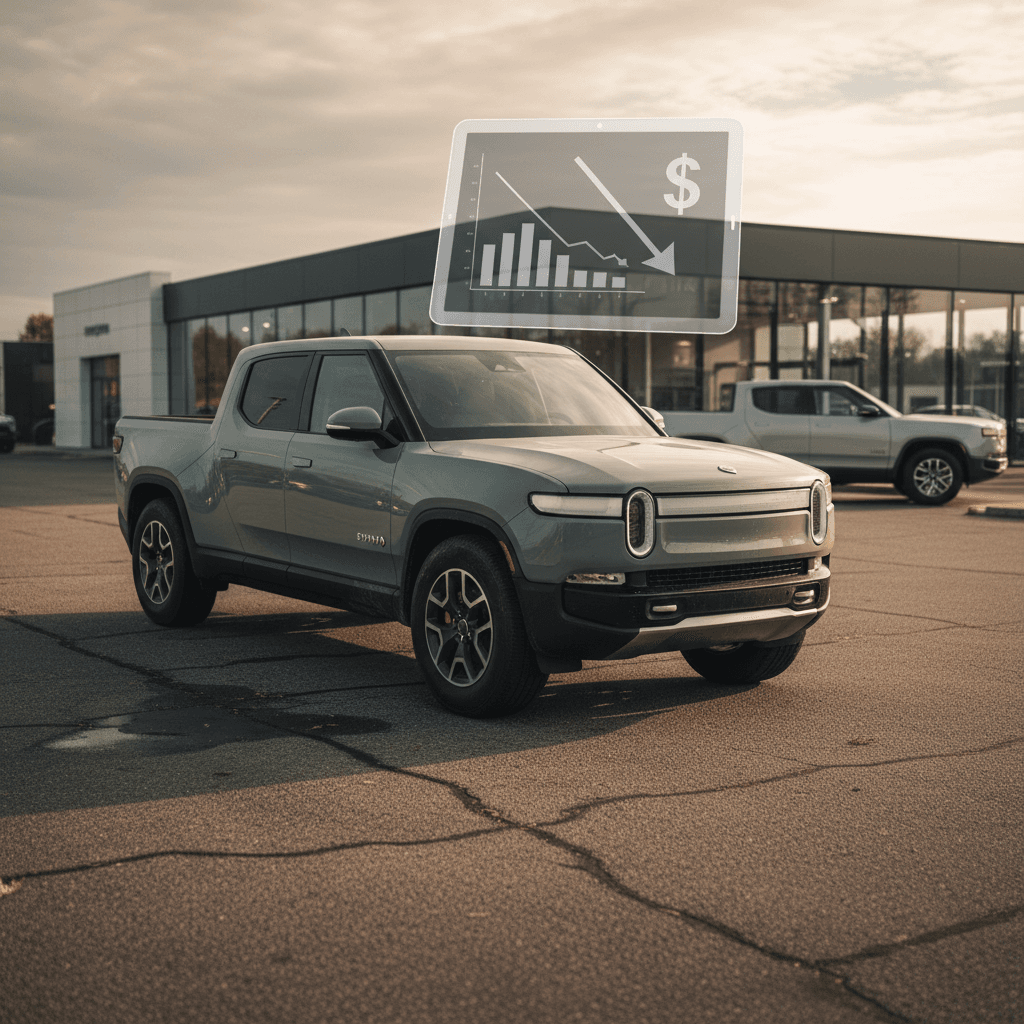
You didn’t buy a 2024 Rivian R1T because you’re a spreadsheet person. You bought it because it makes every Home Depot run feel like a national park commercial. But now it’s 2026, Rivian’s rolled out new trims and incentives, and you’re staring down one blunt question: what’s my 2024 R1T trade‑in value actually worth?
Quick snapshot: 2024 R1T trade‑in in early 2026
Understanding 2024 R1T trade‑in value in 2026
Let’s start with the reality check. Trade‑in value is not the same thing as market value. Market value is roughly what your 2024 R1T would sell for on the open used market. Trade‑in value is the number a dealer is willing to cut you on a check (or roll into your next deal) while they still need room to recondition the truck, ship it, floorplan it, and hopefully make a profit without crying themselves to sleep.
For a 2024 Rivian R1T, those two numbers can easily be $3,000–$7,000 apart. Pricing tools like Kelley Blue Book and Edmunds publish both, but if you look closely, their trade‑in line is consistently under their resale line. As of spring 2026, KBB’s depreciation model for a 2024 R1T shows a current resale value just under $50,000 and a trade‑in value a few thousand lower, after roughly 30% depreciation from new. Edmunds’ appraisal tools tell a similar story for “clean” condition trucks with typical mileage.
2024 Rivian R1T value snapshot (spring 2026)
These are averages, not offers
What pricing guides say your 2024 R1T is worth
To get oriented, it helps to translate the alphabet soup, KBB, Edmunds, J.D. Power, into the plain‑English question you care about: If I roll my 2024 R1T onto a dealer’s lot today, what’s the check?
Guidebook views on 2024 Rivian R1T value (illustrative)
How different pricing sources frame 2024 R1T value for a typical clean, average‑mile truck in early 2026.
| Source / metric | What it represents | Example 2024 R1T number | Typical use |
|---|---|---|---|
| Kelley Blue Book – Resale | Estimated retail sale price if you sold or a dealer retailed it | ≈$49,900 | Benchmark for fair asking price on listings. |
| Kelley Blue Book – Trade‑in | What a dealer might pay you on trade | ≈$46,600 | Starting point for dealer trade negotiations. |
| Edmunds – Trade‑in (clean) | Dealer offer for a clean, average‑mile truck | Mid‑$40,000s to low‑$50,000s | Real‑world anchored value estimate by condition. |
| J.D. Power (formerly NADA) – Average trade‑in | Auction‑ and dealer‑driven pricing data | Similar mid‑$40,000s band | Used heavily by franchise dealers and banks. |
Use these numbers as ballpark ranges, not promises. Real offers will reflect your specific truck and local market.
Notice the pattern: every guide puts trade‑in below resale. They’re all looking at the same market, just through slightly different lenses, auction transactions, retail listings, dealer surveys. Your actual offer will be some blend of these numbers, plus a healthy dose of "How badly does this dealer want an R1T on the lot right now?"
How to sanity‑check any offer
Why your trade‑in offer may not match the “book” value
You whip out your phone, you see KBB says your 2024 R1T is worth $46,600 as a trade‑in, and the local multi‑brand dealer across town comes back at $41,000. You feel insulted. They feel like they’re doing you a favor. Who’s right? They both are, because the guidebook is a national average, and the offer is one dealer’s bet on a very specific truck.
Four reasons your offer can undercut the guide
All of them are fixable or negotiable to some degree.
1. Your local Rivian demand is soft
2. Reconditioning costs are high
3. Carfax history dings your value
4. Miles and options don’t match the template
Don’t anchor on original MSRP
Factors that move your 2024 R1T trade‑in value up or down
If you want to know where you’ll land in that wide mid‑$40k to low‑$50k band, you have to look beyond the paint color. The 2024 R1T lineup is a Russian doll set of powertrains and battery packs, and each one moves the needle.
Key value drivers on a 2024 R1T trade‑in
Powertrain and battery pack
Quad‑motor and Max Pack trucks, especially with Performance upgrades, still pull stronger offers than base Dual‑Motor Standard packs. They appeal to a more performance‑hungry buyer and are rarer in used inventory.
Mileage vs model year
In early 2026, “typical” mileage for a 2024 Rivian R1T is ~15,000–25,000 miles. Under 10,000 is low‑mile cream‑puff territory; over 30,000 starts to drag your trade‑in toward the low end of the range.
Accident and repair history
A clean Carfax with documented service history can be the difference between an “average” and “rough” wholesale grade. Even one moderate accident can cost you several thousand dollars in trade‑in value.
Tires, brakes, and cosmetic condition
Dealers assume they’ll need to make your truck look retail‑ready. Curb‑rashed 21s, windshield chips, bed rash, and a front bumper that kissed a parking post, these all get priced into your offer.
Color and options mix
Earth‑tone paints, popular wheel packages, and adventure‑oriented options usually help. Oddball color combos, deleted driver‑assist features, or niche accessories can narrow your buyer pool and reduce what a dealer’s willing to risk.
Market timing and incentives
If Rivian is running aggressive lease or trade‑in credits on new R1Ts, or if a big wave of off‑lease EV trucks hits the market, wholesale values can wobble in a matter of weeks. Your offer may reflect those headwinds.
2024 R1T trade‑in value vs selling private party
The classic question: trade‑in or sell it yourself? With a truck as niche and high‑ticket as a 2024 R1T, the spread can be meaningful, but so can the hassle.
Trading in your 2024 R1T
- Pros: Fast, simple, good for tax savings in many states (you pay sales tax only on the price difference between new vehicle and trade value).
- Cons: Typically $3,000–$7,000 less than what you could reasonably get in a well‑managed private sale for the same truck and mileage.
- Best for: Time‑starved owners, people rolling equity straight into a new vehicle, and anyone with a payoff that needs to be handled cleanly.
Selling your 2024 R1T yourself
- Pros: You capture more of the truck’s true market value, often close to the guidebook resale number or better if your spec is desirable.
- Cons: Photos, listings, test drives with strangers, paperwork, payoff coordination, possible shipping and inspection headaches.
- Best for: Owners with rare specs (Max Pack, Performance), ultra‑low miles, or clean paid‑off titles who can afford to wait for the right buyer.
Rule of thumb
How Rivian’s trade‑in program works (and its limits)
Rivian, like Tesla, would prefer you never leave the ecosystem. Their trade‑in process is built into the online buying flow: you spec your new R1T or R1S, punch in your existing vehicle details (including non‑Rivian EVs and gas trucks), and Rivian serves up a conditional trade estimate.
- The offer is based on your VIN, declared condition, photos, mileage, and third‑party valuation data.
- The number can be adjusted at inspection if the truck shows up with undeclared damage or mileage far above what you entered.
- Rivian isn’t in the business of retailing every brand they take in on trade. Many non‑Rivian vehicles go straight to wholesale auctions, which caps what they can offer.
- Historically, Rivian has periodically layered in additional credits or incentives (lease cash, loyalty bonuses, etc.) that effectively sweeten the deal for trade‑in customers, even if the raw trade number is similar to local dealers.
Watch for stacked incentives
The punchline: Rivian’s trade‑in program is convenient but rarely the top‑dollar option. It’s worth getting a quote, but you should treat it as one data point alongside local dealer offers, instant‑sale bids, and marketplace valuations.
How to get top dollar for your 2024 R1T in 2026
You can’t control where used‑EV values sit in the macroeconomic blender, but you absolutely can control how your 2024 R1T presents itself to the next owner, or the next appraiser.
Seven steps to squeeze more out of your trade‑in or sale
1. Know your real‑world number
Before talking to anyone, run your truck through at least two online appraisers and look up comparable 2024 R1T listings with your mileage, pack, and options. That gives you a rational band to negotiate within.
2. Fix the cheap stuff first
Wiper blades, cabin air filters, overdue oil‑equivalent services, basic detailing, and small paintless dent repairs are usually worth doing. $300–$600 of cleanup can easily add $1,000+ to your offer on a premium EV truck.
3. Bring records and both keys
Dealers and serious private buyers pay more for a 2024 R1T with documented service, OTA update history noted, and both key fobs. Missing keys or unknown history equals risk, and risk gets priced into your offer.
4. Time your sale around demand
Adventure season, spring through early fall, is when lifestyle trucks like the R1T look best and sell fastest. Dumping a truck right after a wave of aggressive new‑vehicle incentives, by contrast, can kneecap your value.
5. Shop multiple offers in 48 hours
Get quotes from Rivian, a local EV‑friendly dealer, a national used‑car chain, and at least one online marketplace. If you do it quickly, they’re all looking at roughly the same market conditions, and you can play them off each other.
6. Be honest about damage, but don’t undersell
You don’t need to apologize for a professionally repaired bumper or a bedliner that’s actually been used. Frame it properly: clean title, no structural damage, fixed right, priced accordingly.
7. Consider a consignment or managed‑sale option
If you want more than a straight trade‑in but less headache than a pure private sale, look at platforms that will price, market, and sell your Rivian for you while you keep ownership until it’s sold. That’s where Recharged lives.
Where a platform like Recharged fits in
Traditional trade‑ins treat your 2024 Rivian R1T like just another unit of expensive metal that happens to run on electrons. But an R1T is more than a VIN and a Carfax; its value is tightly bound to the one component most dealers barely understand: the battery.
Recharged was built specifically for used EVs. When you sell or consign a truck through Recharged, it gets a Recharged Score Report, a battery‑health and value analysis that goes beyond “looks clean” and “smells okay.” That does two things for a 2024 R1T owner:
How Recharged can help you sell your 2024 R1T
Capture more of the truck’s true value, especially its battery health.
Turn battery health into dollars
Dealer‑ease, private‑party price
Ready to find your next EV?
Browse VehiclesYou can also trade in or get an instant offer on your current EV through Recharged and apply that toward another used EV in the marketplace, with EV‑specialist support and financing baked in. For someone stepping out of a 2024 R1T into something smaller, that simplicity matters.
Not just online – there’s a real place too
2024 Rivian R1T trade‑in FAQ
Frequently asked questions about 2024 R1T trade‑in value
Bottom line: should you trade in your 2024 R1T now?
If you’re expecting your 2024 Rivian R1T trade‑in value to look anything like the day‑one sticker, you’re going to have a bad time. Two years in, most trucks are down roughly a third from MSRP on paper, yet among EVs, the R1T is actually one of the better stories. Limited volume and loyal fans have kept resale reasonably buoyant in a wobbly market.
The real question isn’t, “Did I lose money?” (you did), but, “What am I getting in return for what’s left in this truck?” If a fast, tax‑advantaged trade‑in into your next vehicle solves more problems than the extra $5,000–$7,000 you might chase privately, do the deal and don’t look back. If your R1T is a low‑mile, Max Pack, Instagram‑ready specimen, you probably owe it to yourself to explore marketplace, consignment, or managed‑sale options.
Either way, walk into any negotiation armed with guidebook values, recent comps, and a clear sense of your truck’s condition. And if you want an EV‑specific second opinion, with verified battery health front and center, letting Recharged put a Score Report on your 2024 R1T is one of the more rational decisions you can make in an otherwise emotional process.