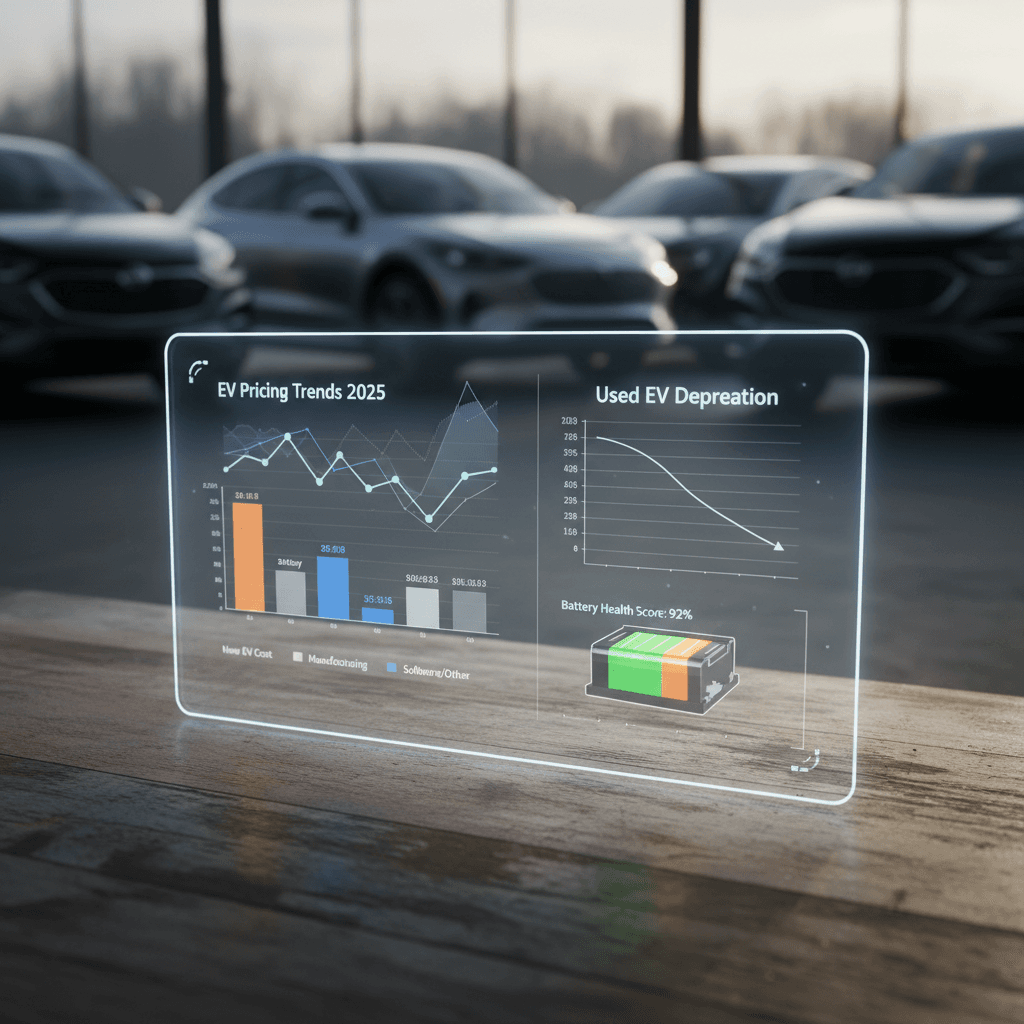
If you follow EV sales headlines, 2025 can look confusing. On one hand, battery-electric vehicles (BEVs) keep setting records. On the other, you’re seeing stories about slowing demand, incentive changes, and automakers “pulling back” on EV plans. If you’re thinking about a used EV, it’s fair to ask: is this the moment to jump in, or to wait?
The short version
EV sales in 2025: the big picture
Key EV sales numbers for 2025
Step back from the noise, and one pattern is clear: EV sales volume is still rising, but the curve is flattening compared with the breakneck growth of 2020–2023. In the U.S., EVs now account for roughly one in ten new vehicles sold. Globally, BEVs are approaching one in six.
At the same time, gasoline vehicles still dominate new sales, and hybrids and plug-in hybrids are soaking up shoppers who aren’t ready to go fully electric. That mix is what you’d expect in the middle phase of a big technology shift: early adopters are already in, and the mainstream needs clearer value, better education, and sharper pricing.
Why EV sales growth is slowing, not stopping
If EVs are the future, why do we keep hearing about softening demand and forecast downgrades? A few overlapping factors are at play:
- Affordability: Even after recent price cuts, many new EVs still transact above the average new-car price, especially once federal tax credits start to phase out or disappear.
- Incentive whiplash: Policy changes, like the end of the federal $7,500 EV tax credit for many buyers in late 2025, pull demand forward and then leave a temporary valley.
- Charging anxiety, not just range anxiety: Surveys show fewer Americans say they’ll pick an EV as their next vehicle than in 2023, and a quarter still worry about public charging availability and reliability.
- Too many headlines, not enough education: Consumers hear about battery replacement costs but rarely see clear, vehicle-specific battery health data when they shop. That uncertainty slows purchases.
Don’t confuse slower growth with shrinking demand
For shoppers, this combination is powerful. Automakers and dealers still need to move EVs, but a more cautious mainstream buyer means more negotiation room on new cars and, crucially, more inventory and softer prices on used EVs as leases and early purchases cycle back into the market.
How EV sales shifts are fueling used EV deals
Every wave of new-vehicle sales eventually becomes used inventory. The first big EV wave hit in the early 2020s, helped by generous incentives and leases. Those vehicles are now returning as trade-ins and lease turn-ins, right as new EV demand gets choppier. That’s a recipe for a buyer’s market on the used side.
Three forces powering today’s used EV market
Why the smartest EV deals in 2025 are often pre-owned, not brand new.
Off-lease inventory surge
Leasing was a popular way to tap into federal credits and lower payments on new EVs. As those leases end, low-mileage EVs are flowing into the used market at scale.
Price vs. value sweet spot
Early depreciation hit many EVs hard, especially luxury models. Today, prices have reset, and used buyers can capture a large share of the original value at a fraction of the original MSRP.
Better battery transparency
Tools like the Recharged Score battery health diagnostics let you see how a specific car’s pack has aged, turning what used to be a guessing game into a data-driven decision.
Where Recharged fits in
Ready to find your next EV?
Browse VehiclesPrice trends: new vs. used EVs
The past two years have pushed EV prices in opposite directions depending on whether you’re looking at new or used. Automakers cut prices on some high-volume EVs to stay competitive, while used EV prices dropped sharply in 2023 and then stabilized or ticked up modestly in 2024–2025 as demand caught up with the bargains.
How EV pricing is shifting
Broad directional trends in U.S. EV pricing based on recent market data. Exact numbers vary by model, trim, and region.
| Segment | Recent Trend | What It Means for You |
|---|---|---|
| New mainstream EVs | MSRPs moderating; incentives heavily tied to changing tax-credit rules | Watch total out-the-door cost, not just MSRP. Incentive rules can change quickly. |
| New luxury EVs | Aggressive discounts and lease deals as competition intensifies | If you’re flexible, you can sometimes buy a used version for the price of a well-optioned gas car. |
| Used 2–4-year-old EVs | Prices reset after early depreciation; many now under $30k | Sweet spot for value, especially if you verify battery health. |
| Older EVs (6+ years) | Prices can be very low but vary widely with battery condition | Only consider with a thorough battery health report and realistic range expectations. |
Used EVs absorbed the early depreciation hit, making 2–4-year-old cars especially compelling in 2025.
Think in cost-per-mile, not just purchase price
What EV sales data means if you own an EV now
If you already own an EV, you’re living inside these sales trends. Maybe you’re wondering if you should keep your car longer, trade it in while demand is still strong, or switch brands altogether. Here’s how the current EV sales environment translates to real-world decisions.
If you’re happy with your EV
Slower new EV growth doesn’t change the daily reality: you’re likely spending less on fuel and maintenance than neighbors driving comparable gas cars. If your vehicle still meets your range and space needs, keeping it longer can be a smart financial move.
Pay special attention to software support and battery health. Regularly monitor range and consider an independent battery health check, like the Recharged Score, before your warranty expires.
If you’re thinking about trading in
A wave of owners are trading out of first EVs, particularly from brands facing more competition. That’s pulling more used EVs into the market and putting downward pressure on prices.
If you plan to move on, trading in before the market gets even more crowded, or before warranties age out, can help you maximize your equity. Recharged can give you an instant offer or consignment option on your current EV and help you step into your next one with confidence.
How to shop smart in today’s used EV market
Used EV shopping in 2025 is very different from hunting for a used gas car. The engine is simpler, but the battery is everything. The good news is that you no longer have to guess. With the right data and a clear process, you can use current EV sales trends to your advantage.
A 7-step checklist for buying a used EV in 2025
1. Start with your real-world range needs
How many miles do you drive on a typical day? How often do you take long trips? If you routinely drive 40–60 miles a day and road trip a few times a year, a used EV rated for 200+ miles when new is usually plenty, especially if you can charge at home or work.
2. Decide on home charging first
Before you shop, confirm where and how you’ll charge. If you have a driveway or garage, a Level 2 charger will transform ownership. If you’re in an apartment, focus on models that fast-charge quickly and map public charging near your routine routes.
3. Make battery health non‑negotiable
On a used EV, <strong>battery health is worth more than low miles</strong>. Look for vehicles with a documented battery health report, not just a guess based on range bars. Every EV sold through Recharged includes a Recharged Score battery diagnostic so you know exactly what you’re getting.
4. Check warranty coverage the right way
Most EVs carry separate battery warranties (often 8 years/100,000+ miles) alongside basic warranties. Verify in-service date, mileage, and whether you’d still be covered if range drops below the manufacturer’s threshold.
5. Compare total cost of ownership, not just price
Factor in energy costs, likely maintenance, and any remaining tax credits or state/local incentives for used EVs. In many areas, a used EV will beat a similarly priced gas car on monthly cost once you include fuel and maintenance.
6. Prioritize models with strong charging support
With networks evolving and connector standards shifting, favor models that have good fast-charging support today and a clear path to future compatibility (for example, NACS adapters included or available).
7. Use specialists, not just generic used-car tools
Because EVs are different, it helps to work with EV specialists. Recharged’s EV-focused team, trade‑in tools, and nationwide delivery are built around the realities of electric ownership, not just rebranded gas-car processes.
Financing and incentives in a post-tax-credit world
For years, federal tax credits warped EV pricing. Buyers chased specific models at specific MSRPs to qualify, and leases became a workaround to capture commercial-vehicle credits. As major portions of those credits expire or phase out after October 2025, the market is adjusting.
That shift doesn’t mean deals are gone, it just means they look different:
- New EVs may lean more on direct discounts, low‑APR financing, or loyalty bonuses instead of back‑end tax credits.
- Used EVs rarely depended on federal credits in the first place, so their relative value can actually improve as new‑car subsidies fade.
- Some state and local programs still offer rebates for used EVs, charging equipment, or utility bill credits, worth checking before you sign.
Use financing as a lever, not an afterthought
Future outlook for EV sales and resale values
Forecasts for EV sales in the late 2020s still point up and to the right, even after recent downgrades. Research firms expect EVs to climb from around 10–11% of U.S. new-vehicle sales today to roughly one‑third by 2030, and more than half by the mid‑2030s, assuming policy support doesn’t vanish entirely.
Near term (2025–2027)
- More EV nameplates arrive, but some low‑volume or unprofitable models are quietly retired.
- Charging networks consolidate and improve reliability; NACS becomes more visible at non‑Tesla stations.
- Used EV prices likely stay attractive as early waves of vehicles keep hitting the market.
Medium term (2028–2032)
- Battery costs continue to fall, improving new EV affordability and narrowing the price gap with gas cars.
- Resale values stabilize as buyers better understand battery longevity and demand broadens beyond early adopters.
- Clean, well‑documented used EVs with strong battery health command a clear premium over sketchy or undocumented examples.
The biggest long-term risk: unknown battery condition
EV sales & used EV market FAQ
Frequently asked questions about EV sales and the used market
Bottom line for used EV buyers in 2025
EV sales in 2025 are sending a mixed message: slower growth, more cautious forecasts, and shifting incentives on one side; record BEV market share and rising global volumes on the other. For everyday drivers, what matters is simpler: there are more used EVs at better prices than ever before, and the tools to evaluate them are finally catching up.
If you approach the market with clear range needs, a plan for charging, and a firm insistence on verified battery health, you can let today’s EV sales turbulence work in your favor. And if you’d rather not decode all of that alone, Recharged is built for this moment, combining Recharged Score battery diagnostics, fair pricing, EV‑savvy financing, and expert support from your first search to nationwide delivery.