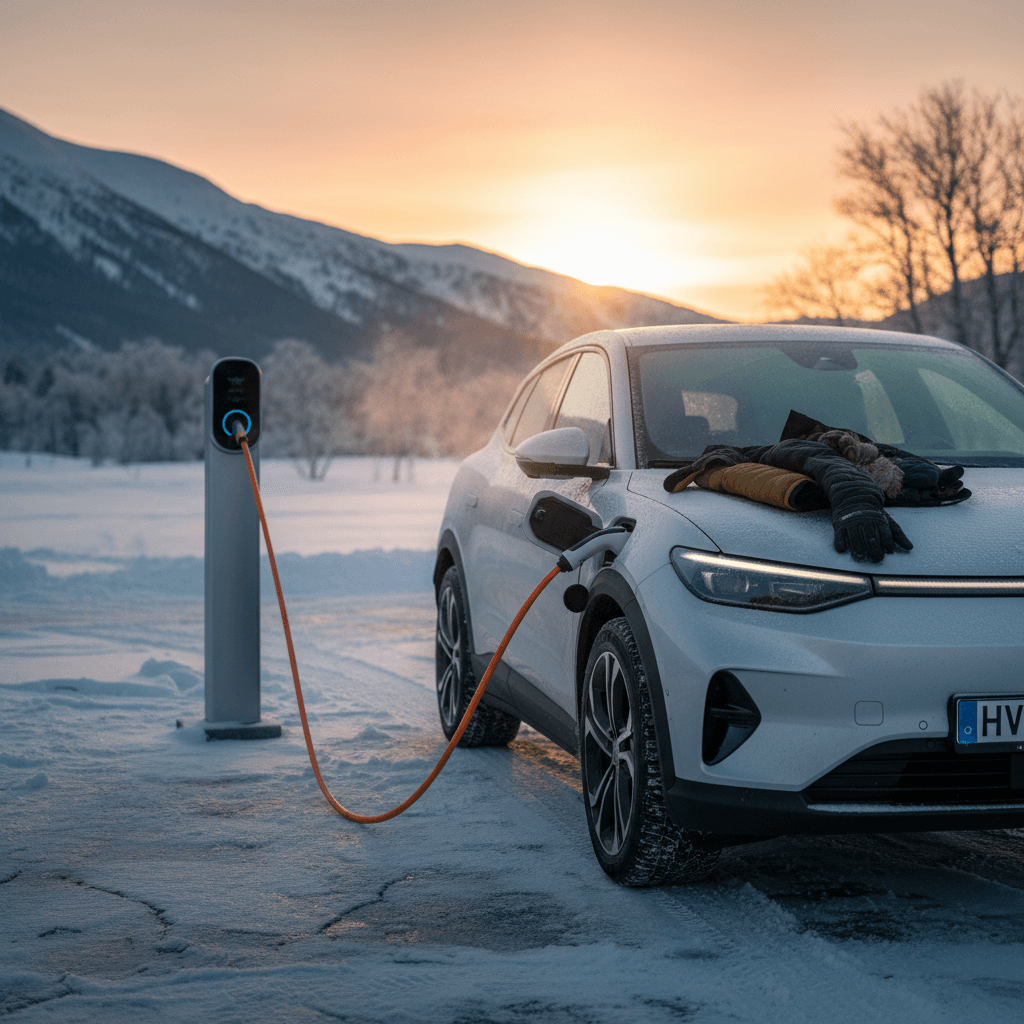
A winter EV road trip can be fantastic, quiet cabin, instant torque on snowy passes, zero tailpipe emissions. But cold weather changes how your battery behaves, how fast you can charge, and how far you can really go between stops. With the right winter-specific tips, you can turn potential stress into a smooth, confident adventure.
Winter in an EV is different, not worse
Why winter EV road trips feel different
Every car loses efficiency in the cold, but EVs make those losses more obvious. Your battery chemistry slows down, the cabin heater is fully electric, and snow or slush adds rolling resistance. Unlike a gas car, you can’t just “splash and dash” in two minutes if you cut it too close to empty, so your **planning and safety margin matter more** in winter.
What changes in your EV
- Less usable range as temperatures drop and heaters run.
- Slower DC fast charging, especially if the battery is cold-soaked.
- More energy for heating the cabin, mirrors, cameras, and battery.
- Traction control working harder in snow and ice, using more power.
What stays the same
- You still need good tires, wipers, and visibility.
- Speed, wind, and hills still affect your range.
- Careful planning still beats winging it, in any car.
- Driver comfort and safety are the real goals, not hitting an EPA range number.
Think in hours, not just miles
How much range you really lose in the cold
You’ll see a range of numbers online, from terrifying to reassuring. The truth sits in the middle, and depends on your car and how you use heat.
Winter range loss: what to expect
Don’t trust summer range in winter
Converting rated range into winter road-trip range
Use this as a starting point, then adjust for your specific EV and conditions.
| EPA rated range | Mild winter (−10%) | Freezing, efficient EV (−20%) | Harsh winter / heavy heat (−35%) |
|---|---|---|---|
| 250 miles | 225 miles | 200 miles | 160 miles |
| 300 miles | 270 miles | 240 miles | 195 miles |
| 350 miles | 315 miles | 280 miles | 230 miles |
| 400 miles | 360 miles | 320 miles | 260 miles |
Always give yourself extra margin if a storm is forecast or you’re unfamiliar with the route.
Plan your route around winter-friendly charging
Winter magnifies whatever’s good or bad about your charging stops. Well‑lit stations next to open restaurants are a gift on a dark, 20°F night. A single lonely charger behind a closed store can feel like the North Pole. Planning the right route is your biggest winter superpower.
Apps and tools to build a winter-safe route
Use at least two planning tools so you’re not surprised on the road.
In‑car route planner
Your EV’s built‑in planner usually understands your battery, consumption, and preconditioning. Use it as your primary guide.
Pros: Deep integration with battery and charger warm‑up. Cons: Some systems are conservative or lack non‑network chargers.
Dedicated EV apps
Apps like A Better Routeplanner, PlugShare, and Chargeway let you preview chargers, reviews, and amenities.
Look for: multiple chargers at a site, 24/7 access, nearby food and restrooms.
Amenity-first planning
When possible, choose chargers near open cafés, hotels, or malls so you can warm up while you charge.
In winter, creature comforts matter as much as kilowatts.
Favor multi-stall sites
Before you leave, map at least one backup charger within 15–30 miles of every planned DC fast stop. Save them in your car’s nav and your phone. If a station is down, you don’t want to be learning new apps in a snowstorm.
Precondition like a pro: battery and cabin
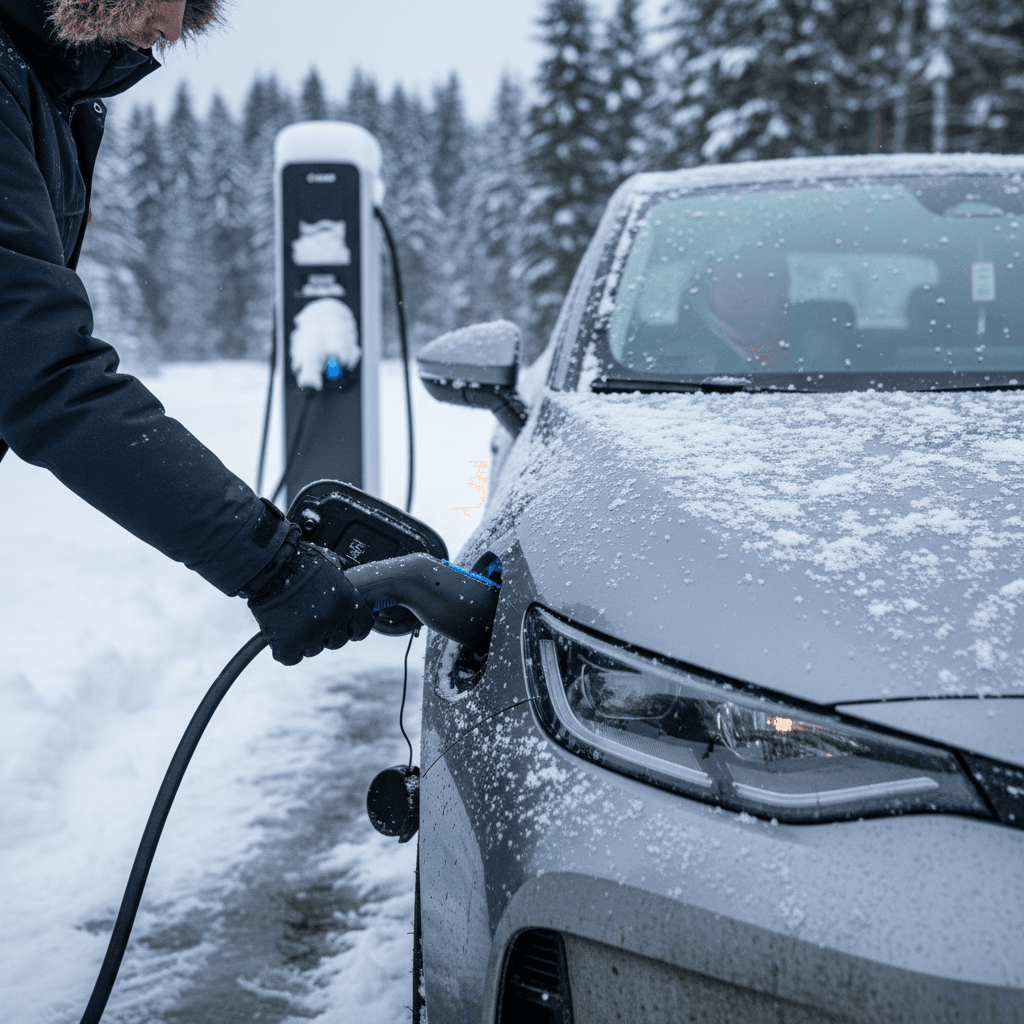
Preconditioning is EV‑speak for warming (or cooling) the battery and cabin before you drive or fast charge. In winter, it’s the difference between a slow, frustrating session and a quick, efficient top‑up.
- Whenever possible, preheat the cabin while plugged in so the energy comes from the grid, not your battery.
- Use your EV’s “preconditioning for fast charging” or “battery warm‑up” feature when navigating to a DC fast charger, this can dramatically improve charging speed.
- If your car doesn’t support automatic battery preconditioning, drive the last 15–30 minutes before a fast charge at highway speeds to warm the pack.
- Start with seat and steering-wheel heaters on high and the main cabin heater a bit lower; they use less energy for the same comfort.
Garage advantage
Drive for winter range, not just speed
On a summer trip, you might drive 5–10 mph over the limit and barely notice it in your range. In winter, that same habit can be the difference between arriving with 20% and creeping in at 3% with your knuckles white on the wheel.
Small habits that add up to big winter range
You don’t have to crawl in the right lane, just be intentional.
Speed & lane choice
- Keep highway speed near the posted limit, not far above.
- Use cruise control gently where roads are clear and dry.
- In strong headwinds, consider tucking behind (not tailgating) larger vehicles for reduced drag.
Smooth, predictable driving
- Accelerate smoothly; EV torque makes it easy to waste energy.
- Look far ahead to reduce unnecessary braking and re‑accelerating.
- Choose eco or snow drive modes where available for gentler responses.
Snow, slush, and headwinds are sneaky
Smart charging strategy in freezing weather
In cold weather, your goal is to keep the battery in its happy zone and minimize time spent at low states of charge. That means more frequent, shallower DC fast-charging stops and smart use of AC charging overnight.
- Aim to arrive at fast chargers with **15–25% state of charge (SoC)**, not 1–5%. This gives you a buffer if a charger is offline or slower than expected.
- In the cold, it’s usually fastest to charge from **about 10–60%**. Above ~60–70%, most EVs slow down sharply, slower still when it’s freezing.
- If your next leg is short, don’t chase 100%. Leave once you have a comfortable buffer (for example, 40% charge for a one‑hour drive).
- Whenever possible, charge overnight on Level 2 at hotels or relatives’ houses so you start the day warm and full.
- If you must rely on Level 1 (120V) at a cabin or friend’s house, plug in as soon as you arrive; every hour helps in the cold.
Book "charging-optional" lodging
Pack a winter EV road-trip kit
If you’re used to road‑tripping a gas car with nothing but a phone charger and a coffee mug, an EV in winter asks a bit more of you. A well‑packed trunk turns minor delays into mild annoyances instead of real emergencies.
Winter EV road-trip essentials
1. Charging adapters & cables
Bring every adapter your EV supports: J1772, NACS/CCS where needed, plus your portable Level 1 or Level 2 cable if you have one. Keep them in a dry, easy‑to‑reach bag.
2. Warmth if you’re stuck
Pack real winter gear: insulated boots, gloves, hats, blankets or sleeping bags, and chemical hand warmers. Assume you might be stationary for an hour or more with reduced cabin heat.
3. Visibility & traction
Snow brush and ice scraper, good wiper fluid rated for low temps, and a small shovel. In snowy regions, consider a compact set of traction boards or tire socks/chains (if allowed by your EV and local laws).
4. Food, water, and power banks
Non‑perishable snacks, water in non‑glass containers, and at least one fully charged power bank for phones. In a worst‑case scenario, connectivity and calories matter more than convenience.
5. Paper backup info
Write down key charger locations, phone numbers for roadside assistance, and hotel info. If your phone dies or loses signal, analog notes are worth their weight in gold.
Never run to 0% for heat
Use tech to your advantage
Your EV and your phone already know more about your winter road trip than you do, if you let them help. Winter is when route planning, live charger status, and battery data really earn their keep.
Tech that makes winter trips easier
Layer data sources so you’re not surprised on the highway.
Live charger status
Most major networks and many vehicle nav systems show which stalls are in use or offline. Refresh the map 10–15 minutes before you arrive.
Realistic arrival estimates
Watch your projected arrival SoC. If it keeps dropping, slow down or add a stop. If it rises, you can skip topping up to 90% at the next charger.
Battery health insight
Cold weather doesn’t make EV road trips impossible; it just forces you to drive the way many long‑haul pros already do, deliberate, observant, and always with a backup plan.
Extra considerations for used EVs
If your winter road trip car is a used EV, you’re adding one more variable: battery age. A healthy 240‑mile EV behaves very differently from the same model that’s down to 190 miles of real‑world capacity. You want to know which one you’re driving **before** you point it at a snowy interstate.
Know your real range
- Don’t assume the original window‑sticker range. Look at recent long drives or energy‑use logs if you have them.
- A Recharged Score battery health report gives you verified capacity data, so your winter route is based on facts, not guesses.
- If your usable range is modest, simply plan more frequent, shorter legs and favor routes with denser charging.
Mind older thermal systems
- Some older EVs lack heat pumps or have less sophisticated battery warming. Expect larger winter range loss and slower fast charging.
- Build in extra time for charging stops, especially on the first cold day of the trip.
- Consider starting your first leg shorter so you can confirm real consumption before committing to longer stretches.
How Recharged helps
Ready to find your next EV?
Browse VehiclesWinter EV road trip checklist
Bring this all together, and a winter EV trip becomes a series of simple, repeatable steps. Use this checklist the week before you leave and again the night before departure.
Step-by-step winter EV trip prep
1. Reality‑check your range
Look at your typical highway consumption in cold weather and conservatively adjust your expected range. If this is your first winter, assume a 25–35% hit until you see real numbers.
2. Map chargers and backups
Plan each leg so you arrive with ~20% SoC, and save at least one backup DC fast charger within 15–30 miles of every stop.
3. Confirm lodging and charging
Call hotels or rentals that list EV charging to confirm plugs are working and not blocked. Have a plan B nearby if a charger is out of order.
4. Pre-pack your winter kit
Load blankets, warm clothing, scraper, shovel, adapters, snacks, water, and power banks. Keep critical items inside the cabin, not buried under luggage.
5. Update apps and accounts
Install and sign into major charging apps along your route, add payment methods, and download offline maps in case of spotty coverage.
6. Day-of departure routine
While plugged in, preheat the cabin and windows; set your first destination in the nav so the car can precondition the battery; double‑check road and weather reports before pulling out.
EV winter road trip FAQ
Common questions about winter EV road trips
Bringing it all together
A winter EV road trip isn’t a dare; it’s a logistics puzzle. Once you understand how cold affects your range and charging, and you build in a little extra margin, the anxiety fades and the fun takes over. You start noticing how quiet the car is on fresh snow, how easy it is to leave a lodge with a prewarmed cabin, and how much you prefer a 25‑minute coffee‑and‑charging break to shivering at a gas pump.
If you’re heading into your first cold‑weather adventure, start with shorter legs, generous buffers, and well‑reviewed charging stops. If you’re shopping for an EV to make those trips in, consider working with Recharged so you know exactly how healthy the battery is before winter hits. Either way, with these winter‑specific EV road trip tips, you’ll be ready to trade range anxiety for the simple, satisfying rhythm of drive, warm up, charge, repeat.