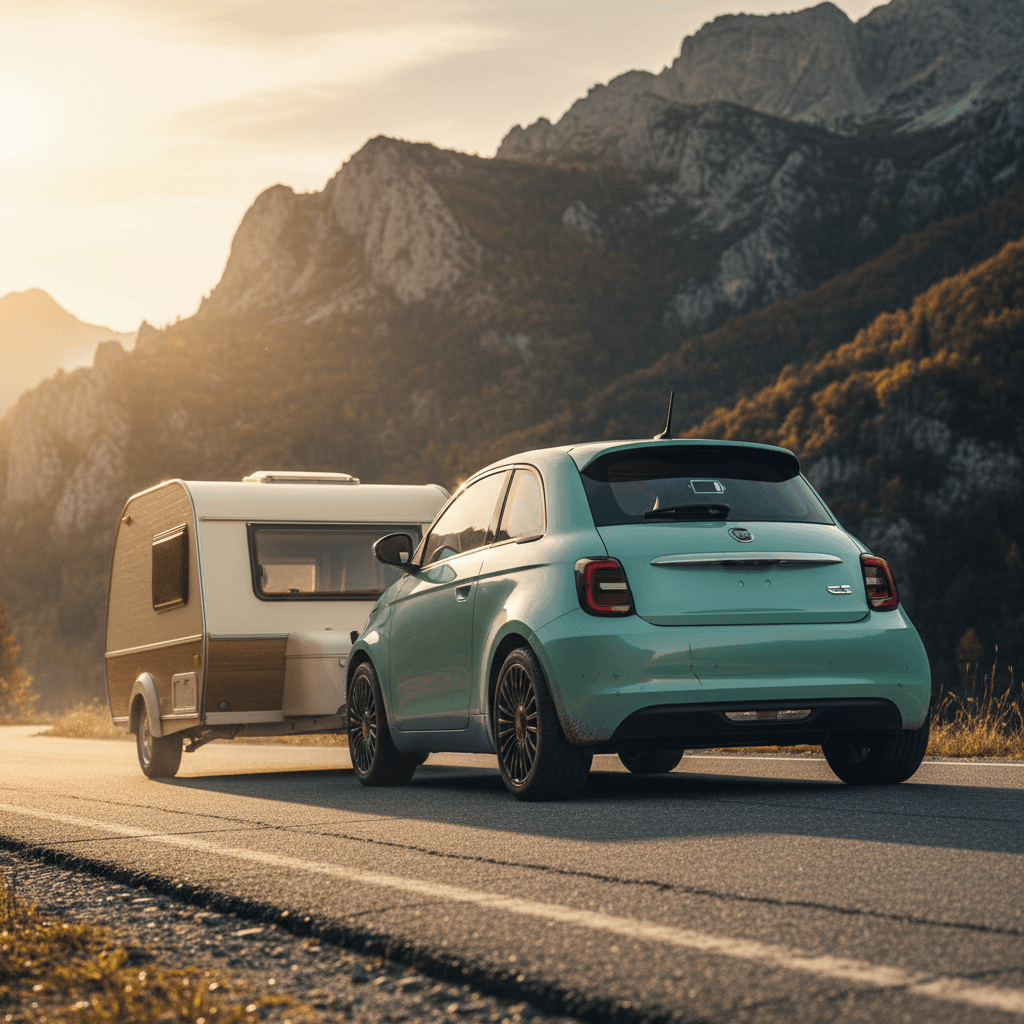
You are not the first person to look at a tiny, plucky Fiat 500e and think, “How bad could a little trailer be?” Whether it’s a utility trailer, a teardrop camper, or just a hitch‑mount cargo box, the question *can a Fiat 500e tow a trailer* comes up a lot, and the real answer is less about raw power than about what the car is actually engineered and approved to do.
Key takeaway
Short answer: can a Fiat 500e tow a trailer?
In practical, legal, and warranty terms, **no**, you should treat the Fiat 500e as a **non‑towing vehicle**. The U.S. owner’s manuals for the latest 500e explicitly state that **trailer towing is not recommended**, and several official spec sheets list maximum towing capacity as **“Not suitable” or “0 kg.”** That applies to the modern 42 kWh 500e sold in Europe and other markets as well as to the earlier U.S.‑market 500e city car.
- Official towing capacity: **0 lb / 0 kg**
- No factory tow package or approved towbar in the U.S.
- Aftermarket hitches, where available, are **not** endorsed by Fiat
- Using the car to tow can create safety, liability, and warranty issues
Important distinction
Why most Fiat 500e models are not rated to tow
Electrically, the 500e has plenty of torque. The reason it’s not rated to tow is everything **around** the motor: structure, cooling, chassis hardware, and how the car is certified.
Four big reasons the 500e isn’t a tow vehicle
It’s a city car first, cargo mule never.
1. Battery + structure packaging
2. Thermal load and range
3. Brakes and stability
4. Homologation and liability
Torque isn’t the problem
U.S. vs. Europe: how ratings and hitches differ
If you go down an internet rabbit hole, you’ll eventually find European discussions of “Fiat 500 towing 400–800 kg” and eBay listings for towbars. That’s mostly about **petrol Fiat 500s**, not the electric 500e. Even in Europe, the current 500e is typically shown with **0 kg braked and unbraked trailer weight** and marked “not suitable” for towing in official brochures.
U.S.-market Fiat 500e
- No factory tow rating; manuals say trailer towing is not recommended.
- No OEM towbar option, no rated tongue weight.
- Aftermarket hitches (if you find them) are sold primarily for light accessories like bike racks, not for towing.
European-market 500 & 500e
- Some ICE Fiat 500 models have modest tow ratings (e.g., 400–800 kg) and approved towbars.
- The electric 500e, even in Europe, is generally listed with 0 kg trailer capacity.
- Towbars offered for the 500e are usually intended for bicycle racks, not trailers.
Don’t assume a towbar equals a tow rating
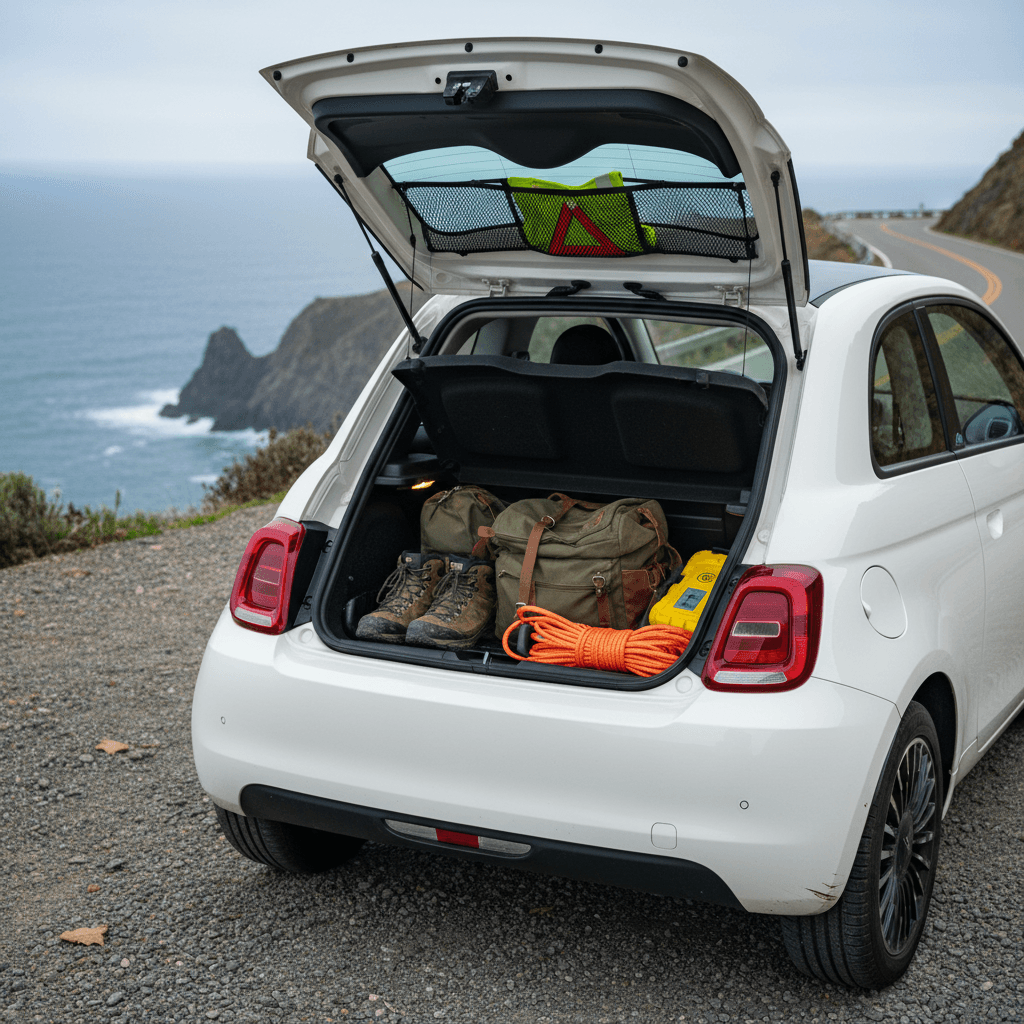
What happens if you add an aftermarket hitch anyway?
Some owners go rogue, bolt on an aftermarket receiver, and tug a tiny trailer around town. The car doesn’t explode; the cops don’t fall from the sky. But you are very much **on your own** if anything goes wrong.
Risks of towing a trailer with a 500e
Beyond “might feel sketchy,” there are concrete downsides.
Warranty and liability
Crash performance
Handling surprises
Mounting point fatigue
Recharged’s stance
Safe weights, tongue loads, and why “zero” means zero
In towing discussions you’ll hear rules of thumb like “10% tongue weight” and see compact cars in Europe rated to tow 1,500–2,000 lb. It’s tempting to back‑calculate a hypothetical number for the 500e. Don’t. When the official rating is **0 lb**, there is no safe margin to nibble at.
Towing terms in the context of a Fiat 500e
How common towing concepts would apply, if the car were rated at all.
| Term | Normal definition | Why it doesn’t apply to 500e |
|---|---|---|
| Tow rating | Maximum trailer weight the vehicle is certified to pull. | For the 500e the certified tow rating is 0, so there is no legal or engineered allowance. |
| Tongue weight | Downward force of the trailer on the hitch, often ~10% of trailer weight. | No tongue weight rating is published for the 500e; the structure was not validated for this load. |
| Braked vs. unbraked | Braked trailers have their own brakes; unbraked rely solely on the tow vehicle. | The 500e’s manuals don’t distinguish; they simply say towing is not recommended. |
| Payload | Weight you can carry in the car itself (passengers + cargo). | This *does* apply: you can load the cabin and hatch up to the rated payload, even though you can’t tow. |
These numbers are examples of general towing rules, not recommendations for the Fiat 500e, which remains a zero‑towing‑capacity vehicle.
Use payload, not a trailer
Smarter alternatives to towing with a Fiat 500e
The good news is that most people who ask about towing with a 500e don’t actually need to haul an Airstream. They need to move bikes, a mattress, or a stack of boxes on moving day. For that sort of work, there are better answers than defying the owner’s manual.
Practical ways to haul more without a trailer
1. Get serious about interior cargo space
Drop the rear seats, take the parcel shelf out, and suddenly the 500e swallows more than you’d think. Pack heavier items low and forward, and use soft bags instead of hard bins to maximize space.
2. Consider a hatch‑mounted bike rack
If you only need to carry a couple of bikes, look at strap‑on hatch racks designed for small hatchbacks. Weight limits still matter, but they’re usually well within what the rear sheet metal can handle.
3. Use a roof system with care
If the specific 500e variant you’re looking at has approved roof‑rack mounting points, a quality cross‑bar system plus a cargo box can replace the job of a tiny trailer. Mind the roof load limit and the extra drag on range.
4. Let the trailer be someone else’s problem
Need to move furniture or building supplies once or twice a year? Rent a small pickup or cargo van from a home‑improvement store. That’s cheaper and safer than trying to turn your 500e into something it isn’t.
5. For regular towing, choose a different EV
If towing a small camper, boat, or cargo trailer is part of your lifestyle, start your search with EVs that have published tow ratings and available factory hitches. A 500e is the wrong starting point for that mission.
Where Recharged fits in
Ready to find your next EV?
Browse VehiclesTips for hauling more with a small EV
Even if you never tow, small EVs like the 500e ask you to think more deliberately about space and weight. That’s not a bug; it’s part of the charm, like living in a smartly organized studio apartment instead of a McMansion.
Make your 500e (or any tiny EV) more useful
Thoughtful packing beats brute force.
Pack heavy, pack low
Balance passengers and cargo
Measure before you move
Watch your range
Buying a used Fiat 500e: checklist for hitches and towing
Used 500e shoppers sometimes stumble across cars with aftermarket receivers, or with a seller casually mentioning that they “pulled a little trailer now and then.” That’s your cue to slow down and ask better questions.
What to look for if a used 500e has (or had) a hitch
1. Ask exactly how it was used
Was the receiver only used for a lightweight bike rack, or did the owner tow a utility trailer, jet‑ski, or camper? How often? City speeds or highway road trips?
2. Inspect the mounting area
Look under the rear bumper for signs of drilling, non‑factory hardware, or bent metal. Fresh undercoating or paint can sometimes hide repairs.
3. Listen and feel on the test drive
Over bumps, listen for clunks or creaks from the rear. A car that’s done a lot of unauthorized towing may feel looser, with worn bushings or a fatigued structure.
4. Get a professional opinion
If you’re serious about the car, have a mechanic or EV specialist put it on a lift and inspect the rear subframe and suspension. At Recharged, that sort of scrutiny is baked into how vehicles are evaluated before they’re listed.
5. Decide if you’re comfortable with the risk
A 500e that only carried a 2‑bike rack may be acceptable. One that regularly dragged a loaded cargo trailer across state lines is a different story, walk away unless the price and condition justify the gamble.
FAQ: Fiat 500e and trailer towing
Common questions about the Fiat 500e and towing
Bottom line: should you tow a trailer with a Fiat 500e?
If your question is **“can a Fiat 500e tow a trailer?”**, the honest, boring, safety‑forward answer is **no, treat it as a zero‑towing‑capacity car**. The 500e is a brilliant little urban runabout, a battery‑powered scooter in car form, and it’s happiest carrying people and a weekend’s worth of cargo, not a trailer tongue weight.
If your life involves bikes, kayaks, furniture runs, or a lightweight camper, you’re much better served either configuring the 500e with racks and smart packing **within its design limits**, or choosing an EV that left the factory with a real tow rating and an engineered hitch. That’s where a curated used‑EV marketplace like Recharged can help you sort out which models will do the chores you actually need done, without asking a tiny city car to be something it was never built to be.