You’ve heard the line: “EVs are nearly maintenance‑free.” It’s catchy, but incomplete. EV regular maintenance is absolutely a thing, just a very different thing from the oil-change treadmill you know from gas cars. If you understand those differences, you’ll save real money and avoid the kinds of expensive surprises that have spooked some early EV owners.
Big picture
Why EV regular maintenance still matters
Because EVs skip oil changes, transmission services, and exhaust-system drama, it’s tempting to ignore the service reminders altogether. Bad idea. Regular maintenance still matters for three reasons: safety (brakes, tires, suspension), longevity (battery cooling, seals, bushings), and resale value. A clean service history and documented battery health can easily swing a used EV’s value by thousands of dollars.
- EVs are heavier and quicker than equivalent gas cars, which can stress tires and suspension if neglected.
- High‑voltage batteries rely on coolant and thermal management; if that’s ignored, repair bills can get astronomical.
- Buyers and lenders are getting picky about service records on used EVs. A car that’s been maintained on schedule is easier to sell or trade in.
Don’t skip inspections
How EV regular maintenance differs from gas cars
EVs: fewer moving parts
- No engine oil, spark plugs, timing belts, or exhaust system.
- No multi‑gear automatic transmission in most models.
- Regenerative braking captures energy instead of wearing brake pads.
- Most service visits are simple inspections, tire work, and software checks.
Gas cars: consumables everywhere
- Regular oil changes every 5,000–10,000 miles.
- Transmission service, belts, plugs, filters, emissions systems.
- More heat, vibration, and mechanical complexity = more wear items.
- Frequent small services add up to thousands of dollars over time.
EV vs. gas regular maintenance at a glance
Core EV regular maintenance checklist
Every EV brand has its own service booklet, but when you boil them down, EV regular maintenance tends to revolve around the same core items. Think of this as your baseline checklist for the first 100,000 miles.
Essential EV maintenance items and intervals (typical)
1. Tire rotation and inspection (every 6–10k miles)
EVs are heavy and have instant torque, so they can chew through tires if you don’t rotate them. Plan on rotating every 6,000–10,000 miles and checking for uneven wear, sidewall damage, and proper load‑rated tires.
2. Brake inspection (annually or 15–20k miles)
Regenerative braking means pads can last 70,000+ miles, but calipers and rotors still need attention. Ask the shop to check pad thickness, rotor condition, and for corrosion from infrequent use.
3. Cabin air filter (every 2 years)
The filter that cleans the air you breathe and protects HVAC components. Most manufacturers recommend replacing every 2 years, sooner if you drive in dusty or polluted environments.
4. Brake fluid change (every 3–5 years)
Even in EVs, brake fluid absorbs moisture over time, which can corrode components and reduce braking performance. Many brands specify a fluid flush around the 3‑ or 4‑year mark.
5. Coolant for battery/drive unit (per manual)
Liquid‑cooled batteries and inverters use specialized coolant. Intervals vary, from “inspect only” to about every 100,000 miles, so this is where reading the owner’s manual actually matters.
6. Suspension and steering inspection (annually)
The extra weight of an EV can accelerate bushing and joint wear. An annual check keeps you ahead of clunks, wandering steering, or inner‑edge tire wear that hints at alignment issues.
Build a simple EV service rhythm
Battery health: the new “oil change”
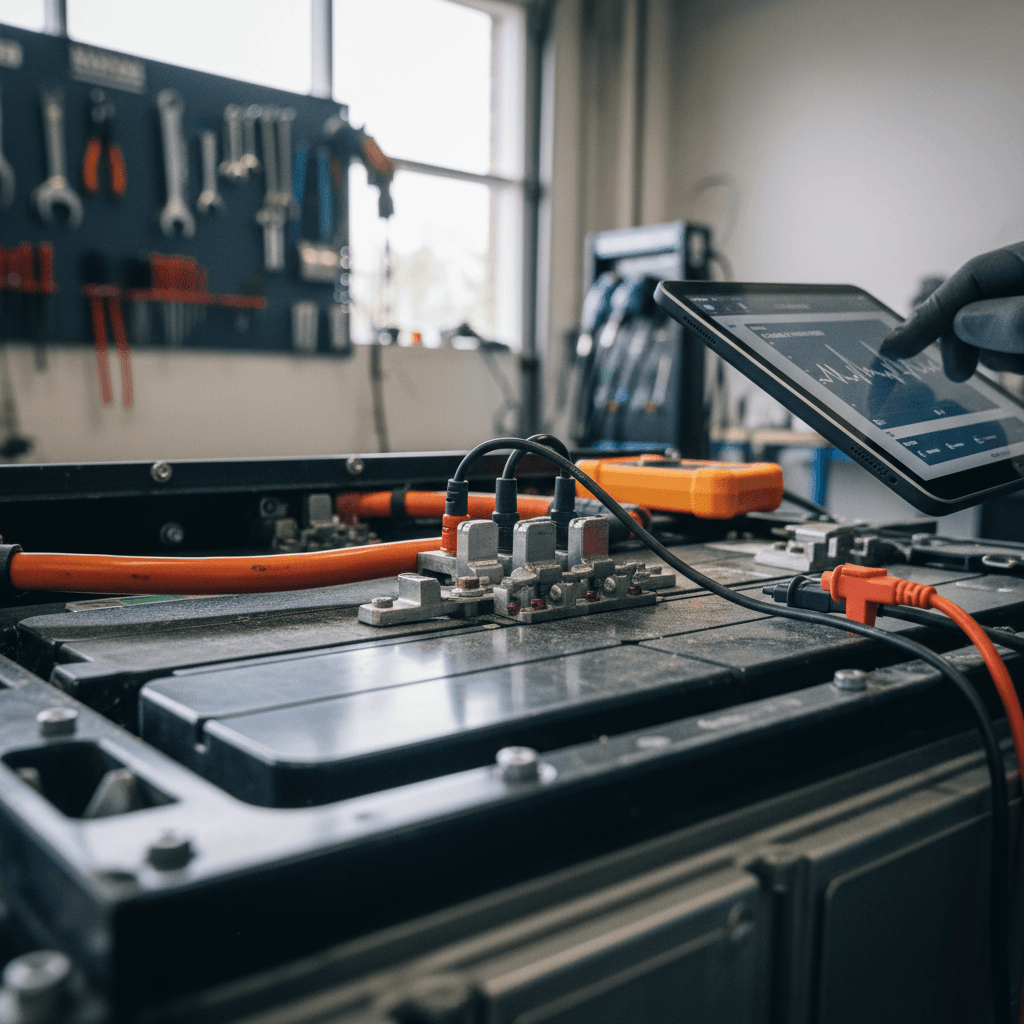
Modern EV batteries age slowly, on average, many packs lose only a couple of percent of capacity per year, but they’re still the most expensive component in the car. Regular maintenance here isn’t about swapping parts; it’s about daily habits and periodic health checks.
Everyday habits that count as EV maintenance
Small choices that protect range and resale value
Avoid chronic 100% charging
Frequently charging to 100% and letting the car sit full is like living on triple‑espressos, possible, but not ideal. Daily, aim for 70–90% unless you need full range for a trip.
Don’t live at 0% or 10%
Running an EV down to “turtle mode” all the time stresses the bottom of the pack. Treat 10% as your unofficial reserve for daily driving whenever you can.
Manage heat and cold
Extreme temperatures accelerate battery wear. Use pre‑conditioning while plugged in, and don’t fast‑charge repeatedly when the pack is already hot from a long drive.
How Recharged helps on used EVs
Ready to find your next EV?
Browse VehiclesBrakes, tires, and suspension on an EV
Here’s where EVs quietly diverge from the “maintenance‑free” myth. Electric cars are heavy hitters, literally. The battery pack adds hundreds of pounds, and the instant torque invites enthusiastic launches. That weight and power flows straight to the tires, suspension, and mechanical brakes.
- Tires: Expect tread life closer to the lower end of the range on performance EVs, sometimes 20,000–30,000 miles for soft, sticky rubber. Touring‑oriented EVs on efficient tires can still see 40,000+ miles if rotated religiously.
- Brakes: Pads often last much longer than in gas cars thanks to regen, but calipers can seize or corrode if they’re never exercised. Ask your shop to clean and lubricate slide pins during inspections, especially where roads are salted.
- Suspension: Control arm bushings, sway‑bar links, and ball joints carry more weight than in a similar gas car. Listen for clunks and squeaks, and don’t ignore uneven tire wear or a car that drifts in its lane, those are your early warning lights.
The pothole problem
Fluids and filters: what still needs changing
“No fluids” is another half‑truth. EVs absolutely use fluids, just not engine oil. What changes is the type of fluid and how often it genuinely needs attention.
Typical EV fluids and filters
Always check your model’s maintenance guide, but this table captures what most EV owners can expect.
| Component | Needs regular replacement? | Typical interval | Notes |
|---|---|---|---|
| Engine oil | No | Never | Electric motors are lubricated for life; no oil changes. |
| Brake fluid | Yes | 3–5 years | Moisture absorption can corrode components if ignored. |
| Coolant (battery/drive unit) | Sometimes | ~100,000 miles or inspect only | Some brands specify replacement; others only inspection. |
| Cabin air filter | Yes | 2 years | More often in dusty or polluted areas. |
| Desiccant for A/C/battery | Sometimes | As specified | Some EVs have serviceable desiccant packs for moisture control. |
| Gearbox fluid (single‑speed reduction gear) | Rarely | Inspect only or long interval | Most EVs have sealed units, but some manufacturers specify checks. |
Intervals are approximate; your manual is the final word.
Read the EV section of the manual (really)
Software updates and diagnostics
Software is now a maintenance item, whether automakers admit it or not. Many EVs receive over‑the‑air updates that tweak efficiency, charging behavior, even suspension tuning. In between those updates, your car is quietly running diagnostics on high‑voltage components, sensors, and safety systems.
Digital maintenance: what to watch
Your EV’s computer is doing half the service work already
Over‑the‑air updates
Keep your EV connected so it can receive bug fixes and improvements. Skipping updates can mean missing out on better range, reliability, or charging behavior.
Health reports and warnings
Don’t ignore mysterious warnings in the instrument cluster. High‑voltage faults, sensor glitches, or charger errors often start as “soft” alerts. Treat them as early maintenance signals, not background noise.
“The biggest shift with EV maintenance is psychological. You’re not living by a dipstick anymore, you’re managing a rolling computer with a long‑life energy pack. The best maintenance habit is paying attention.”
EV maintenance costs vs. gas cars
So what does all of this cost you in the real world? Different analyses peg the average EV regular maintenance cost around six cents per mile, with comparable gas cars closer to ten cents. Stretch that over 100,000 miles and you’re talking roughly $6,000 in maintenance for an EV versus about $10,000 for a gas car, before you even touch fuel.
Where EVs save you money
- No oil changes, spark plugs, timing belts, or exhaust work.
- Fewer routine shop visits; many cars just need annual checkups plus tires.
- Regenerative braking means far fewer brake jobs over the first 100,000 miles.
- Predictable maintenance helps if you’re budgeting for a long commute.
Where costs can spike
- Collision repairs and body work can be pricier, especially around the battery area.
- Insurance is often higher because of repair complexity and MSRP.
- Out‑of‑warranty high‑voltage repairs are expensive if they do occur, which is why battery warranties are so valuable.
- Fast tire wear on powerful EVs is a real line item; cheap tires are a false economy.
Total cost vs monthly reality
Used EVs: what regular maintenance reveals
In 2025, the best EV deals are often on the used market, where first‑owner depreciation has already done its damage. That makes maintenance history, and especially battery health, more important than ever. A used EV with spotty records is like a novel with missing chapters: the ending might be fine, but you’re taking it on faith.
How to read a used EV’s maintenance story
Questions that separate a great EV from a gamble
Service records present?
Look for regular tire rotations, brake inspections, and coolant or brake‑fluid checks. A two‑page Carfax isn’t a maintenance history; detailed invoices are.
Battery checked recently?
Ask for a recent battery health report. At Recharged, this data is baked into the Recharged Score, so you see verified capacity instead of guesswork.
Recalls and updates done?
Confirm that software updates and safety recalls have been completed. An EV that’s been kept up to date will charge and drive better, and it’s worth more.
Where Recharged fits in
EV regular maintenance FAQ
Frequently asked questions about EV regular maintenance
Electric vehicles simplify the chore list, but they don’t abolish it. The good news is that EV regular maintenance is more about smart habits and occasional checkups than standing in a waiting room every three months. Rotate the tires, respect the battery, don’t ignore software updates, and your EV will quietly pay you back with lower running costs and better resale value. And if you’re stepping into the used EV market, lean on tools like the Recharged Score so you’re not just buying a car, you’re buying its maintenance story, too.