If you’re drawn to the 2023 Rivian R1S, you’re not alone. It’s one of the most capable three-row electric SUVs on sale, fast, rugged, and shockingly good off‑road. But shoppers quickly discover another headline: early R1S models, including 2023, have earned low reliability scores and a list of recalls. This guide breaks down the most common 2023 Rivian R1S problems, how they’re being fixed, and what you should do before buying one used.
Quick note before we dive in
2023 Rivian R1S reliability at a glance
2023 R1S reliability snapshot
The big paradox with the 2023 R1S is simple: owners love driving it, even while reporting more issues than you’d see with a typical mainstream SUV. Most of those issues fall into a few buckets, software glitches, brake warnings, suspension concerns, and fit‑and‑finish complaints, plus a handful of traditional recalls. The good news is that many fixes are already in place; the challenge is making sure the specific R1S you’re looking at has had them done.
Major recalls affecting the 2023 Rivian R1S
By 2026, the 2023 Rivian R1S had been involved in multiple NHTSA safety recalls. Several are minor label or software items, but a few matter more for daily driving and long‑term confidence. Here are the big ones you should know about when you run a VIN or review service history.
Key 2023 Rivian R1S recalls (simplified)
Always confirm recall status by VIN on NHTSA.gov or Rivian’s site, this table is a high‑level overview, not a substitute for an official check.
| Recall theme | What can happen | Typical fix | Owner to‑do |
|---|---|---|---|
| Highway Assist misidentifying lead vehicles | Hands‑free system may not react correctly to traffic ahead under some conditions. | Software update to Highway Assist and related driver‑assist logic via OTA or service visit. | Verify the latest driver‑assist software has been installed; test the system conservatively. |
| Headlight aim too low | Reduced nighttime visibility and potential non‑compliance with lighting rules. | Dealer adjusts headlight aim to spec. | Check headlight pattern on a dark road; confirm recall completion in the service history. |
| Incorrect weight/tire placard label | Wrong load or tire information on doorjamb label. | Replace label with correct specifications. | Make sure the correct placard is present; photograph it for your records. |
| Suspension service reassembly risk | If a previous toe‑link repair was done incorrectly, rear suspension could be compromised. | Inspection and, if needed, re‑work of toe‑link joints and hardware. | Ask specifically about toe‑link or rear‑suspension recalls and get proof of completion. |
Many 2023 R1S recalls are handled with simple inspections or over‑the‑air (OTA) updates, but you still want documentation that the work was completed.
Don’t rely on seller promises
Software glitches and infotainment bugs
If there’s one thread running through most 2023 R1S complaints, it’s software weirdness. Owners describe everything from one‑off hiccups to road‑trip‑ruining infotainment crashes. Many of these are inconveniences rather than safety issues, but they shape how the truck feels to live with.
- Center screen freezing or rebooting, sometimes losing navigation or media mid‑drive.
- Laggy or inconsistent driver profiles (mirrors, seat, steering wheel not always returning to saved positions).
- Glitches in climate control logic, fans blasting unexpectedly, or cabin temperature not matching the setpoint.
- Occasional false warning messages (for example, “Electronic fault” or “System unavailable”) that clear after a restart or update.
- Key fob / phone‑as‑key delays, especially after the vehicle sits for a while.
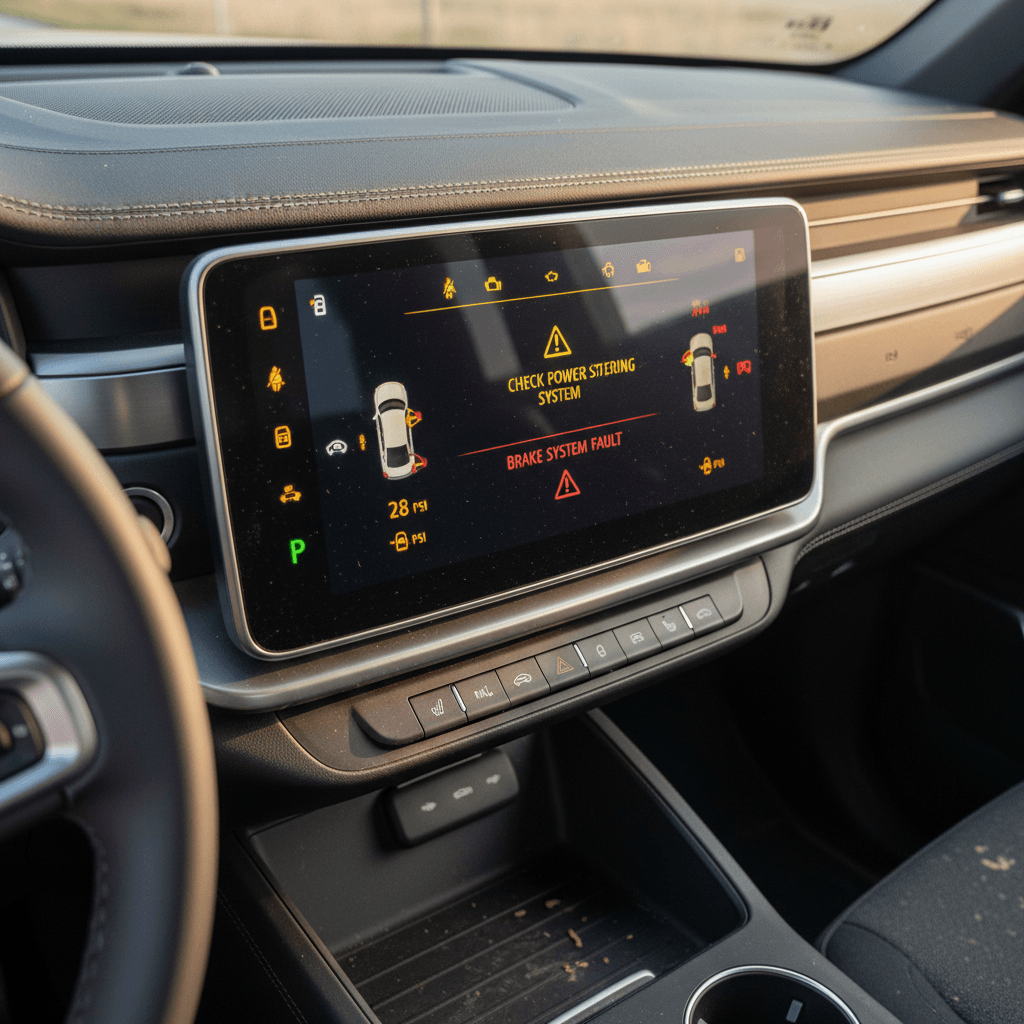
Simple owner-level fixes to try first
Rivian leans heavily on over‑the‑air (OTA) updates, which is both blessing and curse. The company can push meaningful fixes without a service visit, but it also means new bugs sometimes appear with new builds. When you’re shopping used, you want a 2023 R1S that’s been updated regularly and whose previous owner has already lived through, and resolved, the worst of those early‑build gremlins.
Brake booster and warning light issues
Another pattern emerging across 2022–2025 R1S and R1T models is a cluster of brake system warnings. A number of owners report sudden “Brake System Malfunction” messages, sometimes paired with a very stiff brake pedal. That’s unnerving in any vehicle, but especially in a heavy three‑row EV.
How 2023 R1S brake issues typically show up
Most cases are rare, but you’ll want to know the signs and the fixes.
1. Sudden brake warnings
Drivers see a red brake icon or “Brake System Malfunction” message, often after a long drive or DC fast‑charge session.
2. Stiff brake pedal
The pedal can feel unusually hard, like boosting assist has dropped out. Stopping power is there, but pedal effort jumps dramatically.
3. Software & hardware checks
Service centers typically pull logs, check the electric brake booster and related modules, and apply updated software or replace parts if needed.
If your brake warning light comes on
For a used 2023 R1S, ask specifically about any brake‑system work: warnings, booster replacement, or software campaigns. Occasional false alarms that were fixed via OTA update are one thing; repeated hard‑pedal episodes with unclear diagnosis are a red flag.
Suspension noises and service-related risks
Rivian’s air‑suspension setup is a big part of the R1S magic, adjustable ride height, real off‑road capability, surprising comfort. But early trucks, including 2023 models, have seen more than their share of suspension chatter and, in some rare cases, serious component issues.
- Clunks or knocking from the front end over sharp bumps or at low speeds.
- Creaks or groans at full steering lock or when entering driveways at an angle.
- Uneven ride height or “sagging” at one corner after the vehicle is parked.
- Recalls tied to rear toe‑link hardware that may have been incorrectly reassembled after prior service.
Why the toe-link recall matters
On a test drive, pay attention to noises over broken pavement and how the truck feels in sweeping highway curves. You’re listening for more than the normal thumps you’d expect from a 7,000‑pound SUV. When in doubt, a pre‑purchase inspection with the vehicle raised on a lift is money well spent.
Fit, finish, and water-leak complaints
No new automaker gets build quality perfect on the first try, and the 2023 R1S shows its start‑up roots in the usual places: paint, trim, and weather‑sealing. Many owners never see more than minor quirks, but here’s what tends to pop up:
- Panel alignment that’s a bit off at the hatch, hood, or charge door.
- Wind noise from the A‑pillars or frameless windows at highway speeds.
- Door seals that squeak or allow a faint whistle until adjusted or replaced.
- Reports of water intrusion around the liftgate or roof rails in heavy rain or car washes, usually addressed under warranty.
How serious is it?
Most of these issues fall into the category of annoyances, not deal‑breakers. They rarely strand the vehicle or affect safety, but they can dull the luxury feel you expect at this price.
What you can do
Inspect the body carefully in daylight, run your hand along seals, and hose down the truck while someone checks the interior for drips. Any reputable seller should be willing to address clear leaks or severe misalignment.
Charging and Highway Assist quirks
On the charging side, most 2023 R1S complaints sound familiar to any non‑Tesla owner: public DC fast chargers that are flaky or offline, occasional handshake failures, or reduced charging power on busy days. Those problems are often about the station, not the vehicle, but they still shape owner sentiment.
Real-world quirks 2023 R1S owners report
Not all are Rivian’s fault, but you feel them as the driver.
DC fast-charging drama
Some owners report sessions that start fine and then drop to low power, or fail to initiate until unplugging and trying again, especially at older third‑party stations.
Highway Assist behavior
Before key software updates, Rivian’s Highway Assist could mis‑identify lead vehicles or disengage unpredictably. Later firmware builds have tightened this up, but you should still treat it as driver aid, not autopilot.
App & key inconsistencies
Phone‑as‑key working perfectly one day and needing multiple attempts the next; charge sessions not appearing in the app right away; remote commands timing out.
Use Highway Assist conservatively
What Rivian is doing to fix 2023 R1S issues
If there’s an upside to owning a tech‑heavy EV from a young automaker, it’s this: Rivian iterates fast. Instead of waiting for an annual model‑year refresh, R1S owners have seen dozens of OTA software updates and running production updates aimed at improving quality and reliability.
- Frequent software updates smoothing out infotainment bugs, driver‑assist behavior, charging logic, and minor warning‑light gremlins.
- Expanded service footprint and mobile service coverage, making it easier to get suspension, brake, or body issues addressed without a traditional dealer visit.
- Updated hardware revisions on wear‑items and known trouble spots on later‑built R1S models, which sometimes appear as replacement parts on earlier 2023 trucks.
- Proactive outreach for certain recalls and campaigns, nudging owners to install updates or schedule inspections before problems surface.
The silver lining for used‑R1S shoppers
Checklist: buying a used 2023 Rivian R1S wisely
Pre‑purchase checklist for a 2023 Rivian R1S
1. Run the VIN for recalls and service history
Check NHTSA and Rivian’s recall lookup, then ask for <strong>printed repair orders</strong>. You want proof that key campaigns, Highway Assist, suspension toe‑link inspections, headlight aim, are complete.
2. Confirm software version and update history
In the settings menu, note the current software build and update date. A vehicle stuck on an old version or with long gaps between updates may have been neglected.
3. Test drive with a purpose
On your drive, deliberately check: braking feel (no hard pedal or warnings), suspension noises over rough pavement, straight tracking on the highway, and basic driver‑assist functions. Don’t rush this, 15–20 minutes is a minimum.
4. Soak‑test for leaks and wind noise
Use a carwash or hose to simulate heavy rain, then inspect the headliner, hatch, and door sills. On the highway, listen for whistling around the A‑pillars and frameless windows.
5. Stress the software (gently)
Run navigation, music, and climate together. Try driver profiles, key fob and phone‑as‑key, and open/close all powered features. One small glitch is normal; <strong>a pattern</strong> of freezing or warnings is not.
6. Verify warranty and support options
Check how much factory warranty is left based on in‑service date and mileage. If you’re buying from a retailer like <strong>Recharged</strong>, ask about additional coverage or return windows for peace of mind.
How Recharged helps if you’re eyeing a 2023 R1S
A used 2023 Rivian R1S can be an incredible SUV, and also a complicated one to evaluate on your own. That’s where Recharged comes in. Every EV we list, including any 2023 R1S, gets a Recharged Score Report with verified battery health, pricing benchmarks, and a plain‑English rundown of condition and history.
What you get when you buy an R1S through Recharged
Designed around the quirks of modern EVs, not just generic used‑car checklists.
Battery & charging insight
We run advanced diagnostics to understand real‑world battery health and charging behavior, so you’re not guessing how the pack has aged.
Problem & recall transparency
Our team checks open recalls and known 2023 R1S problem areas, brakes, suspension, software history, and bakes that into the vehicle’s Recharged Score and pricing.
Financing, trade‑in & delivery
From instant offers on your current vehicle to EV‑friendly financing and nationwide delivery, we handle the logistics so you can focus on choosing the right R1S.
Ready to find your next EV?
Browse VehiclesIf you’d rather see one in person, Recharged also operates an Experience Center in Richmond, VA, where you can sit in, poke at screens, and ask EV specialists very specific questions about how the R1S behaves in the real world.
2023 Rivian R1S problems: FAQ
Frequently asked questions about 2023 R1S problems
Bottom line: should you avoid a 2023 R1S?
If you’re looking at a 2023 Rivian R1S, you’re considering one of the most interesting family vehicles on the road, electric or otherwise. The flip side is that you’re also looking at an early product from a young automaker, with more recalls and small issues than a typical Toyota or Hyundai. For some shoppers, that trade‑off is worth it; for others, the extra trips to service are a deal‑breaker.
The key is not to panic about every forum horror story, but to buy the specific truck in front of you, not the average. Look for a 2023 R1S with current software, documented recall completions, and a clean, drama‑free test drive. And if you’d rather have experts do the worrying, consider finding your R1S through Recharged, where battery health, service history, and known problem areas are already surfaced for you. That way, you get the wild‑card adventure SUV, with far fewer surprises attached.