If you live in or around Lynchburg and you’re thinking about an electric car, the natural question is: **what EV rebates in Lynchburg, VA are actually available right now?** Between shifting federal rules, evolving Virginia programs, and local utility discounts, it’s easy to get lost. This guide pulls it together so you can see what’s real, what’s changing, and how to lower your upfront and ongoing EV costs, especially if you’re considering a used EV through Recharged.
Time-sensitive incentives
Overview: What EV rebates exist in Lynchburg, VA?
What’s available today (high level)
- Federal EV tax credits for certain new and used EVs purchased before key 2025–2026 phase‑out dates.
- Virginia state rebates on some new EV purchases, primarily at the point of sale through participating dealers.
- Appalachian Power programs in Virginia, including a Level 2 home charger rebate and discounted off‑peak charging rates.
- Potential changes to Lynchburg’s personal property (“car”) tax policy that could benefit many vehicle owners if adopted.
What you won’t find (yet)
- No Lynchburg‑specific cash rebate just for buying an EV.
- No ongoing local EV tax credit separate from the state and federal programs.
- Limited direct incentives on used EVs beyond the federal credit and any discounts built into the sale price.
That doesn’t mean a used EV isn’t a good deal, especially once you factor in fuel and maintenance savings. It just means most of your “rebate” comes from smart shopping and lower operating costs rather than big local checks in the mail.
How much can a Lynchburg EV driver realistically save?
Federal EV tax credits for Lynchburg drivers
Even though this article focuses on **EV rebates in Lynchburg, VA**, the single biggest program you’re likely to use lives at the federal level. Today, federal rules still offer up to **$7,500 for qualifying new EVs** and up to **$4,000 for qualifying used EVs** purchased from a dealer, but Congress has already scheduled multiple phase‑outs between late 2025 and 2026. The key detail for you is timing: if you want to claim federal money, you need to buy before those cutoff dates and make sure the car and your income qualify.
- For **new EVs**: maximum $7,500 credit, but only for models that meet final‑assembly, battery sourcing, and price caps. Several mass‑market models no longer qualify, so check each VIN in real time.
- For **used EVs**: up to $4,000 (capped at 30% of sale price) when you buy a qualifying used EV from a licensed dealer, subject to income and vehicle‑price limits.
- Starting with the 2024 tax year, many dealers can apply the federal credit as an **instant discount at the point of sale**, effectively turning it into a rebate for buyers.
Watch the federal phase‑out dates
If you’re shopping for a **used EV through Recharged**, the federal used EV credit can be layered on top of our already‑discounted pricing, provided the car, your income, and the sale date all line up with the rules. Recharged’s EV specialists can help you understand which models have historically qualified and what documentation you’ll need, but final eligibility always depends on IRS rules and your personal tax situation.
Virginia state EV incentives and how they work
Virginia runs its own incentive programs alongside the federal government. These are statewide, so **Lynchburg drivers qualify on the same terms as anyone else in the Commonwealth**. The specific program details have shifted over time, but the current landscape includes two main ideas: a point‑of‑sale rebate on certain new EVs and various tax rules that affect EV ownership costs.
Key Virginia EV incentives for Lynchburg residents
What’s most likely to affect your bottom line in 2025–2026
State EV purchase rebate
Virginia has funded a state‑level program that can provide up to $2,500 on a qualifying new EV, with an additional income‑based bonus that can push total help as high as $4,500 for lower‑ and moderate‑income households.
Funding has historically been limited and sometimes paused, and rebates are usually handled through participating dealers rather than as a check you file for later. Before you fall in love with a specific car, ask the dealer whether state funds are still available and how they’re applied.
Registration & inspection savings
All‑electric vehicles in Virginia are exempt from emissions inspections, which saves you money every time your registration renews compared with many gas cars.
EVs also avoid certain maintenance items that indirectly affect costs, from oil changes to smog‑related repairs. None of this shows up as a line‑item “rebate,” but it’s real money that stays in your pocket over several years of ownership.
Sales tax vs. rebates: Virginia is different
Local and Lynchburg-specific savings to watch
As of early 2026, Lynchburg doesn’t offer a city‑only cash rebate just for buying an EV. But **local policy still matters**, especially around the city’s personal property tax, what Virginians often call the “car tax.” In 2025, Lynchburg’s City Council debated a **“No Car Tax Plan”** that would eliminate the car tax on vehicles under $20,000 in value and reduce the rate for higher‑value vehicles as part of the proposed FY26 budget.
Car-tax changes are proposed, not guaranteed
If some version of the plan passes, many EVs, especially **used EVs that are already under $20,000 in assessed value**, could effectively become exempt from the city car tax. That’s not an EV‑specific rebate, but if you pair a reasonably priced used EV with lower fuel and maintenance costs, the long‑term savings add up quickly for Lynchburg households.
Utility programs: Appalachian Power EV rebates & off-peak rates
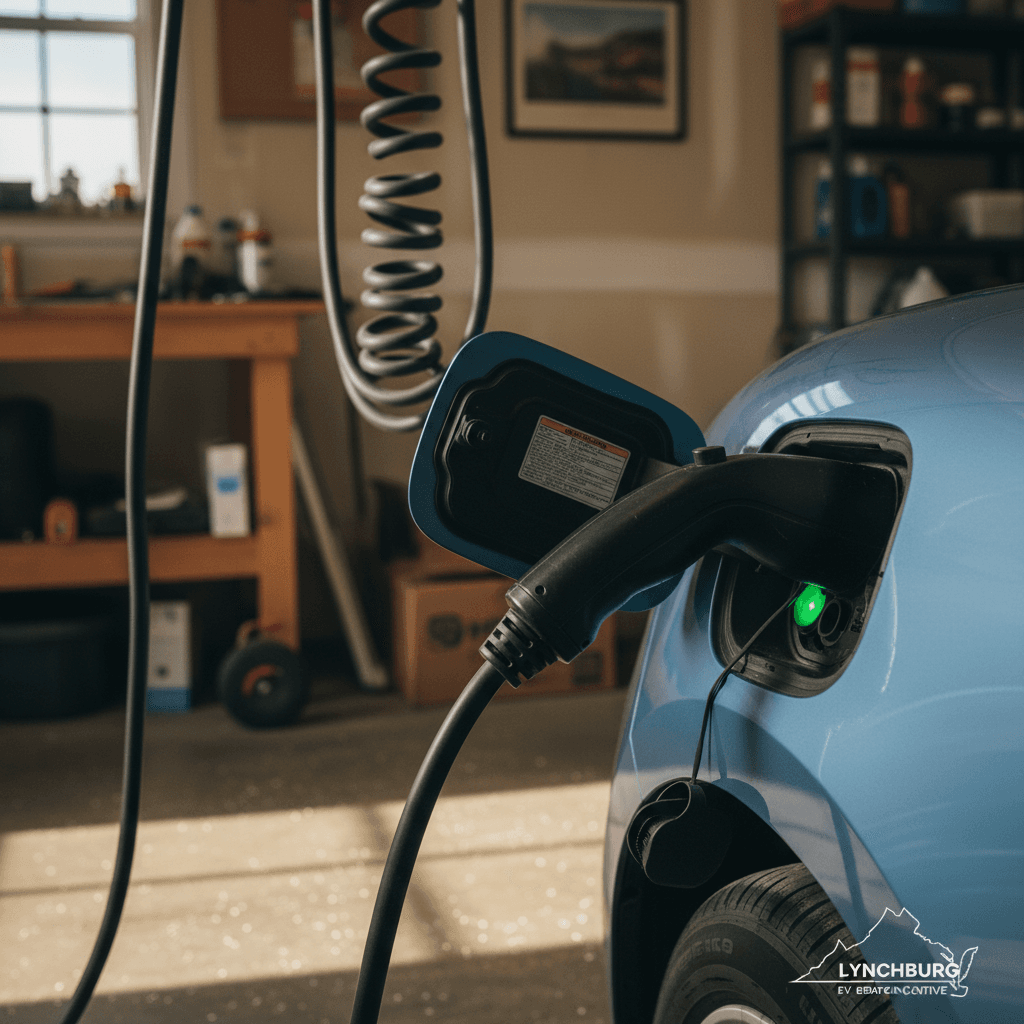
For most Lynchburg drivers, your **electric utility may actually provide the most reliable “rebate”‑style benefit**, especially if you plan to charge at home. Lynchburg is served by Appalachian Power, which runs several EV‑related programs in Virginia.
Appalachian Power EV benefits for Lynchburg customers
These are utility programs available to qualifying residential customers in Virginia.
| Program | What it is | Typical Benefit | Key Requirements |
|---|---|---|---|
| ENERGY STAR® Level 2 charger rebate | Rebate on qualifying home charging equipment. | Up to $100 off an eligible Level 2 charger. | Must be an Appalachian Power residential customer in Virginia using qualifying ENERGY STAR® EVSE. |
| Off‑Peak EV rate (Tariff RS‑PEV) | Discounted electricity when you charge overnight or on weekends. | About 20% lower kWh rate during off‑peak hours. | Requires an advanced (AMI) meter and separate EV meter/installation; charges outside off‑peak hours may cost more. |
| Energy efficiency programs (TakeCharge Virginia) | Rebates and discounts for efficient appliances and home upgrades. | Varies; can reduce overall home energy use, freeing up budget for EV charging. | Program‑specific; not EV‑only, but can lower your total electric bill. |
Exact eligibility and program rules can change; always confirm details with Appalachian Power before you enroll or purchase equipment.
Stack home-charging savings
How to stack incentives when you buy a used EV
Used EVs are where the economics get interesting for Lynchburg buyers. Unlike brand‑new models, a well‑priced used EV can qualify for the federal used EV credit, slot under potential future car‑tax relief, and still deliver the same fuel and maintenance savings as a new one. Even though **Virginia’s state rebate has focused mainly on new EVs**, you’re not shut out if you prefer to let someone else take the initial depreciation.
Smart stacking strategy for a used EV in Lynchburg
1. Start with a realistic budget
Decide how much you can afford *out of pocket* before incentives. Because programs can change or run out of funding, structure the deal so it still works even if one incentive falls through.
2. Target models that often qualify federally
Look for used EVs under the federal price cap that have historically met the IRS rules for the used EV credit. At Recharged, every listing comes with transparent battery health data and pricing to help you narrow the field.
3. Confirm federal used EV credit eligibility
Before you sign, verify that the car, the dealer, and your income all qualify for the federal used EV credit under current rules and date cutoffs. Ask whether the dealer can apply the credit as a point‑of‑sale discount.
4. Factor in potential Lynchburg car-tax changes
If your target EV will likely be worth under $20,000 in the next few years and Lynchburg adopts the No Car Tax Plan, you could see additional annual savings from a reduced or eliminated personal property tax bill.
5. Add utility savings to the equation
Plan on installing (or at least using) Level 2 home charging and enrolling in Appalachian Power’s off‑peak EV rate. Over a few years, cheaper electricity can be worth more than a small one‑time rebate.
6. Use Recharged’s financing and trade‑in options
Recharged offers <strong>financing</strong>, <strong>instant offers</strong> for your current car, and an optional <strong>consignment</strong> model. Those tools can reduce the cash you need upfront while you still capture any available incentives.
Rebates vs. tax credits: what’s the difference?
Rebates
- Often show up as cash back or an instant discount at purchase.
- Examples: Virginia’s point‑of‑sale state EV rebate, Appalachian Power’s $100 Level 2 charger rebate.
- You don’t have to owe a lot in taxes later to benefit, once the rebate is approved, you get the money.
Tax credits
- Reduce the amount of tax you owe when you file your return.
- Examples: the federal new and used EV tax credits.
- Historically, you claimed them when you filed, but new rules allow many dealers to apply them as a point‑of‑sale credit, effectively turning them into an instant rebate.
Either way, your bottom line as a Lynchburg driver is what matters: lower net purchase price and lower operating costs over time.
Get tax advice from a professional
Step-by-step: how to claim your EV incentives
From research to rebate: a simple workflow
1. Map out your timing
Because several federal and state incentives change after late 2025, decide whether you’re buying in 2025 or 2026 and how that lines up with phase‑out dates. Earlier is usually safer if a credit is critical to your budget.
2. Verify program status
Check the latest information on Virginia’s state EV rebate funding, Appalachian Power’s EV programs, and any Lynchburg car‑tax decisions. Government and utility sites, plus reputable EV advocacy organizations, are your best sources.
3. Choose new vs. used
If initial price is your main hurdle, a <strong>used EV</strong> plus the federal used EV credit and utility savings often beats a new car even if state rebates favor brand‑new models.
4. Shop with total cost in mind
Look beyond the sticker price. Compare fuel savings, maintenance, potential car‑tax changes, and home‑charging costs. Recharged’s <strong>Recharged Score Report</strong> gives you verified battery health and fair‑market pricing so you can compare apples to apples.
5. Confirm paperwork at the dealership
For any point‑of‑sale federal or state credit, make sure the forms are completed and that the **buyer’s order clearly reflects the incentive**. Keep copies of every document in case the IRS or state tax department has questions.
6. Enroll in utility programs after delivery
Once the car is home, work with a licensed electrician to install any needed wiring for a Level 2 charger, then submit your rebate application and sign up for Appalachian Power’s off‑peak EV rate if it fits your driving pattern.
FAQ: EV rebates in Lynchburg, VA
Frequently asked questions about EV rebates in Lynchburg, VA
The bottom line for Lynchburg EV shoppers
The phrase **“EV rebates in Lynchburg, VA”** can be misleading, because there isn’t a single local program that writes you a check the moment you go electric. Instead, your savings come from a stack of moving parts: federal tax credits that phase out on specific dates, a Virginia rebate program that’s subject to funding and dealer participation, proposed local car‑tax changes, and very real, but less flashy, utility discounts from Appalachian Power.
If you’re serious about an EV, especially a **used EV with verified battery health**, the most practical play is to: lock in any federal credit before its deadline, confirm whether a state rebate is actually funded for your purchase window, and then squeeze long‑term value from home charging and off‑peak rates. That’s exactly the ecosystem Recharged is built for: we pair transparent used EV listings and a Recharged Score battery report with financing, trade‑in options, and nationwide delivery, so Lynchburg drivers can focus on the total cost of ownership, not just today’s sticker price.
From here, your next step is simple: decide whether you’re likely to buy in 2025 or 2026, check the latest incentive rules, and then start browsing used EVs that fit your budget. When you’re ready, Recharged can help you compare vehicles, estimate ownership costs in Lynchburg, and move from research to keys in hand with as much clarity, and as little sales pressure, as possible.