
If you live in the Sunshine State, you’ve probably noticed that gas prices in Florida in 2026 don’t feel as painful as the post‑pandemic spikes, but they’re still high enough to sting, especially if you commute or road‑trip a lot. The big questions are: where are prices heading next, what’s driving the change, and at what point does switching to an electric vehicle simply make more financial sense?
Quick snapshot for 2026
Overview: Where gas prices in Florida are heading in 2026
Gas price outlook: U.S. and Florida context for 2026
National forecasts from the U.S. Energy Information Administration (EIA) point to slightly lower retail gasoline prices in 2026 versus 2025, driven by softer crude prices and growing efficiency. At the same time, Florida’s tourism‑heavy, drive‑everywhere economy and hurricane risks mean local prices can jump quickly even in an overall down year. In other words: 2026 likely won’t be a repeat of the worst spikes we’ve seen, but you shouldn’t budget as if cheap gas is guaranteed.
What gas costs in Florida right now
As of early 2026, daily AAA data shows Florida’s average price for regular unleaded hovering in the high‑$3 per gallon range, after a run‑up from the low‑$3s at the start of the year. At the very end of 2025, AAA reported that Florida’s full‑year average was about $3.04 per gallon, already down roughly a quarter from 2024’s average, and the state opened 2026 on a similar or slightly lower footing before seasonal demand pushed prices higher.
Florida moves faster than you think
That volatility matters more in Florida than in many states. Long commutes, car‑dependent suburbs, and a major tourism industry mean that a sudden 50–70 cent jump per gallon can ripple through your monthly budget, from commuting to rideshares to the cost of groceries and deliveries.
2026 gas price forecast for Florida
No agency publishes a precise, official forecast just for gas prices in Florida in 2026, but we can triangulate a reasonable range by combining national data with Florida’s recent history.
How 2026 Florida gas prices are likely to behave
Illustrative ranges based on national EIA gasoline forecasts plus Florida’s typical premium and seasonal patterns.
| Timeframe (2026) | Likely FL Average | What Drives It | What It Means for You |
|---|---|---|---|
| Q1 (Jan–Mar) | $3.10–$3.40/gal | Post‑holiday demand plus refinery maintenance can keep prices firm, with occasional short‑term spikes. | Budget on the higher side of national projections, especially if you commute by car. |
| Q2 (Apr–Jun) | $3.20–$3.50/gal | Spring break and early vacation travel push up demand along with tighter supplies. | Expect busy stations in coastal and tourist areas; prices can jump before long weekends. |
| Q3 (Jul–Sep) | $3.30–$3.70/gal | Peak driving season plus hurricane risk in the Gulf and Atlantic often creates the year’s highest volatility. | Build room in your budget, this is when storm‑driven price spikes are most likely. |
| Q4 (Oct–Dec) | $3.00–$3.40/gal | Shoulder season, slightly lower demand, and cheaper seasonal fuel blends can ease prices. | If forecasts hold, late 2026 could offer some of the better prices of the year. |
These are directional estimates, not guaranteed prices, local station prices will vary by city and even by intersection.
Forecasts aren’t guarantees
Why gas prices are moving in 2026
1. Global oil markets and refinery margins
Historically, crude oil explains more than half of the price you see on a gas station sign. In 2026, EIA expects crude to account for a slightly smaller share of the pump price as refinery and distribution costs grow, but it’s still the main driver. When Brent crude slips from the high‑$60s per barrel toward the mid‑$50s, that usually translates into a noticeable drop at the pump over time.
2. Florida’s unique local factors
- Tourism and population growth: More cars on the road year‑round keeps demand high.
- Hurricane risk: Storm threats in the Gulf or Caribbean can send prices spiking even before landfall.
- Limited transit alternatives: In much of Florida, you can’t simply swap to a subway pass when prices jump.
These local factors are why Florida frequently runs a few cents above or below the national average, even when the trend is the same.
Vehicle efficiency also matters. Every year, a larger share of Florida’s vehicle fleet is made up of more efficient gasoline cars and hybrids, which slightly dampens total gasoline demand even as the population grows. But as long as most miles in Florida are powered by gasoline, the state will remain highly exposed to oil price swings and storm‑driven disruptions.
How much you’ll likely spend on gas in 2026
To make this concrete, let’s walk through what different Florida drivers might spend on gas in 2026 if average prices land around $3.30 per gallon, a plausible statewide average once you smooth out seasonal highs and lows.
- Light commuter (8,000 miles/year, 28 mpg): about 286 gallons × $3.30 ≈ $945 per year.
- Typical driver (12,000 miles/year, 26 mpg): about 462 gallons × $3.30 ≈ $1,525 per year.
- Heavy commuter (18,000 miles/year, 24 mpg): about 750 gallons × $3.30 ≈ $2,475 per year.
- Ride‑share / delivery (25,000 miles/year, 28 mpg): about 893 gallons × $3.30 ≈ $2,950 per year.
Use your own numbers
Gas prices vs EV charging costs in Florida
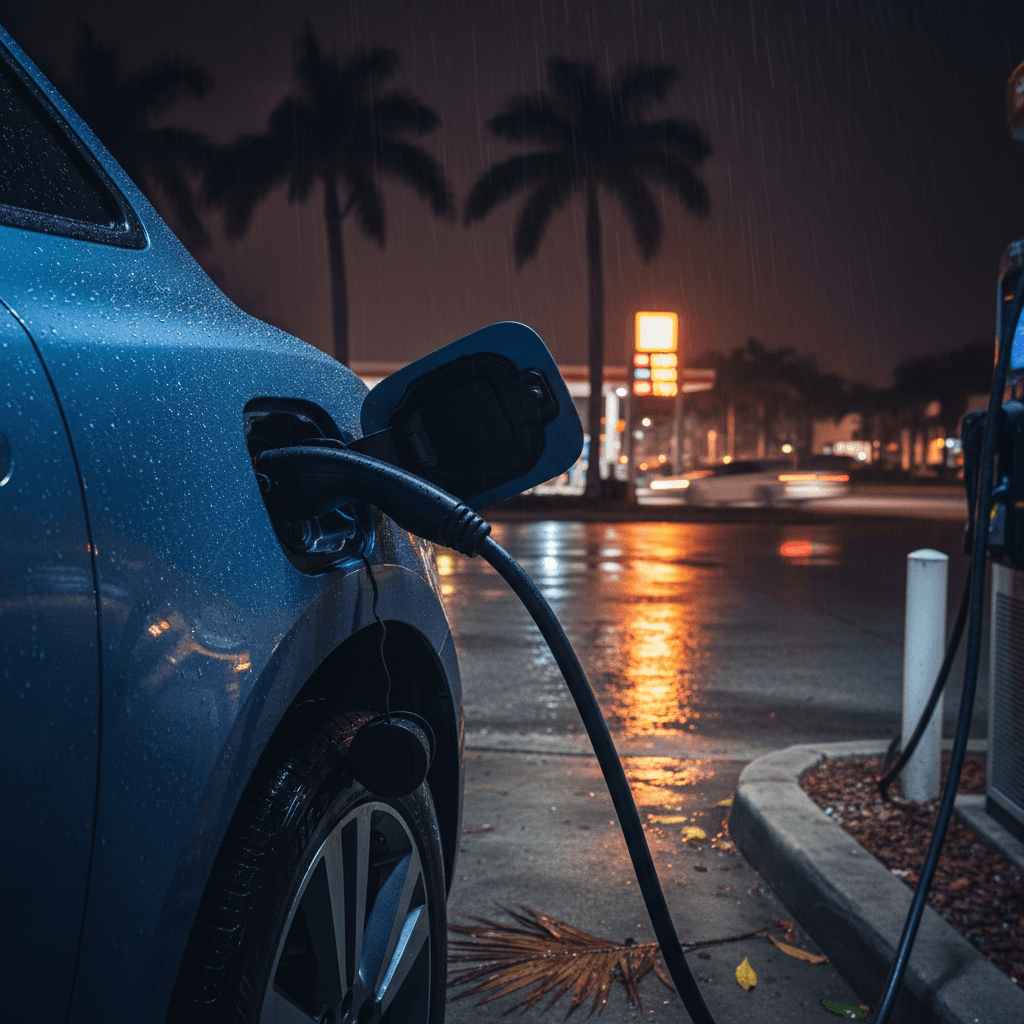
For a lot of readers, the reason to care about gas prices in Florida 2026 is simple: you’re trying to decide whether it’s finally time to go electric, especially with used EV prices softening after the 2023–2024 surge. Comparing costs isn’t just about the pump vs the plug; it’s about cost per mile over years of ownership.
Typical fuel vs charging costs for Florida drivers
Estimates assume 12,000 miles per year and average 2026 energy prices.
Gasoline sedan
26 mpg at $3.30/gal:
≈ 12.7¢/mi
12,000 miles uses about 462 gallons, or roughly $1,525 per year in fuel alone.
EV, home charging
3.0 mi/kWh at ~15¢/kWh:
≈ 5.0¢/mi
Annual charging cost around $600, assuming mostly overnight home charging on a typical Florida electric rate.
EV, fast charging heavy use
3.0 mi/kWh at ~35–40¢/kWh:
≈ 12–13¢/mi
Relying heavily on DC fast charging can erase most of an EV’s fuel‑cost advantage over a reasonably efficient gas car.
Charging strategy matters more than headlines
This is where a used EV can be compelling. On Recharged, every vehicle comes with a Recharged Score Report that includes verified battery health, so you can estimate how many efficient miles you’re actually buying, not just what the window sticker claimed when the car was new.
When gas prices make an EV worth it
Whether higher gas prices in Florida in 2026 tip you into an EV depends on your mileage, access to charging, and what kind of vehicle you’re cross‑shopping. But you can think about it in thresholds rather than perfection.
Simple rules of thumb for Florida drivers
1. You drive 12,000+ miles per year
The more you drive, the faster EV fuel savings add up. Above ~12,000 miles per year, even a modest 5–7¢ per‑mile advantage is worth hundreds of dollars annually.
2. You can reliably charge at home or work
If you can plug in overnight on a standard 120V outlet or a 240V Level 2 charger, your kWh cost is usually far below the per‑mile cost of gas.
3. Your current car gets under 25 mpg
If you’re driving an older SUV or pickup that struggles to hit 20–22 mpg in real traffic, gas price spikes hurt more and EV payback comes faster.
4. You’re facing upcoming maintenance costs
Brakes, exhaust, transmission work, if your gas car needs a few thousand dollars of work, that money might be better put into a down payment on a used EV with fewer moving parts.
5. You’re open to buying used
Used EVs have dropped in price relative to 2022 peaks. A used EV with a verified battery from a marketplace like Recharged can deliver EV fuel savings without new‑car pricing.
6. You plan to keep the car 5+ years
Electric powertrains shine over longer ownership windows. A five‑to‑seven‑year horizon lets lower fuel and maintenance costs smooth out purchase‑price differences.
How Recharged fits in
Ready to find your next EV?
Browse VehiclesPractical tips to lower your fuel or energy bill
If you’re staying with gas in 2026
- Shop stations, not just brands: In metro Florida, price gaps of 20–30¢ per gallon between nearby stations are common. Apps like GasBuddy can pay for themselves quickly.
- Avoid premium unless required: Many modern engines are tuned for regular. If your owner’s manual says premium is “recommended” not required, ask a trusted mechanic whether regular is acceptable.
- Drive smoother: Aggressive starts, high speeds, and under‑inflated tires can knock real‑world mpg down by 10–20%.
- Time big trips smartly: If you can avoid filling up right before major holidays or in the immediate run‑up to a hurricane landfall, you’ll usually pay less.
If you’re already in (or moving to) an EV
- Charge off‑peak when possible: Some Florida utilities offer time‑of‑use plans that make overnight charging considerably cheaper.
- Favor Level 2 over DC fast charging: Slower charging is almost always cheaper per kWh and easier on your battery.
- Precondition while plugged in: Cooling or heating the cabin while connected to the charger reduces on‑road energy use, especially important in Florida’s heat.
- Use route planning tools: Apps and built‑in navigation can help you avoid pricey fast‑charge stops when a slightly slower route with Level 2 stations will do.
Watch your electricity rate, too
Florida gas prices 2026: FAQ
Frequently asked questions about gas prices in Florida in 2026
Key takeaways for Florida drivers in 2026
Gas prices in Florida in 2026 are unlikely to be catastrophic, but they’re also unlikely to feel “cheap.” National forecasts point to modest relief, yet local volatility, especially around tourism peaks and hurricanes, remains a fact of life. If you’re a typical Florida driver logging 12,000–15,000 miles a year, that still means a four‑figure fuel bill, with the risk of painful surprises when global or local events hit.
The good news is that you have levers to pull. Smarter fueling habits, route planning, and vehicle maintenance can soften the blow if you stay with gas. And if you’re EV‑curious, rising gas prices plus maturing used‑EV inventory and better battery‑health data make 2026 a more rational time than ever to run the numbers. At Recharged, those numbers are front‑and‑center in the Recharged Score, so you can compare gas and electric options on total cost of ownership, not just monthly payment, and choose the path that makes the most sense for the miles you actually drive.