Few things are more frustrating than waking up, heading to the driveway and realizing your EV didn’t charge at home. The good news: in most cases, there’s a simple fix, if you know how to narrow down whether the problem is the outlet, the home charger, your settings, or the car itself.
What this guide covers
Why your EV isn’t charging at home
When an EV is not charging at home, the root cause almost always falls into one of four buckets:
- Power source issue (tripped breaker, bad outlet, loose wiring)
- Home EVSE/charger issue (faulty cable, internal fault, wrong amperage setting)
- Vehicle or software issue (charge limit, schedule, locked port, battery protections)
- Environmental or safety limits (very hot/cold battery, wet/damaged connector)
Your goal is to isolate which bucket you’re in as quickly and safely as possible. You don’t need to be an electrician, you just need a methodical checklist and the discipline not to keep blindly plugging in and hoping it works.
Home charging: what typically goes wrong
Quick safety check before you troubleshoot
Before you dive into any EV not charging at home fix, take 60 seconds to make sure you’re not dealing with a dangerous situation.
Safety pre‑check: do this first
1. Stop if you smell burning
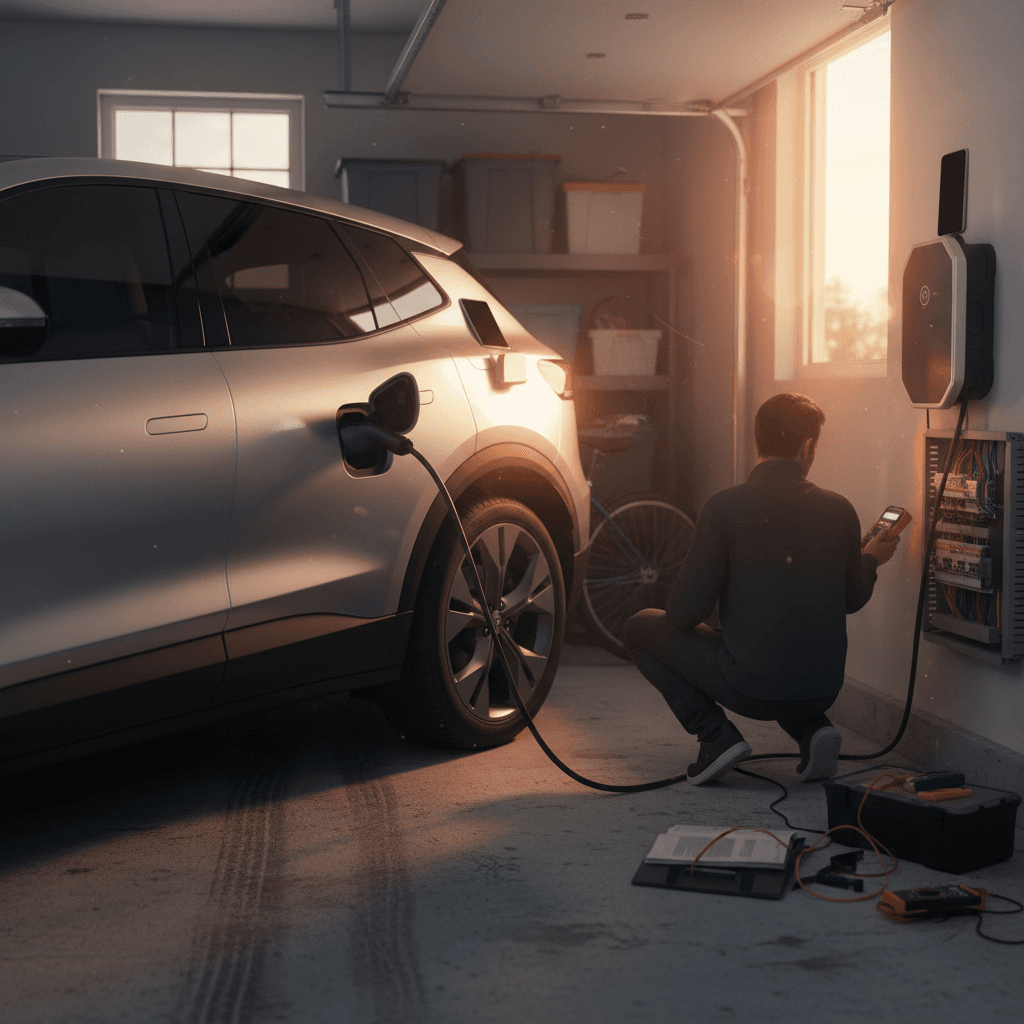
If you notice a burning smell, melted plastic, or scorch marks on the outlet, plug, or wall, <strong>stop using the charger immediately</strong>. Do not try “one more time”, call a licensed electrician.
2. Check for heat
Carefully touch (briefly) the charger plug, cable, and outlet face. Warm is expected; hot or soft to the touch is not. Excess heat suggests a loose connection or overloaded circuit.
3. Inspect for visible damage
Look for cracks, exposed wires, bent pins, or corrosion on the plug, connector, or cable. Any visible damage is a reason to take the charger out of service until it’s inspected or replaced.
4. Keep water away
If the charger, outlet, or extension cord (if you’re using one) has been in standing water or heavy spray, don’t use it. Let it dry completely and have an electrician check the installation.
Never ignore repeated breaker trips
Fast home checklist: EV not charging at home (fix in 10 steps)
Use this quick sequence to isolate the problem. You don’t need tools, just access to your electrical panel, charger, and car.
10‑step home EV charging fix checklist
1. Confirm the basics on the car
Make sure the charge port door is fully open, the connector is fully inserted, and the car is actually in Park. Check the car’s screen for any charging error messages or icons.
2. Look at charger indicator lights
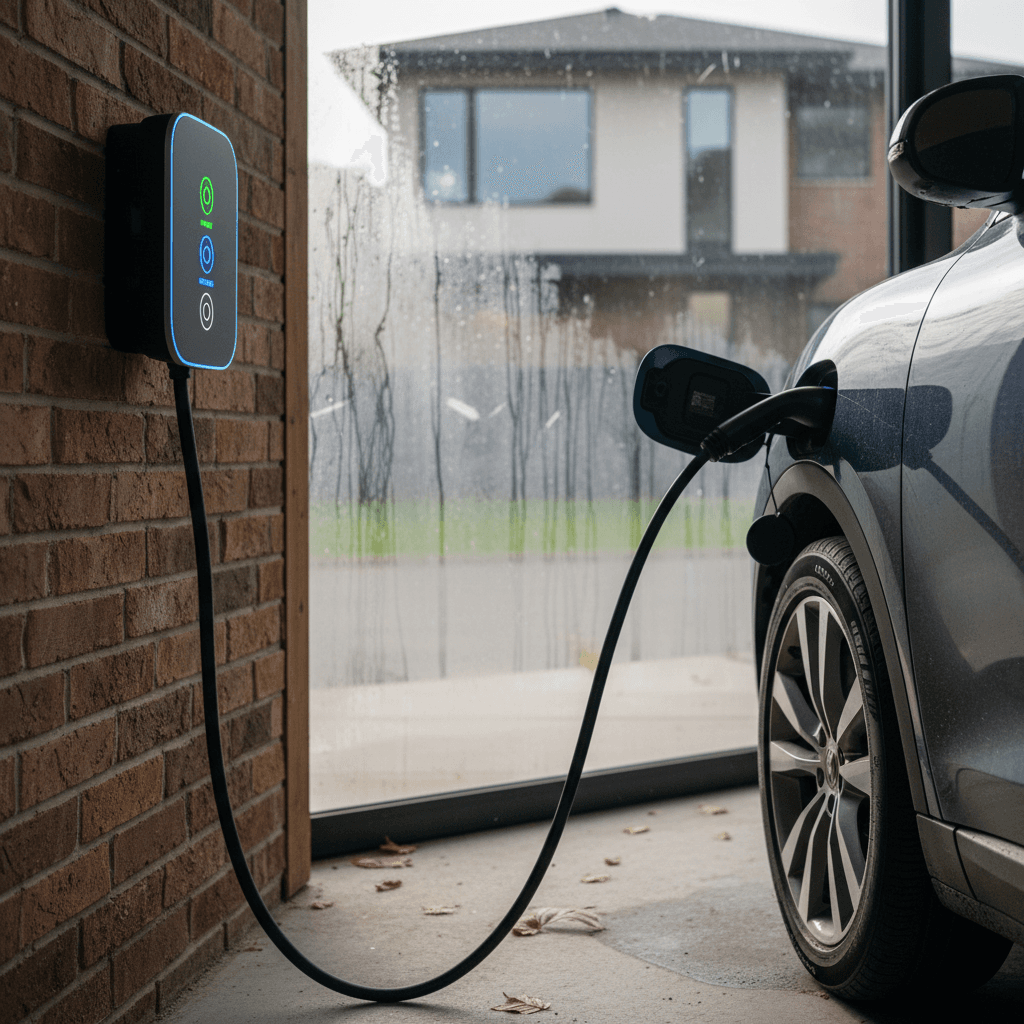
Most Level 1 and Level 2 chargers have LEDs that indicate power, charging, or fault states. A solid green light often means ready, while red or flashing patterns can signal specific faults, check your charger’s manual or label.
3. Power‑cycle the charger
Unplug the charger from the wall (or turn off its breaker if it’s hard‑wired), wait 30–60 seconds, then restore power. Many charging hiccups resolve with a simple reset, just like a home router.
4. Try a different outlet (for plug‑in units)
If you use a portable Level 1 or Level 2 charger, move it to a <strong>different circuit</strong>, ideally a newer outlet in another part of the house. If it works there, your original outlet or circuit is the culprit.
5. Verify the breaker position
Open your electrical panel and look for the breaker labeled “garage,” “EV,” or the correct amperage (for example, 40A). If it’s tripped to the middle position, fully switch it OFF, then back ON once. If it trips again, stop and call an electrician.
6. Check charge limits and schedule in the car
Open your car’s charging settings. Make sure there isn’t a delayed start set for later in the night and that your <strong>charge limit</strong> isn’t already reached. If your limit is set to 60% and the battery is at 59%, the car may only take a tiny amount of energy you won’t notice.
7. Disable any utility “time‑of‑use” schedule
If you’ve set a “charge only during off‑peak” schedule (in the car or your charger’s app), temporarily turn it off and start a charge immediately. This rules out mis‑aligned time settings or daylight savings glitches.
8. Try the factory portable charger
If your car came with a 120V Level 1 cordset, plug it directly into a known‑good household outlet and into the car. If that works, your issue is more likely the dedicated Level 2 unit or its circuit, not the vehicle.
9. Test with a different vehicle or charger
If possible, plug a different EV into your home charger, or test your car on a neighbor’s home charger. This quick A/B test tells you whether the problem travels with the car or stays with the house.
10. Note and save error messages
Take photos of any warnings on the charger, the car’s screen, or in the app. These details help an electrician, dealer, or EV‑specialist service like Recharged quickly pinpoint what’s going on.
Is it the outlet, the home charger, or the car?
Once you’ve run the checklist, you can usually tell which part of the system is at fault by looking at a few simple patterns.
How to narrow down the source of the problem
Match your symptoms to the most likely culprit.
Signs it’s the outlet or circuit
- Breaker trips as soon as charging starts
- Other devices on the same circuit flicker or shut off
- Outlet faceplate is warm or damaged
- Charger works on a different outlet
Signs it’s the home charger
- Charger shows red/fault lights even with no car connected
- Different EVs all fail on this charger
- App shows internal fault or over‑temperature warning
- Power light is off even though breaker and outlet are good
Signs it’s the vehicle
- Car shows “Charging Error” or “Charge Port Fault”
- Home charger works fine with another EV
- Public Level 2 stations also have trouble starting a session
- Charging starts then repeatedly stops within minutes
Use public charging as a test
Common home charging issues by setup type
Different home setups fail in different ways. Here’s what typically goes wrong with each one, and how to fix it.
Level 1 (120V) charging issues
Level 1 chargers plug into standard household outlets. They’re convenient but often push older circuits to their limits.
- Problem: Breaker trips after 10–30 minutes of charging.
Fix: Move to a dedicated 15A or 20A circuit with no other major loads. Avoid running tools, heaters, or fridges on the same circuit while charging. - Problem: Outlet feels hot or discolored.
Fix: Stop using that outlet. Have an electrician replace it with a high‑quality, properly wired receptacle rated for continuous load, or install a dedicated circuit for EV charging. - Problem: Charger is plugged into an extension cord or power strip.
Fix: Unplug and connect directly to a properly grounded wall outlet. Most EV makers explicitly warn against extension cords because of overheating risk.
Level 2 (240V) charging issues
Level 2 home charging uses 240V circuits, either via a wall outlet (NEMA 14‑50, 6‑50, etc.) or a hard‑wired station.
- Problem: Charger shows fault as soon as you plug into the car.
Fix: Reduce the current in the charger app (for example, from 40A to 32A) and test again. Undersized wiring or marginal connections can trigger overcurrent or temperature faults. - Problem: Hard‑wired charger completely dead.
Fix: Confirm the breaker is on. If it still shows no power, the internal electronics or wiring could have failed, time for an electrician or warranty claim. - Problem: GFCI breaker or outlet trips repeatedly.
Fix: Many newer codes require GFCI protection on 240V circuits. Nuisance trips can indicate a real ground fault or just a sensitive device. An electrician can test the circuit and, if appropriate, recommend a different configuration that still meets code.
Watch out for DIY rewiring
When your EV charges at public stations but not at home
If your EV consistently charges fine at public Level 2 or DC fast chargers but won’t charge at home, you can almost rule out a serious onboard charger or battery fault. The spotlight turns to your home installation.
Public works, home doesn’t: what it usually means
Compare what you’re seeing at home versus public chargers to zero in on root causes.
| What you’re seeing | Likely cause | Next step |
|---|---|---|
| Public stations always work; home fails on start | Home EVSE wiring, breaker size, or internal fault | Have an electrician inspect the EVSE circuit; contact charger manufacturer with error codes. |
| Home works at reduced current; full power trips breaker or faults | Circuit or wiring can’t safely handle configured amperage | Lower the charger’s max current permanently or upgrade wiring/breaker. |
| Home charging fails on very hot or cold days only | Battery temperature protection and/or marginal home circuit | Try preconditioning the car, then consult dealer or electrician if pattern persists. |
| Tesla wall connector won’t start, but third‑party Level 2 works | Configuration or firmware issue with specific charger | Update firmware, reset, and check configuration (vehicle authorization, load sharing, etc.). |
Public charging success is a strong sign your vehicle’s onboard charger and high‑voltage battery are healthy.
How Recharged can help
Ready to find your next EV?
Browse VehiclesSigns the problem is battery health, not the charger
It’s rare, but sometimes what looks like a home charging issue is really a car that’s protecting a weak or damaged battery. That’s where diagnostics go beyond simple outlet checks.
- Car frequently stops charging at high states of charge (for example, above 80%) and shows warnings about battery or high‑voltage system.
- Charging speed at public DC fast chargers is dramatically lower than other owners report for the same model under similar conditions.
- You see repeated messages about “Service charging system,” “Battery needs service,” or “Unable to charge – contact service.”
- Real‑world range has dropped sharply versus what you used to get on the same commute, even in similar weather.
If you’re buying a used EV, this is where independent battery health verification matters. At Recharged, we use the Recharged Score to quantify battery capacity and charging behavior so you’re not guessing about what’s under the floorpan before you install or upgrade home charging.
With used EVs, a clean battery bill of health is just as important as a clean vehicle history report, especially before you invest in a home charging install.
Preventing future home charging problems
Once you’ve solved today’s issue, a few habits and small upgrades can make home charging boring, in the best possible way.
Simple ways to keep home charging reliable
Use a dedicated circuit for EV charging
Whenever possible, have your electrician install a dedicated 20A (Level 1) or 40–60A (Level 2) circuit that serves only your EVSE. Avoid sharing with refrigerators, freezers, or heavy tools.
Mount and support the cable correctly
Don’t let the weight of the cable hang from the plug or connector. Use cable hooks or reels so stress stays off the outlet and charge port.
Keep firmware and apps up to date
Both vehicles and smart chargers receive software updates that fix bugs and improve charging logic. Enabling automatic updates can quietly prevent a lot of strange behavior.
Avoid repeated full charges to 100%
Unless you need full range for a trip, most EV makers recommend daily limits around 70–90%. That’s easier on the battery and reduces the odds of high‑SOC charging quirks.
Log unusual behavior early
If you notice intermittent failures, charging cuts off at random, or only on hot afternoons, keep a simple log. Time, temperature, and state of charge notes help pros connect the dots later.
Plan home charging when shopping used
Frequently asked questions: EV not charging at home
Common questions when your EV won’t charge at home
Bottom line: Getting your home EV charging back on track
When your EV isn’t charging at home, it’s tempting to assume the worst. In reality, most issues trace back to a tripped breaker, aging outlet, confusing schedule setting, or a misbehaving wall unit, not a catastrophic vehicle failure. By working through a structured checklist and paying attention to what works at public stations versus home, you can usually zero in on the problem in an evening.
If you’re already in the market for a different EV, or you want to be sure your next car will play nicely with your garage, shopping with Recharged adds an extra layer of confidence. Every vehicle includes a Recharged Score with verified battery and charging performance, plus EV‑specialist support that can talk through your home setup before you buy. That way, the only surprise you get from your next EV is how easy it is to live with once it’s plugged in every night.